









1 oz Silver Mapping History 2027 (Mintage: 999 | Prooflike)











- Map Art: Hondius' world of 1630
- Two Sides: colored and pure relief
- Legal Tender: 5 dollars from Samoa
- Map ArtCalifornia as an island, plus Mercator and Ptolemy
- Two SidesOne side in color, the other as bare silver relief
- Legal TenderLegal tender bearing the national emblem of Samoa
 Price alert
  Share
Share1 oz Silver Mapping History 2027 – the world of 1630 captured in fine silver
- Strictly limited: a worldwide micro mintage of only 999 pieces – there will never be more.
- Growth potential: the hard limitation meets an internationally strong collector demand – giving rise to a remarkable appreciation potential.
- Rarity: an exceptionally rare collector's coin from the "Symbolism" series.
- Minting quality: Prooflike – mirrored surfaces and sharp reliefs that come very close to Proof (PP).
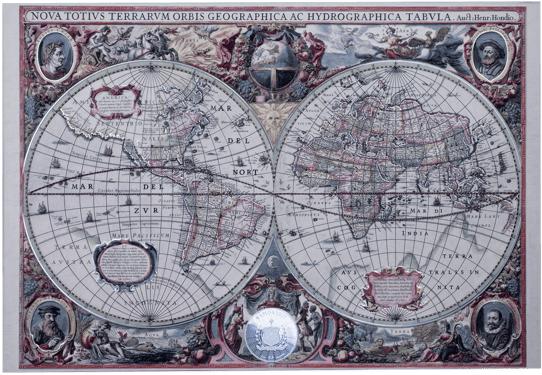
- Design: the famous double-hemisphere world map by Henricus Hondius from 1630, hand-coloured down to the finest cartouches, sailing ships and sea monsters.
- Format: an extraordinary 254 x 170 mm banknote format – a silver sheet instead of a round disc.
- Manufacturer: Various minting partners, issued on behalf of the issuing country.
- Country of origin: Samoa, legal tender with a face value of 5 dollars.
Some issues one wants to own because the numbers add up. This one you want to own simply because it looks stunning. The 1 oz silver "Mapping History" 2027 from Samoa transfers one of the most beautiful world maps in the history of cartography onto a rectangular sheet of 999 fine silver – 31.1 grams gross weight, 31.1 grams fine weight, delivered in a protective coin capsule. With a very low mintage of just 999 pieces worldwide, this issue is a genuine rarity even before the first collector holds it in their hands.
The design: Hondius' world map of 1630 – science, art and an error
The obverse features the "Nova Totius Terrarum Orbis Geographica ac Hydrographica Tabula", created by Henricus Hondius in Amsterdam. Two large hemispheres show the world as it was known during the Golden Age of Dutch cartography – with gaps, assumptions and a legendary misconception: California appears as an island. The South Seas, too, remain largely "Terra Australis Incognita". Those who look closely will discover grid lines, sailing routes, tiny place names and the lavish ornamentation of the Baroque era.
In the four corners, medallion portraits gaze out: Julius Caesar and Claudius Ptolemy above, Gerhard Mercator and Jodocus Hondius below – the ancestral line of world surveying. In between, allegories of the four elements and the seasons speak of the order of the cosmos, while at the lower edge the continents pay homage to Europe. Right there, elegantly woven into the scenery, sits the coat of arms of Samoa with the motto "FAAVAE I LE ATUA SAMOA" as well as the details 1 oz, $5 and Ag999.
Two sides, two characters
The second side dispenses with colour entirely and shows the same map as a pure silver relief. This is the real highlight of this issue: only without the colouring can one truly appreciate how deep and sculptural the minting actually is. Colour on one side, bare metal on the other – two works of art in one piece.
Technique: banknote format, colour printing and Prooflike finish
- Large format: 254 x 170 mm offer room for details that would simply be lost on a classic round coin.
- Colour finishing: high-resolution printing preserves the aged sepia, red and green tones of the original copper engraving.
- Surface: the Prooflike finish makes the contours shine – visually a close relative of Proof.
- Material: 999/1,000 fine silver, durable, dimensionally stable and tradable worldwide.
Why this particular issue makes collectors' hearts beat faster
With silver coins, the collector market usually determines desirability along three lines: design quality, craftsmanship and mintage. All three turn out unusually favourable here. A mintage of just 999 pieces is spread across a global market – for Germany, this leaves only a fraction in mathematical terms. Anyone collecting themed series around cartography, the history of discovery and historical art motifs knows the pattern: such designs appeal not only to numismatists but also to lovers of old maps. Two groups of demand, one tiny supply.
Cartography is the attempt to bring order to the unknown. This 1 oz silver coin turns that into a collector's piece you'd rather hang up than lock away.
Comparing this issue to classic bullion favourites such as Maple Leaf, Britannia or Krugerrand reveals clear differences: bullion coins are minted by the millions and live off pure material value. This silver coin from Samoa, by contrast, thrives on the interplay of design, technique and scarcity. Its premium is correspondingly higher – a deliberate trade-off: rarity instead of mass. Among the Samoa issues, alongside "Seahorse" or "Golden Eagle", "Mapping History" stands out in particular for its generous banknote format.
Silver: the metal of collectors and merchants
Silver has a millennia-old tradition as a coinage metal and was regarded in many cultures as a sign of wealth and prestige. Its availability is limited, while industrial demand – electronics, solar technology, medical technology – is high and technology-driven. Added to this is its high liquidity: physical silver can be traded worldwide, it does not age and retains its properties over generations. One tax aspect should also be mentioned: profits from the sale of physical precious metals are generally tax-free, provided a minimum holding period of one year is observed. This makes silver assets suitable for long-term passing on within the family – and anyone additionally thinking about inflation hedging or solid crisis protection will find suitable additions in our range.
Who this piece is suitable for
- For collectors of historical designs, maps and Baroque art.
- For lovers of unusual formats beyond the standard round coin.
- For anyone specifically building up issues with tiny mintages and thinking long term.
- As a representative gift for special occasions – hardly any design tells so much history on so little surface area.
The world of 1630, cast in fine silver, strictly limited to 999 sheets. Anyone who loves the art of maps won't need to think twice.
Product depiction may differ from the final product.
