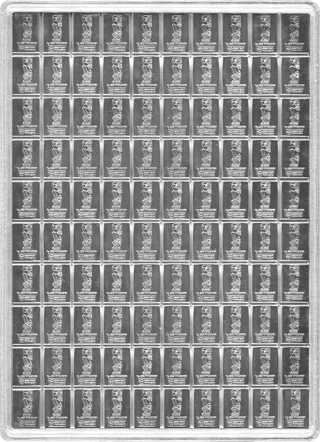
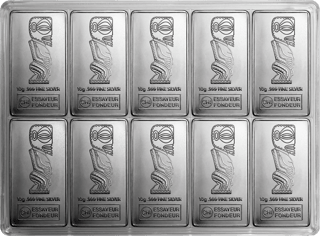
100 x 1g Silver Heimerle und Meule UnityBox
€280.00€290.00
incl. VAT and excl. shipping
Available in 6–7 business days

 More than 310,000
 Over 30 years
 Secure shipping
 Google: 4.9/5
Silver is enjoying growing popularity and the future for silver looks bright for those betting on price appreciation. The rising silver price means that smaller denominations are increasingly in demand in the silver segment, and silver is also being purchased more and more as a crisis hedge. The smaller a silver piece is, the easier it is to use as a means of exchange. A distinction is made between coin CombiBars and classic CombiBars.


Many small bars together, each of which can be separated on its own: this comes in five forms. Only in one of them, the tablet, are the pieces firmly joined.
“20, 50 or 100 individual 1 g minted gold bars are [joined] together to form one large bar. The single 1 g bars can easily be separated from one another.”
Heraeus on its tablets, data sheet
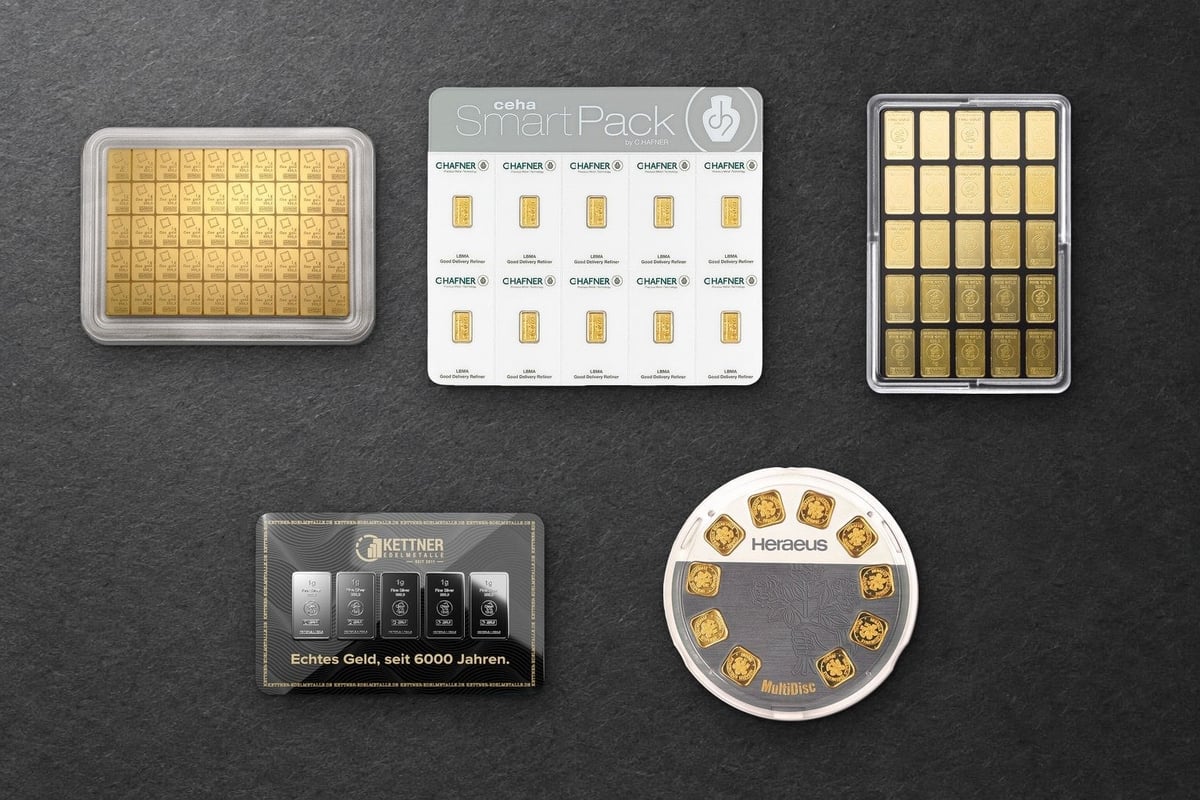
In the Smart Pack by C. Hafner, each bar sits in its own small card. “Each bar can be detached individually along a perforation,” writes the maker.
Heimerle + Meule places its UnityBars individually side by side in a capsule or box. Nothing is broken there; the maker heads its page “Snapping is a thing of the past”.
Then there are cards in which single bars are sealed in with space between them, and the MultiDisc by Heraeus: ten square bars of 1 gram each in round packaging.
Only the tablet has to be broken.
Schematic drawings after the product photos, not to scale.
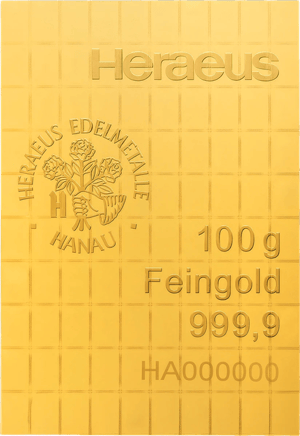
At Heraeus, the 100‑gram tablet measures 74 by 105 millimetres, the 50‑gram one 74 by 52.5. To within half a millimetre, these are the paper sizes DIN A7 and A8.
“The ESG divisible bars are DIN A7 or A8 in size and can be stacked perfectly in safes and safe deposit boxes.”
ESG Edelmetall‑Service in the trade journal zt, No. 6, June 2011, translated
The DIN 476 standard was published on 18 August 1922. Its largest sheet, A0, measures one square metre. Halve it along the long side and you get A1, and the aspect ratio stays the same, writes DIN, the German Institute for Standardization.
Divide the tablet of ten by ten pieces down the middle and you have two halves of 50 pieces each, each as large as the 50‑gram tablet: twice A8.
By calculation, each of the hundred pieces thus has a field of 7.4 by 10.5 millimetres, grooves included. This field, too, has the shape of the whole tablet.
The same area, a different thickness: the 100‑gram gold tablet from Heraeus is 0.85 millimetres thick, the 100‑gram silver tablet from Valcambi 1.5 millimetres. Tablets also come in platinum.
Halve the tablet and its shape stays the same, just as with paper.
Dimensions: Heraeus for gold, combibar.com for silver, the bank card to ISO/IEC 7810, format ID‑1. The field is calculated from the dimensions. At the same scale, not at a scale of 1:1.
The grooves between the pieces do not go through the tablet. A web of metal remains and holds the pieces together. That is how the patent specification for the tablet describes it.
“… preferably high enough that bending under the force of gravity is prevented, and at most high enough that the material connection can be destroyed by hand by bending or breaking.”
Patent specification on the bending strength of the web, translated
According to the patent specification, the web can be 0.05 to 0.4 millimetres thick, and the groove can open at an angle of about 10 to 60 degrees. The specification calls a groove thin if it is narrower than it is deep. These are ranges from the specification, not measurements of a particular tablet.
The groove cuts nothing out. It only pushes the metal aside, and the small bead that forms can be pressed flat again straight away during minting. So says the same specification.
Strong enough for gravity, yielding enough for the hand.
Diagram based on the figures in the patent specification, greatly enlarged. The drawing shows one example within the stated ranges, not to scale.
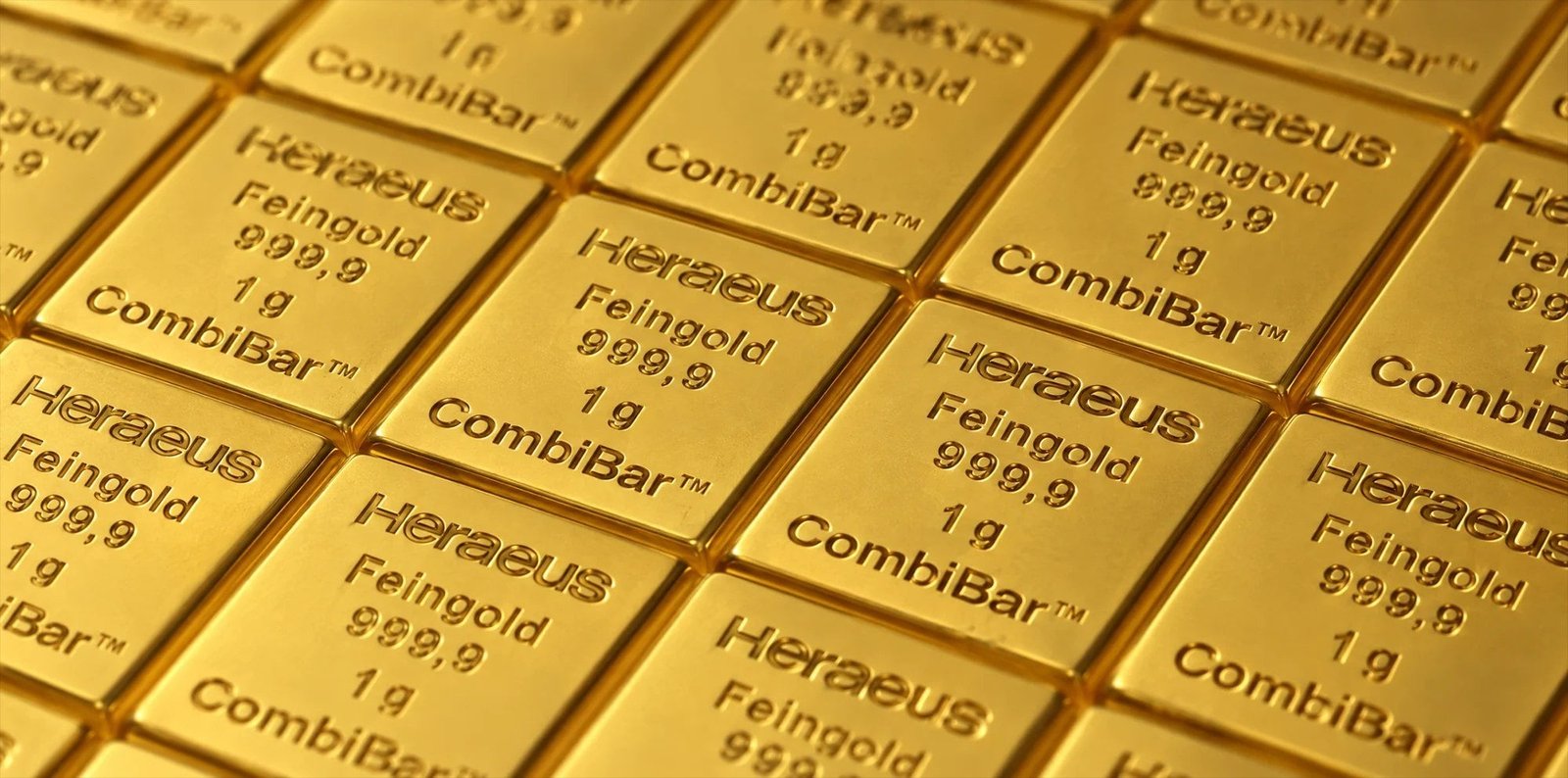
The same strike that forms the grooves stamps each piece with the maker’s mark, the weight and the purity. So says the patent specification. Even a single piece thus shows what it is.
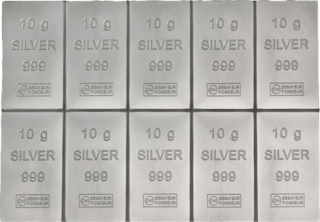
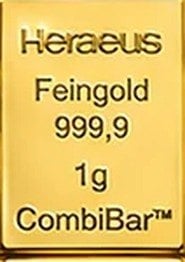
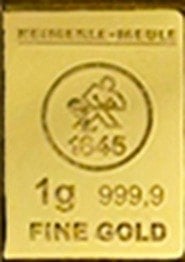
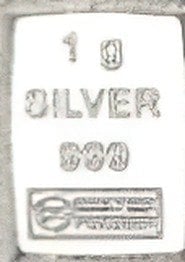
The product photos show how each house does it. Heraeus stamps “Feingold 999,9” and “1 g”, Heimerle + Meule its company mark with 1845 and “1g 999,9 FINE GOLD”, Valcambi on the silver tablet “1 g SILVER 999”.
So the fineness is not the same everywhere. The gold tablets bear 999.9/1,000, the silver tablets from Valcambi 999/1,000. On the silver bars from Heimerle + Meule it says 999,9.
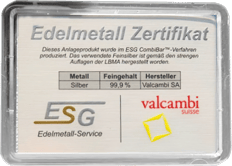
None of the pieces bears a number. At Heraeus, only the large bar bears a serial number, and the certificate comes with it in the plastic packaging. For the 50‑gram tablet from Valcambi, the reference work Gold Bars Worldwide 2011 names a tamper-proof sheath with a numbered certificate. With the Smart Pack by C. Hafner, each small card comes with its own certificate.
Weight and fineness are on every piece, a number on none.
Enlarged; the three pieces at the same scale, the back shown smaller. Details of product photos from the shop.
Handing over precious metal in pieces by weight is an old idea. In England, silver pennies were cut into halves and quarters until the 13th century whenever change was needed.
“… so that a halfpenny was literally half a penny and a farthing a quarter or ‘fourthing’.”
Royal Mint Museum, “Halfpenny and farthing”
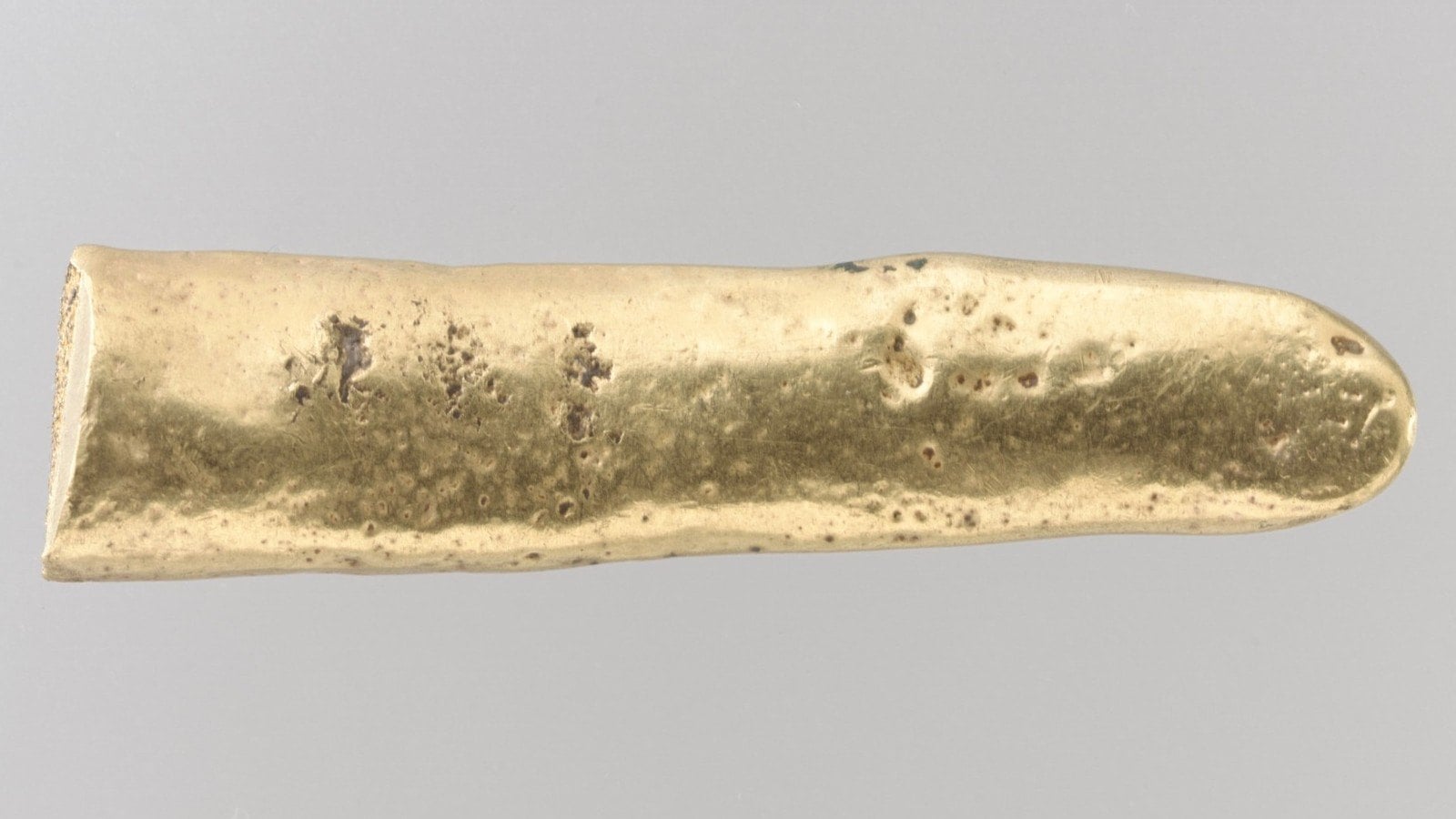
On the Schlei near Hedeby, archaeologists uncovered a hoard of around 200 objects, “mostly of silver: hacksilver, fragments of Arab coins (dirhams), ingot fragments and jewellery”, as the Schleswig‑Holstein State Archaeology Office reported in 2025. Paying by weight, with standardised sets of weights and accurate scales, arose at the end of the 9th and in the 10th century, at the same time as the rise of the trading centres Birka and Hedeby, writes the archaeologist Heiko Steuer.
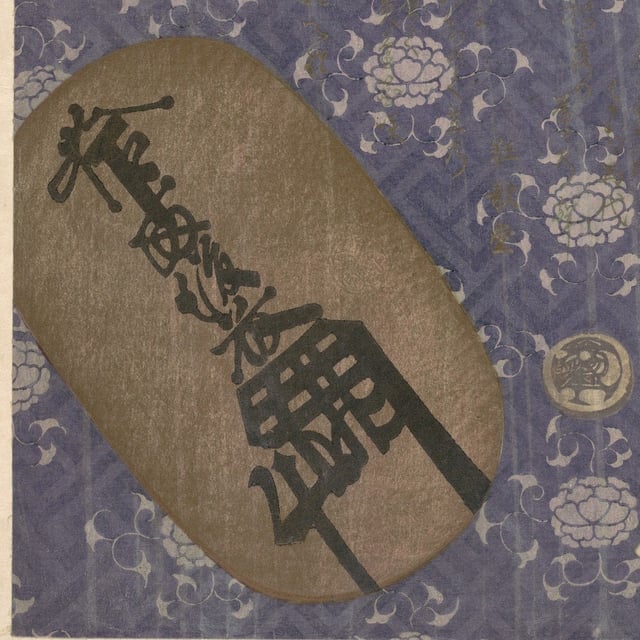
In Japan in the Edo period, silver was traded by weight, in the unit monme of 3.75 grams. Gold, by contrast, was counted in coins, writes the Currency Museum of the Bank of Japan.
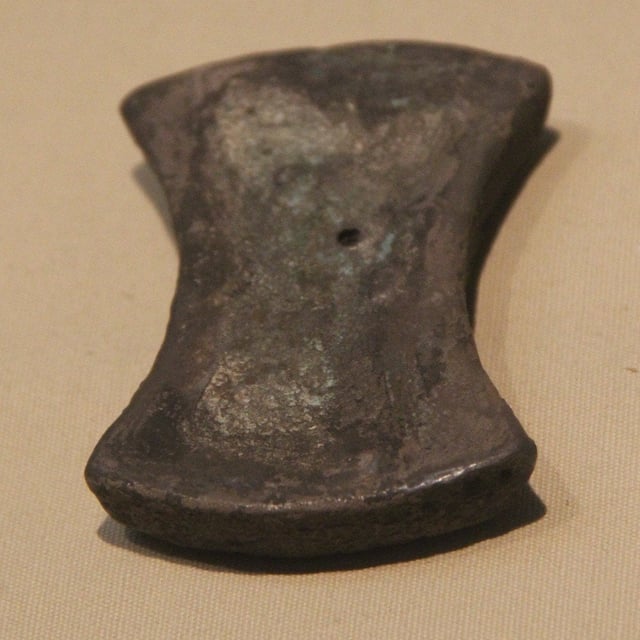
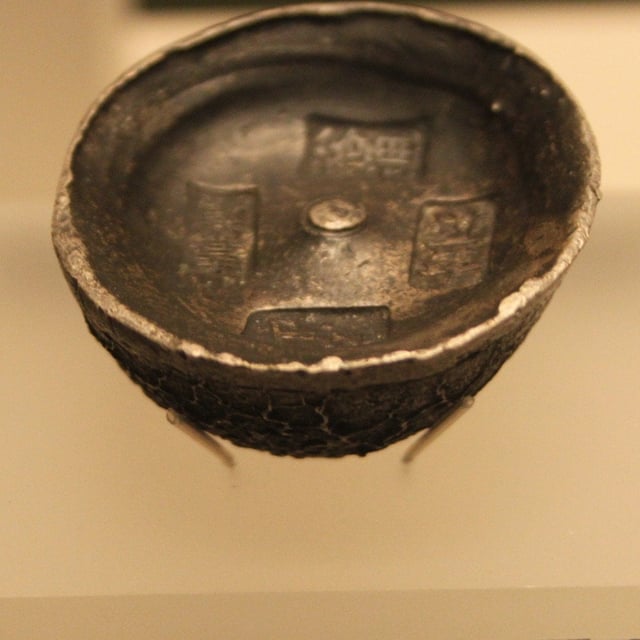
In China, silver ingots played an important part in domestic trade until 1933. Their stamps usually named the dynasty, the province and the guaranteed weight, reports the MoneyMuseum in Zurich.
The penny had to be cut up; the tablet is already divided.
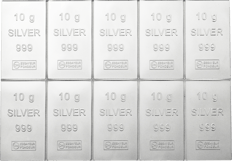
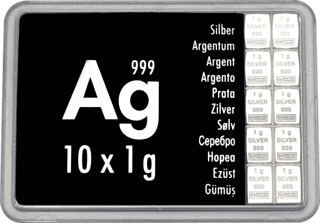
A silver CombiBar consists of many silver tablets, usually of 1 g or 10 g, joined together to form a sheet, similar to a bar of chocolate. At fine perforated break lines, you detach individual pieces by hand, without tools and without any loss of material. It is also called a silver tablet or combi bar, after the CombiBar developed by the company ESG. From us you can buy silver tablets and coin tablets with 10 to 100 segments, most of them from Valcambi, as well as gift cards with 3 x 1 g and 1 g pieces from Heimerle + Meule, 5 in our Crisis Protection Card and 50 or 100 in the box.
The advantages start with divisibility. With a 100 x 1 g silver tablet, you acquire a hundred 1 g pieces at once. If you later only need part of it, you sell or give away a few grams and keep the rest joined together. With a solid 100 g bar, this is not possible. In this way, you combine a large quantity of silver with the flexibility of one-gram pieces.
Many investors hold silver tablets as a reserve for times of crisis, because trading is possible even in individual grams. Others buy them for the family, so that children or grandchildren can later share the silver. Demand for silver, however, does not come from investors alone: as an industrial metal, it is found in electronics, solar cells and medical technology. You can see all weights and shapes in our overview of silver in bar form.
Perforated break lines run between the segments. You hold a row between your fingers and carefully bend it back and forth at the break line until it comes free, without any loss of material. You then separate the tablets from the row in the same way. On the combi bars, each segment bears its weight and fineness, so even a detached gram remains identifiable by its markings. Only break off as many as you currently need, and leave the rest in its original packaging.
The Swiss refinery Valcambi from Balerna in Ticino was founded in 1961 and has carried the mark ESSAYEUR FONDEUR, French for assayer and smelter, since 1965. This mark appears on its silver tablets and confirms that the fineness has been verified.
The fineness of both is 999/1,000. The 100 g combi bar is available, depending on supply, from either Valcambi or Heimerle + Meule, likewise with a fineness of 999/1,000.
A coin tablet works like a CombiBar, but additionally carries a face value and is therefore official legal tender. The issuing country of our coin tablets is the Cook Islands, and they are minted by Valcambi.
We show further silver coins from there under Cook Islands.
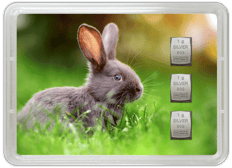
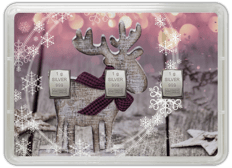
Anyone who prefers not to break anything apart chooses a set whose pieces are separate from the start. In the UnityBox from Heimerle + Meule of Pforzheim, they lie together in a transparent capsule that protects against scratches, moisture and other external influences. You take out each piece individually, for example as a gift, and unlike with a classic CombiBar, you can top up the set again afterwards.
All pieces in these sets have a fineness of 999.9/1,000. You can see further bars with a face value under silver coin bars.
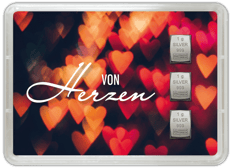
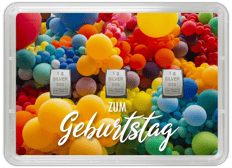
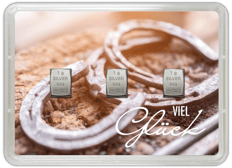
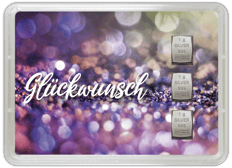
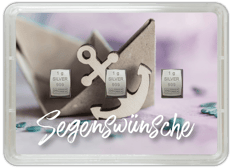
Silver is a gift that lasts. Popular occasions are birthdays, christenings and Easter. The gift cards from Valcambi hold three 1 g tablets with a fineness of 999/1,000, capsuled and supplied with a certificate of authenticity. You can choose from Happy Birthday, With Love, Good Luck, Congratulations, For the Christening and Happy Easter. You can find further gifts made of silver and gold under Gift Ideas.
Silver CombiBars and sets are available from us in these denominations:
Anyone who prefers a solid piece chooses the 1 oz bar, the 50 g bar, the 250 g bar or the 1 kg bar made of silver.
The fineness indicates how pure the silver is. Valcambi's tablets consist of 999/1,000 pure silver, while the sets from Heimerle + Meule are 999.9/1,000. Both count as fine silver. Whether the manufacturer stamps the fineness with a comma or a point makes no difference to the fineness itself. Which value applies to a given item is stated on each product page.
The best way to protect yourself against counterfeits is to buy from an established precious metals dealer like us. When unpacking, check for an undamaged capsule and for the details on manufacturer, weight and fineness. You can read how to check silver in the guide Checking Silver for Authenticity.
The price follows the silver price, which is quoted worldwide in US dollars per troy ounce. The exchange rate therefore also factors into the price in euros. Added to this are the manufacturing costs, since each gram carries its own stamping. You can see the current price of each item on the product tile, with information directly below on whether shipping is free. You can read about how the price develops in the guide Silver Price.
Fine silver is soft and can tarnish in air. Therefore, leave the CombiBar in its capsule or box and do not touch the surface with bare fingers. Store it dry and safely, for example in a safe or in a safe deposit box, which many banks offer. We carry suitable coin capsules and further accessories in our shop.
Besides silver tablets, many investors choose silver coins, usually in 1 oz with a face value and year of issue. A tablet, by contrast, can be divided into grams. The same principle exists with the gold CombiBar. As investment gold, it is exempt from VAT, whereas silver is not. Those who diversify more broadly add gold, platinum or palladium to silver. You can find ready-assembled stockpiles for times of crisis among the Crisis Protection Packages, and for regular purchases the savings plan products.
VAT on silver
Unlike investment gold, silver is not exempt from VAT under § 25c UStG. CombiBars without a face value carry 19 % VAT, which is included in our prices. Depending on stock, we also supply coin tablets and coin bars with a face value under the margin scheme pursuant to § 25a UStG, in which case VAT is not shown separately.
If you sell silver as a private individual, any profit is generally tax-free after a holding period of more than one year (§ 23 EStG). The period begins on the date of purchase. This is general information and does not replace tax advice.
You can order your silver CombiBar directly here in the shop or by phone from our customer advisors at 07930-2699, Monday to Friday from 8 am to 8 pm. If you would like to invest a larger amount, we will be happy to put together a personal purchase offer for you. You can also request it online.
Whether an item is immediately available and what delivery time applies is shown on the product tile and on every product page. Every shipment is insured for its full value until it is handed over to you. In our warehouse, a video-monitored high-security facility, two specialists check every order under the dual-control principle and pack it in a plain box. We split large orders across several insured parcels, but you still only pay the shipping costs once. For parcels above a certain value, we reserve the right to deliver via a specialised valuables logistics provider. You can pay by bank transfer or online, for example with PayPal or credit card. You will see the shipping costs and the payment methods available for your order before submitting it at checkout. Further information can be found under Shipping and Payment.
Silver that you have bought from us, we will buy back on request. You select the pieces directly from your orders in our buy-back portal, and you do not need an invoice for this. You can offer us items from another purchase there together with the purchase invoice. Whether we make you an offer in this case depends on the item, the quantity and our current demand.
You will usually receive a written buy-back offer within 24 hours. If you accept it, we will provide you with an insured DHL shipping label for sending the item from Germany, free of charge above a minimum offer amount. A parcel can hold goods up to a set insured value; above that, we prepare several parcels or arrange a secure valuables transport. Please include the capsule, box or card and certificate with your silver tablet or the individual pieces, provided these were originally supplied with them. Our experts check authenticity, completeness and condition, after which we transfer the amount. The silver price on the day the goods reach us is decisive. Fixed agreed prices remain valid. Due to customs regulations, a buy-back from Liechtenstein and Switzerland is currently not possible.
A silver CombiBar, also called a combi bar or silver tablet, consists of many silver tablets, usually of 1 g or 10 g, joined together. At the perforated break lines, you detach individual pieces by hand.
You acquire a large quantity of silver in one piece and later detach only as many grams as you currently need. The rest stays joined together and in its original packaging.
No. No material is lost when separating, and each segment carries its own stamping, on the combi bars including weight and fineness. A detached gram therefore remains identifiable, so you can sell it or give it as a gift.
With the CombiBar, bars without a face value are firmly joined together, and you separate them by hand as needed. The CombiCoin is such a tablet with a Cook Islands face value and is therefore a coin. In the UnityBox from Heimerle + Meule, separate pieces lie in a capsule. You take out each one individually and can top up the set again.
Most of the CombiBars, combi bars and coin tablets we offer come from Valcambi in Switzerland; the 100 g combi bar is also available from Heimerle + Meule. Heimerle + Meule of Pforzheim also supplies the sets in the UnityBox, the Malta coin bars and the pieces in our Crisis Protection Card.
Silver is not exempt from VAT like investment gold. CombiBars without a face value carry 19 % VAT, which is included in our prices. Depending on stock, coin tablets and coin bars with a face value are also available under the margin scheme pursuant to § 25a UStG.
You can buy silver CombiBars from us in the shop or by phone at 07930-2699, Monday to Friday from 8 am to 8 pm. The price, shipping costs and delivery time are shown for each item.
Yes. You select silver that you have bought from us from your orders in the buy-back portal, and you will usually receive a written buy-back offer within 24 hours.
Stay informed with product launches, financial news and exclusive offers. Sign up for our free newsletter today.
By entering your email address and clicking the “Submit” button, you give the following consent: “I agree to be informed by email about new products, financial news and exclusive offers, and therefore consent to the processing of my email address for the purpose of sending the newsletter. I can revoke this consent at any time without giving reasons, with effect for the future. The lawfulness of processing carried out prior to revocation remains unaffected.”