1/10 oz Silver Britannia 2026
€11.47
incl. VAT and excl. shipping
Available in 2–3 business days

 More than 310,000
 Over 30 years
 Secure shipping
 Google: 4.9/5
The first bullion coin in Europe was the Britannia. These silver coins are released annually in a new design. The partially gold-plated coins are also highly prized among collectors. The manufacturer The Royal Mint crafts the outstanding designs beautifully and to the highest quality. We carry various special finishes including emerald dust, ruby dust, gold-plated, hologram, and noble ruthenium (price per kilo ~ €14,000). Here you will find the Britannia in gold.


Hardly any silver coin combines classical symbolism with modern minting technology as confidently as the Silver Britannia. Since 1997, the British Royal Mint has issued the proud goddess of war in fine silver: as Europe's first silver bullion coin and today one of the world's most widely traded bullion coins. This guide examines history, design, denominations, fineness, the elaborate security features and the special tax treatment, and positions the Britannia in comparison with other silver coins.
Following the great success of the gold Britannia, the Royal Mint launched the first Silver Britannia in 1997, ten years after the gold premiere. This made it the first European silver bullion coin ever, creating a counterpart to classics such as the Canadian Maple Leaf or the Austrian Vienna Philharmonic. The first issue appeared exclusively in Proof quality and was limited to just 20,000 pieces, making this year of issue correspondingly sought after among collectors.
What has distinguished the Britannia from the very beginning is its dual character: it is both legal tender with a face value of 2 pounds and a sought-after investment object. This combination of state guarantee, high mintage and iconic design quickly made it a fixture in the world of silver bullion coins. As manufacturer, the oldest still-active mint in Great Britain, the British Royal Mint, guarantees consistently high quality.
The name goes back to the Latin term for the Roman province of Britannia. Even in antiquity, the personification of the land was venerated as a warlike female figure, a symbol of patriotism, strength and protection. On the design side, Britannia classically appears as a standing figure with a helmet, trident and shield bearing the Union Jack. The trident represents dominion over the seas, the shield stands for the protection of the land, and the robe billowing in the wind for freedom and movement.
The long-standing standard design, "Standing Britannia", was created by sculptor Philip Nathan, who had already designed the figure for the gold coin in 1987. Between 2001 and 2008, the Royal Mint regularly changed the design in odd years, producing variants such as the seated Britannia, the helmeted bust or the depiction with a lion. For some years now, the design has been standardised again, which strengthens recognisability for investors.
A design that has stood for the soul of a nation for over two millennia, condensed onto one troy ounce of fine silver.
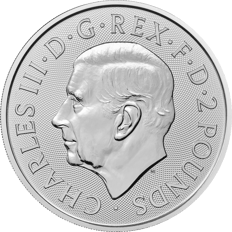
As is customary with British coins, the value side shows the portrait of the reigning head of state. From 1997 to 2022, this was Queen Elizabeth II, in several successive portraits, among others by Ian Rank-Broadley and Jody Clark. Following the Queen's death in September 2022, the coin has featured the portrait of King Charles III since the 2023 year of issue, designed by Martin Jennings. Following an old tradition, the King faces left, while his predecessor faced right. Related series such as the Maple Leaf now also carry the new royal portrait.
A central chapter in the history of the Silver Britannia is the increase in fineness. Up to and including 2012, the coin consisted of a silver alloy of around 958/1,000 with a copper content that gave it higher scratch resistance. Since the 2013 year of issue, the Royal Mint has consistently minted in 999/1,000 fine silver, bringing the Britannia into line with the established bullion coins of high fineness. The classic minting quality is Brilliant Uncirculated (BU); in addition, a limited Proof edition is issued every year, which is particularly valued by collectors.
The 1 oz Britannia is the heart of the series, alongside which smaller denominations also exist. Those wishing to diversify into fine silver often combine the Britannia with matching 1 oz silver bars or opt for whole tubes and monster boxes.
The design remains identical across all denominations, and the reverse is not altered either. The edge of the coin is usually reeded. Those storing the coins long-term should ensure proper storage; suitable coin capsules protect the sensitive surface from scratches and environmental influences.
Since the 2021 year of issue, the Silver Britannia has ranked among the most counterfeit-proof bullion coins in the world. For this, the Royal Mint combines four interlocking security features that make imitation considerably more difficult:
These features can already be checked with the naked eye or a simple magnifying glass. In addition, the usual checks apply to fine silver coins: weight, diameter and sound provide reliable indications of authenticity. At Kettner Edelmetalle, every coin undergoes an ISO-compliant authenticity verification before being dispatched via insured shipping.
The standard Brilliant Uncirculated edition is issued in high mintage, in some years several hundred thousand pieces. This very availability is an advantage for investors: it ensures a liquid market and a premium that closely tracks the current silver price. Collectors, on the other hand, focus their attention on the special features of the series.
The Proof version is issued in a significantly smaller mintage and with an elaborate polish. Over the years, the Royal Mint has released numerous collector editions, including multi-part coin sets that bundle all denominations of a given year, as well as anniversary editions marking the 20th and 25th anniversaries of the series. Such pieces regularly command premiums over the pure material value.
A British peculiarity are the Privy Mark Britannias: instead of placing the special symbol on the design side, the Royal Mint applies it around the edge of the coin, for example with the zodiac signs of the Chinese lunar calendar. Visually, the design side remains unchanged, which makes these issues a subtle rarity. Those interested in the combination of bullion coin and East Asian symbolism will find related items in the Lunar Series UK from the same mint.
Collector's item or investment object?
For pure silver ownership, the affordable Brilliant Uncirculated ounce is the first choice. Those who enjoy rarities opt for Proof editions, anniversary sets or Privy Mark variants: they combine material value with a possible collector's premium.
In Germany, silver coins are generally subject to VAT, unlike VAT-exempt investment gold. For the Britannia, however, a special situation arises: following the United Kingdom's departure from the European Union, the country is considered a third country, which means the coin can generally be traded under the margin scheme. In this case, only the trading margin is taxed, not the full value of the goods, which noticeably reduces the effective tax burden compared with standard taxation.
As with all precious metals, the following also applies: after a holding period of one year, any private capital gain is tax-free. For the specific details, it is worth looking at the other offers in the category of margin scheme taxed silver coins. Tax regulations can change; the following information is general in nature and does not replace tax advice.
The Britannia is issued not only in silver but also in gold and platinum, for investors who want to collect the same design across several precious metals. Compared with other fine silver classics, it scores points with its high level of counterfeit protection and its eventful design heritage.
Compared with the Vienna Philharmonic and the Maple Leaf, the Britannia shares the high fineness of 999/1,000 but stands out through its animated surface and micro-text. Those who like design-rich series will find another British coin with collector appeal in the Queen’s Beasts. For systematic long-term wealth building, Britannias can also be acquired regularly through savings plan products.
The first Silver Britannia was issued in 1997, ten years after the gold premiere of 1987. It is considered Europe's first silver bullion coin and has been reissued annually ever since.
Since the 2013 year of issue, the coin has consisted of 999/1,000 fine silver. Before that, the fineness was around 958/1,000 with a copper content that increased scratch resistance.
In addition to the classic 1 oz, the coin is available in 1/2 oz, 1/4 oz and 1/10 oz. The standard and most liquid size is the full ounce; the smaller formats are often found in sets.
Since 2021, the coin has combined four security features: tincture lines on the shield, a laser-engraved micro-text with the phrase "DECUS ET TUTAMEN", a latent image, and an animated wave surface. This combination makes counterfeiting considerably more difficult.
Since the United Kingdom has been considered a third country since leaving the EU, the Britannia can generally be traded under the margin scheme. In this case, only the trading margin is taxed, which reduces the effective tax burden. The specific treatment may change; this does not constitute tax advice.
Since the 2023 year of issue, the value side has shown the portrait of King Charles III by Martin Jennings. Before that, from 1997 to 2022, Queen Elizabeth II was depicted in several different portrait versions.
 Britannia
Stay informed with product launches, financial news and exclusive offers. Sign up for our free newsletter today.
By entering your email address and clicking the "Submit" button, you give the following consent: "I agree to be informed by email about new products, financial news and exclusive offers, and therefore consent to the processing of my email address for the purpose of sending the newsletter. I can revoke this consent at any time without giving reasons, with effect for the future. The lawfulness of processing carried out prior to revocation remains unaffected."