Offer -100,00 €

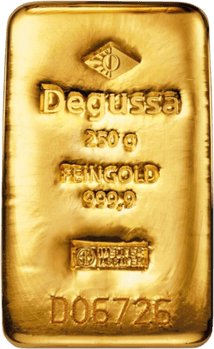
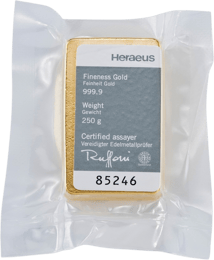
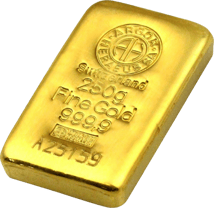
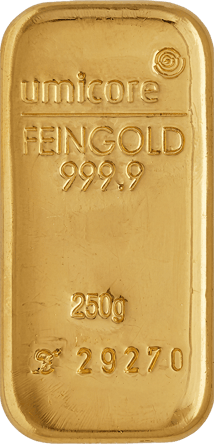
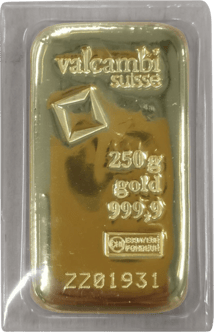
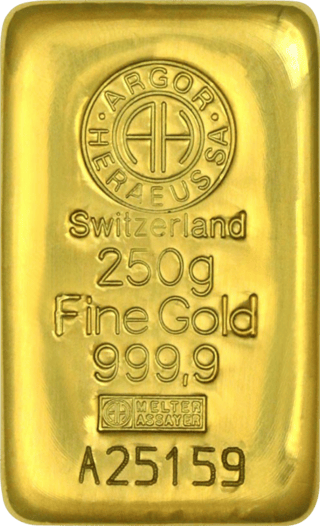
250g Gold Bar Heimerle und Meule (cast)
32.170,21 €32.270,21 €
VAT-free and excl. shipping
Available in 3–4 business days

 More than 280,000
 Over 30 years
 Secure shipping
 Google: 4.9/5
Are you a fan of the traditional, smooth and finely shaped cast gold bars? In our shop you will find exclusively 250g gold bars in cast form. We appreciate the distinct individuality of each bar, whose casting does not have to be exactly uniform. Your gold bar is therefore as unique as you are. You deserve it.


The Shanghai Gold Exchange delivers its Au99.99 contract in bars of one kilogram. Each of these bars has a fineness of at least 999.9/1,000.
“The Exchange shall only provide whole bars and ingots for withdrawal, and will not offer to cut or exchange any bars or ingots.”
Shanghai Gold Exchange, Detailed Delivery Rules of 2019, Article 36
Based on the Detailed Delivery Rules of the Shanghai Gold Exchange of 2019, Annex 1 and Article 14, and its product page for Au99.99. The 100 tick marks are calculated: 1,000 grams per bar, 10 grams per lot.
This contract is traded in lots of 10 grams. Whoever withdraws gold from the exchange’s vault, however, receives it only as a whole bar. By calculation, that is 100 lots for one kilo bar.
Kilo bars may go into any vault the exchange has certified. The large bars of 12.5 kilograms are accepted only in its vaults in Shanghai and Shenzhen.
Refineries recognised by the LBMA, the association of the London precious metals market, may also deliver. The gold and silver exchange in Hong Kong also has its own contract for the kilo bar of 999.9/1,000.
In the London wholesale market, the kilo bar does not count as a standard bar. For the kilo bar of 999.9/1,000 there is a separate specification, endorsed by the LBMA, the association of the London precious metals market, and by the gold exchange in Shanghai.
It sets out a frame: 80 to 120 millimetres long, 40 to 60 millimetres wide and 7 to 14 millimetres high, rectangular and weighing at least 1,000 grams.
“Specifications are for cast bars.”
LBMA and Shanghai Gold Exchange, specifications for the kilo bar of 999.9/1,000
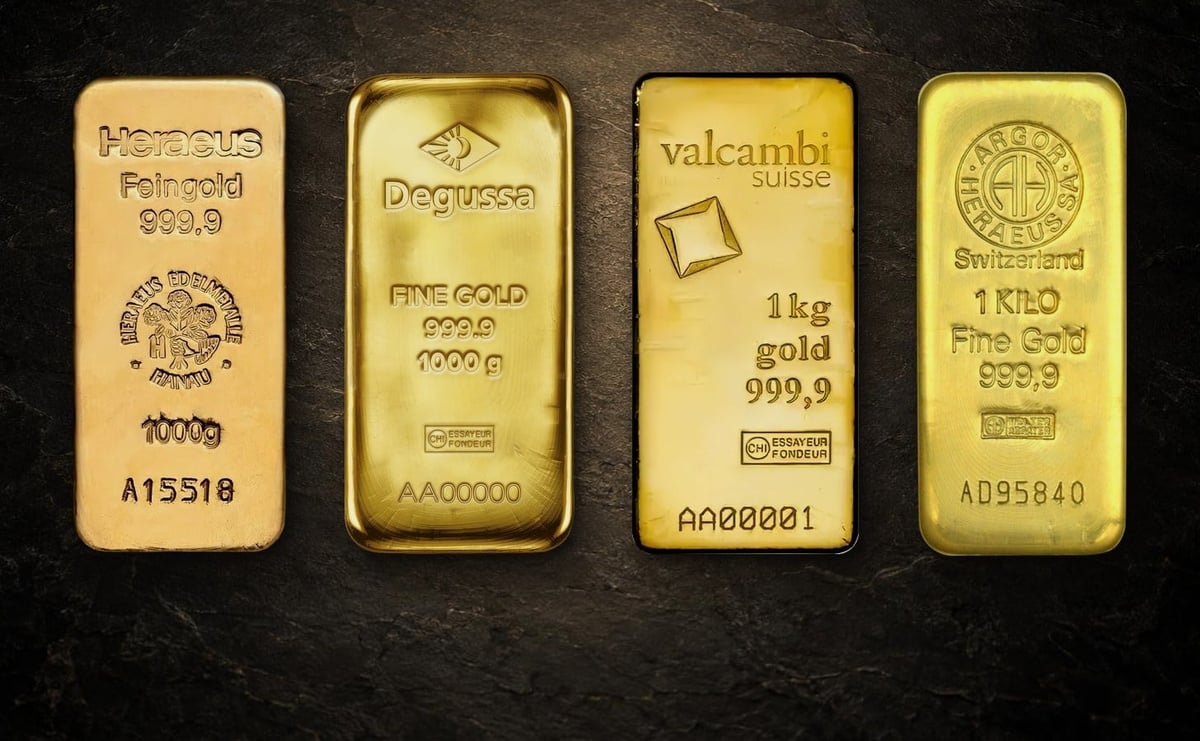
Outlines according to the makers: Heraeus 116 × 51, Degussa 117 × 51, Valcambi 117 × 53, Argor‑Heraeus 117.5 × 52 millimetres. Heraeus, Degussa and Argor‑Heraeus state the height, Valcambi does not. The identity card in the card format ID‑1. At the same scale, not at a scale of 1:1.
Four details belong on each of these bars: the refiner’s stamp, a serial number, the weight and the fineness to four digits. Every bar leaves the refinery with a certificate of analysis, and no serial number may be issued a second time.
In length and width, the kilo bars from Heraeus, Degussa, Valcambi and Argor‑Heraeus fall within this frame. According to the makers, they measure 116 to 117.5 by 51 to 53 millimetres.
For comparison, an identity card: it is 85.6 millimetres wide and 54 millimetres high. So these kilo bars are roughly as wide as the card is high, and about three centimetres longer than it is wide.
The London gold trade works in large bars of 350 to 430 fine ounces of gold. The World Gold Council calls them 400‑ounce bars. By calculation, 400 fine ounces are 12.44 kilograms of fine gold, enough for twelve kilo bars.
“… the shipment and transformation, on an epic scale, of 400oz London Good Delivery (LGD) bars into smaller denominations more suitable for consumers’ pockets.”
World Gold Council, Gold Demand Trends Full year 2013
Seen from above, at the same scale. The large bar in the middle of the dimensions the LBMA permits: 250 by 70 millimetres on top, 35 millimetres high, about four times as high as a kilo bar of 9 millimetres. Weights calculated at 31.1035 grams per fine ounce.
That is how the World Gold Council described the year 2013. At the time, much gold went from western vaults via refineries in North America, Switzerland and Dubai to Asia and the Middle East.
In the assessment of Thomson Reuters GFMS, the large bars went mainly through Swiss refineries and were converted there into kilo bars or smaller bars. According to its customs statistics, Switzerland exported 2,777 tonnes of gold that year, Reuters reported in February 2014.
Two formats meet here: London stores large bars, while in Shanghai, Hong Kong and India the kilo bar is one of the usual sizes.
Around two‑thirds of the gold India imports arrives as cast kilo bars of 995.0/1,000 or as 100‑gram bars. So the World Gold Council wrote in 2021. In the year before, the largest supplier was Switzerland.
There is a weight for gold and silver there that is older than the gram: the tola. Its name comes from the Sanskrit word tulā, “a balance”. That is what the Anglo‑Indian dictionary Hobson‑Jobson records, in its edition of 1903.

The balance is schematic, its tilt not to scale. Valcambi states the footprint of both bars, not their height. Calculated at 0.06479891 grams per grain, the value of the grain since 1959.
In 1833 the tola was fixed in British India at 180 grains, the weight of a silver rupee. In 1939 a law laid down the tola of 180 grains for the whole of British India, in force from 1 July 1942. By calculation, that is 11.66 grams.
By calculation, a bar of ten tola weighs just over 116.6 grams, about a sixth more than a 100‑gram bar. Valcambi in Switzerland still casts it today. At Valcambi, both bars have the same footprint of 26 by 44 millimetres. The extra weight of the tola bar lies in its height.
On 1 October 1958, India officially began to use the metric system. In 2003, Indian customs expressly set tola bars apart from bars that carry their weight in grams or kilograms and a serial number. In trade, the tola lives on: in the Emirates, according to an LBMA report, bars for private buyers range from 1 gram up to 10 tola.
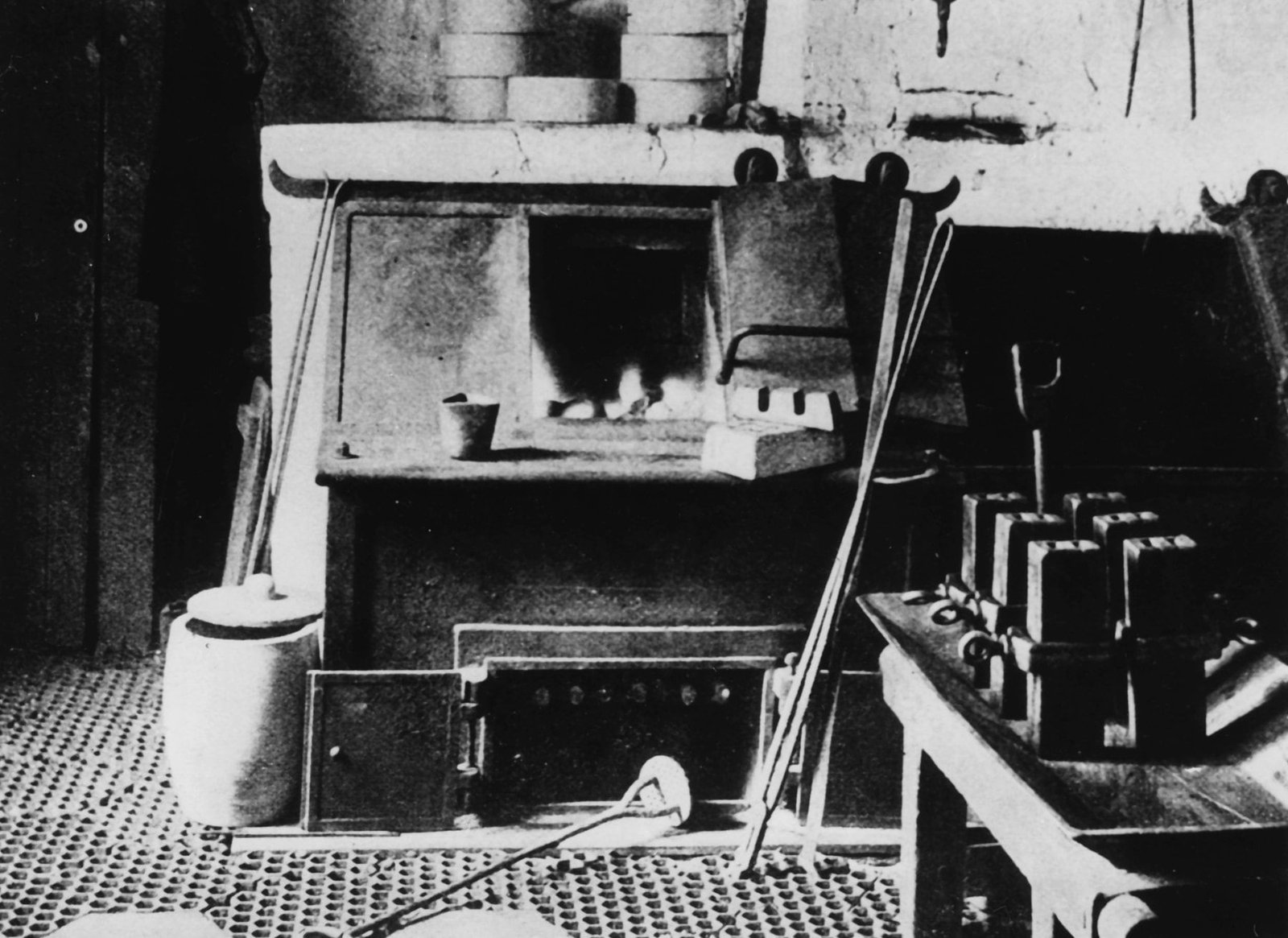
Large gold bars are mostly cast. For its large gold bars, the LBMA permits exactly two methods, both with moulds of graphite or cast iron.
“… either by the conventional method of pouring molten metal into them; or non‑conventional method of melting grain in an induction tunnel system …”
LBMA, Good Delivery List Rules, January 2022, section 2.1.2
Schematic, after the Rand Refinery for open casting and the equipment maker Italimpianti for the tunnel furnace.
In open casting, the caster directs a soft gas flame onto the gold in the mould until the top has solidified. In this way the bar cools from the bottom upwards, no shrinkage cavities remain, and the flame polishes the surface at the same time. Then the bar goes into the water bath. That is how a description of the Rand Refinery in South Africa from the 1980s puts it.
In the tunnel furnace, the gold already lies in the graphite mould as grain. A pusher moves the moulds into the melting zone, where induction melts the gold, and then over a water‑cooled plate, usually under nitrogen instead of air. Each bar weighs as much as the grain that lay in its mould, so the grain is weighed beforehand. That is how the equipment maker Italimpianti describes it.
Stamping comes only after casting. At the Rand Refinery in the mid‑1980s, the large bars waited for the laboratory result first, and only then was their fineness stamped in.
Receive a free and individual precious metals offer matching your financial goals within just a few minutes.
 Request offer now
Ein 250-g-Goldbarren liegt schwer und satt in der Hand – kompakt wie eine Streichholzschachtel und doch ein Viertelkilo pures Feingold. Genau diese Verbindung aus greifbarer Wertdichte und günstigem Aufgeld macht ihn zu einem der beliebtesten Formate für alle, die einen substanziellen Teil ihres Vermögens in physischem Gold anlegen möchten. In den folgenden Abschnitten geht es um Herstellung, Feingehalt, Aufgeld, Steuerfreiheit, Echtheitsmerkmale und die richtige Aufbewahrung – kompakt, aber vollständig.
Der 250-Gramm-Barren gehört zu den größeren Stückelungen im Segment der Goldbarren und ist auf Anleger zugeschnitten, die auf einen Schlag eine namhafte Menge Feingold erwerben wollen. Ein einzelner Barren enthält ein Viertelkilo reines Gold – das entspricht etwa acht Feinunzen. Damit füllt dieses Format die Lücke zwischen dem handlichen 100-g-Goldbarren und dem 1-kg-Goldbarren.
Der entscheidende Vorteil liegt im Aufgeld: Je größer der Barren, desto geringer fällt der prozentuale Aufschlag auf den reinen Materialwert aus, weil Prägung, Verpackung und Zertifikat auf mehr Gramm verteilt werden. Interessant ist, dass die Aufgelder pro Unze bei 250-Gramm- und Kilobarren nahezu identisch liegen. Für Anleger, die Flexibilität schätzen, kann es deshalb sinnvoll sein, statt eines einzigen Kilobarrens lieber vier 250-g-Barren zu halten – so lässt sich später ein Teil des Bestands verkaufen, ohne die gesamte Position auflösen zu müssen.
Goldbarren entstehen auf zwei Wegen: geprägt aus gewalzten Goldplättchen oder gegossen aus geschmolzenem Feingold. In diesem Format dominieren die klassischen Gussbarren. Beim Guss wird flüssiges Gold in eine Form gegossen und erstarrt dort zu einem Barren mit leicht unregelmäßiger, lebendiger Oberfläche.
Diese Individualität ist gewollt: Kein Gussbarren gleicht exakt dem anderen. Wo geprägte Barren makellos glatt und uniform wirken, trägt jeder gegossene Barren seine eigene Signatur aus feinen Wellen und Kanten. Für viele Anleger und Sammler ist genau das der Reiz.
Ein Gussbarren wird nicht gestanzt, sondern geboren – jede Oberfläche erzählt vom Moment des Erstarrens.

Alle seriösen 250-g-Goldbarren werden in der höchsten handelsüblichen Reinheit von 999,9 (24 Karat, Feingold) gefertigt. Ein Barren wiegt exakt 250 Gramm Feingewicht und misst je nach Hersteller rund 4,5 × 2,5 cm bei einigen Millimetern Dicke – kompakt genug für jedes Schließfach.
Die Produzenten in diesem Segment zählen zu den renommiertesten Scheideanstalten der Welt. Barren dieser Häuser tragen in der Regel die Zertifizierung der London Bullion Market Association (LBMA), dem globalen Qualitätsstandard für Anlagegold, und werden von Händlern weltweit ohne Vorbehalt angekauft.
Wer sich vor dem Kauf einen Überblick über die verfügbaren Marken verschaffen möchte, findet in der Hersteller-Übersicht alle anerkannten Produzenten auf einen Blick.
Ein zentraler Grund für die Beliebtheit von Goldbarren ist die steuerliche Behandlung. Anlagegold ist in Deutschland und der gesamten EU von der Umsatzsteuer befreit. Ein 250-g-Goldbarren erfüllt die gesetzlichen Kriterien für Anlagegold – hoher Feingehalt und Barrenform – und wird daher mehrwertsteuerfrei gehandelt.
Steuerlicher Hinweis
Der Verkauf physischen Goldes ist nach einer Haltedauer von mehr als einem Jahr für Privatpersonen von der Abgeltungssteuer befreit. Das gilt für alle klassischen Goldbarren ebenso wie für Anlage-Goldmünzen. Für die persönliche steuerliche Einordnung empfiehlt sich die Beratung durch einen Steuerberater.
Weil kein Mehrwertsteuerhebel anfällt, liegt der Verkaufspreis eines 250-g-Barrens sehr nah am aktuellen Goldpreis. Wie sich der Kurs entwickelt, lässt sich transparent im Bereich Gold nachvollziehen. Diese Preisnähe ist einer der Gründe, warum große Barren als besonders effizientes Anlagegold gelten.
Gerade bei höherwertigen Barren ist die Echtheit entscheidend. Namhafte Hersteller bauen mehrere Sicherheitsmerkmale ein, an denen sich ein Original zuverlässig erkennen lässt.
Wer den Originalzustand erhalten will, sollte die Blisterverpackung nicht öffnen – sie ist Teil des Echtheitsnachweises und erleichtert den späteren Wiederverkauf. Bei einem etablierten Edelmetallhändler durchläuft jeder Barren zudem eine ISO-konforme Echtheitsprüfung, bevor er das Logistikzentrum verlässt.
Ein Viertelkilo Gold will sicher verwahrt werden. Grundsätzlich stehen drei Wege offen, die sich auch kombinieren lassen.
Damit die Oberfläche der Barren makellos bleibt, empfiehlt sich passendes Zubehör. Für einzelne Barren eignen sich schützende Münzkapseln, für eine geordnete Sammlung bieten sich Münzkassetten an. So bleibt jeder Barren vor Kratzern und Fingerabdrücken geschützt.
Die richtige Größe hängt von der Anlagesumme und dem gewünschten Grad an Flexibilität ab. Der 250-g-Barren ist ein Kompromiss aus niedrigem Aufgeld und noch teilbarer Position.
| Format | Feingold | Eignung |
|---|---|---|
| 100 g | 100 Gramm | Einstieg in größere Barren, gut teilbar |
| 250 g | 250 Gramm | Niedriges Aufgeld, größere Portfolios |
| 500 g | 500 Gramm | Hohe Wertdichte, geringes Aufgeld |
| 1 kg | 1.000 Gramm | Niedrigstes Aufgeld, wenig teilbar |
Wer eine kleinere Position bevorzugt, findet mit dem 500-g-Goldbarren oder dem handlichen 50-g-Goldbarren passende Alternativen. Als Ergänzung zu Barren sind auch klassische Krügerrand-Goldmünzen beliebt, die sich in kleineren Einheiten leichter verkaufen lassen. Und wer sein Edelmetall-Portfolio breiter aufstellen möchte, kombiniert Gold gern mit Silberbarren als preisgünstigere Beimischung.
Ein 250-g-Goldbarren enthält exakt 250 Gramm Feingold in einer Reinheit von 999,9. Das entspricht rund acht Feinunzen reinem Gold.
Ja. Als Anlagegold sind 250-g-Goldbarren in Deutschland und der EU von der Umsatzsteuer befreit. Dadurch liegt der Kaufpreis sehr nah am aktuellen Goldpreis.
Gussbarren entstehen, indem flüssiges Gold in eine Form gegossen wird und dort erstarrt. Sie haben eine leicht unregelmäßige, individuelle Oberfläche. Geprägte Barren werden aus gewalzten Platten gestanzt und wirken glatt und uniform. Bei 250 Gramm sind Gussbarren die übliche Variante.
Die Aufgelder pro Unze liegen bei beiden Formaten nahezu gleich. Vier 250-g-Barren bieten jedoch mehr Flexibilität, da sich Teilbeträge einzeln verkaufen lassen, ohne die gesamte Position aufzulösen.
Merkmale sind die individuelle Seriennummer, das mitgelieferte Echtheitszertifikat, der saubere Prägestempel mit Herstellerlogo und Feingehalt sowie exakt stimmende Maße und Gewicht. Die eingeschweißte Verpackung sollte für den Werterhalt ungeöffnet bleiben.
Möglich sind ein Bankschließfach, ein zertifizierter Heimtresor oder eine externe Hochsicherheitsverwahrung. Für den Schutz der Oberfläche eignen sich Münzkapseln und Münzkassetten aus dem Zubehör-Sortiment.
 250 g Goldbarren
Stay informed with product launches, financial news and exclusive offers. Sign up for our free newsletter today.
By entering your email address and clicking the "Submit" button, you give the following consent: "I agree to be informed by email about new products, financial news and exclusive offers, and therefore consent to the processing of my email address for the purpose of sending the newsletter. I can revoke this consent at any time without giving reasons, with effect for the future. The lawfulness of processing carried out prior to revocation remains unaffected."