Only 2 left to order
1 oz Platinum American Eagle
€2,017.75
incl. VAT and excl. shipping
Available in 2–3 business days

 More than 310,000
 Over 30 years
 Secure shipping
 Google: 4.9/5
The 1 ounce American Eagle Platinum is minted by the U.S. Mint, the same mint that also issues the American Eagle in silver and gold. The 1oz American Eagle platinum coin appeared in 1997 and was the first official bullion coin made of platinum produced by the United States Mint.


The Platinum American Eagle is one of the few bullion coins in the world available in platinum at all, and at the same time the first official platinum bullion coin of the United States. Since its introduction in 1997 by the United States Mint, it has combined the rare white metal with one of the strongest national symbols of all: the Statue of Liberty. This guide examines the history, design, denominations, fineness, the annually changing collector editions, as well as tax and practical aspects surrounding the American platinum coin.
When the U.S. Mint introduced the Platinum American Eagle in 1997, it ventured into new territory. The United States had already minted the American Eagle in gold and silver since 1986; however, a bullion coin in platinum was a novelty and largely remained one, as only a handful of nations issue bullion coins in this rare metal. Although the USA thus entered the platinum market considerably later than Canada, Australia or Austria, the series quickly developed into one of the best-known platinum bullion coins of all.
A characteristic feature of the Platinum Eagle is its often very limited availability. In many years, only a small number of coins were minted, so that the ounce sold out several times within a short period. This scarcity distinguishes the platinum Eagle from the classics in gold and silver, which are produced in large quantities, and gives it a particular appeal for collectors and investors alike. Anyone who views the series in the context of the entire range of platinum coins quickly recognises its special status.
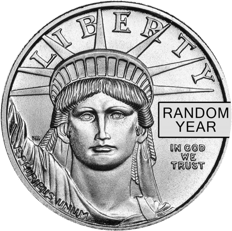
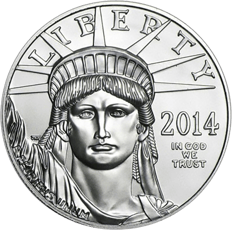
The design side has unchanged shown the head of the Statue of Liberty since the first issue: that Lady Liberty on Liberty Island off New York, regarded worldwide as a symbol of freedom and new beginnings. The design was created by John Mercanti, the long-standing chief engraver of the United States Mint, who also designed the Gold Eagle. The portrait is accompanied by the motto E Pluribus Unum, translated roughly as "out of many, one", a motto expressing the unity of the American federal states.
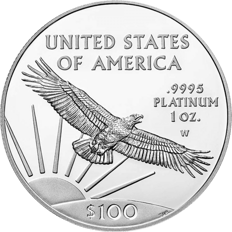
The value side of the regular bullion issue is adorned with the bald eagle, the heraldic animal of the United States, depicted in flight before a rising sun. The eagle has stood for freedom and independence on American coins for centuries. The coin's edge is reeded, a classic security feature that makes tampering with the metal edge more difficult. Those who appreciate the American eagle tradition will also find the same heraldic animal on the gold American Eagle.
The eagle has always stood for freedom on American coins; cast in platinum, this symbol becomes a rarity.
The Platinum American Eagle is minted in four denominations, which are identical in design except for the weight and face value. The fineness is 999.5 parts per thousand (.9995 fine platinum); the U.S. Mint guarantees the exact platinum content of every coin. All issues are official legal tender of the USA, even though their pure metal value exceeds the stamped face value many times over.
| Denomination | Fine weight | Diameter | Face value |
|---|---|---|---|
| 1 oz | 31.10 g | 32.7 mm | 100 USD |
| 1/2 oz | 15.55 g | 27.0 mm | 50 USD |
| 1/4 oz | 7.78 g | 22.0 mm | 25 USD |
| 1/10 oz | 3.11 g | 16.5 mm | 10 USD |
Those who prefer smaller units will also find comparable fractional denominations in the Platinum Maple Leaf or the platinum Vienna Philharmonic.
The series is issued in two fundamentally different versions. The bullion strike in Mint State (MS) finish is aimed at price-conscious buyers: its value closely tracks the current platinum price on the world market, and the premium remains moderate. There is also the Proof issue with mirror-like fields and frosted relief, produced for collectors, in a significantly lower mintage and at a price clearly above the pure metal value.
A genuine special feature makes the Platinum Eagle unique among US bullion coins: since 1998, the Proof issues have featured a newly designed reverse every year. In the early years, these designs showed the bald eagle in changing American landscapes: on a rocky coast with a lighthouse, over the wetlands of the southeast, or in front of the American flag. Later years drew on core concepts of the US Constitution, reinterpreting freedom, justice and unity thematically. Because the design on the value side changes with every year of issue, the Proof series is a collecting field with clear year sequences; different years can be assembled into a continuous series. Collector's pieces with a high grade of preservation can also be found in the broader range of collector's coins.
Platinum is significantly rarer than gold and is largely consumed by industry, above all in vehicle catalytic converters, the chemical industry and medical technology. This close link to the real economy results in an independent price dynamic that often behaves differently from the gold market. For investors, this offers an opportunity to diversify across precious metals, complementing classic holdings of gold and silver.
Note on Price Development
The platinum price is subject to fluctuations and is heavily influenced by industrial demand, production volumes and exchange rates. Historical price trends do not represent a forecast for the future and do not constitute investment advice.
Those who prefer to hold platinum in bar form will find an alternative with usually lower premiums per gram in the range of platinum bars.
An important difference to investment gold: while investment gold is exempt from VAT in Germany, platinum coins are subject to VAT. When purchased under the margin scheme, tax is levied only on the trading margin, which can lower the final price compared with standard taxation. Furthermore, the income-tax one-year holding period applies to disposals: if a coin is held for longer than twelve months, any capital gain remains tax-free for private sellers.
Tax Notice
The tax treatment depends on the individual case. This information does not replace tax advice; if in doubt, we recommend consulting a tax advisor.
The clearly defined values of the Platinum American Eagle make authenticity verification easier: fine weight, diameter and thickness can be checked with a precision scale and callipers, while the reeded edge and sharp strike provide further clues. Because platinum has a high density, deviations in weight and dimensions quickly reveal a counterfeit. At Kettner Edelmetalle, every coin undergoes an ISO-compliant authenticity verification before being shipped with insurance.
Proper storage is crucial for preserving value. Recommended are:
When buying, it is worth looking at the grade: for bullion strikes, the low premium counts, while for Proof issues, a complete case and certificate of authenticity determine the value. As an official partner of international mints, Kettner Edelmetalle carries the broad range of platinum coins, from the platinum Krugerrand to the platinum Britannia.
The coin has been minted by the United States Mint since 1997 and was the first official US bullion coin made of platinum. It complemented the American Eagle in gold and silver, which had already existed since 1986.
The fineness is 999.5 parts per thousand (.9995 fine platinum). The U.S. Mint guarantees the stated fine weight in ounces for every coin minted.
There are four sizes: 1 oz (100 USD face value), 1/2 oz (50 USD), 1/4 oz (25 USD) and 1/10 oz (10 USD). The design and motif are identical across all denominations; they differ only in weight and face value.
The collector editions in Proof have featured a newly designed reverse every year since 1998, a peculiarity that makes the Platinum Eagle unique among US bullion coins. Early years show the bald eagle in changing American landscapes, while later ones draw on themes from the American Constitution.
No. Unlike investment gold, platinum coins are subject to VAT, often under the margin scheme. However, after the one-year holding period has elapsed, any private capital gain remains exempt from income tax. For individual cases, tax advice is recommended.
The Platinum Eagle has its own distinctive design with the Statue of Liberty on the obverse, while the gold and silver issues carry different designs. It is also minted from the rarer platinum, usually in a lower mintage, and the Proof reverses change every year.
 American Eagle
Stay informed with product launches, financial news and exclusive offers. Sign up for our free newsletter today.
By entering your email address and clicking the "Submit" button, you give the following consent: "I agree to be informed by email about new products, financial news and exclusive offers, and therefore consent to the processing of my email address for the purpose of sending the newsletter. I can revoke this consent at any time without giving reasons, with effect for the future. The lawfulness of processing carried out prior to revocation remains unaffected."