Only 5 left to order
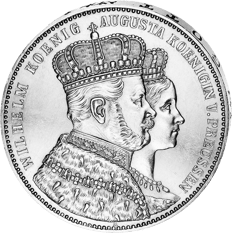
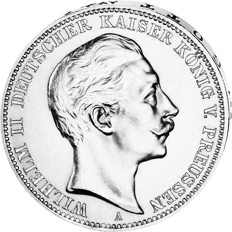
1/4 oz Gold Kaiser Wilhelm I 155 Years of the Gold Standard 2026 (Mintage: 99 | Proof)
€1,990.00€2,490.00
VAT-free and excl. shipping
Ships from 18/12/2026

 More than 310,000
 Over 30 years
 Secure shipping
 Google: 4.9/5
The actions of a few decide the lives of many! The history of humanity has been decisively shaped by a few outstanding minds. Wars, inventions and cultural achievements are largely attributed to a handful of individuals – for better or for worse. Important personalities have always been depicted on coins and remain a classic among designs.


What survives of six people is what was printed, filed for a patent, photographed or given as a lecture. Each of the five chapters shows one of these documents and at the end tells of the coin that belongs to it.
William Shakespeare, 1623
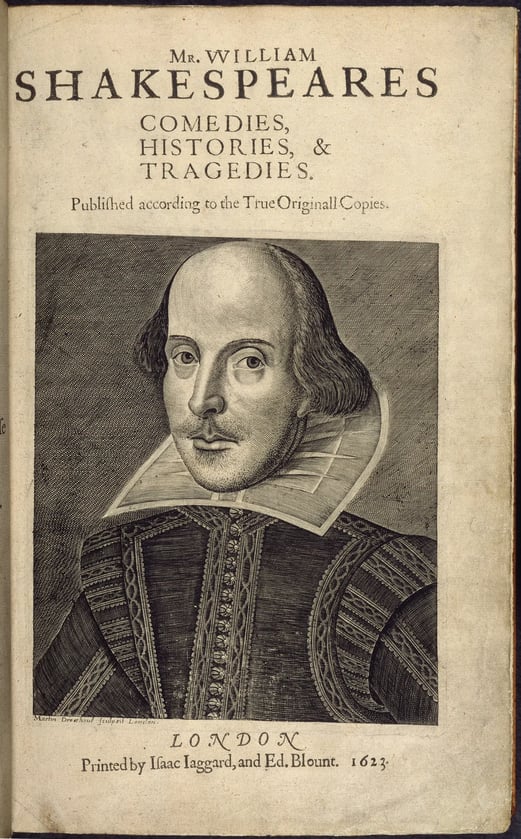
In 1623, seven years after Shakespeare’s death, the First Folio appeared in London, a book in the large folio format with 36 of his plays. It was compiled by his colleagues John Heminge and Henry Condell, actors and part owners of the acting company King’s Men. Of the 36 plays, 18 had never been printed before. His manuscripts of these plays have not survived.
Probably about 750 copies were printed; 235 are known today.
According to the Folger Shakespeare Library, accessed in October 2026.
* Troilus and Cressida stands in the book between Henry VIII and Coriolanus. According to the Folger Shakespeare Library, the play is missing from the book’s table of contents. Titles in modern spelling.
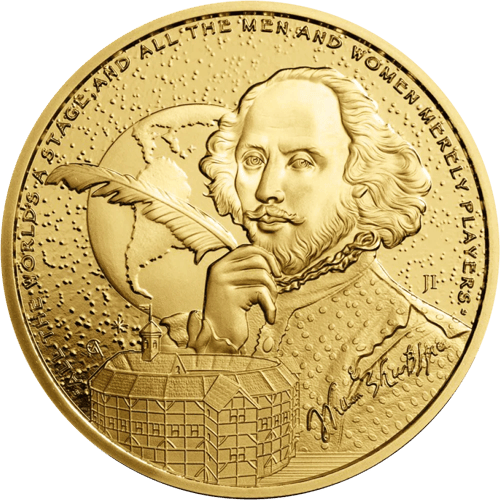
All the world’s a stage,And all the men and women merely players.
As You Like It, act 2, scene 7, spoken by the character Jaques
The lines run as an inscription around Shakespeare’s portrait on the coin. Their play had never been printed before the book; without the book they might no longer exist.
Thomas Edison, 1877 and 1878
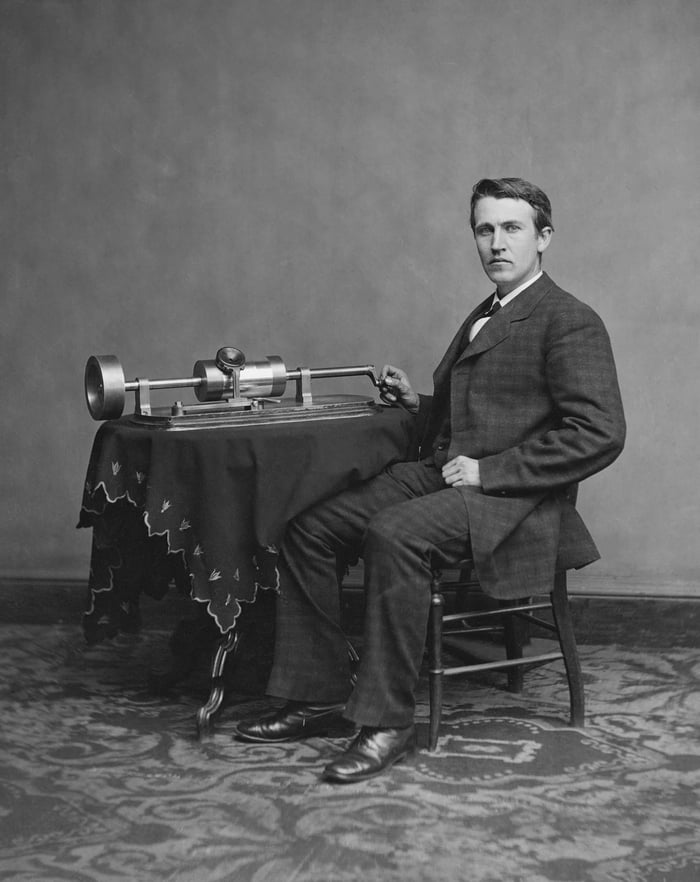
In Menlo Park, Thomas Edison made his first sound recordings in 1877. His phonograph presses the sound as a groove into a sheet of tinfoil wrapped around a cylinder, and plays it back. On 24 December 1877 Edison applied for a patent on the machine, that is, for official protection of his invention; patent No. 200,521 was granted on 19 February 1878.
Sketch, demonstration and announcement according to the Engineering and Technology History Wiki and the Thomas Edison National Historical Park; application and grant according to the head of the patent specification.
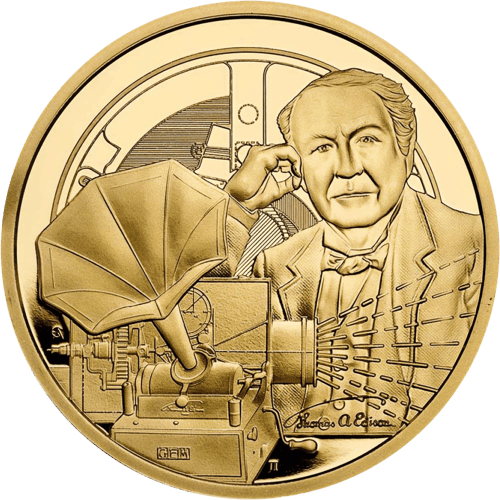
On the coin, Edison holds his hand to his ear; beside him stands a phonograph with a large horn, and behind it gears can be seen.
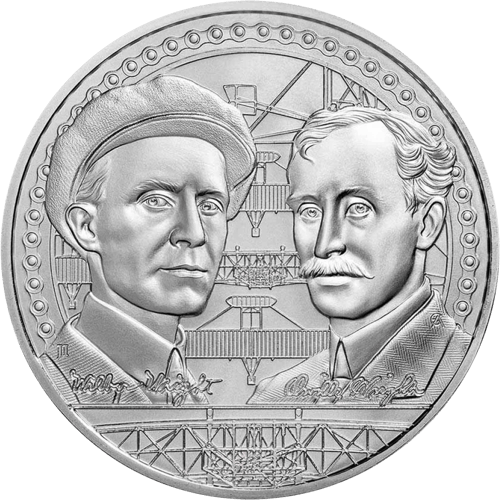
Orville and Wilbur Wright, 1903
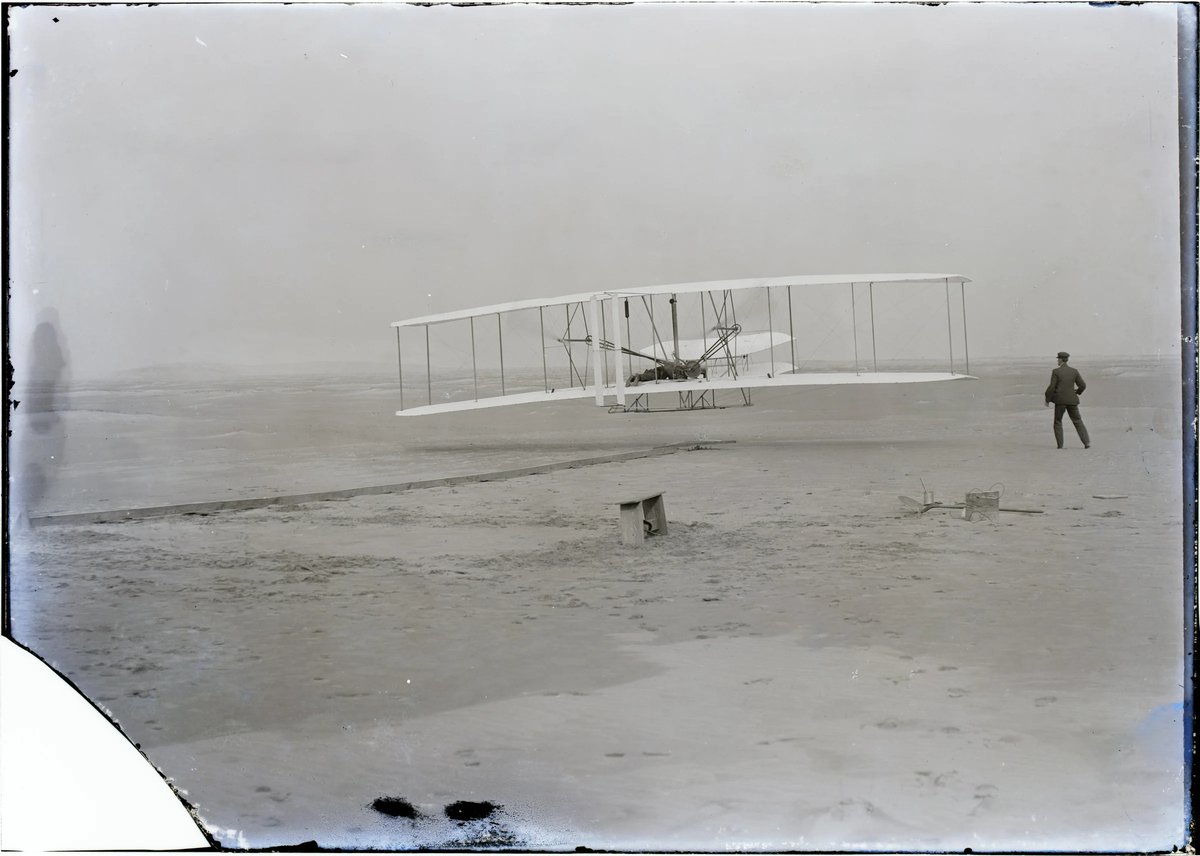
On 17 December 1903, a powered flying machine took off near Kitty Hawk. Orville Wright lay at the controls: for 12 seconds, over 36 metres. According to the Library of Congress, it was the first sustained flight, fully controlled by the pilot, of a machine heavier than air. What was new was the brothers’ control: they twisted the ends of the wings in opposite directions, so that the two ends received different amounts of lift.
Wilbur Wright piloted the fourth flight. The brothers’ telegram to their father begins with “Success four flights Thursday morning” and gives 57 seconds for the longest flight; according to the National Air and Space Museum, it was 59.
Our own calculation: distance divided by the wingspan. The distances (36 m and 255.6 m), the flight times and the wingspan according to the National Air and Space Museum.
The coin shows Orville and Wilbur Wright as two portraits with their signatures, and between them a biplane seen from the front.
Albert Einstein, 1905
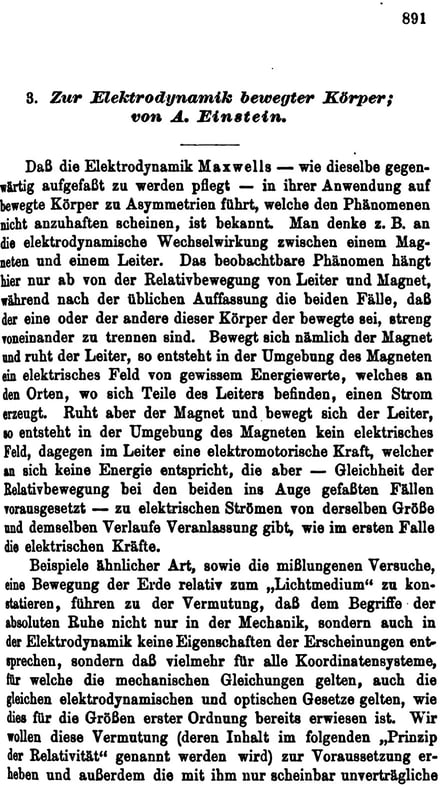
In 1905 the journal Annalen der Physik published two related papers by Albert Einstein, both dated in Bern. The first, “Zur Elektrodynamik bewegter Körper” (On the Electrodynamics of Moving Bodies), fills 31 pages. The second, “Ist die Trägheit eines Körpers von seinem Energieinhalt abhängig?” (Does the Inertia of a Body Depend on Its Energy Content?), is only three pages long.
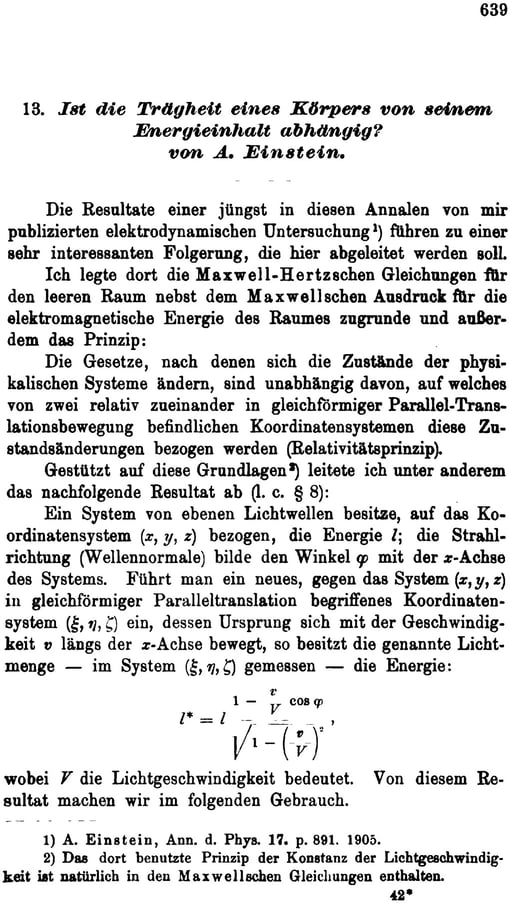
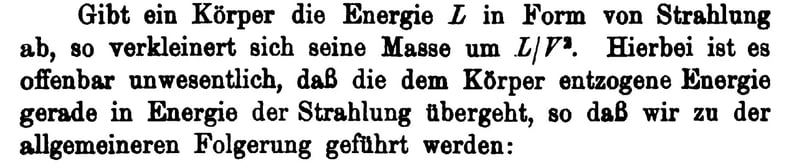
The sentence on mass and energy, in German:… so verkleinert sich seine Masse um L/V²
At the lower edge of the coin is E=mc²: today’s short form of the sentence on p. 641, in which Einstein still writes L and V.
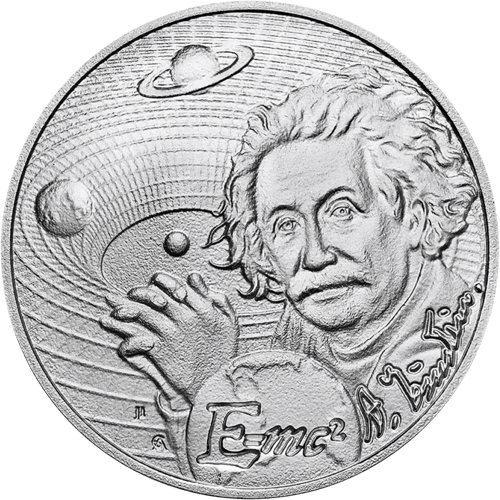
At the end of the paper, Einstein names a substance on which the theory could be tested:
Es ist nicht ausgeschlossen, daß bei Körpern, deren Energieinhalt in hohem Maße veränderlich ist (z. B. bei den Radiumsalzen), eine Prüfung der Theorie gelingen wird.
It is not ruled out that with bodies whose energy content is variable to a high degree (e.g. with the salts of radium) a test of the theory will succeed.
A. Einstein, Annalen der Physik (4) 18, 1905, p. 641
Marie Curie, 1903 and 1911
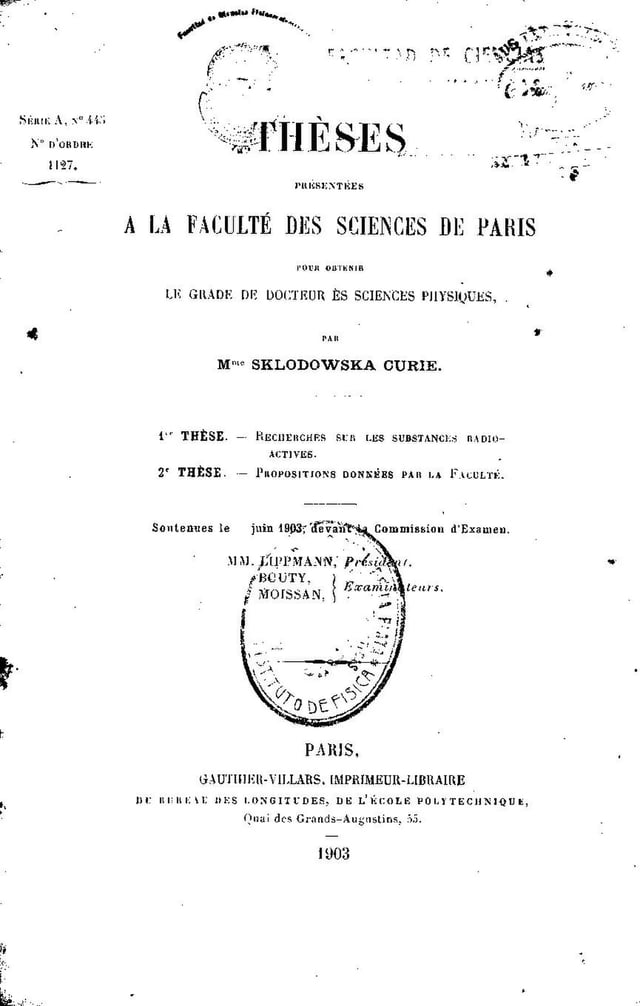
Together with Pierre Curie, Marie Curie discovered radium; in 1903 she presented her doctoral thesis on it. In her Nobel lecture on 11 December 1911 in Stockholm she gave the amounts: residues from processing uranium ore from St. Joachimsthal contain a few decigrams of radium per tonne, that is, a few tenths of a gram. She separated it in several thousand crystallisations; in this process a salt is dissolved and forms crystals again, a little purer each time. As the purity grew, so did the value she determined for the atomic weight, the measure of how heavy an atom is.
as the purity grows
Values and amounts according to the Nobel lecture of 11 December 1911; the bars start at zero, the tenths of a gram are converted from decigrams.
In 1910, together with André Debierne, she obtained radium as a metal.
On the coin, Marie Curie holds a small vial in her raised hand; beside it stands an atomic model with Ra, the symbol for radium.
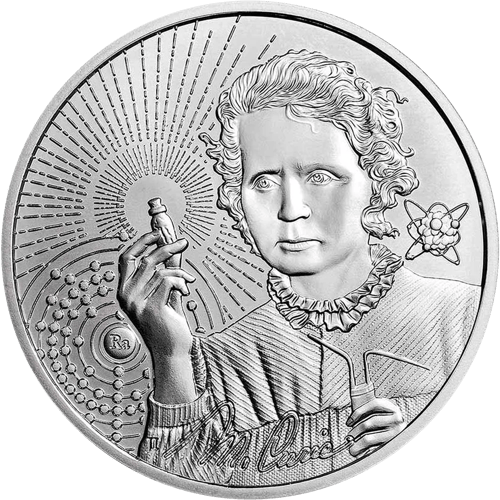
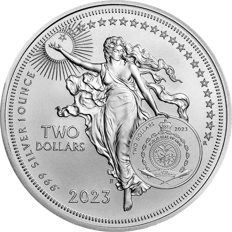
The coins of the five chapters belong to a series from Niue called “Inspiring Icons”. The picture side of each coin shows the person with tools or works and a signature, both brothers on the Wright coin; on the back, all of them carry the seal of Niue.
The actions of a few often decide the fate of many. Human history has been shaped by extraordinary minds: by rulers and explorers, by artists and musicians, by politicians and idols who formed entire epochs. Those who leave their mark are immortalised: since antiquity, coins have captured the faces of significant people. The following sections show what defines gold and silver coins featuring portraits of famous personalities, which thematic worlds they cover, what collectors should look out for in terms of minting quality, mintage and authenticity, and how these pieces are classified for tax purposes.
Coins featuring personalities are among the oldest and most popular motifs in numismatics. Even Roman emperors had their profiles struck in silver and gold to secure power and remembrance. Today, this tradition continues: high-quality collector's coins feature monarchs, statesmen, composers, explorers and icons of pop culture. Each of these coins tells its own story and combines history, culture and numismatic passion in a way that hardly any other collecting field achieves.
The appeal lies in this dual character: such a coin is both an artistic portrait and a piece of precious metal with material value. Gold and silver coins featuring personalities are often limited to a specific number of pieces, a restriction that makes them especially interesting for collectors. Those wishing to explore the subject more broadly will find numerous further motif groups, from animals to mythical creatures to historical events, in the overarching themed world.
A portrait on a coin outlasts centuries: it is the smallest stage of world history.
To be chosen as a coin motif, a person must have achieved, invented or inspired something extraordinary. The spectrum ranges from sitting heads of state to legends of long-past eras. Common occasions for a coin issue are round birth or death anniversaries, jubilees, political offices or groundbreaking cultural achievements. At Kettner Edelmetalle, the range is organised into clearly defined thematic areas that cover the entire field of famous personalities.
Emperors, kings and princes are among the classic motifs of the art of coinage. From the German Empire to the British royal family, royal portraits have always graced bullion and commemorative coins. Those enthusiastic about crowned heads will find what they are looking for in the Monarchs section, closely related in theme to the British Royal Family, which has established its own major collecting tradition.
Chancellors, presidents and freedom fighters have changed the course of history, for better or worse. Commemorative issues honour defining political figures, from early founders of nations to icons of the democratic movement. The Politicians range brings these motifs together; those seeking historical context will find the fitting complement in the History theme area.
Classical composers and legends of the modern stage are immortalised on precious metal in equal measure. The range extends from Mozart to rock and pop icons. Lovers of illustrious names will discover the fitting coins in the Musicians section, while film and stage greats are gathered under Stars. Those who view art and culture as a greater whole will find further treasures in the Art and Culture theme area, with literature, fine art and music.
Pioneers who mapped continents, conquered the poles or expanded humanity's knowledge form their own fascinating collecting field. The range of motifs extends from polar explorers to Renaissance polymaths. The Explorers range offers coins featuring these courageous characters, a theme area that captures the spirit of discovery of entire generations.
Gold and silver are equally popular as collector's coins of famous personalities, but they differ in character. Gold coins impress with high material value in a small format and are considered stable in value. A look at the long-term development of the gold price shows a trend that has pointed upwards for decades, while the silver price fluctuates more strongly.
Silver coins, in turn, score with larger minting surfaces on which portraits come into their own with particular detail, as well as a lower entry price. Especially for motif coins, silver is therefore the preferred material for elaborate depictions. Those wishing to delve deeper into the fundamental question of material will find the respective ranges at a glance under Gold and Silver.
For collector's coins, the quality of the strike is a decisive factor in their sentimental value. Pieces in Proof quality show mirror-like surfaces and matte, raised motifs, the highest numismatic minting quality. There are also versions in Brilliant Uncirculated (BU) or with finishes such as partial gilding and colouring, which give particular emphasis to individual portraits.
A key purchasing criterion is the mintage: the lower the number of pieces struck, the more sought-after a coin becomes among collectors. Many personality editions are issued in strictly limited numbers and come with a certificate of authenticity. This limitation links the collecting motif with the character of a limited rarity. At Kettner Edelmetalle, every coin undergoes an ISO-compliant authenticity verification, ensuring that the material and fineness are reliably guaranteed.
The tax classification depends on the precious metal. Investment gold is exempt from VAT in Germany under § 25c UStG, so no VAT is generally charged when purchasing gold coins featuring personalities. Silver coins, on the other hand, are often traded for private customers under the margin scheme pursuant to § 25a UStG: only the difference between the purchase and selling price is taxed, not the full amount.
Tax Note
Gold coins are exempt from VAT as investment gold under § 25c UStG. Silver coins are usually subject to the margin scheme under § 25a UStG for private customers. This information is for general guidance only and does not replace tax advice.
Background knowledge on precious metals as an investment is gathered on the theme pages about inflation hedge and value appreciation: especially in times of crisis, gold and silver are traditionally regarded as stable tangible assets.
A personality coin is often an emotional piece: a gift, a keepsake or the highlight of a collection. Proper storage is crucial to preserving its shine and relief. Coins should ideally not be touched with bare fingers and should be protected from moisture, dust and scratches. Proof coins are particularly sensitive to fingerprints.
For reliable protection, precisely fitted coin capsules that enclose each coin individually are recommended. Those wishing to organise an entire collection can turn to high-quality coin cassettes, which present portrait coins clearly while protecting them at the same time. Further suitable accessories, from coin cases to tubes, round off proper storage.
Hardly any other collecting field is so well suited as a gift. A coin bearing the portrait of an admired musician, a revered monarch or a courageous explorer matches the recipient's personal taste while also holding lasting material value. Whether for an anniversary, as a keepsake or simply as an extraordinary gesture, a fine coin remains memorable for a long time.
Further inspiration for special occasions is offered by the gift ideas as well as the commemorative coins, which honour historical events and round anniversaries. This way, the right motif can be found for every occasion.
The range extends from monarchs and politicians to musicians, artists and stars, to explorers and researchers. At Kettner Edelmetalle, these areas are organised into their own ranges, so you can browse specifically for your preferred theme area.
That depends on the goal. Gold coins offer high material value in a small format and are VAT-exempt. Silver coins are more affordable to start with and offer larger minting surfaces on which portraits appear particularly detailed.
The mintage indicates the maximum number of pieces struck. The lower it is, the rarer and more sought-after a coin is among collectors. Many personality editions are issued in strictly limited numbers and are delivered with a certificate of authenticity.
Gold coins are exempt from VAT as investment gold under § 25c UStG. Silver coins are usually traded for private customers under the margin scheme pursuant to § 25a UStG, in which only the difference between the purchase and selling price is taxed.
Coins should not be touched with bare fingers and should be protected from moisture, dust and scratches. Coin capsules enclose each piece individually, while coin cassettes organise an entire collection. Proof coins in particular are sensitive to fingerprints.
Very much so. A coin bearing the portrait of an admired person combines a personal connection with lasting material value and is suitable for anniversaries, keepsakes or as an extraordinary gesture.
 Personalities
Stay informed with product launches, financial news and exclusive offers. Sign up for our free newsletter today.
By entering your email address and clicking the "Submit" button, you give the following consent: "I agree to be informed by email about new products, financial news and exclusive offers, and therefore consent to the processing of my email address for the purpose of sending the newsletter. I can revoke this consent at any time without giving reasons, with effect for the future. The lawfulness of processing carried out prior to revocation remains unaffected."