Only 8 left to order
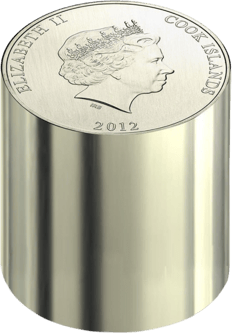
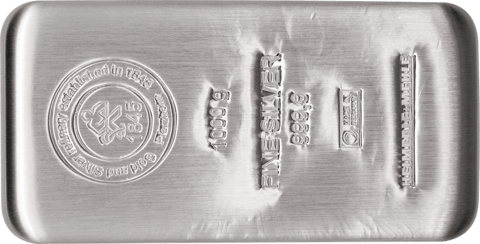
1kg Silver Minted Bar Ascension Island
€2,008.41€2,058.41
incl. VAT and excl. shipping
Available in 2–3 business days

 More than 310,000
 Over 30 years
 Secure shipping
 Google: 4.9/5
Silver bars with a fine weight of one kilogram are particularly popular and are among the best-selling silver products. The 1-kilo bars are easy to stack and fit neatly into any safe deposit box or safe. In addition, compared to even larger units, such as the 5- or 15-kilogram silver bars, the premiums are only marginally higher.


Silver bars range from a few grams to about 31 kilograms. Between 10 grams and 15 kilograms, the small ones are usually minted and the large ones cast. Where one stops and the other begins, each house decides for itself.
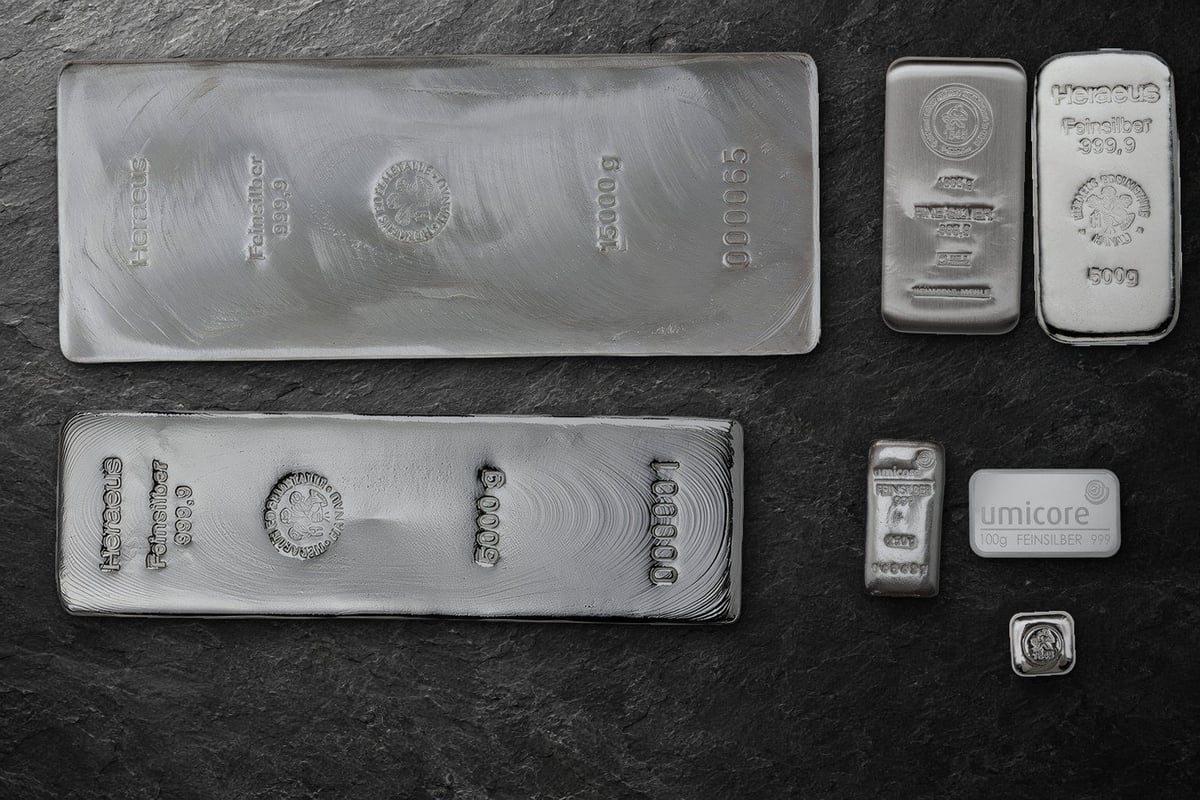
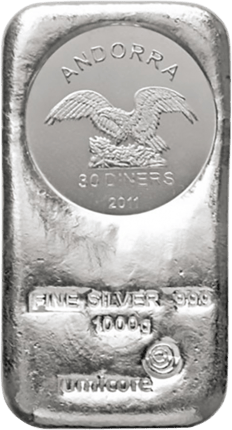
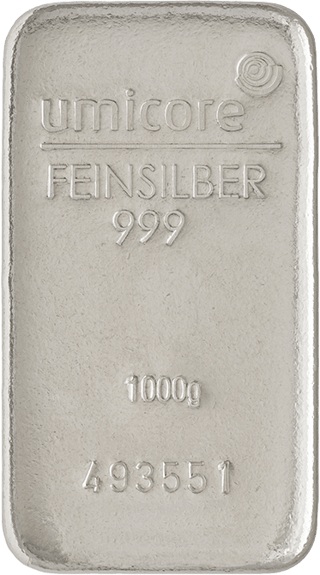
Umicore mints its silver bars from 10 to 100 grams. From 250 grams on, the house casts them, right up to 15 kilograms.
At Heraeus, the line falls in the same place. There, the ounce and 100 grams are minted, while 250 and 500 grams and 1, 5 and 15 kilograms are cast.
Other houses draw the line somewhere else entirely. Heimerle + Meule already casts the ounce, a small square with sides of 23.5 millimetres. Valcambi still mints the kilo, 130 millimetres long and 11.2 millimetres thick.
The larger the bar, the more likely it is cast.
Sizes according to the makers, for Heraeus only the sizes the house itself lists; the minted ounce from Heimerle + Meule according to its bar in the shop. On the axis, it is as far from 10 to 100 grams as from 100 grams to 1 kilogram.
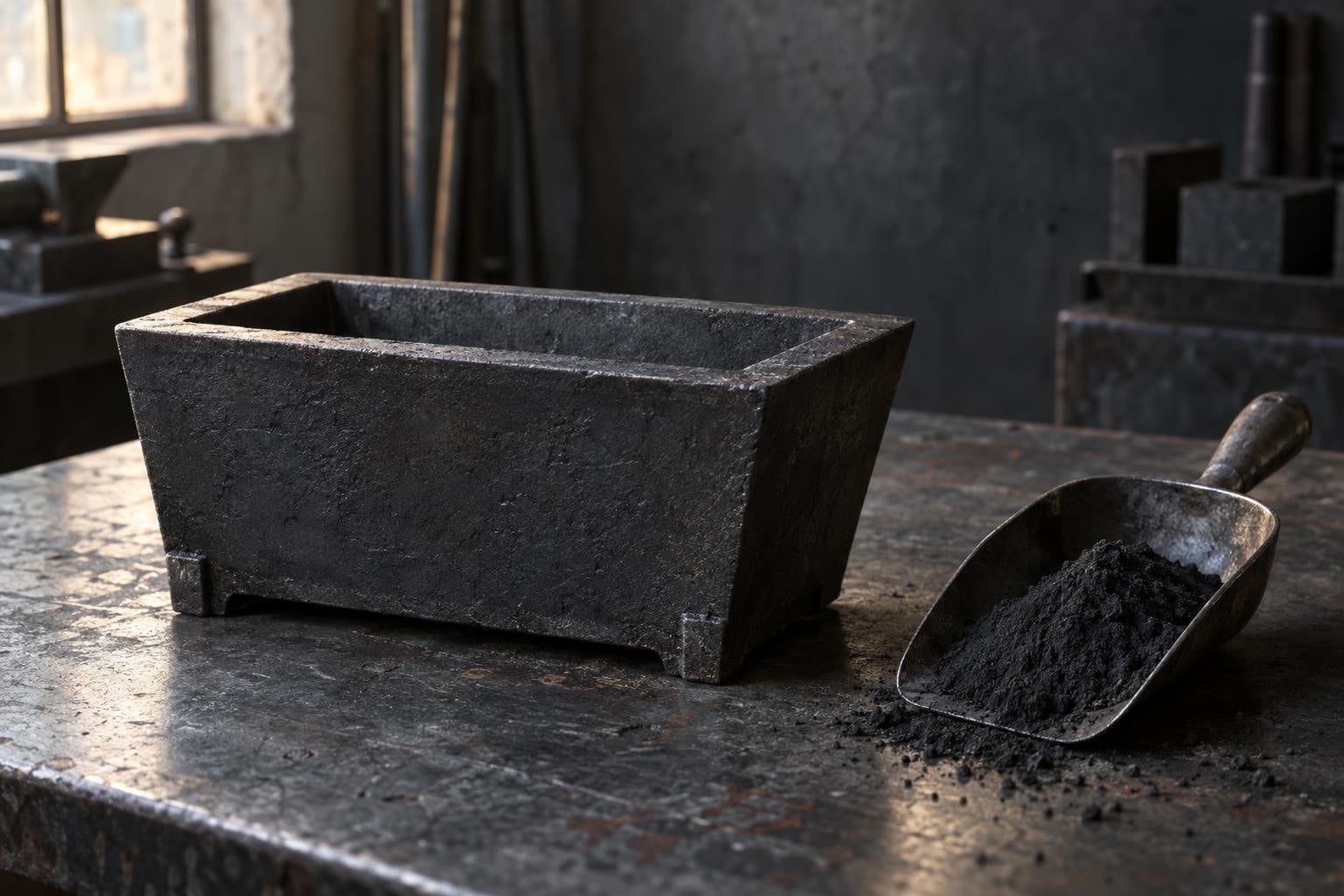
When pure silver melts, it takes up oxygen from the air. As it solidifies, the oxygen escapes again, and that can happen violently. Old encyclopaedias call it spitting.
“When melted in contact with air, pure silver absorbs a great deal of oxygen, which, however, escapes at the moment of solidification …”
Pierer’s Universal‑Lexikon, volume 16, 1863, entry “Spratzen”, translated
In doing so, the oxygen breaks through the crust that has already set and drives out the silver that is still liquid, into a spongy mass from which beads of silver leap. That is how Pierer’s encyclopaedia describes it.
The chemist Gay‑Lussac caught the oxygen under a bell jar filled with water. He obtained twenty to thirty times the volume of the silver, Pierer reports. In 1911, the Encyclopaedia Britannica gives twenty times. These are figures from encyclopaedias of 1863 and 1911, not present-day measurements.
The remedy is given in the same article: stir while the silver solidifies, “but best of all” sprinkle charcoal powder on it before it sets. According to Pierer, silver with 1 to 2 percent copper does not spit, but pure silver does.
The oxygen is not entirely out of the picture. When a refinery on the London list assays its silver with a spectrograph today, oxygen and nitrogen expressly count as silver.
Diagram after the description in Pierer’s Universal‑Lexikon of 1863, not to scale.
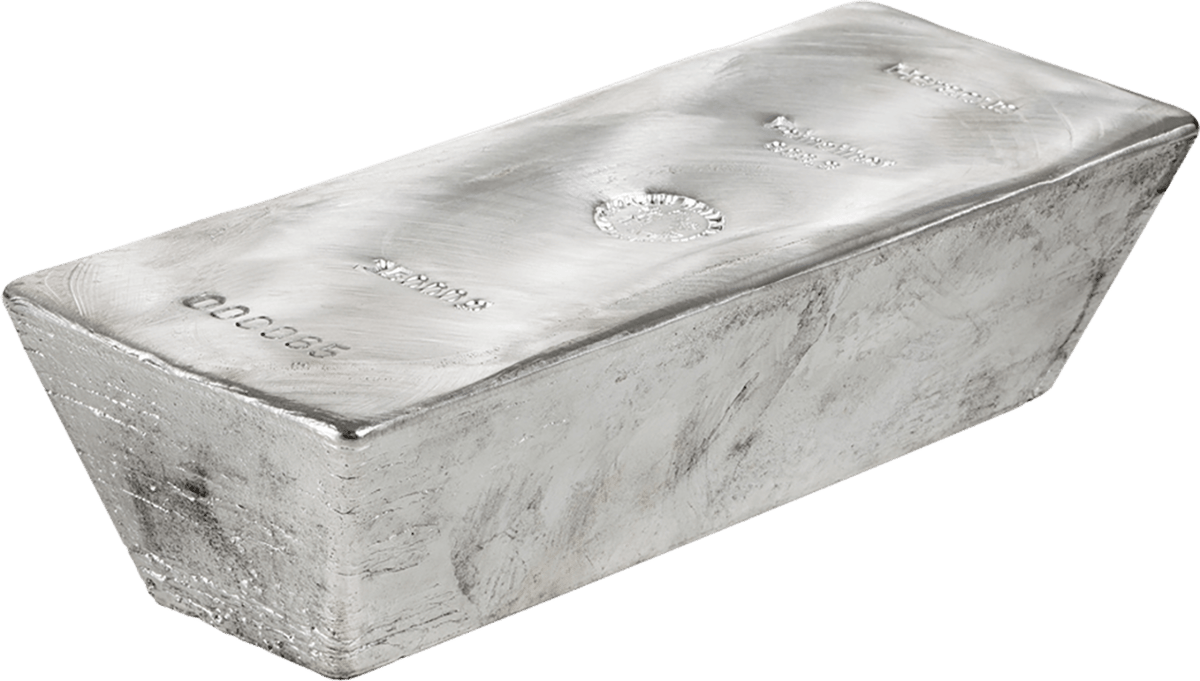
Silver contracts strongly as it solidifies, the Meyers encyclopaedia of 1909 writes. On a cast bar, this shows on top: the top face can sink slightly in the middle, and rings from cooling can appear as well.
“Excessive shrinkage (i.e. the concavity of the top face of the Bar and any concentric cooling rings) must not significantly affect the clarity of the Bar marks or the safe stacking of the Bars.”
LBMA, Good Delivery Rules, Technical Specifications, section 2.1.4
The LBMA is the association of the London precious metals market. Its rules are written for the large bars of this market. They show what happens when silver is cast.
Silver has rules of its own there. A little hammering of the surface is allowed; for gold, at most the smoothing of a sharp burr. And closed moulds have been banned for silver since 2008, mainly because hidden cavities can form in them.
Cast bars are wider at the top than at the bottom. On the 15‑kilogram bar from Umicore, the top face measures about 235 by 100 millimetres and the bottom 210 by 80, with a height of 75 millimetres. For its silver bars, the LBMA requires a slope of 5 to 15 degrees, so that they are easy to grip.
Calculated from Umicore’s dimensions, the sides of its cast bars slope at about 6 to 10 degrees.
A cast bar shows on its top face how it solidified.
Dimensions from Umicore. In gold, the top face, the dip in it only suggested: its depth has not been measured. The slope is calculated from the top and bottom widths and the height.
For gold, the LBMA requires its referee laboratory to carry out the fire assay, at least six times. For silver, the laboratory measures what is not silver and subtracts it from 1,000 parts.
“In the case of silver, the Referee will normally use one or other spectrographic analysis method and determine the silver assay by difference (with dissolved gases such as oxygen counting as silver).”
LBMA, Good Delivery List Rules, January 2026, Annex D, section 2.3
These are the rules for the refineries on the London list. They show how differently the two metals are assayed.
For a long time, silver was assayed in fire, in small dishes called cupels. In 1832, the French mint commission published instructions by Gay‑Lussac, the same man who had caught the oxygen in silver. After that, it could also be done “by the wet way”: the silver is precipitated with a solution of common salt instead of being assayed in fire in the cupel.
In 1874, Jacob Volhard described another wet method, with thiocyanate instead of common salt.
The common salt assay lives on in the standards. ISO 13756 determines silver in jewellery and precious metals with sodium or potassium chloride, ISO 11427 with potassium bromide, both today in the edition of 2024 and for silver contents of 100 to 999 parts per thousand. For higher contents, both name spectroscopy by difference.
With silver, the rest is what counts: 1,000 parts minus everything foreign.
According to the LBMA rules of January 2026. The foreign share is drawn greatly enlarged.
Stamping the weight onto the bar is an old practice. The silver treasure of Kaiseraugst in Switzerland includes a bar from shortly after AD 350. Punched into it is P III, three Roman pounds.
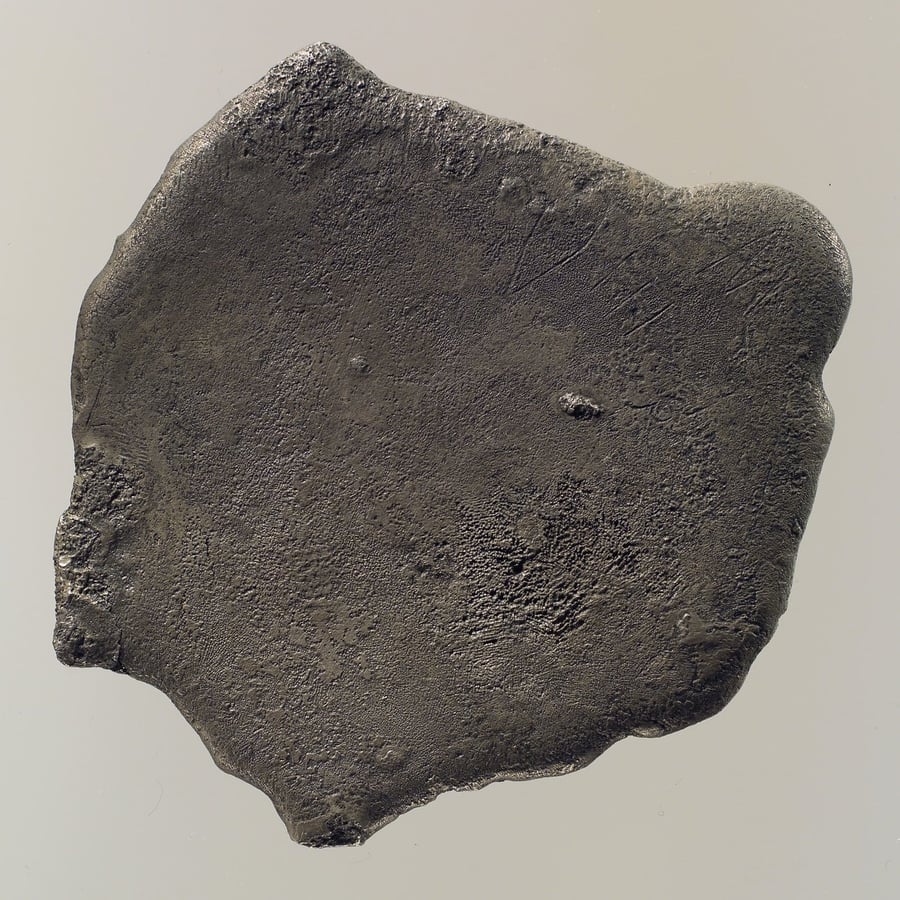
The bar measures 12.3 by 7.8 centimetres and is 1 centimetre thick. It weighs 947.8 grams, which corresponds to three Roman pounds.
Beside it are two small stamps reading GRONOPI, probably the name of the official in charge, and a round stamp with the bust and name of the Emperor Magnentius.
A kilo bar of today weighs almost the same, yet has a different shape. The cast kilo bar from Heraeus measures 111 by 51 millimetres and is 21 millimetres thick, more than twice as thick as the Roman bar.
Much older still is a silver bar with Hittite hieroglyphs in the Metropolitan Museum in New York, from the 14th to 13th century BC.
More than 1,650 years ago, the weight was already on the bar.
Dimensions: Augusta Raurica, Augster Blätter zur Römerzeit 10, and the makers. All three from above at the same scale, the kilo bars as product photos from the shop, the Roman bar drawn as an outline to its dimensions.
A 1 kg silver bar contains one kilogram of fine silver, which is around 32.15 troy ounces. It is one of the most popular sizes for investors who want to hold a larger amount of silver in just a few pieces. At Kettner Edelmetalle you can buy 1 kg silver bars from Heimerle + Meule, Heraeus and Umicore, as well as minted bars with a face value.
Anyone who wants to buy silver in larger quantities only needs a few pieces with the kilo bar. Ten bars of 1 kg each are ten kilograms of silver that can be counted, stacked and stored in a clear and manageable way. At the same time, each bar remains its own unit: if you need part of your silver later, you sell individual bars and keep the rest.
Silver is both a tangible asset and an industrial metal. It is found in electronics, solar cells and medical technology, and it served as money for thousands of years. Many investors therefore hold silver alongside gold bars and gold coins. You can find all weights at a glance under silver bars.
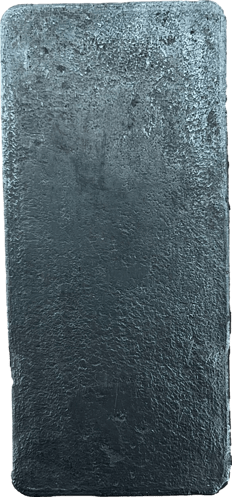
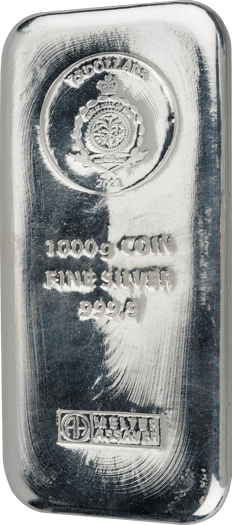
Most 1 kg silver bars are cast bars. For these, liquid fine silver is poured into a mould. After cooling, the bar has a slightly wavy surface with rounded edges, with manufacturer, weight and fineness stamped in, often also a serial number. Minted bars, on the other hand, are made from silver sheet that is stamped by a die under high pressure. Their surface is smooth and shiny, with sharp edges.

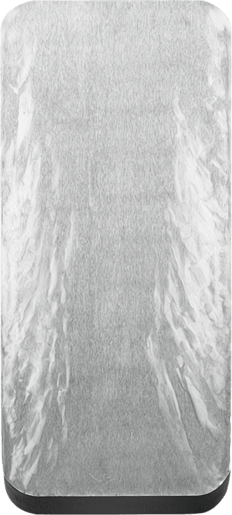
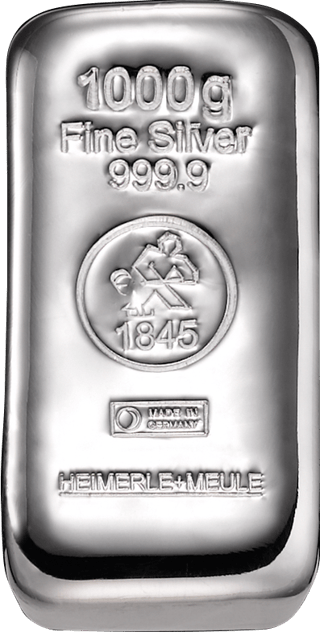
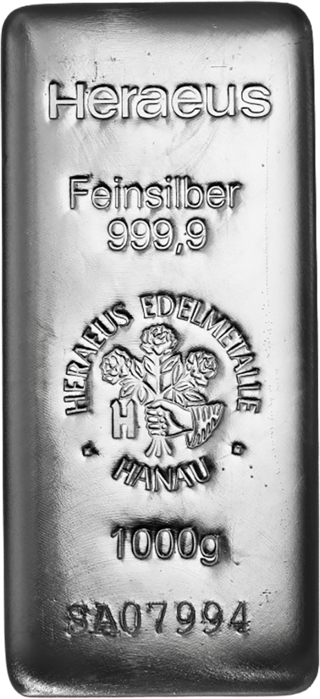
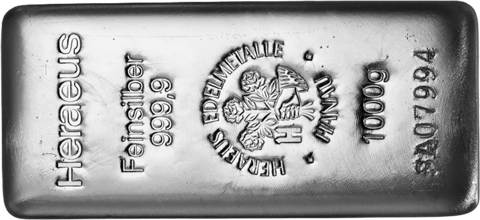
The 1 kg silver bar Heimerle + Meule is cast in fine silver 999.9/1,000 and comes sealed on a black card. Heimerle + Meule from Pforzheim has existed since 1845 and is one of Germany's most traditional refineries. The 1 kg silver bar Heraeus is cast by the Hanau-based company, which has existed since 1851. It is also made of fine silver 999.9/1,000, bears a stamped serial number and comes sealed in foil without a separate certificate.
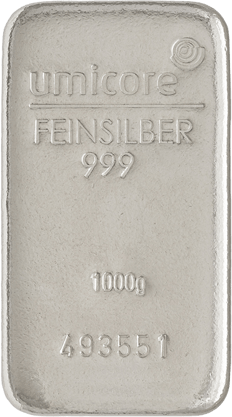
The 1 kg silver bar Umicore comes from the refinery of the Belgian Umicore group in Hoboken. It is listed for gold and silver on the Good Delivery List of the London Bullion Market Association (LBMA), the benchmark of the international precious metals trade. With the 1 kg silver bar from various manufacturers, we select the manufacturer according to our stock, and you receive a cast bar with a fineness of at least 999/1,000. You can find all manufacturers in our manufacturer overview.
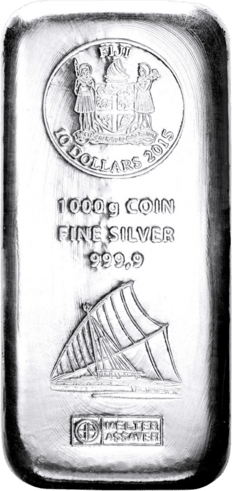
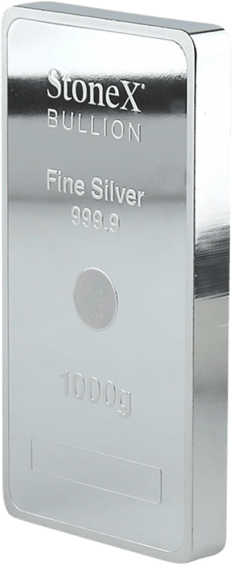
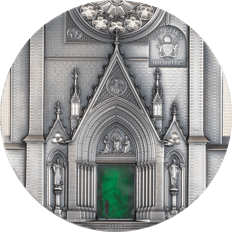
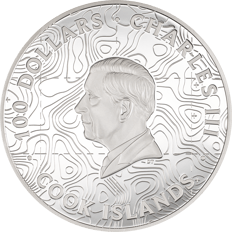
A minted bar has the shape of a bar and is issued by an issuing country with a face value. The 1 kg silver minted bar Ascension Island shows a three-master in full sail, bears a face value of 25 dollars and is made of fine silver 999.9/1,000. The 1 kg silver minted bar from StoneX bears a face value of 30 Niue dollars.
For collectors there are also kilo coins with a design, such as the 1 kg silver Famous Bullion Giants 2026 featuring the designs of well-known bullion coins, partially gilded and with a mintage of 199 pieces. You can find further minted bars under silver minted bars.
The purity of a silver bar is indicated by its fineness. A 1 kg silver bar consists of fine silver with a fineness of at least 999/1,000, and 999.9/1,000 in the case of Heimerle + Meule and Heraeus. The exact value is stated on each product page. Leave the sealing closed. It protects the surface of the bar from scratches and other external influences.
The best protection against counterfeits is to buy from an established dealer. You can read how to check silver for authenticity at home and with an expert under checking silver for authenticity.
The price of a 1 kg silver bar follows the silver price, which is quoted worldwide in US dollars per troy ounce. The exchange rate therefore also matters for the price in euros. The current price of each bar is shown on the product tile, and you can see the development of the silver price under silver price.
One kilogram of silver needs considerably more space than the same value in gold. The cast bar from Heimerle + Meule measures 100 x 50 x 21 mm, the bar from Heraeus 111 x 51 x 21 mm. For storage the rule is: dry and in the sealing, at home in a safe or in a bank safe deposit box. The foil protects the surface from moisture and other external influences. For larger holdings, ask your insurer up to what value it covers precious metals at home.
Below one kilogram you will find 500 g silver bars, 250 g silver bars and 100 g silver bars, and above it 5 kg silver bars and 15 kg silver bars. If you prefer to hold coins, you will find well-known bullion coins under silver coins and coins containing one kilogram of fine silver under 1 kg silver coins. Bullion coins in tubes and monster boxes as well as ready-made packages are available among the silver investor packages.
VAT on silver
Unlike investment gold, silver is not exempt from VAT under § 25c UStG. Silver bars generally carry 19% VAT, which is included in our prices. How an item is taxed is shown next to the price on the product tile and on every product page.
If you sell silver as a private individual, a profit is generally tax-free after a holding period of more than one year (§ 23 EStG). This is general information and does not replace tax advice.
You can order your 1 kg silver bar directly here in the shop or by phone with our customer advisors at 07930-2699, Monday to Friday from 8 am to 8 pm. If you would like to invest a larger amount, we will gladly prepare a personal offer for you and discuss selection, payment and delivery with you. You can also request an offer online.
Every shipment is insured for its full value until it is handed over to you. In a video-monitored high-security area, two specialists check each order according to the dual-control principle and pack it in a neutral box.
Your order is sent as an insured parcel, and you receive the tracking number by e-mail with the shipment. We split large orders into several insured parcels, but you still only pay for shipping once. From a value of €10,000 per parcel, we reserve the right to deliver via a security logistics provider. Whether a bar is in stock and when it will arrive is shown on the product tile and on every product page, and the shipping costs are shown in the shopping basket before you place your order. You can pay by bank transfer or online, for example with PayPal or credit card. The checkout shows you which payment methods are available for your order. You can read more about this under shipping and payment.
We are happy to buy back silver bars that you purchased from us, on request. After logging in to our buy-back portal, you select the pieces directly from your orders. You do not need an invoice for this. You can offer us silver from another purchase there with the purchase invoice. Whether we make you an offer in this case depends on the item, the quantity and our current demand.
You usually receive a written offer within 24 hours. If you accept it, you receive an insured DHL shipping label for shipping from Germany. From an offer sum of €500 it is free of charge. A parcel can hold goods worth up to €12,500. If the value is higher, we prepare several insured parcels for you or have the goods collected from you by a security transport service. Please send in your bars complete, that is with card, capsule and certificate, provided these were supplied with them. Our experts check authenticity, completeness and condition. We then transfer the amount to your account. For bullion bars, the silver price on the day your silver arrives with us applies, which is why the amount may change compared to the offer. For limited collector's items, the price depends on demand. Fixed, agreed prices remain unchanged. A buy-back from Switzerland and Liechtenstein is currently not possible due to customs regulations.
A 1 kg silver bar contains around 32.15 troy ounces (oz) of silver. One troy ounce equals 31.1035 grams.
Unlike investment gold, silver is not exempt from VAT on purchase. Silver bars generally carry 19% VAT, which is included in the displayed price. How an item is taxed is shown next to the price.
With the same fineness, all 1 kg silver bars contain the same amount of silver. Many investors choose a well-known manufacturer such as Heimerle + Meule, Heraeus or Umicore. A minted bar with a face value is a matter of taste.
This depends on the manufacturer. The cast bar from Heimerle + Meule measures 100 x 50 x 21 mm, the bar from Heraeus 111 x 51 x 21 mm. The dimensions of each bar are stated on the product page.
Dry and in the closed sealing, at home in a safe or in a bank safe deposit box. The foil keeps moisture and scratches away from the surface.
We are happy to buy back silver bars that you purchased from us, on request. After logging in to the buy-back portal, you select the pieces from your orders and usually receive a written offer within 24 hours.
 1 kg Silver Bars
Stay informed with product launches, financial news and exclusive offers. Sign up for our free newsletter today.
By entering your email address and clicking the "Submit" button, you give the following consent: "I agree to be informed by email about new products, financial news and exclusive offers, and therefore consent to the processing of my email address for the purpose of sending the newsletter. I can revoke this consent at any time without giving reasons, with effect for the future. The lawfulness of processing carried out prior to revocation remains unaffected."