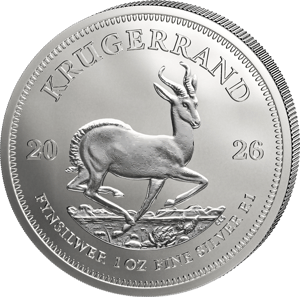
1 Ounce Silver Krugerrand 2026
€57.78
incl. VAT and excl. shipping
Ships from 25/11/2026

 More than 310,000
 Over 30 years
 Secure shipping
 Google: 4.9/5
Feeling that flutter of excitement again? Time for new silver treasures? Silver coins have fascinated people since the days of ancient Egypt. Collectors and investors are discovering their latest favourite pieces right now. Expand your silver treasure too – our offers are better than ever.


Ten of these bullion coins are issued as one ounce of silver, the Panda as 30 grams since 2016. What sets them apart is the country, the design, the fineness and a few millimetres.
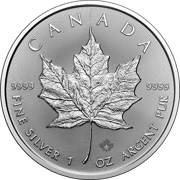 38 mmMaple LeafCanada
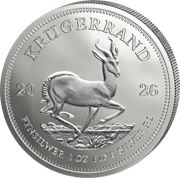 38.725 mmKrugerrandSouth Africa
All coins at the same scale, diameters according to the mints and central banks. For the Kangaroo, Kookaburra, Koala and Lunar, the Perth Mint gives maximum sizes, here for the 2026 issue.
A bullion coin is weighed silver bearing the stamp of a state. Five details almost always appear on it. On the Vienna Philharmonic, you will find all five on the side with the organ.
REPUBLIK ÖSTERREICH, the Republic of Austria. The country that issues the coin.
1 UNZE, one ounce. This means the troy ounce, the unit of weight for precious metals: 31.1 grams. Almost all mints state the silver content of their bullion coins in troy ounces.
1,50 EURO. With this face value, the Vienna Philharmonic is legal tender in Austria. As a rule, the face value is what sets a coin apart from a medal.
FEINSILBER, fine silver. There is no number on the Vienna Philharmonic. Münze Österreich gives 999/1,000: of 1,000 parts, 999 are silver. The Maple Leaf carries the number itself: 9999, that is 999.9/1,000.
2026. The year of the coin, usually also the year it was struck. On the Vienna Philharmonic, only this number changes from year to year; the design stays the same.
| Philharmonic |  Maple Leaf | Libertad |
|---|---|---|
| Issuing country | ||
| REPUBLIK ÖSTERREICH | CANADA | ESTADOS UNIDOS MEXICANOS |
| Weight | ||
| 1 UNZE | 1 OZ | 1 ONZA |
| Face value | ||
| 1,50 EURO | 5 DOLLARS | no face valuenone |
| Fineness | ||
| FEINSILBER | 9999FINE SILVERARGENT PUR | PLATA PURALEY .999 |
| Year | ||
| 2026 | 2026 | 2024 |
The Libertad carries no face value. Mexican coinage law requires it to state its fine silver content instead: 1 ONZA PLATA PURA. It is still legal tender in Mexico.
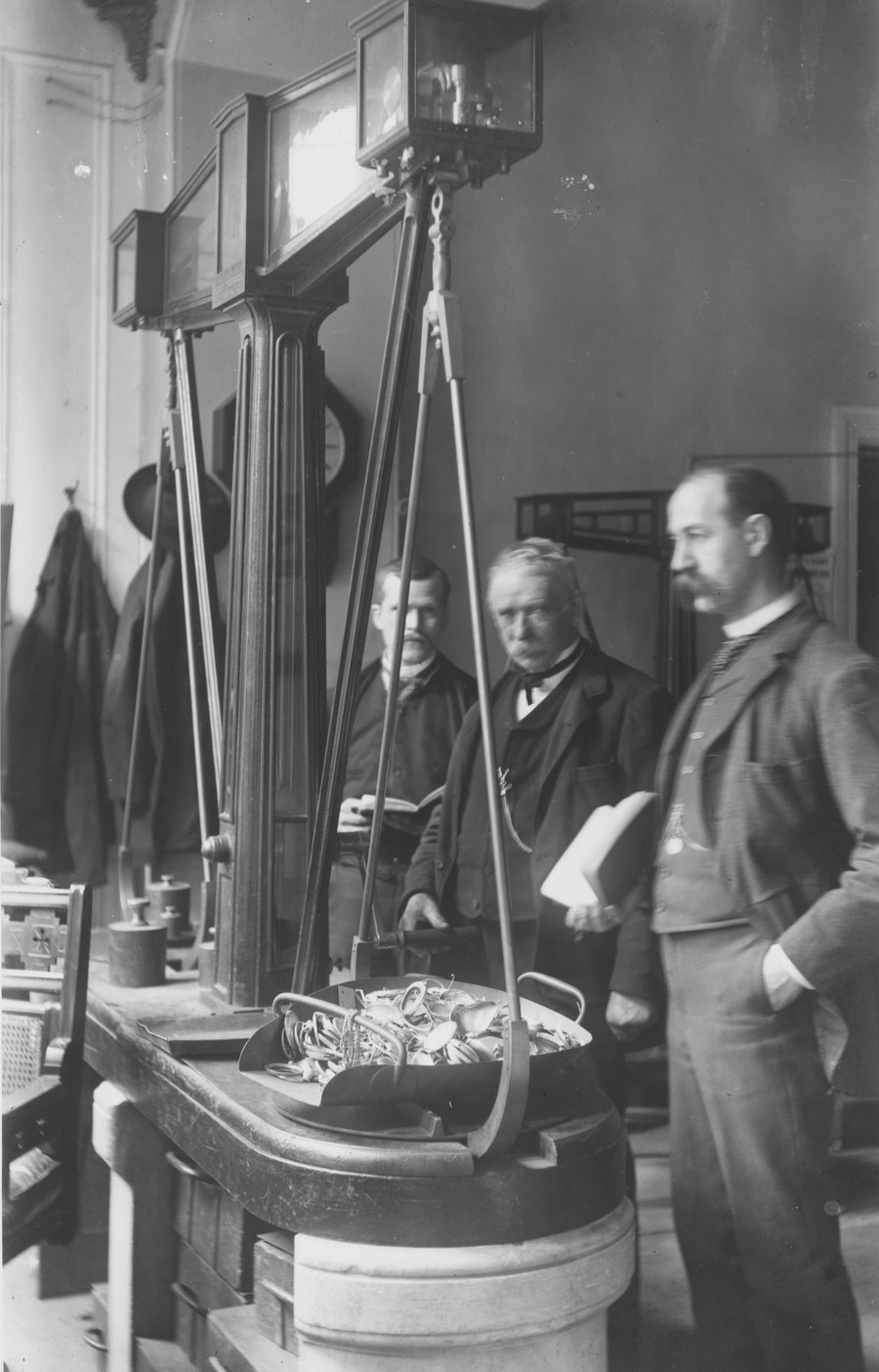
For the classic bullion coins, the design is the trademark. It stays; the year changes. That is why some offers read “various years”. With the annual designs, it is the years that people collect.
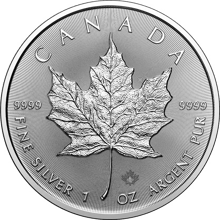 2026
Maple Leaf
Since the first Silver Maple Leaf in 1988, the ounce has carried the same maple leaf.
Vienna Philharmonic
In silver since 2008, always with the same organ and the same instruments.
American Eagle
It has carried the Walking Liberty since 1986. Since mid‑2021, the reverse has shown a new eagle; the 2021 issue exists with both.
Today the Krugerrand, the Kangaroo and the Britannia bullion coin do the same. The proof Britannia, by contrast, gets a new design every year.
China Panda
A new panda design almost every year. The other side always shows the Temple of Heaven.
Lunar III
Each year an animal of the lunar calendar. After the Horse in 2026 comes the Goat in 2027, the eighth animal of the third series.
Kookaburra
A new image of the bird every year since 1990.
Koala
A new koala every year since 2007.
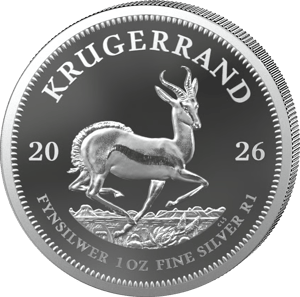
The silver Krugerrand comes as a bullion coin and in proof quality. Both measure 38.725 millimetres and carry the same design with the same details.
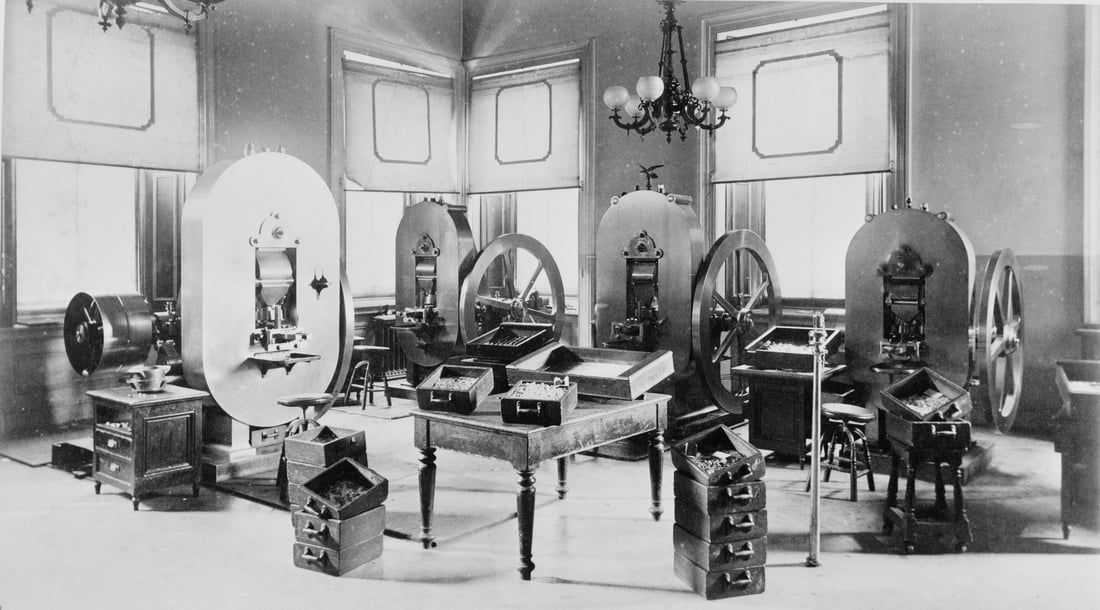
What usually sets bullion and collector coins apart:
Bullion coin
Uncirculated, without a mirror finish.
Proof
Die and blank are polished to a high shine. The result is a mirror field with frosted design and lettering.
Bullion coin
No fixed mintage; coins are struck to demand.
Proof
Fixed; for the Krugerrand 2026, a mintage of 10,000.
Bullion coin
In large quantities on high‑speed presses, usually with a single strike.
Proof
Usually in small batches on manually operated presses, often with two or three strikes.
Bullion coin
Packed in bulk, for example in tubes.
Proof
Individually in a capsule and case, with a certificate of authenticity. The coin stays in its capsule.
Silver reacts with sulphur compounds in the air. A wafer‑thin layer of silver sulphide grows on the surface, and its colour changes with its thickness. This is natural and no reason to clean a coin.
thin layer
thick layer
What collectors call toning is the same layer.
Milk spots are white marks that can appear on silver bullion coins. The mints link them to production; according to the Royal Canadian Mint, there is no single cause. They do not change the silver content.
Since the 2018 issue, the Royal Canadian Mint has given the silver Maple Leaf a surface protection called MINTSHIELD. According to the mint, it significantly reduces milk spots, but it cannot prevent them entirely.
Hold the coin by its edge, between thumb and forefinger. Fingerprints leave salt on the silver. The salt combines with the silver, and the print can darken later.
Modern coins are best kept in their tube or capsule. Never take a proof coin out of its capsule.
Dips contain acids, polishes contain abrasives. Both attack the surface, and any polishing removes silver.
Silver has fascinated humanity for thousands of years: as a means of payment, as jewellery and as a tangible asset that can be held securely in the hand. Silver coins embody this appeal to this day: they are at once an investment, a collector's item and a piece of cultural history. Whether the Canadian Maple Leaf, the Austrian Vienna Philharmonic or the Australian Kangaroo, each coin tells its own story. The following sections cover countries of origin, denominations, finenesses, tax treatment, proper storage and everything that matters when buying silver coins.

Alongside gold, silver is one of the most popular precious metals for private wealth protection. Its particular appeal lies in the metal's dual role: silver is both an investment metal and an industrial metal. Thanks to its high electrical conductivity and antibacterial properties, it is consumed in electronics, photovoltaics and medical technology, a demand factor that does not exist for gold in this form.
Essentially, two worlds can be distinguished. On one side are bullion coins, also known as investment coins, whose price closely tracks the current silver price. On the other side are collector's coins with limited mintages, changing designs and additional collector's value. Those who value a low premium tend to opt for classic bullion coins; those seeking enjoyment in the design and rarity will find their field in collector's editions.
A key advantage of physical precious metals: unlike exchange-traded securities, the owner retains direct control over their tangible asset. Silver coins are recognised worldwide, easily divisible and can be resold flexibly at any time.
Silver coins are produced by state and private mints around the globe. Each region has produced its own classics, which differ in design, fineness and mintage. The overview below assigns some of the best-known issues to their countries of origin.
Those seeking the full spectrum will also find unusual issues such as the Somalia Elephant or Noah's Ark, two series that are particularly popular as classics taxed under the margin scheme.
Silver coins are available in various weights, with several standard sizes having become established. By far the most common unit is the troy ounce (1 oz), equivalent to a fine weight of around 31.1 grams. It is standardised worldwide, widely available and traded with a comparatively low premium over the silver price.
For those wishing to build up larger quantities cost-effectively, heavier and lighter formats are also available:
For easier storage of larger holdings, silver bars are a useful addition. A combination of coins and bars allows for flexible portfolio structuring. Less well known are coin bar strips and minted bars, which combine the characteristics of coins and bars.
Fineness indicates the proportion of pure silver in a coin. Modern bullion coins today predominantly achieve a fineness of 999.9/1,000, i.e. 99.99 per cent pure silver. Older issues and circulation coins, by contrast, have lower values, as alloys provide greater stability.
Besides fineness, minting quality plays an important role in determining value. For bullion coins, the usual grade is Brilliant Uncirculated (BU). Collector's editions are often struck in Mint State (MS) or the especially high-quality Proof finish, with mirrored fields and frosted designs. For such editions, it is worth taking a look at the coloured silver coins and partially gilded coins, which stand out with their special finishes.
The decisive difference compared with gold lies in taxation. While investment gold is exempt from VAT in Germany, the purchase of silver is generally subject to VAT. For many silver coins, the standard rate of 19 per cent applies.
Tax note
Until 1 October 2022, imported silver coins could be traded at a reduced effective tax rate under the margin scheme pursuant to §25a UStG. This simplification rule has since been abolished. However, a margin-scheme-taxed silver purchase remains possible for certain issues.
Also relevant for investors is the holding period: after a holding period of more than one year, any gains from the sale of silver coins or silver bars are tax-free in Germany. Those wishing to avoid the full VAT rate will find an alternative in margin-scheme-taxed issues. Similar rules also applied to platinum coins, so a comparison of the metals is worthwhile. Tax questions should always be clarified individually with a professional adviser.
Silver is more sensitive than gold. The two most common problems are contamination and oxidation: those dark discolourations that occur when silver reacts with sulphur compounds in the air. Those who treat their coins carefully from the outset will preserve their condition for years.
Storage in coin capsules, supplemented by coin tubes, coin cassettes or master boxes, has proven effective. This avoids scratches, impacts and humidity. For long-term, oxidation-free storage, airtight sealed coin pouches are suitable.
The patina of an old coin is its individual identifying mark: removing it often destroys the value of the collector's item.
An important principle: historical coins with natural patina should never be cleaned. The greenish to blackish shimmering layer, which also occurs on old copper coins, is firmly bonded to the surface and generally does not reduce value. When in doubt: do not clean, but seek professional advice.
Those buying silver coins should keep a few criteria in mind in order to sensibly combine investment and collector interests. The following points summarise the most important aspects.
Kettner Edelmetalle is the official German partner of the South African Mint and relies on ISO-compliant authenticity verification. Collector's coins are delivered already capsuled, while plain bullion coins are securely packed in a coin pouch. In addition to selling, there is also the option of selling back to us. Those wishing to diversify more broadly will also find ready-made silver investor packages.
You can order your silver coins directly here in the shop or by phone through our customer advisors on 07930-2699, Monday to Friday from 8 a.m. to 8 p.m. If you would like to invest a larger amount, our customer advisors will gladly prepare an individual offer for you and discuss selection, payment and delivery with you. You can also put together your personal offer online.
Every shipment is insured for its full value. We pack your order at our own logistics centre in Germany and ship it in neutral boxes that give no indication of precious metals. For orders with a value of €20,000 or more, we recommend delivery by secure courier. If your order is sent as a parcel, you will receive the tracking number by e-mail. You can pay by bank transfer or directly online, for example with PayPal or credit card. The checkout will show you which payment methods are available for your order. You can read more about this under Shipping and payment.
We are happy to buy back silver coins you purchased from us, if you wish. After registering in our buy-back portal, you select the items directly from your orders; you don't need an invoice for this. You can also offer us coins from another purchase there, along with the purchase invoice. Whether we make an offer depends on the item, quantity and our current demand.
You will usually receive a written offer within 24 hours. If you accept it, you will receive an insured DHL shipping label for sending the coins from Germany, free of charge for offers of €500 or more. Please send the coins in complete condition, i.e. with capsule, case and certificate, if they were delivered with these. Otherwise, we may only be able to pay the metal value. Our experts check authenticity, completeness and condition, after which we transfer the amount to your account. For bullion coins, the silver price on the day your coins reach us applies; for collector's coins, market demand applies. Due to customs regulations, buy-back from Switzerland and Liechtenstein is currently not possible.
Classic bullion coins with high mintage and low premiums are suitable for beginners, such as the Maple Leaf, the Vienna Philharmonic or the Kangaroo in the 1 oz denomination. They are recognised worldwide and can be resold easily at any time.
Coins go through several production steps, during which the silver granules are rolled and struck. These minting costs, together with the design and packaging, lead to a somewhat higher premium compared with plain silver bars. In return, coins are easier to divide and more sought after worldwide.
No. Unlike investment gold, the purchase of silver is generally subject to VAT, with the standard rate of 19 per cent applying to many coins. For certain issues, however, a margin-scheme-taxed purchase is possible, and gains from a later sale are tax-free in Germany after a holding period of more than one year. For your personal situation, it is best to consult your tax adviser.
Bullion coins closely track the silver price and are minted in large quantities. Collector's coins are issued in limited mintages with changing designs and can develop additional collector's value beyond the metal value, depending on mintage, year of issue and minting quality.
Storage in coin capsules, supplemented by coin tubes or master boxes, is ideal to keep scratches and moisture away. Airtight sealed coin pouches help against oxidation. Coins with historical patina should not be cleaned.
Most modern bullion coins have a fineness of 999/1,000 or 999.9/1,000, i.e. 99.9 to 99.99 per cent pure silver. Older and historical issues can have significantly lower finenesses, such as 900/1,000, as alloys made them more resistant.
Yes. Silver coins can be sold at any time: common bullion coins are recognised worldwide and easily traded. In addition to selling, Kettner Edelmetalle also offers the option of buying back your coins. The buy-back price is based on the current silver price and, for collector's items, additionally on year of issue, mintage and minting quality.
Stay informed with product launches, financial news and exclusive offers. Sign up for our free newsletter today.
By entering your email address and clicking the "Submit" button, you give the following consent: "I agree to be informed by email about new products, financial news and exclusive offers, and therefore consent to the processing of my email address for the purpose of sending the newsletter. I can revoke this consent at any time without giving reasons, with effect for the future. The lawfulness of processing carried out prior to revocation remains unaffected."