20g Platinum Bar Umicore, Degussa
€1,332.88
incl. VAT and excl. shipping
Available in 2–3 business days

 More than 310,000
 Over 30 years
 Secure shipping
 Google: 4.9/5

The 20 g platinum bar hits a point that many investors have long been searching for: it is tangible enough to hold in your hand and feel its value, yet handy enough to stay flexible. Platinum is the rarer of the classic precious metals: only around 200 tonnes are mined worldwide each year, a fraction of the gold volume. This guide explains what sets the 20-gram bar apart: from manufacturers and fineness to tax treatment and proper storage, so that your buying decision rests on facts, not gut feeling.

Between tiny gram bars and heavy kilo units lies a middle ground that is often the most sensible choice in practice. The 20-gram bar combines two properties that otherwise tend to exclude each other: a manageable purchase price alongside a reasonable premium. Smaller denominations become noticeably more expensive per gram, because production and distribution incur fixed costs that are spread over little material. Larger bars do reduce this spread, but they tie up a great deal of capital in a single piece.
Platinum is not just an investment asset but an industrial heavyweight: a significant share of demand comes from the automotive industry, where the metal cleans exhaust gases in catalytic converters, as well as from the chemical, glass and hydrogen technology sectors. This real-world use gives the precious metal a base level of demand that purely monetary investment metals do not have in the same way. Anyone wishing to broaden their portfolio beyond gold and silver, for instance in addition to silver bars or gold bars, will find in platinum as fine platinum an independent component with a different price behaviour.
The quality of a platinum bar stands or falls with its manufacturer. Renowned refineries such as Umicore, Heraeus, Degussa, Valcambi or PAMP stand for bars that are internationally recognised and therefore easy to trade again. What matters is accreditation by the London Platinum and Palladium Market (LPPM): only refineries holding the good delivery quality seal are permitted to take part in official wholesale trading. This seal is effectively the worldwide guarantee of authenticity and quality for platinum.
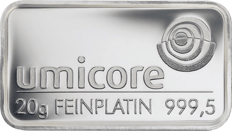
Investment platinum is issued across all manufacturers with a fineness of 999.5/1,000. This standard is just as binding for 20-gram bars as for any other denomination, which makes a direct comparison of different manufacturers straightforward, since the pure platinum weight remains identical. Each bar bears a stamped weight, fineness, manufacturer's logo and, as a rule, an individual serial number that serves traceability.
20-gram bars are usually produced either minted or stamped. Minting allows for a particularly clean, detailed bar design and a sharp edge; it is more elaborate than casting, which is used mainly for very heavy bars from around 250 g upwards. Minted bars are typically supplied in a sealed blister card with a certificate, which further supports authenticity verification and value retention. Anyone wishing to delve deeper into the subject of refineries will find the most important names in the industry in the manufacturer overview.
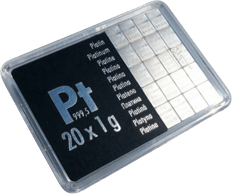
A particularly practical variant in this weight class is the CombiBar, also known as a minted multi-gram bar. It consists of 20 individual one-gram tablets that can be separated from one another cleanly and without any loss along pre-stamped break lines, much like a bar of chocolate. This means a single piece combines the price advantages of a larger bar with the divisibility of small units.
The appeal is obvious: anyone who later wants to turn only a small part of their platinum into cash can break off a few grams and keep the rest. This makes the CombiBar a flexible building block for crisis protection and for anyone who wants to retain some room for manoeuvre. The same principle also exists with the gold CombiBar, a concept that has proven itself across several precious metals.

A CombiBar is purchased flexibility: a piece that, when needed, you can divide into exactly the portion you really require.
This is where the decisive difference from investment gold lies. While physical investment gold is exempt from VAT in Germany, no comparable relief applies to platinum. When buying platinum bars, the full VAT rate of 19% applies, which is relevant both for standard-taxed bars and for a later resale. This surcharge should be factored into every calculation, since it increases the price gain needed to reach the break-even point.
Tax notice
In Germany, unlike investment gold, platinum is subject to the full VAT rate of 19%. There is a silver lining: if physical platinum is held beyond the one-year speculation period, any capital gain on resale is exempt from income tax for private individuals. This information does not replace individual tax advice.
For anonymous transactions, the rule is: precious metals can be purchased up to an amount of €1,999.99 without recording personal data; this applies to platinum bars just as it does to investment products made of palladium or other metals. Above this threshold, the statutory identification requirements apply.
The price of a bar is made up of the pure material value and a surcharge. The material value is based on the spot price, the daily world market price for platinum, which is newly determined several times a day. The metal is traded mainly on the London Metal Exchange, on COMEX in New York and on the Shanghai Futures Exchange. On top of this come production, storage and transport costs as well as the dealer's margin; together these make up what is known as the premium.
Platinum is considered a distinctly volatile precious metal. The close link to industrial demand and the heavily concentrated mining, with most of it coming from southern Africa and Russia, cause pronounced price movements. Historically, the platinum price has at times been above the gold price, and in other periods significantly below it. This interplay creates opportunities as well as risks; no future performance can be derived from it. Anyone who sees platinum as a building block against currency devaluation will find further considerations in the inflation hedge topic area.
Platinum bars are available in a continuous range of weights, from just a few grams up to kilo bars. The following overview places the 20-gram bar in context and shows which size suits which need:
| Denomination | Character | Premium |
|---|---|---|
| 5 g / 10 g | Small entry point, high divisibility | higher |
| 20 g | Balanced middle ground between price and flexibility | moderate |
| 50 g / 100 g | Larger position, cheaper per gram | lower |
| 500 g / 1 kg | Large investment, lowest premium | lowest |
The 1-ounce version (around 31.1 g) is also widespread and is close in weight to the 20-gram bar. Anyone who combines several sizes builds up a tiered position that can later be dissolved in portions, an idea that also applies to the gradual build-up of a precious metals position.
A 20-gram platinum bar represents considerable value in a very small space, which is precisely why storage deserves attention. In principle, three options are available: keeping it at home in your own safe, a bank safe deposit box, or professional storage. Each option has its price and its particular features; a safe deposit box incurs ongoing fees, while home storage requires good insurance cover.
To keep the bar flawless for years, the original sealed packaging should remain as intact as possible. It protects against scratches, skin oils and environmental influences, and makes authenticity verification easier when it comes to a later sale. Suitable accessories such as coin capsules, can safes or coin cases help to keep a growing collection organised and protected.
As one of Germany's largest online dealers for precious metals, Kettner Edelmetalle carries exclusively bars from LPPM-certified manufacturers; every piece meets at least the good delivery standard. Shipping is 100% insured, and authenticity verification follows ISO-compliant procedures. Alongside the classic 20-gram bar, the divisible platinum CombiBar is also part of the range, so investors can choose between compact value density and maximum flexibility.
Anyone weighing up bars against coins is best off comparing directly: investment bars score with the most cost-effective access to the pure material value, while platinum Maple Leaf coins or other bullion coins additionally bring a decorative design. Collector's items from the field of collector's coins can develop a sentimental value beyond the material value, but for purely investment-oriented goals, the bar remains the most direct choice.
The 20-gram bar combines a manageable purchase price with a moderate premium. Very small bars have higher surcharges per gram, while very large ones tie up a lot of capital. The 20-gram class hits the middle ground and remains easy to resell.
Investment platinum is issued across all manufacturers with a fineness of 999.5/1,000. This standard applies to all common denominations, so bars from different manufacturers can be compared directly on the basis of their pure platinum weight.
Yes. Unlike investment gold, platinum is not exempt from VAT. The full VAT rate of 19% applies on purchase. However, if the metal is held for longer than one year, any capital gain on resale is exempt from income tax for private individuals. This information does not replace tax advice.
A CombiBar consists of several one-gram tablets that can be separated from one another without any loss along pre-stamped break lines. At 20 grams, that means 20 individual one-gram tablets. This allows a small part to be sold later on without having to break up the entire bar.
Authenticity is evident from the origin from an LPPM-certified manufacturer with good delivery status, from the stamped weight and fineness, from the serial number, and from the original sealed blister card with certificate. Intact packaging makes verification considerably easier.
For purely investment-oriented goals, the bar offers the most direct access to the material value. Platinum bullion coins additionally bring a decorative design, and collector's items can gain value beyond the pure metal value. The choice depends on whether the investment or the collecting aspect takes priority.
 20 g Platinum Bars
Stay informed with product launches, financial news and exclusive offers. Sign up for our free newsletter today.
By entering your email address and clicking the "Submit" button, you give the following consent: "I agree to be informed by email about new products, financial news and exclusive offers, and therefore consent to the processing of my email address for the purpose of sending the newsletter. I can revoke this consent at any time without giving reasons, with effect for the future. The lawfulness of processing carried out prior to revocation remains unaffected."