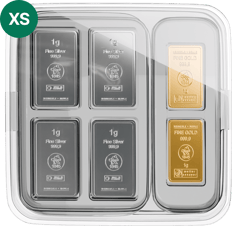
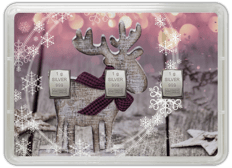
50 x 1g Silver Heimerle und Meule UnityBox
€155.81
incl. VAT and excl. shipping
Ships from 26/11/2026

 More than 310,000
 Over 30 years
 Secure shipping
 Google: 4.9/5


A cubic centimetre of silver weighs 10.5 grams, a cubic centimetre of gold 19.3 grams. So a kilo of silver needs 95 cubic centimetres, a kilo of gold only 52.
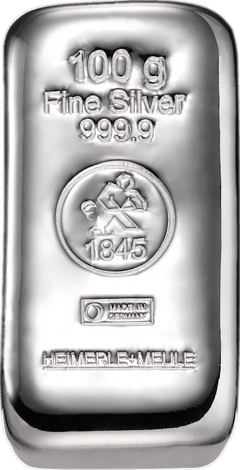
Two cast bars from Heimerle + Meule, 100 grams each, at the same scale. Seen from above, both are the same size, 40 × 20 millimetres. Yet at 13.5 millimetres the silver bar is almost twice as thick as the gold bar at 7.5.
Valcambi of Switzerland mints its 500‑gram silver bar in the same format as its 1‑kilogram gold bar. Both measure 117 × 53 millimetres and are almost equally thick, 8.3 and 8.7 millimetres.
A coin bar has the shape of a bar and the legal status of a coin. It carries a face value, and in its issuing country it is legal tender. Two coin bars show you where to find both.
Australia’s coinage law lists the Dragon as a 1‑dollar coin, rectangular with rounded corners and 47.6 × 27.6 millimetres in size. In Australia it is legal tender.
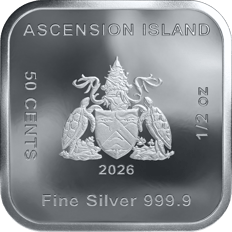
On the island of Ascension in the South Atlantic, the Governor sets the face value, weight, shape and design of such coins. Whoever mints them on commission must take back every coin at its face value.
The same idea on a smaller scale: the Square Coins of 1/10, 1/4 and 1/2 ounce, with a face value of 10, 25 and 50 cents.
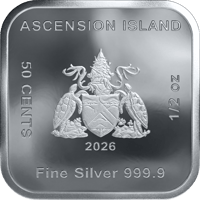 1/2 oz50 cents
In the London wholesale market, a silver bar weighs around 1,000 ounces, 10 percent more or less. That is around 31 kilograms, with a fineness of at least 999/1,000. This is set out in the rules of the LBMA, the association of the London precious metals market.
In the London market, what counts for a gold bar is the weight of the pure gold it contains, for a silver bar its whole weight. The weight list for silver does not even have a column for the fine weight.
At the end of August 2026, the London vaults held 28,431 tonnes of silver. The LBMA converts this into around 948,000 bars. The Bank of England holds no silver.
On the futures exchange in Shanghai, a silver bar weighs around 15 or 30 kilograms.
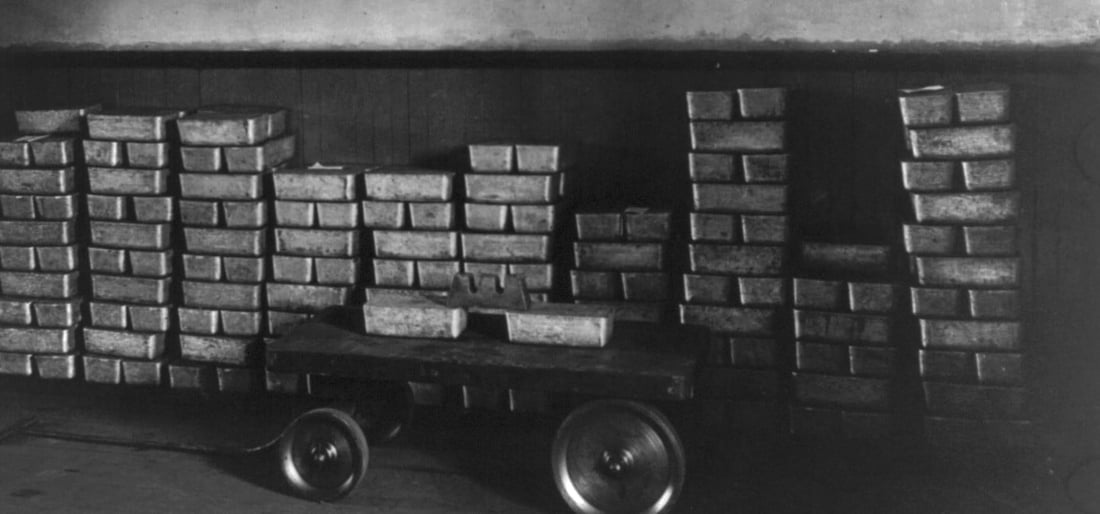
Only just over a quarter of the silver mined in 2025 came from mines that mainly produce silver. Around three quarters came from mines that mainly produce lead and zinc, copper or gold.
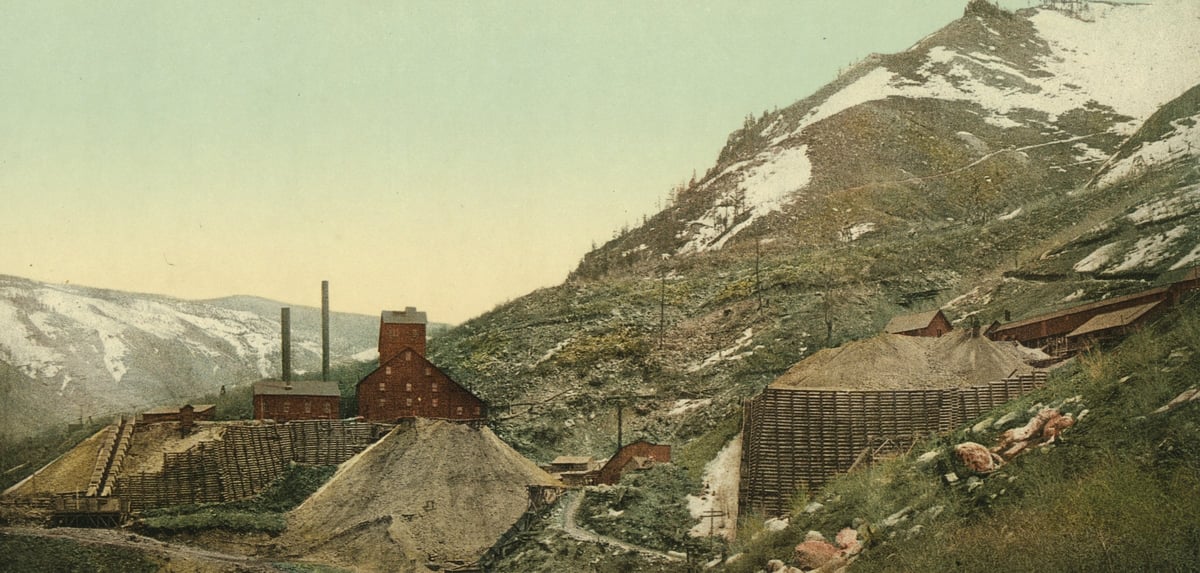
Around 26,300 tonnes of silver were mined worldwide in 2025, with Mexico, Peru and China mining the most.
Source: World Silver Survey 2026 by the Silver Institute, data year 2025.
Demand for silver in 2025 came to 1,130.6 million ounces. Of this, 657.4 million went into industry, or 58 percent. Photovoltaics alone used 186.6 million ounces.
Source: World Silver Survey 2026 by the Silver Institute, data year 2025.
Silver conducts electricity around 6 percent better than copper, and heat better than any other metal. That is why it is found in solar cells, circuit boards and switches.
Silver bars are among the most tangible forms of investment there is: a piece of pure precious metal that you can hold in your hand, stack and preserve across generations. As the most affordable entry into physical precious metals, they combine the material value of silver with low minting costs, making silver buying possible from just a few grams. The following sections explain how bars differ from one another, which weight units and manufacturers exist, how authenticity, fineness and tax are connected, and what investors should pay attention to when buying and storing.
Anyone looking to diversify their wealth will sooner or later come across silver, the precious metal often referred to as the poor man's gold. Silver bars are the most cost-effective way to acquire larger quantities of the metal, as their price is based almost entirely on the pure material value. Unlike a silver coin, there is no need for elaborate minting or limited mintages, so the premium over the silver price remains comparatively low.
Silver is also an industrial metal: large quantities are processed every year in electronics, photovoltaics and information technology. This dual role, as both a store of value and a raw material, makes the metal attractive to many investors who want to build a second tangible-asset pillar alongside gold bars. Those who own silver physically hold a tangible asset that exists independently of banks and digital systems and that has established itself as a building block for crisis protection.
A silver bar promises no interest: it promises durability. For many investors, that is exactly where its appeal lies.
The two best-known forms of silver investment are bars and coins. Both have their merits, but they follow different logics. A bar is, as a rule, not legal tender and carries no face value: its value is determined by weight and fineness. This makes it the classic choice for investors who focus above all on material value and seek the lowest possible premium per ounce.
A silver coin, on the other hand, can develop a collector's value beyond its pure metal value, for example through limited mintages, popular designs or special years of issue. Classics such as the Maple Leaf or the Vienna Philharmonic are traded worldwide and, thanks to their small denominations, are also suitable as a rainy-day reserve. Bars, meanwhile, score points with a lower price per gram: the larger the unit, the lower the surcharge.
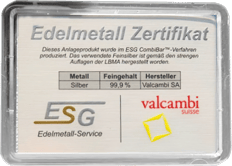
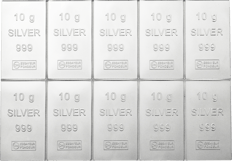
A practical middle ground is the CombiBar, also known as a combi bar or silver bar sheet: it works like a bar of chocolate and can be broken along perforations into small one-gram units. This combines the favourable purchase price of a larger bar with the divisibility of small denominations, ideal for anyone who wants to stay flexible and pass on small quantities. Related to these are minted bars, which bear the design of a bullion coin.
The benchmark unit in the world of precious metals is the troy ounce (around 31.1 grams), but silver bars come in a wide range, from the handy gram bar to the heavy kilo bar and beyond. As a general rule: the higher the weight, the less the manufacturing costs weigh per gram, and the more favourable the bar is relative to the silver price.
Small bars from 10 grams, 20 grams or 50 grams are suitable as a starting point, as a divisible crisis reserve and as a gift. They are considerably more attractive than a bundle of cash and are popular presents at Christmas or for birthdays. The downside: the premium per gram is highest for small units.
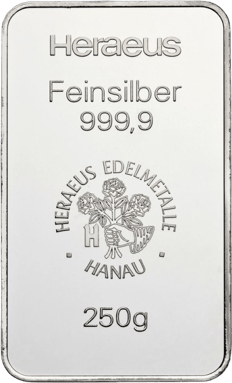
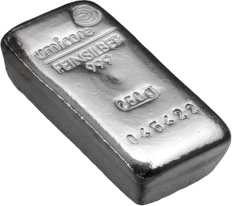
Bars of 100 grams and 250 grams are most frequently recommended as an entry point into silver investment. They offer a balanced ratio of favourable price per gram and good tradability. The 500-gram bar is also in demand when investors want to build up a larger position step by step.
Anyone aiming for the lowest possible premium opts for large units. The kilo bar is regarded as a classic among investment bars, alongside 5-kilogram and even 15-kilogram bars for investors with a larger budget. In terms of ounces, there are also the 1-ounce, 2-ounce and 10-ounce bars. A fineness of 999/1,000 is prescribed for silver, and a fineness of 999.9/1,000 is frequently offered as well.
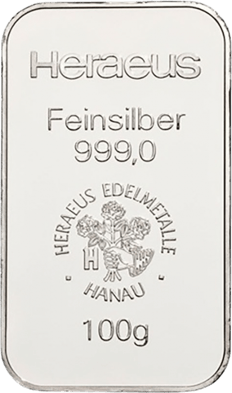
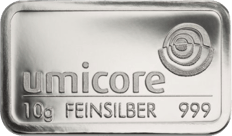
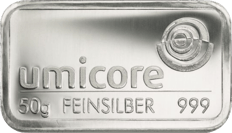
When buying silver bars, the choice of manufacturer determines resale value and trust. Renowned refineries mint and cast bars to strict quality standards and mark them with details of fineness, weight and, for larger bars, a serial number. The best-known brands worldwide include:
A decisive quality feature is certification by the London Bullion Market Association (LBMA). This association brings together certified minting houses that have agreed on common standards for purity and processing. Bars from an LBMA-listed refinery are internationally recognised and can be put back into circulation more easily when resold, without the need for elaborate testing. A further distinction is made between minted bars with clean edges and a smooth surface, and cast bars with a more rustic, individual appearance.
The security of a silver investment depends entirely on the authenticity of the goods. Reputable bars carry the manufacturer's mint mark, the weight and fineness details, and can be checked against several characteristics. It is important to purchase through an established specialist dealer rather than auction or classified-ad platforms, where the risk of counterfeits is considerably higher.
At Kettner Edelmetalle, all goods undergo an ISO-compliant authenticity verification, ensuring that only bars from certified manufacturers reach our range. Accessories such as coin capsules or coin cassettes also help protect sensitive surfaces from scratches and tarnishing.
Unlike investment gold, silver is not exempt from VAT in Germany. Silver bars are generally subject to the full rate of VAT in addition to the trading price, just like platinum or palladium. Anyone wanting to avoid this premium is more likely to opt for VAT-exempt investment gold.
Important note on margin scheme taxation
Until October 2022, minted bars and coin bars could be sold under the margin scheme via a simplification rule, bringing their price closer to the silver price. This rule has not been applicable since then. Classic silver bars were never eligible for this tax relief in the first place. This text is general information and does not replace tax advice.
One privilege remains for silver investors, however: the one-year holding period. If a silver bar is held for more than one year, any subsequent profit on sale is tax-free under current law. If the holding period is shorter, any profit must be declared in the tax return. Anyone planning for the long term can therefore position themselves accordingly, which is one reason why many investors regard silver as a patient, long-term investment.
Physical silver needs to be stored securely. One advantage of the bar form is that it can be stacked to save space and, for larger units, requires little volume relative to its value. Many private investors keep their bars at home in a safe, while others rely on a bank safe-deposit box or external storage solutions.
Protection against moisture and mechanical damage is important, as silver can tarnish. For smaller bars and minted bars, coin pouches and coin cases are suitable, as they create order and protect the surface. In addition to bars, many investors use small silver coins as a divisible emergency reserve, allowing physical silver to be distributed flexibly across different storage locations.
You can order your silver bars directly here in the shop or by phone from our customer advisors on 07930-2699, Monday to Friday from 8 a.m. to 8 p.m. If you would like to invest a larger amount, our customer advisors will be happy to prepare an individual offer for you and discuss selection, payment and delivery with you. You can also put together your personal offer online.
Every shipment is insured for its full value. We pack your order at our own logistics centre in Germany and ship it in neutral boxes that give no indication of precious metals. From a goods value of €20,000, we recommend delivery via a valuables courier service. If your order is sent as a parcel, you will receive the tracking number by e-mail. You can pay by bank transfer or directly online, for example with PayPal or credit card. The checkout will show you which payment methods are available for your order. You can read more about this under Shipping and Payment.
A silver bar is only as good as its resale value. Bars from LBMA-certified manufacturers and in common denominations can be resold on the world market without any problems, as their value can be read transparently from the current silver price. Besides selling, Kettner Edelmetalle also buys back silver bars, basing the buy-back price on the daily silver price on the commodity exchanges.
Before selling, it is advisable to obtain several offers and compare prices. Original packaging, a certificate and a good state of preservation have a positive effect on the price achievable. Investors who want to build up larger positions will find bundled solutions that simplify getting started in silver investor packages.
Here is how to sell your silver bars to us: if you bought the bars from us, simply select them directly from your orders after logging in to our buy-back portal; you do not need an invoice for this. Bars from another purchase can be offered to us there together with the purchase invoice. Whether we make an offer for these depends on the item, the quantity and our current demand.
You will usually receive a written offer within 24 hours. If you accept it, you will receive an insured DHL shipping label for sending from Germany, free of charge from an offer value of €500. Our experts check authenticity, completeness and condition, after which we transfer the amount to your account. A buy-back from Switzerland and Liechtenstein is currently not possible due to customs regulations.
For getting started, bars of 100 grams and 250 grams are frequently recommended, as they offer a good balance of favourable price per gram and easy tradability. Anyone who wants to stay especially flexible can opt for a CombiBar, which can be broken into individual gram units.
Investment gold is exempt from VAT in Germany, whereas silver is not. Silver bars are therefore sold with the full rate of VAT in addition to the trading price. The simplification rule for margin scheme taxation that used to apply to minted bars has not been applicable since October 2022.
Under current law, a profit from the sale is tax-free if the bar has been held for more than one year. If the holding period is less than one year, the profit must be declared in the tax return. This information is of a general nature and does not replace individual tax advice.
A minimum fineness of 999/1,000 is prescribed for silver bars, meaning 999 parts out of 1,000 are pure silver. Many manufacturers even offer a fineness of 999.9/1,000. High purity makes a later resale easier and is a particular quality feature for minted bars.
Bars from LBMA-certified manufacturers are advisable, purchased through an established specialist dealer rather than auction or classified-ad platforms. The minted design, weight, fineness details and, for larger bars, the serial number provide information about authenticity. Smaller bars are often supplied in sealed packaging with proof of authenticity.
Minted bars are produced under high pressure and are characterised by smooth surfaces, sharp edges and a precise design. Cast bars appear more rustic and individual. For the pure material value, the manufacturing method plays little role; however, minted bars are often perceived as particularly high-value.
Stay informed with product launches, financial news and exclusive offers. Sign up for our free newsletter today.
By entering your email address and clicking the "Submit" button, you give the following consent: "I agree to be informed by email about new products, financial news and exclusive offers, and therefore consent to the processing of my email address for the purpose of sending the newsletter. I can revoke this consent at any time without giving reasons, with effect for the future. The lawfulness of processing carried out prior to revocation remains unaffected."