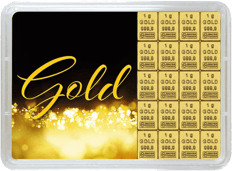
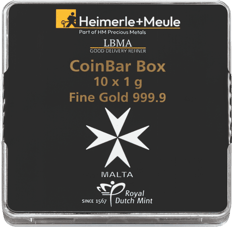
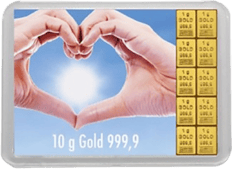
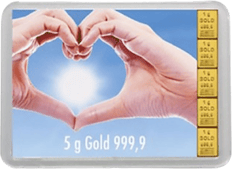
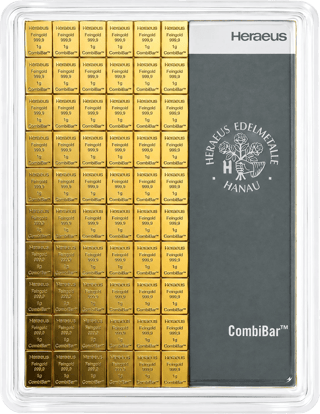
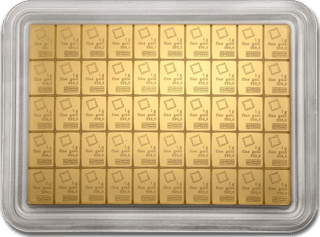
25 x 1g Gold Bar Heimerle und Meule UnityBar
€3,227.05€3,277.05
VAT-free and excl. shipping
Available in 3–4 business days

 More than 310,000
 Over 30 years
 Secure shipping
 Google: 4.9/5
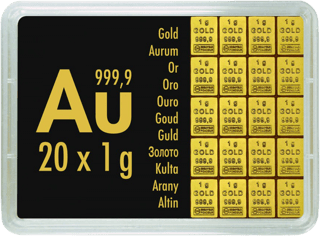
Gold CombiBars – a composite of small fine gold bars, each featuring a hallmark stamp. The bar weight, fineness, type of precious metal, and the manufacturer's logo are all embossed on each bar. Gold CombiBars can be separated from one another without any loss along pre-defined break points, making them ideal for crisis protection.


Many small bars together, each of which can be separated on its own: this comes in five forms. Only in one of them, the tablet, are the pieces firmly joined.
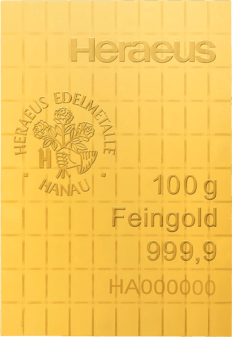
“20, 50 or 100 individual 1 g minted gold bars are [joined] together to form one large bar. The single 1 g bars can easily be separated from one another.”
Heraeus on its tablets, data sheet
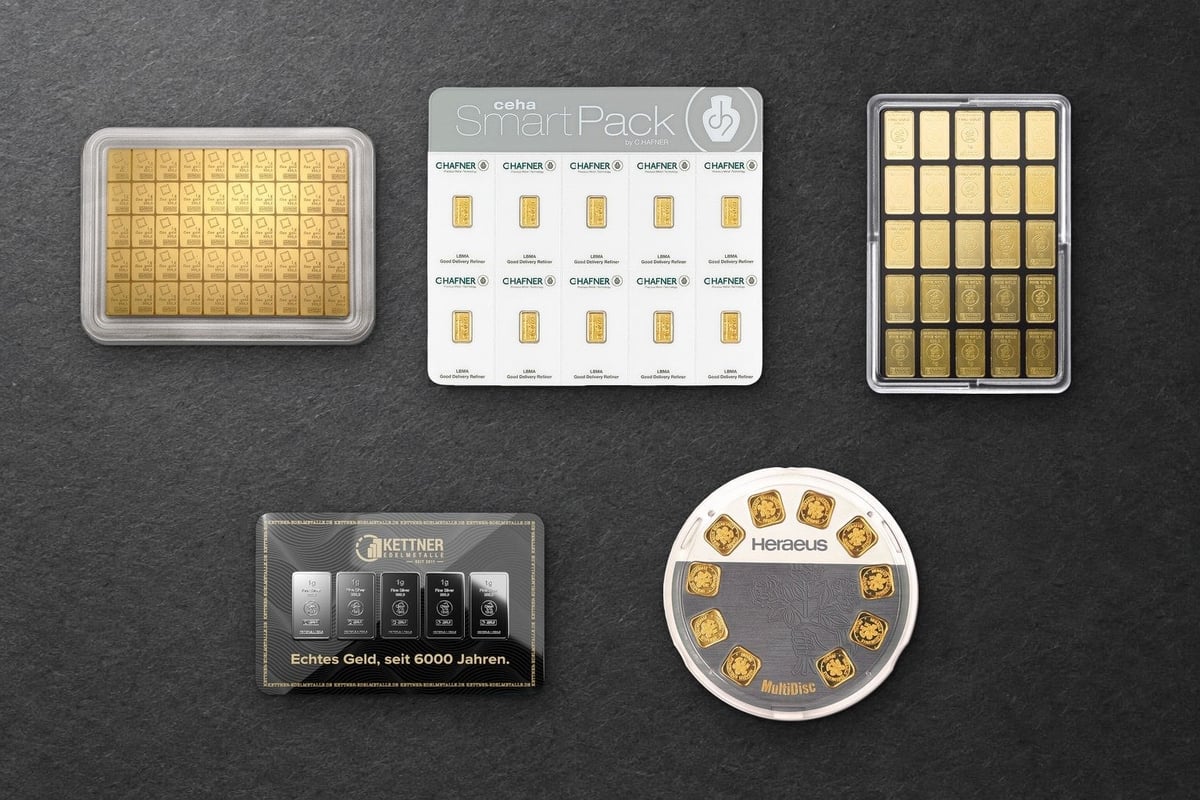
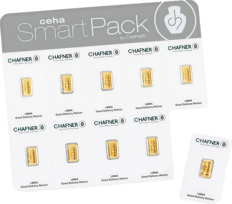
In the Smart Pack by C. Hafner, each bar sits in its own small card. “Each bar can be detached individually along a perforation,” writes the maker.
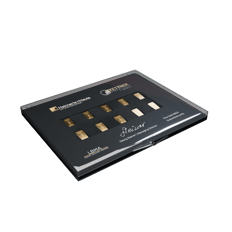
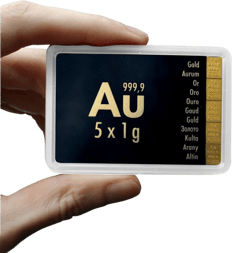
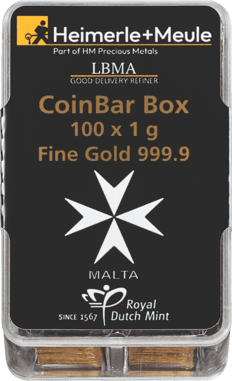
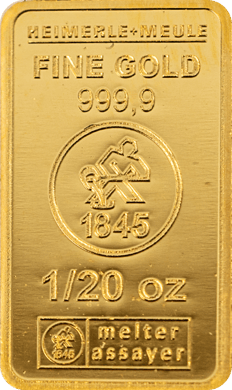
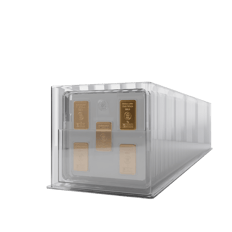
Heimerle + Meule places its UnityBars individually side by side in a capsule or box. Nothing is broken there; the maker heads its page “Snapping is a thing of the past”.
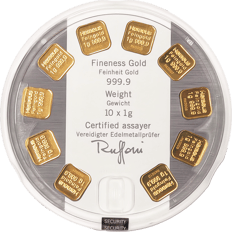
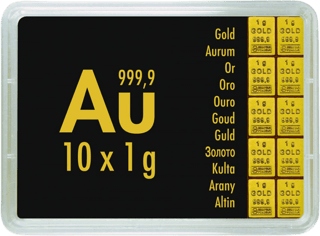
Then there are cards in which single bars are sealed in with space between them, and the MultiDisc by Heraeus: ten square bars of 1 gram each in round packaging.
Only the tablet has to be broken.
Schematic drawings after the product photos, not to scale.
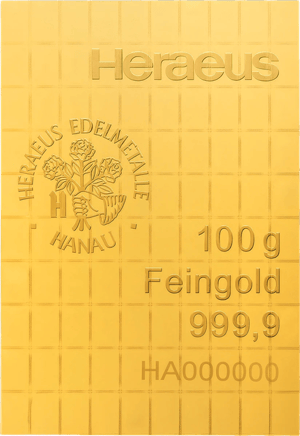
At Heraeus, the 100‑gram tablet measures 74 by 105 millimetres, the 50‑gram one 74 by 52.5. To within half a millimetre, these are the paper sizes DIN A7 and A8.
“The ESG divisible bars are DIN A7 or A8 in size and can be stacked perfectly in safes and safe deposit boxes.”
ESG Edelmetall‑Service in the trade journal zt, No. 6, June 2011, translated
The DIN 476 standard was published on 18 August 1922. Its largest sheet, A0, measures one square metre. Halve it along the long side and you get A1, and the aspect ratio stays the same, writes DIN, the German Institute for Standardization.
Divide the tablet of ten by ten pieces down the middle and you have two halves of 50 pieces each, each as large as the 50‑gram tablet: twice A8.
By calculation, each of the hundred pieces thus has a field of 7.4 by 10.5 millimetres, grooves included. This field, too, has the shape of the whole tablet.
The same area, a different thickness: the 100‑gram gold tablet from Heraeus is 0.85 millimetres thick, the 100‑gram silver tablet from Valcambi 1.5 millimetres. Tablets also come in platinum.
Halve the tablet and its shape stays the same, just as with paper.
Dimensions: Heraeus for gold, combibar.com for silver, the bank card to ISO/IEC 7810, format ID‑1. The field is calculated from the dimensions. At the same scale, not at a scale of 1:1.
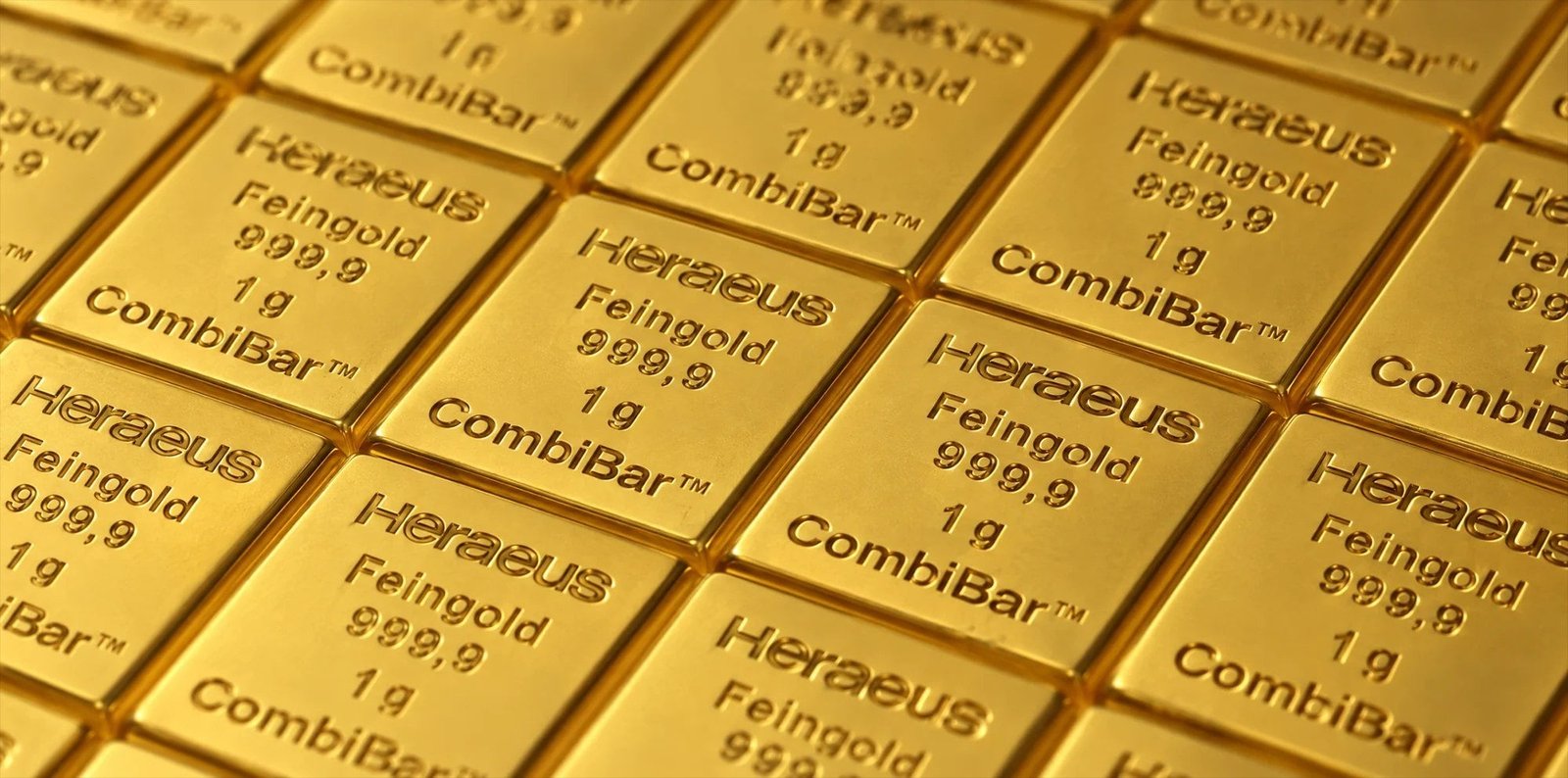
The grooves between the pieces do not go through the tablet. A web of metal remains and holds the pieces together. That is how the patent specification for the tablet describes it.
“… preferably high enough that bending under the force of gravity is prevented, and at most high enough that the material connection can be destroyed by hand by bending or breaking.”
Patent specification on the bending strength of the web, translated
According to the patent specification, the web can be 0.05 to 0.4 millimetres thick, and the groove can open at an angle of about 10 to 60 degrees. The specification calls a groove thin if it is narrower than it is deep. These are ranges from the specification, not measurements of a particular tablet.
The groove cuts nothing out. It only pushes the metal aside, and the small bead that forms can be pressed flat again straight away during minting. So says the same specification.
Strong enough for gravity, yielding enough for the hand.
Diagram based on the figures in the patent specification, greatly enlarged. The drawing shows one example within the stated ranges, not to scale.
The same strike that forms the grooves stamps each piece with the maker’s mark, the weight and the purity. So says the patent specification. Even a single piece thus shows what it is.
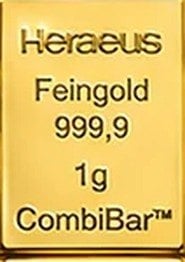
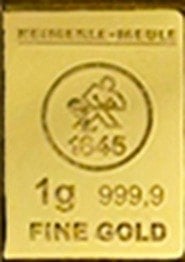
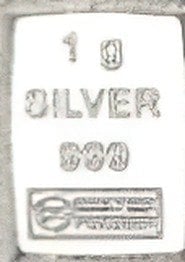
The product photos show how each house does it. Heraeus stamps “Feingold 999,9” and “1 g”, Heimerle + Meule its company mark with 1845 and “1g 999,9 FINE GOLD”, Valcambi on the silver tablet “1 g SILVER 999”.
So the fineness is not the same everywhere. The gold tablets bear 999.9/1,000, the silver tablets from Valcambi 999/1,000. On the silver bars from Heimerle + Meule it says 999,9.
None of the pieces bears a number. At Heraeus, only the large bar bears a serial number, and the certificate comes with it in the plastic packaging. For the 50‑gram tablet from Valcambi, the reference work Gold Bars Worldwide 2011 names a tamper-proof sheath with a numbered certificate. With the Smart Pack by C. Hafner, each small card comes with its own certificate.
Weight and fineness are on every piece, a number on none.
Enlarged; the three pieces at the same scale, the back shown smaller. Details of product photos from the shop.
Handing over precious metal in pieces by weight is an old idea. In England, silver pennies were cut into halves and quarters until the 13th century whenever change was needed.
“… so that a halfpenny was literally half a penny and a farthing a quarter or ‘fourthing’.”
Royal Mint Museum, “Halfpenny and farthing”
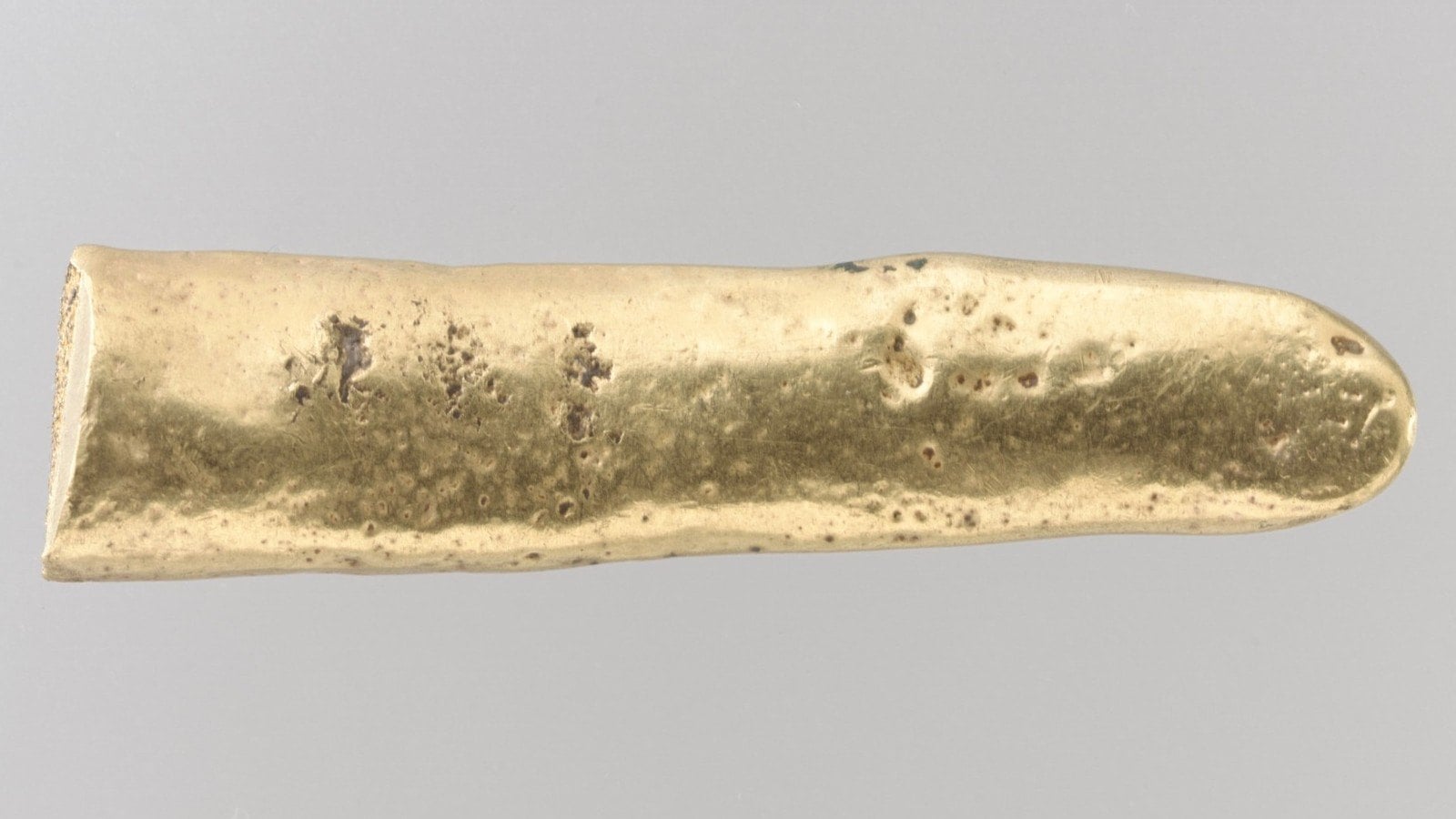
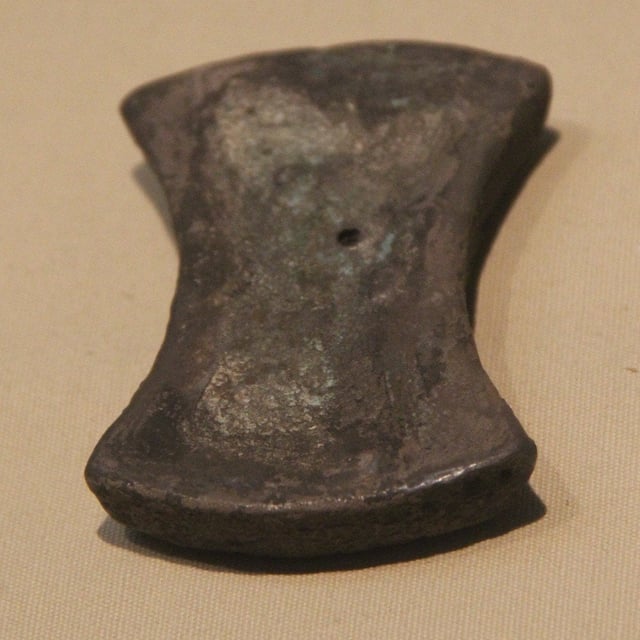
On the Schlei near Hedeby, archaeologists uncovered a hoard of around 200 objects, “mostly of silver: hacksilver, fragments of Arab coins (dirhams), ingot fragments and jewellery”, as the Schleswig‑Holstein State Archaeology Office reported in 2025. Paying by weight, with standardised sets of weights and accurate scales, arose at the end of the 9th and in the 10th century, at the same time as the rise of the trading centres Birka and Hedeby, writes the archaeologist Heiko Steuer.
In Japan in the Edo period, silver was traded by weight, in the unit monme of 3.75 grams. Gold, by contrast, was counted in coins, writes the Currency Museum of the Bank of Japan.
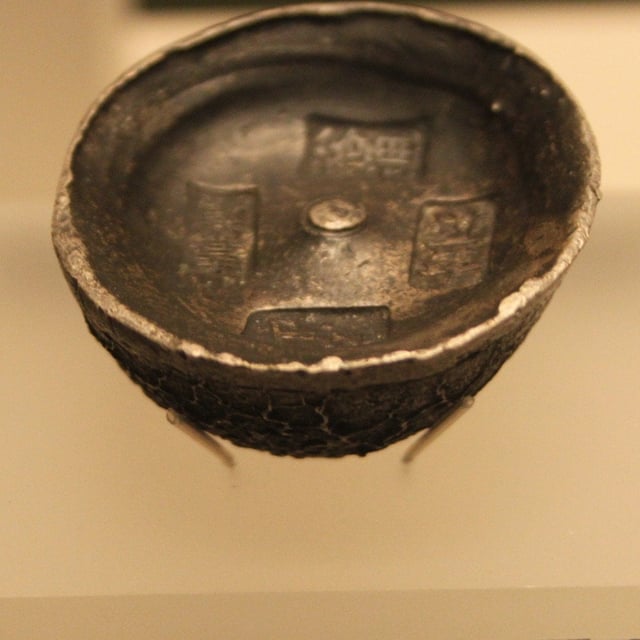
In China, silver ingots played an important part in domestic trade until 1933. Their stamps usually named the dynasty, the province and the guaranteed weight, reports the MoneyMuseum in Zurich.
The penny had to be cut up; the tablet is already divided.

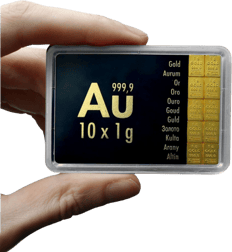
A gold CombiBar combines the lasting value of physical gold with a feature that classic bars cannot offer: true divisibility. Like a bar of chocolate, the connected array of many small 1 g fine gold bars can be broken apart along fine perforations without any loss of material. For anyone who sees gold not only as a store of value but also as a ready reserve for uncertain times, the divisible gold bar, also known as a CombiBar, combi bar or gold sheet, is one of the most well thought-out forms of gold investment. This guide explains its structure, manufacturers, fineness, tax treatment, storage and the question of who benefits most from this special bar format.
A gold CombiBar is a connected array of individual fine gold bars, usually weighing 1 gram or 0.5 grams per tablet. The name derives from its characteristic structure: the stamped tablets sit side by side in a grid and resemble a bar of chocolate. Each bridge between the tablets incorporates a perforation, so the small gold pieces can be snapped apart from one another without tools and without any loss of material.
The appeal lies in both the psychological and the practical detail: instead of having to sell an entire 50 g gold bar in one piece, you can detach exactly the amount currently needed. This granularity makes the CombiBar a link between the handy 1 g gold bar and the large standard formats. Anyone wanting to get to know the principle will find suitable denominations across the entire range of gold bars.
A CombiBar is gold that thinks ahead: a store of value that can be divided precisely when it matters most.
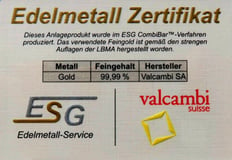
The idea of the divisible gold array dates back to 2011. At that time, the Swiss gold refinery Valcambi SA, in cooperation with the German refinery ESG, launched the patented CombiBar, a small revolution in the field of divisible gold investment. To this day, only a few established houses mint these high-quality CombiBars.
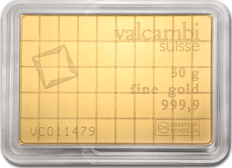
Valcambi mainly produces the 50 g CombiBars, made up of 50 individual 1 g tablets of pure fine gold. They feature a clean, glossy strike, carry the marking "1 g Fine Gold 999.9" as well as LBMA certification (London Bullion Market Association). This LBMA-certified standard and the high-quality strike of each individual bar considerably ease the later resale of the detached gold tablets.
The traditional Pforzheim refinery Heimerle + Meule produces the larger 100 g CombiBars with 100 tablets of 1 g each. These are matte-rolled and then hallmarked. There are also minted bar boxes in smaller denominations, which are particularly suitable for building wealth step by step. An overview of all mints can be found in the list of manufacturers.
A popular alternative to the classic array are the MultiCards from Heraeus: here, several individual, already separated 1 g bars are arranged in a blister card, similarly flexible, but separated from the outset. Anyone who prefers individual small bars should also take a look at the 5 g gold bar.
All gold CombiBars have the highest fineness commonly found on the market, 999.9 (24 carat). An absolute purity of 100% is technically not achievable, which is why minimal residual proportions of other metals remain. Each individual bar is fully struck and carries the key information in its hallmark.
In shape, the tablets follow the classic rectangular form. A 100 g CombiBar with 100 tablets corresponds to the DIN A7 format and measures around 74 × 105 mm, while the 50 g CombiBar measures approximately 52 × 74 mm. The reverse often features a continuous design, the manufacturer's logo, a serial number, as well as details on total weight and fineness. Anyone who values larger individual formats can compare this with a classically cast 100 g gold bar.
CombiBars are offered in numerous sizes, from the small entry-level array to the large sheet. This allows the denomination to be tailored precisely to your own budget and desired flexibility.
The smaller the individual tablet, the easier it is to use as a medium of exchange when gold prices are high. Anyone looking for a lower premium per gram, on the other hand, will find it more readily with large individual bars such as the 250 g gold bar or the 1 kg gold bar. Ounce-based formats such as the 1 oz gold bar are also available.
The biggest advantage of a CombiBar is its flexibility: investors can freely decide whether to convert the gold back into cash in full or in small units. With a solid bar, cutting it would only be possible with a loss of material, and therefore value. This is offset by a higher manufacturing effort.
Important regarding the price
The fine minting work and the many perforations raise the price of a CombiBar slightly above its pure material value. Compared to a solid bar of the same weight, the premium is noticeable: anyone seeking maximum proximity to the pure gold value is better off with a classic single bar. Anyone who wants divisibility consciously pays this surcharge for a measure of freedom to act.
Compared to buying many separate 1 g bars individually, however, the array is often cheaper, since packaging and handling are bundled together. This blended calculation makes the CombiBar a sensible compromise for many. Anyone also thinking in terms of coins likes to combine it with classic investment staples such as the Krugerrand or the Maple Leaf.
Gold CombiBars are classified as investment gold and therefore enjoy a special tax status. In Germany, investment gold is exempt from VAT, provided it meets the statutory criteria for fineness; at a fineness of 999.9, this is always the case. This clearly distinguishes gold from silver, which is subject to VAT or the margin scheme when purchased.
Tax note
If physical gold is sold after a holding period of more than one year, any capital gain is, under current law, tax-free. This is general information and does not replace individual tax or investment advice.
Anyone who combines tax considerations with the idea of long-term value preservation will find further ranges in the area of gold bullion coins as well as among gold coins in general.
Since pure gold at 999.9 is very soft, the thin tablets can easily be bent, scratched or dented. Conversely, it is precisely this softness that allows the clean snapping along the perforation. Authenticity is supported by the struck details, the manufacturer's logo, a serial number and, in the case of Valcambi, LBMA certification.
CombiBars are usually supplied in a protective plastic capsule or blister card that can be stacked to save space. For storage at home, a safe is recommended; matching coin capsules and coin cassettes offer additional protection against scratches. Anyone organising several bars reaches for a coin case.
Before breaking off individual tablets, it is advisable to leave the sheet in its original packaging and separate only the amount actually needed. Once a tablet has been broken off, it remains fully tradeable, as does the remaining array.
In addition to the classic investment product, there are enhanced bars that combine the precious metal with a design aspiration. With enhanced silver bars, techniques such as partial gilding, gilding, a proof finish or an antique finish are used, often in strictly limited editions and with design series drawn from art, history or the animal world. Such pieces are aimed less at pure material value than at the collector's mindset.
Gold too has design-enhanced editions with special strikes or packaging. However, the plain CombiBar remains the tool of choice when divisibility and proximity to the gold price are the priority. Anyone who finds the collector's design appealing can additionally browse the silver CombiBars or the exclusive editions under Kettner exclusive products.
The CombiBar appeals to anyone who wants to bundle a larger number of small gold units into a handy format, whether as a flexible reserve, as a building block for retirement planning, or as a well-considered inflation hedge. Particularly in the context of crisis preparedness, small-scale denominations have proven their worth: the smaller the piece of gold, the more easily it can be used as a medium of exchange in an emergency.
As a German family business with more than 200,000 satisfied customers, Kettner Edelmetalle offers CombiBars from established manufacturers with ISO-compliant authenticity verification and fully insured shipping. Anyone wishing to build up small amounts on a regular basis will also find suitable solutions in the area of savings plan products.
A gold CombiBar is a connected array of many small fine gold bars, usually 1 g or 0.5 g. Built-in perforations allow the individual tablets to be separated without any loss of material, similar to a bar of chocolate.
All common gold CombiBars have a fineness of 999.9, i.e. 24 carat. This is the highest level of purity commonly found on the market for gold bars.
The best-known manufacturers are Valcambi SA with the 50 g CombiBar and Heimerle + Meule with the 100 g gold sheet. A similarly flexible alternative is formed by Heraeus's MultiCards with individually separated bars.
The elaborate minting of each individual tablet and the many perforations increase the manufacturing effort. As a result, the price is slightly higher than that of a solid gold bar of the same weight. In return, you get full divisibility.
Yes. The tablets are connected by a stamped bridge with a perforation and can be snapped off by hand. Since fine gold is very soft, this can be done without any loss of material.
Yes. As investment gold with a high fineness, gold CombiBars are exempt from VAT in Germany. This is general information and does not replace individual tax advice.
 Gold CombiBars
Stay informed with product launches, financial news and exclusive offers. Sign up for our free newsletter today.
By entering your email address and clicking the "Submit" button, you give the following consent: "I agree to be informed by email about new products, financial news and exclusive offers, and therefore consent to the processing of my email address for the purpose of sending the newsletter. I can revoke this consent at any time without giving reasons, with effect for the future. The lawfulness of processing carried out prior to revocation remains unaffected."