Only 3 left to order
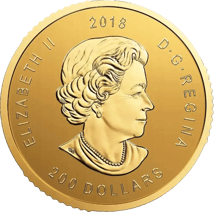
1/4 oz Gold Golden Eagle Germany Edition 2026 (Mintage: 25 | Privy Mark | Proof)
€1,490.00
VAT-free and excl. shipping
Ships from 13/11/2026
 +49 7930-2699

 More than 300,000
 Over 30 years
 Secure shipping
 Google: 4.9/5

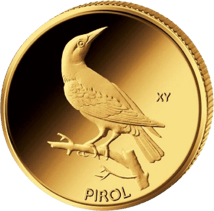
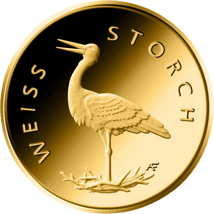
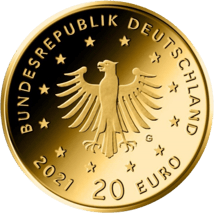
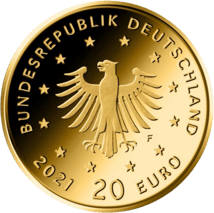
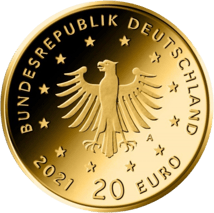
On the design sides of the 20 Euro Native Birds gold coins, a different bird native to Germany will be depicted each year, along with the engraved name of that bird and the mint mark of the issuing mint. The coins, struck from 999.9 gold, have a fine weight of 1/8 oz (approximately 3.89 g). The coins are issued by the Federal Ministry of Finance of the Federal Republic of Germany.


On 27 May 2015, the German Federal Government decided on a series of six 20‑euro gold coins on the theme “Native Birds”. According to the Federal Ministry of Finance, it follows on from the “German Forest” series. The motifs were based on a concept by the zoologist Prof. Dr. Josef H. Reichholf on typical native bird species.
Bodo BroschatBerlin
František ChocholaHamburg
 Golden oriole2017
 Black woodpecker2021
Adelheid FussGeltow
The picture sides of the six coins, two by each artist. Product photos from the shop.
The motifs were developed in an art competition. The first prizes went to three artists, and each designed two birds. Adelheid Fuss also designed the value side.
From 2016 to 2021, one bird appeared each year, always in June: first the nightingale on 23 June 2016, last the black woodpecker on 21 June 2021.
“The character of the series is supported by the uniform value side, on which only the year of issue is adjusted.”
Federal Ministry of Finance on 27 May 2015, quoted from MünzenWoche, translated

Since 1971, NABU and LBV have chosen a Bird of the Year, now by public vote. The very first was the peregrine falcon. It was proclaimed by NABU, which was then still called Deutscher Bund für Vogelschutz.
Later came the black woodpecker in 1981, the golden oriole in 1990, the nightingale in 1995 and the eagle‑owl in 2005. The white stork was the only one of the six to be Bird of the Year twice, in 1984 and 1994.
All six only appeared on the coins years later, and in a different order: first the nightingale in 2016, the peregrine falcon not until 2019, as the fourth. With the two lists side by side, 13 years lie between election and coin for the eagle‑owl, 48 for the peregrine falcon.
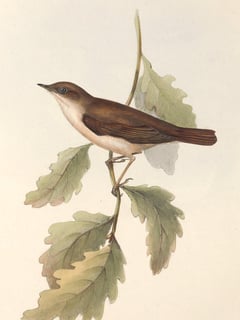
The nightingale is often heard, but it sits well hidden in the bushes. The golden oriole is more often heard than seen, and the shy black woodpecker is given away by its voice. That is how NABU describes it.
The sounds written as NABU writes them. The round close-ups come from the product photos of the coins.
In its breeding area, a male nightingale sings around the clock until it has found a female, and after that only by day. In one hour it can deliver more than 400 phrases in a row. Loud, rhythmically repeated syllables in its song are known in German as the “Nachtigallenschlag”.
The eagle‑owl owes its German name, Uhu, to its deep call “u‑uuooh”.
The white stork clatters its bill at the nest. The peregrine falcon is missing from the sound picture, as it is not very vocal.
“The motif of a clattering white stork follows the swift peregrine falcon in 2020.”
Münze Deutschland on the 2020 issue, translated
Their breeding sites lie at very different heights. The nightingale nests well hidden on the ground or just above it. The black woodpecker chisels a hole into old trees. Its upright oval entrance measures about 9 × 12 cm.
Many other animals move into its holes as “new tenants”, writes NABU.
The golden oriole’s nest hangs in a fork of branches high in the crown. The white stork builds on roofs, chimneys and masts, and its nest of branches grows up to 2 metres wide.
The eagle‑owl breeds on steep rock faces and in quarries. The peregrine falcon also breeds on rock faces, but also in church towers and on bridge piers.
Today, according to LBV, around 1,800 pairs of peregrine falcons breed in Germany again. In Bavaria, buildings and other structures make up just over 50 per cent of the known breeding sites.
The order is approximate and shows no metres. Old bird plates, credits in the sources.
Before the birds, the “German Forest” series appeared from 2010 to 2015. After the black woodpecker, the story continued in 2022 with the “Return of the Wild Animals” series.
 Native Birds
Stay informed with product launches, financial news and exclusive offers. Sign up for our free newsletter today.
By entering your email address and clicking the "Submit" button, you give the following consent: "I agree to be informed by email about new products, financial news and exclusive offers, and therefore consent to the processing of my email address for the purpose of sending the newsletter. I can revoke this consent at any time without giving reasons, with effect for the future. The lawfulness of processing carried out prior to revocation remains unaffected."