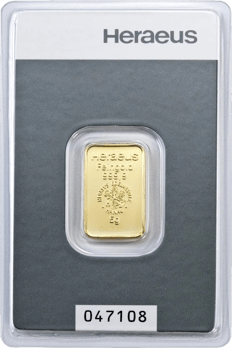
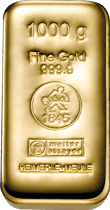
25 x 1g Gold Bar Heimerle und Meule UnityBar
€3,227.05€3,277.05
VAT-free and excl. shipping
Available in 3–4 business days

 More than 310,000
 Over 30 years
 Secure shipping
 Google: 4.9/5


One family from one maker: the gold bars of Heimerle + Meule, all at the same scale. Up to 100 grams we show the minted ones. The larger sizes are only made cast. Click a weight to see all bars of that size.
Every size has a face of its own: from the gram to 100 grams the minted bar grows longer, wider and thicker, from 0.43 to 3.2 millimetres. Heimerle + Meule casts its kilo bar compact, 86 × 43 millimetres and 15.3 millimetres thick. Other makers cast it flat and long, about 117 × 52 millimetres and 9 millimetres thick.
Divisible bars are made of many small bars, usually 1 gram each, that can be separated from one another.
View the divisible barsabout 12.5 kilograms
This is the format in which central banks hold their gold. According to the Bundesbank, its entire stock consists of such standard bars. One weighs roughly as much as a full crate of bottled water and is not even as large as a single water bottle.
When gold changes hands in the vaults of the Bank of England, the bar usually stays where it is. According to the Bank, only the owner changes in its records.
A minted bar is made like a coin: a blank is punched from rolled gold and then struck. A cast bar is made in a mould: molten gold fills it and solidifies.
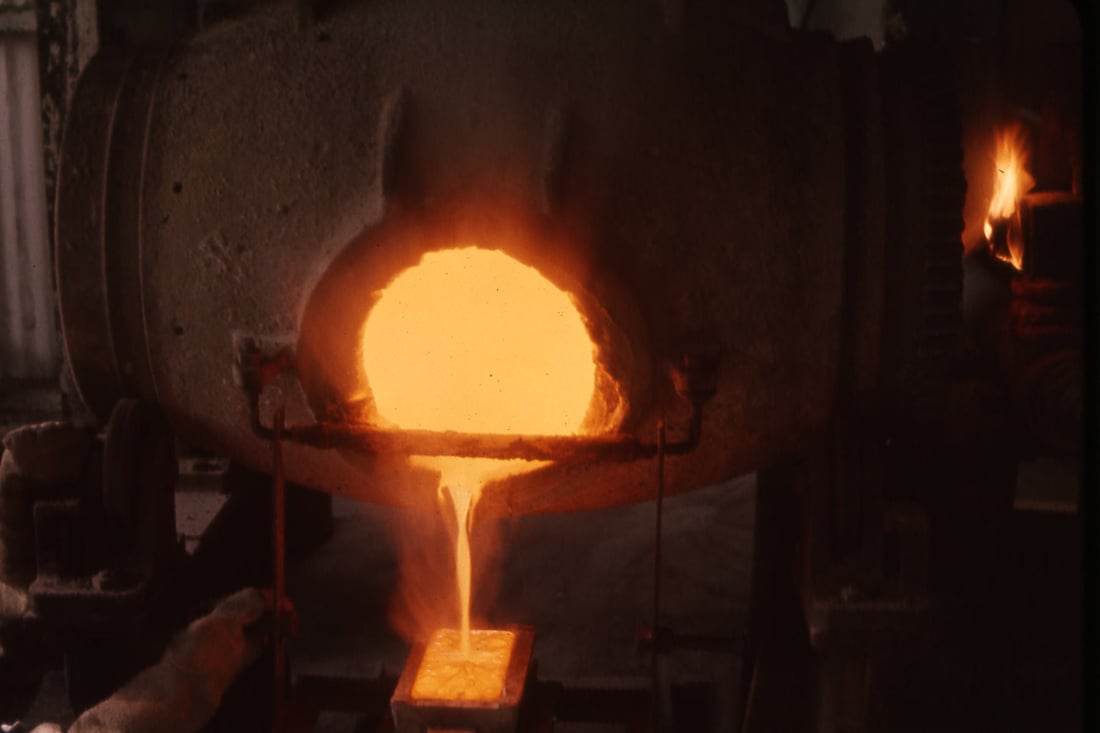
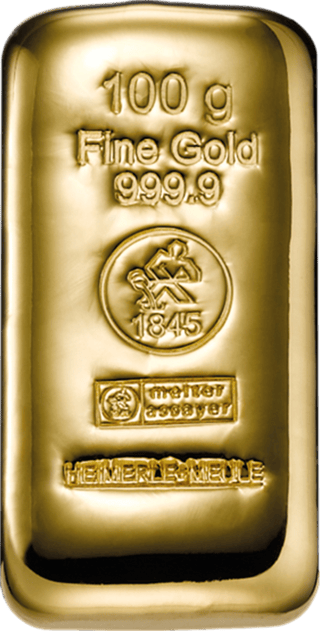 Castabout 40 × 20 mmabout 7.5 mm thick
The two bars shown here each weigh 100 grams and come from Heimerle + Meule. The minted one is flat, with crisply cut edges and a shiny face. The cast one has the smaller face and is more than twice as thick. Its edges are softly rounded.
Both carry the maker, weight and fineness. Heimerle + Meule supplies the minted bar in a card and the cast bar sealed in foil with a certificate.
On the 100‑gram bar by Heimerle + Meule we show where maker, fineness and weight are written and what the marks next to them mean.
Front
HEIMERLE+MEULE at the foot of the bar, and once more at the top of the card, with the caster, the emblem of the house. The gold and silver refinery is based in Pforzheim. Its history begins in 1845.
100 g, right at the top of the bar, above the fineness.
FINE GOLD 999.9 means 999.9/1,000: of 1,000 parts, 999.9 are gold. The back of the card gives the same number.
The stamp “melter assayer” names Heimerle + Meule as the melter and assayer of the bar. To its left is the emblem of the house.
The foot of the card says “LBMA Good Delivery Refiner”. Since 3 June 2014, Heimerle + Meule has been on the Good Delivery List of the LBMA, the association of the London precious metals market. The list applies to the large bars of about 400 ounces. The mark refers to the maker, not to the individual bar.
Back
The top of the back says “Fine gold 999.9, Guaranteed purity”. Beside it is the signature of Georg Steiner, Managing Director of Heimerle + Meule.
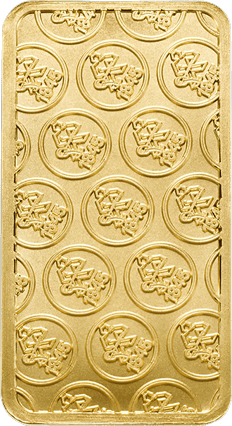
The back of the bar carries the round stamp of the house, row after row: the caster above the year 1845. He has been the emblem of Heimerle + Meule since 1933, and according to the maker every one of its gold bars bears him.
Tax law knows these details too: under § 25c of the German VAT Act, investment gold means gold bars of a weight accepted by the gold markets and a fineness of at least 995/1,000. The tax authorities mention punched or struck details of maker, fineness and weight. Investment gold is exempt from VAT in Germany.
“In principle, all gold bars have a number,” writes the Deutsche Bundesbank. Since 2015 it has published a list of all its bars every year, with number, weight and fineness. At the end of 2025 it listed 267,578 bars.
The maker assigns the number. There is no common format.
A gold bar is the clearest form in which value can be held: a piece of pure precious metal, recognised worldwide, independent of currencies and governments. Anyone who wants to buy gold bars is choosing the most cost-effective route into physical gold, because with a bar you pay almost exclusively for the material itself: the premium above the pure gold value is lower than with most coins. The following sections cover denominations, fineness, manufacturing methods, authenticity features, tax specifics and proper storage, so that every question about the purchase, from the first to the last, is answered clearly.
A gold bar is investment gold in its purest form. Unlike a coin, it carries no elaborate design and no face value: its value is determined almost entirely by the fine gold it contains. The price of gold is set in real time on every trading day on the financial markets, with the London gold exchange and the London Bullion Market Association (LBMA) as the central trading venue. The current daily price per gram or troy ounce determines what is due for a bar: in the Kettner online shop, the continuously updated rates reflect this performance on the world markets.
The great appeal lies in its simplicity: a bar is compact, easy to stack and can be sold anywhere in the world. Bars from well-known manufacturers with a certificate and the LBMA security features in particular can be converted back into cash quickly. In addition to classic gold bars, Kettner Edelmetalle also offers gold coins, whose premium is usually higher due to the elaborate minting.

Commercially available gold bars include all denominations from one gram upwards. A simple rule of thumb applies: the larger the bar, the lower the premium per gram. Minting costs are largely fixed, regardless of weight, which is why larger units are proportionally cheaper, while smaller ones offer more flexibility on resale.
Small denominations such as the 1 g gold bar, the 5 g gold bar or the 10 g gold bar are excellent for building up wealth step by step. Their advantage becomes clear when only part of the holding is to be sold: instead of touching a large bar, a small unit can be sold specifically. They are also popular as a means of exchange in times of crisis.
Anyone investing a larger sum gets the best value with the 100 g gold bar, the 250 g gold bar, the 500 g gold bar or even the 1 kg gold bar, because the premium is spread over more material. The troy ounce is the benchmark of the entire precious metals world and is also in demand when buying bars: the 1 oz gold bar is one of the most widely traded formats internationally.
The quality of a gold bar depends on its fineness. A gold content of at least 999/1,000 has become established as the standard for investment gold, equivalent to 99.9 percent pure gold. Bars with a lower content are usually only bought back at melt value and are rarely available from a classic gold dealer. Anyone who wants to achieve the best possible price on resale should therefore look for the highest possible fineness.
Some manufacturers now even state purity with decimal places: the so-called nine-five standard of 999.99 is currently considered top quality. Investment gold thus differs clearly from jewellery gold with a fineness of 585 (58.5 percent gold), which is alloyed with metals such as copper and silver and used primarily in jewellery making.
What to look for regarding fineness
A fineness of 999.9 (24 carat) is the reliable standard for investment gold bars. The serial number, the manufacturer's stamp and, for minted bars, the sealed blister card are among the most important authenticity features.
In production, a distinction is made between minted and cast bars. For the pure gold value, this makes no difference: 100 grams of fine gold remain 100 grams of fine gold. The choice is primarily a matter of appearance and character.
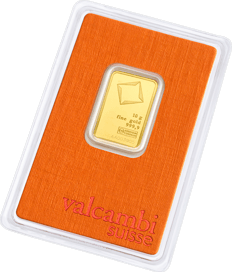
Minted gold bars resemble classic bullion coins: smooth, shiny surface, sharp edges, a clean appearance. They are usually produced up to 100 g and delivered in a sturdy blister card. This packaging should never be opened, as it is itself considered an authenticity feature.
Cast bars appear more rustic, with a rougher surface and irregular edges. They carry the charm of handmade craftsmanship and are usually cast from 250 g upwards, though occasionally also as a 100 g variant. Anyone who appreciates the raw, classic look will choose these.
In addition to classic bars, there is a range of special formats, each serving its own purpose.
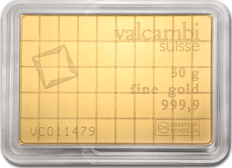
A CombiBar is like a bar of chocolate made of gold, except that the individual pieces can be broken off as needed without diminishing their value.
The manufacturer's reputation also plays a role in how easily a bar can be traded. Internationally recognised mints and refineries lend the product trust and liquid resale value. Well-known names include Heraeus, Valcambi with its CombiBars, PAMP Suisse, Umicore, Heimerle und Meule as well as the Austrian Mint.
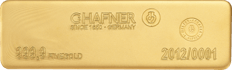
Fairtrade and recycled bars, in which strict ethical standards in production are observed, such as the exclusion of child labour and fair pay for mine workers, are gaining in importance. The manufacturer C.Hafner, for example, produces its bars from recycled gold. A complete overview of all brands carried can be found in the manufacturer overview.
Gold is valuable, and therefore a worthwhile target for counterfeiters. Reliable authenticity features are all the more important. For minted bars, the sealed blister card with serial number is the key feature; if it is opened, the resale value decreases. For cast bars, the manufacturer's stamp, the weight and the individual serial number serve as proof.
Kettner Edelmetalle relies on ISO-compliant authenticity verification and a fully automated, high-security logistics centre, so that every bar arrives with the buyer checked and securely packaged. Suitable coin capsules are ideal accessories for safe presentation and storage.
A key reason for buying gold bars is their tax treatment. In Germany, investment gold is exempt from VAT, an advantage that, for example, silver bars do not enjoy in the same way. This means the full purchase amount goes into the precious metal rather than into sales tax.
On top of that: anyone who holds a gold bar for longer than one year can collect any increase in value tax-free upon sale. For many investors, this combination counts as one of the strongest arguments for physical gold investment compared with investments such as silver bars or other precious metals.
Tax notice
Investment gold is exempt from VAT under the German VAT Act (Umsatzsteuergesetz). This information does not replace tax advice; for individual questions, consulting a professional is recommended.
The best investment is of little use if the gold is lost. Several storage options are available. The classic bank safe deposit box is widespread, but carries a risk: in a financial crisis, access can be temporarily restricted. Many investors therefore prefer storage outside the banking system, such as a high-quality safe at home in a discreet location.
Protection against theft, fire and moisture is important. Minted bars should remain in their original blister card, while small units can be collected in a space-saving way. Useful accessories such as coin cassettes help keep the holding organised and protected. Anyone holding larger quantities should also consider insurance.
The decision between a bar and a coin is often a matter of taste. Gold bars score with a lower premium: their value moves closer to the pure gold price, and there are no collector surcharges on purchase. They are compact and can be stored in a space-saving way.
Gold coins, on the other hand, delight with artistic designs and collector appeal. The world's most famous bullion coin is the Krugerrand from South Africa, alongside which the Maple Leaf and the Vienna Philharmonic are also in demand. Anyone who wants to invest regularly will also find suitable savings plan products. For a pure material investment, the bar is usually the more cost-effective choice; for the enjoyment of design and collecting, the coin.
Gold has accompanied humanity for thousands of years as a store of value that has outlasted wars, currency reforms and crises. At a time when classic forms of saving yield hardly any returns, inflation protection and wealth preservation are moving to the fore. A gold bar is not a promise of quick profit, but a piece of lasting stability that you can hold in your hand.
The behaviour of central banks, which have bought enormous quantities of gold in recent years, also speaks in favour of crisis protection. Anyone who sees physical gold as a building block of retirement provision values exactly this calm: a tangible asset that exists independently of the banking system and remains recognised worldwide.
You can order your gold bars directly here in the shop or by phone from our customer advisors on 07930-2699, Monday to Friday from 8 am to 8 pm. If you would like to invest a larger amount, our customer advisors will be happy to prepare an individual offer for you and discuss selection, payment and delivery with you. You can also put together your personal offer online.
Every shipment is insured for the full value of the goods. We pack your order in our own logistics centre in Germany and ship it in neutral boxes that give no indication of precious metals. For orders with a goods value of €20,000 or more, we recommend delivery by security courier. If your order is sent as a parcel, you will receive the tracking number by email. You can pay by bank transfer or directly online, for example with PayPal or credit card. The checkout will show you which payment methods are available for your order. You can read more about this under Shipping and Payment.
We will buy back, on request, gold bars that you have purchased from us. After logging in to our buy-back portal, you select the bars directly from your orders; you don't need an invoice for this. Bars from another purchase can be offered to us there with the purchase invoice. Whether we make an offer depends on the item, the quantity and our current demand.
You will usually receive a written offer within 24 hours. If you accept it, you will receive an insured DHL shipping label for shipping from Germany, free of charge for offers of €500 or more. Please send the bars in complete form, that is, with the blister card or certificate if they were delivered with one. Our experts check authenticity, completeness and condition, after which we transfer the amount to your account. The gold price on the day your bars reach us applies. Due to customs regulations, a buy-back from Switzerland and Liechtenstein is currently not possible.
The larger the bar, the lower the premium per gram, as minting costs are largely fixed. A 1 kg gold bar is therefore proportionally the cheapest, while a 1 g gold bar is the most flexible for partial sales. The right size depends on your budget and investment goal.
For the pure gold value, there is no difference. Minted bars have a smooth, clean appearance and usually come in a sealed blister card, while cast bars look more rustic. The choice is primarily a matter of taste and size.
A fineness of at least 999/1,000, i.e. 99.9 percent pure gold, is considered the standard. Some manufacturers offer even higher purity with 999.99 (nine-five standard). A high fineness secures the best possible price on resale.
Investment gold is exempt from VAT in Germany. If a gold bar is held for longer than one year, any increase in value is also tax-free upon sale. This information does not replace individual tax advice.
Authenticity features include the manufacturer's stamp with fineness and weight, an individual serial number, the certificate, and, for minted bars, the sealed blister card. LBMA-certified bars from well-known manufacturers can be traded safely worldwide.
A CombiBar is a gold bar with perforated break points that can be divided into individual one-gram pieces. In this way, it combines the attractive premium of a larger bar with the flexibility of small units, practical for targeted partial sales and as a crisis provision.
Stay informed with product launches, financial news and exclusive offers. Sign up for our free newsletter today.
By entering your email address and clicking the "Submit" button, you give the following consent: "I agree to be informed by email about new products, financial news and exclusive offers, and therefore consent to the processing of my email address for the purpose of sending the newsletter. I can revoke this consent at any time without giving reasons, with effect for the future. The lawfulness of processing carried out prior to revocation remains unaffected."