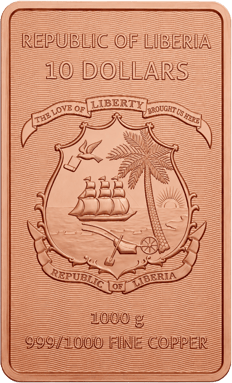
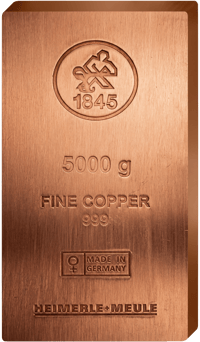
1kg Copper Bar Heimerle und Meule
€89.90€99.90
incl. VAT and excl. shipping
Ships from 24/11/2026

 More than 310,000
 Over 30 years
 Secure shipping
 Google: 4.9/5
Copper as an investment is enjoying increasing demand in the form of copper bars or copper coins. Rising industrial demand is making the freely available quantity of copper ever smaller and driving prices higher. Copper possesses excellent electrical and thermal conductivity and, due to its low internal resistance, is even more conductive than gold.


Most of us hold copper in our hands every day. The 1, 2 and 5‑cent coins have a skin of copper, with steel underneath. The Deutsche Bundesbank describes them as strongly magnetic.
The 10, 20 and 50‑cent coins are made of “Nordic gold”. It is not gold: the alloy is 89 per cent copper, with aluminium, zinc and tin added. It is not magnetic.
A magnet lifts the 1‑cent coin. The 10‑cent coin stays where it is.
The idea is older than the euro. The 1 pfennig coin of the D‑Mark had a steel core covered with copper on both sides. It measured 16.50 millimetres across, weighed 2.00 grams and was introduced in 1948. At 16.25 millimetres, the 1‑cent coin is almost the same size.
All three at the same scale. The diameters are given by the Deutsche Bundesbank, the ECB and our product data.
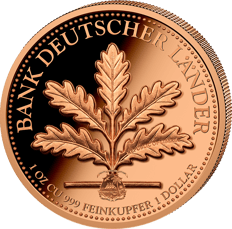
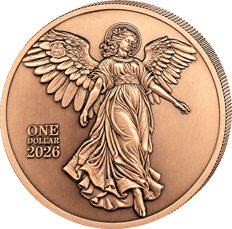
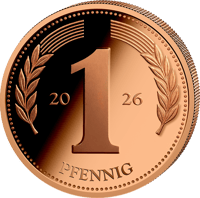 1 ounce copper Pfennig 2026Copper Pfennig 2026Liberia, 1 dollar1 ounce, 40 mmCopper 999/1,000
The design of the old pfennig, the numeral 1 between two ears of grain, now exists in copper for collectors. The coin was issued by Liberia, with a face value of 1 dollar.
Pure gold and pure silver are too soft for coins that pass through many hands. That is why copper was added to them. For the gold coins of the German Empire, the ratio was laid down in law.
“The mixing ratio of the Imperial gold coins is fixed at 900 thousandths gold and 100 thousandths copper.”
Gesetz, betreffend die Ausprägung von Reichsgoldmünzen, of 4 December 1871, § 4, Reichsgesetzblatt 1871, p. 404
Two years later, the silver coins were given the same formula. The Münzgesetz, the coinage act of 9 July 1873, lays down in Article 3: “900 parts silver and 100 parts copper” (Reichsgesetzblatt 1873, p. 234).
Sterling silver has a fineness of 925/1,000. According to The Royal Mint, the rest is usually copper, because copper makes the soft silver stronger.
Swiss gold coins, the Vreneli among them, are 90 per cent gold and 10 per cent copper. Of this alloy, Swissmint writes: “The colour of this material is quite red.”
The coins became yellow because the blanks were treated in a pickling bath before striking. In the process, copper is removed from the surface. The alloy itself makes the coin hard and resistant to wear and tear.
Goldmark, 1871Goldmark
Sterling silverSterling
Each grid has 1,000 squares, and each square is one thousandth. In sterling silver, the rest is usually copper.
The Statue of Liberty in New York is made of copper. Its skin is only 3/32 inch thick, about 2.4 millimetres, according to the National Park Service.
The copper was shaped in Paris, in the workshop of Gaget, Gauthier & Co. There the sheets were hammered over wooden forms, and the statue was assembled from 1881 to 1884.
The skin does not carry its own weight. Flat metal straps connect it to Gustave Eiffel’s framework. They hold the statue together and flex like springs.
Taken apart into 350 pieces, the statue arrived in New York on 17 June 1885 aboard the ship “Isère”. It was dedicated on 28 October 1886.

Both at the same scale, enlarged. The thickness of the skin is given by the National Park Service, that of the coin by the ECB.
There is a lot of copper in American small change, too. The 5‑cent coin is called the “nickel” there, but it is three quarters copper.
“The 5‑cent coin is an alloy of 75 percent copper and 25 percent nickel.”
United States Code, 2024 edition, Title 31, § 5112 (b)
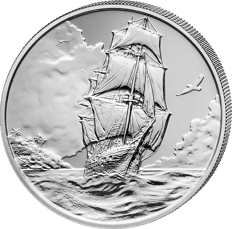
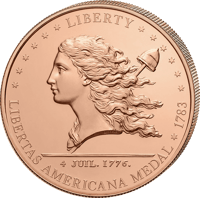 5 ounce copper Libertas Americana 2026Libertas AmericanaLiberia, 1 dollar5 ounces, 65 mmCopper 999/1,000
For collectors, there is the Libertas Americana 2026 in copper, issued by Liberia with a face value of 1 dollar.
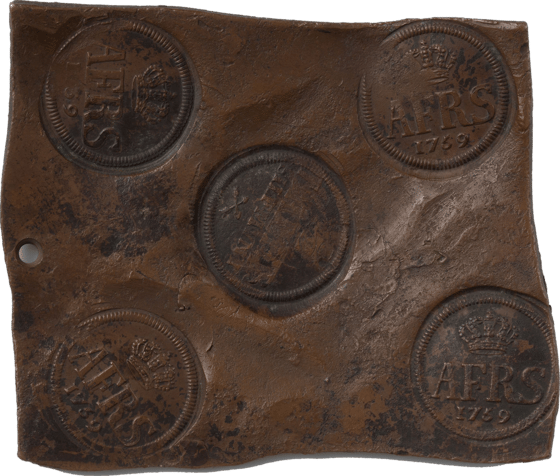
In Sweden in the 17th and 18th centuries, copper itself was money. The coins were worth as much as their metal. Because copper was worth less than silver, a copper coin of 10 daler had to be large and heavy.
The 10‑daler plate made at Avesta in 1644 weighs 19.7 kilograms. The Royal Coin Cabinet in Stockholm calls it the largest coin in the world.
The plates were moved on sledges. Europe’s first banknotes were issued in 1661 by Stockholms Banco. They quickly became popular because they were more convenient than the heavy copper coins, according to Sweden’s Riksbank.
Both at the same scale, seen from above. The measurements of the plate are given by the Rijksmuseum in Amsterdam, those of the coin by the ECB. A ½‑daler plate of 1759 with five stamps. Rijksmuseum Amsterdam, public domain (CC0).
By calculation: 19.7 kilograms is just under four bars of 5 kilograms each.
In the 17th century, at times around two thirds of the world’s copper came from Sweden, above all from the mine at Falun.
At Midsummer 1687, the mine collapsed. It left behind the “Stora Stöten”, a crater 95 metres deep. No miner was killed, because they all had time off to celebrate Midsummer.

In the Mansfeld region of Saxony‑Anhalt, the copper lies in a thin, dark layer of rock, the copper shale. It is only 20 to 40 centimetres thick and was laid down as sediment in a sea about 255 million years ago.
According to tradition, the miners Nappian and Neucke found this layer near Hettstedt in the year 1199. This is reported in the Mansfeldische Chronik by Cyriacus Spangenberg, dating from 1572.
Copper was mined here and near Sangerhausen for almost 800 years. Mining in the Mansfeld basin ended in 1969, near Sangerhausen in 1990.
Diagram of a section two metres high. The thickness of the layer is to scale, based on the Landesamt für Geologie und Bergwesen Sachsen‑Anhalt, the state office for geology and mining.
Shimmering reddish-brown, ancient and yet thoroughly modern: copper has accompanied humankind for over eight thousand years and today is found in almost every cable, every motor and every circuit board. For newcomers to the world of metals, it is the tangible first step: affordable to get into, honest in value and fascinating in its role as the pulse of the world economy. This guide shows what makes copper an investment metal, how the copper price is formed, which forms are suitable for buying and what matters for tax purposes.

Copper carries the element symbol Cu and is counted among the so-called semi-precious metals. Unlike gold or silver, its price is driven primarily not by investors but by industrial demand. That is exactly what makes copper so exciting: anyone investing in the metal is not betting on fear of crisis, but on progress, electrification and growth. For many, buying physical bars or coins is the emotional entry point into the world of tangible assets: you literally hold the raw material of progress in your hand.
Anyone wishing to first become familiar with the classic investment metals will find the more established alternatives in bullion coins and in the range of silver bars: copper complements this world as a down-to-earth, industry-close building block.
The copper price is a mirror of the global economy. Not without reason do analysts speak of "Dr. Copper", a metal with a doctorate in economics. When the economy is running smoothly, demand for cables, motors and plants rises; when it cools down, the price falls too. How strong this link is was shown by the Covid pandemic: when China shut down its industries early on, the price of the metal plunged immediately, only to climb all the more strongly in the following years.

After iron and aluminium, copper is the metal with the third-highest global consumption. It is easy to shape, resistant to corrosion, and forms the basis for the alloys brass and bronze. By far the largest share flows into equipment, buildings, infrastructure and transport, from the circuit board in a smartphone to the battery in an electric car.


On the supply side, mining output and extraction costs determine the price. By far the largest producer is Chile, followed by Peru, China and the USA; the Congo and Zambia in Africa also play an important role. If demand rises faster than new mines can be developed, extraction becomes more expensive, a structural factor that speaks in the metal's favour over the long term. One advantage remains its good recyclability: copper can be reused almost without loss, which secures a strong secondary supply.

Anyone wishing to compare the price dynamics of commodities with those of classic investment gold will find, in the gold bars section, a metal whose value is carried far more by investors and central banks than by industry: an instructive contrast.
Copper has been mined and processed since the so-called Copper Age, which begins in the eighth millennium BC. In more recent history, the price has always been marked by pronounced volatility. After the slump at the start of the Covid crisis, the price climbed in 2021 to what was then a record high of over 10,500 US dollars per tonne at times, and has since moved at a high level with the fluctuations typical of the metal.
Such retrospectives are no forecast: copper remains closely tied to the industrial cycle and is thus prone to fluctuation. As an addition alongside more stable assets from the gold coins range, however, it can round off a portfolio and increase its diversification.
Physical copper is traded chiefly in the form of bars. With a fineness of 999/1,000, these consist of pure copper and are individually sealed in plastic, which reliably protects against oxidation and the dreaded verdigris. Because the material value is low but the manufacturing effort relatively high, larger units are especially worthwhile. As a rule of thumb: the larger the denomination, the better the value for money.
Weights commonly available in German trade range from the handy ounce up to the hefty five-kilogram bar. Anyone wishing to compare the available sizes in detail will find them bundled in the range of copper bars.
Tax note
Unlike investment gold, copper is not exempt from VAT. The full 19% VAT applies on purchase, a point that must always be factored in when comparing it with VAT-exempt investment gold.
Alongside bars, there is a large, often surprisingly creative selection of copper coins. Because of the small amount of material, they are less suited to classic investment purposes but all the more so as collector's items and gifts. The range extends from richly detailed animal designs through Panda and Buffalo issues to unusual themed series: a loving present for enthusiastic coin collectors, available for just a few euros.
Popular design worlds can be found, for example, with the China Panda, the American Buffalo or in the commemorative coins. Anyone who pursues copper purely as a collecting passion likes to combine it with thematically matching silver coins.
Copper reacts more sensitively to environmental influences than gold or silver: moisture and hand perspiration promote oxidation and the greenish coating known as patina. For this reason, bars are delivered sealed and should, as far as possible, remain dry and in their original packaging. Coins are best kept individually protected.
Anyone wishing to invest in copper essentially has two routes. The first is buying physical copper in the form of bars and coins: a genuine tangible asset that you own and hold in your hand. The second route leads via the stock exchange to copper securities: these include exchange-traded ETFs and ETCs (Exchange Traded Commodities), funds, and speculative leveraged products such as CFDs. The underlying price is formed on major commodity exchanges such as the London Metal Exchange, the COMEX in New York and the Shanghai Futures Exchange.
Securities are convincing thanks to low trading costs and easy tradability, but they carry issuer and counterparty risk and merely track the price. Physical copper, on the other hand, always retains a real residual value, even if the price collapses; the price for this security is the premium, storage and the full VAT. For newcomers seeking a tangible entry point and focused less on short-term returns than on a long-term tangible asset, the physical purchase is often the more fitting choice, both emotionally and rationally. Anyone wishing to save into metals regularly will find suitable options in the savings plan products.
Copper is no substitute for the major investment metals, but it is an appealing building block, especially for anyone seeking an entry point into physical tangible assets. A sober look at both sides helps with putting it into perspective.
Advantages
Disadvantages
Anyone who sees copper as a first step and wishes to deepen the tangible-asset idea will find obvious next stops in the investor packages and with the silver coins.
Copper is a volatile semi-precious metal with limited but real opportunities. As a sole investment it is not very suitable, but as an addition for diversification and as an affordable entry point into physical tangible assets, it is indeed interesting. There is no guarantee of returns: this information does not replace investment advice.
Unlike investment gold, copper is not VAT-exempt. The full 19% VAT applies when buying copper bars and copper coins. This cost factor should be included in the calculation.
Copper bars have a fineness of 999/1,000 and are usually offered in sizes from one ounce up to five kilograms. Larger denominations generally offer the better value for money. An overview can be found in the range of copper bars.
Because the state of the world economy can be read from the copper price. As a cyclical commodity, copper rises in economic upswings and falls when industry cools down, hence the tongue-in-cheek nickname "Dr. Copper".
Pure copper has a characteristic salmon-red to reddish-brown, shiny colour. If the metal shows clear colour deviations under neon light or direct sunlight, it is usually an alloy such as brass or bronze.
Volatility describes the strength of price fluctuations. Copper is considered a volatile commodity whose price can swing strongly in either direction. This opens up opportunities, but likewise carries a higher risk of loss than with more stable investments.
Stay informed with product launches, financial news and exclusive offers. Sign up for our free newsletter today.
By entering your email address and clicking the "Submit" button, you give the following consent: "I agree to be informed by email about new products, financial news and exclusive offers, and therefore consent to the processing of my email address for the purpose of sending the newsletter. I can revoke this consent at any time without giving reasons, with effect for the future. The lawfulness of processing carried out prior to revocation remains unaffected."