1 oz Gold Britannia 2027 (40th Anniversary Edition)
€3,462.61
VAT-free and excl. shipping
Available in 3–4 business days

 More than 310,000
 Over 30 years
 Secure shipping
 Google: 4.9/5
Since the minting year 1987, the British Royal Mint has been striking the Gold Britannia with great success and growing popularity among gold investors. After all, the gold coin is available in top quality with a fineness of 999/1000. The obverse features an annually varying image of Britannia (symbol of the United Kingdom), which has changed each year since 2007.


The Britannia gold coin is regarded as Europe's first modern bullion coin, combining British symbolism with investment-grade quality. Minted since 1987 by the British Royal Mint, it depicts the warrior national figure Britannia with trident, shield and helmet: a design that casts the pride of an entire maritime nation into a 999.9/1,000 fine gold coin. The following sections cover its history, changing designs, denominations, security features, tax treatment and the question of who the Britannia suits as part of a precious metals holding.

When the Royal Mint issued the first Britannia in 1987, the United Kingdom entered the bullion coin market late, but firmly. While the Krugerrand from South Africa had already dominated the world market since 1967, the British bullion coin needed a few years to gain recognition. Today, the Britannia ranks among the best known gold coins worldwide, and investors mention it in the same breath as classics such as the Maple Leaf or the Vienna Philharmonic.
Its appeal lies in the combination of a state minting guarantee, high fineness and a design that varies every year yet remains unmistakable. The Britannia is a bullion coin in the classic sense: its value is measured by its pure gold content, not by a collector's premium, and that is precisely what makes it attractive for long-term wealth building.
The name derives from the Latin word Britannia, the Roman term for the island of Britain, which became established around 50 BC during the Roman occupation. The Romans honoured the land with a female deity: a powerful woman in warrior's armour. Over the centuries, this figure became a national symbol representing the strength of British sea power and patriotism.
This symbolic figure can still be found throughout the United Kingdom today, from ship and company names to commemorative and bullion coins. On the modern gold coin, Britannia usually wears a helmet and carries a trident, often accompanied by a shield or the Union Jack. The trident refers to dominion over the seas, the helmet to military strength.
Britannia embodies not just a country, but an idea: that of a nation that for centuries saw itself as a maritime power.
Collectors and investors with a passion for British minting tradition will also find it worthwhile to look at related Royal Mint series such as the Queen's Beasts or the historic Sovereign, which has been minted since as early as the 15th century.
The design side (obverse) shows the image of Britannia with trident, shield and helmet. The original design was created by designer Philip Nathan, whose signature "Nathan", shown as "P. Nathan" on Proof strikes since 2001, appears on the coin. This design remained unchanged from the first issue until 1996; changing designs were only introduced for the tenth anniversary.
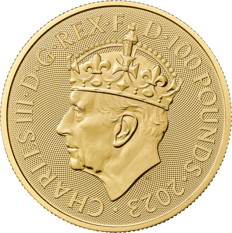
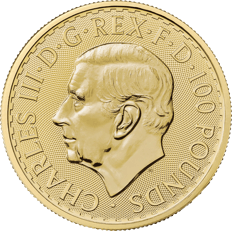
Since 2007, the design on the front has changed without a fixed pattern. The back (reverse) traditionally shows the portrait of the head of state along with the face value. For decades, this was Queen Elizabeth II, whose portrait was adjusted for her age several times, most recently in 2016 by the artist Judy Clark, and before that by Ian Rank-Broadley and Raphael David Maklouf.
Following the death of Queen Elizabeth II, the series underwent a historic change: since December 2022, the Britannia has carried the portrait of King Charles III. In doing so, the Royal Mint follows an old tradition: living monarchs usually face right, deceased ones face left. Charles faces left, while Elizabeth II faced right on earlier issues. The last strikes bearing the portrait of the late Queen are only available in limited mintage and are therefore particularly sought after by collectors.
The Britannia has been available in four classic denominations since its first issue in 1987. Until 2012, the fineness was 916.67/1,000, with the coins alloyed with copper and showing a slightly reddish-yellow shimmer. Since 2013, the Britannia has been issued as "four nine fine" at 999.9/1,000, in other words in the purest 24 carat fine gold. The face value of the 1 oz coin is 100 British pounds.
| Denomination | Fine weight | Face value | Diameter |
|---|---|---|---|
| 1 oz | 31.10 g | £100 | 32.69 mm |
| 1/2 oz | 15.55 g | £50 | 27.00 mm |
| 1/4 oz | 7.78 g | £25 | 22.00 mm |
| 1/10 oz | 3.11 g | £10 | 16.50 mm |
The large 1 oz coin offers the best ratio of material value to minting costs and is the classic choice for long-term wealth building. The smaller fractional coins, such as the 1/10 oz, are more expensive per gram but more flexible for later resale and popular for a gradual entry. Anyone wishing to invest small amounts regularly will find a suitable complement in the savings plan products. A historical point of interest: until 1989, copper was used as the alloying metal, after which a mixture of equal parts silver and copper was used.
The Britannia is not limited to gold: the Royal Mint also issues it in silver and platinum. The silver Britannia ranks among the most traded silver bullion coins in Europe, while the platinum Britannia, with a fineness of 999.5/1,000, is a niche product for connoisseurs. This diversity across several precious metals underlines just how firmly the bullion coin has established itself in recent decades.
For a long time, demand for the Britannia was low, and the Royal Mint had little to show in the bullion coin segment. It was only with the global success of series such as the UK Lunar Series and the Queen's Beasts that interest in the Britannia also rose significantly. Anyone wishing to diversify their precious metals portfolio more broadly often combines gold coins with gold bars of various sizes.
The Britannia is regarded as one of the most counterfeit-proof bullion coins of all. Since 2021, the Royal Mint has integrated several security features directly into the minting process:
The Latin motto "Decus et Tutamen" means "Glory and Defence" and originally came from the edge of British coins. In addition, the coin's edge is reeded. These features allow for a quick visual authenticity check. As an official specialist dealer, Kettner Edelmetalle subjects every coin to an ISO-compliant authenticity verification before it leaves the logistics centre. For secure storage at home, suitable coin capsules and coin tubes are available, protecting the sensitive surface from scratches.
Investment gold enjoys a special tax status in Germany, which makes the Britannia particularly attractive for wealth building.
Tax note
Investment gold coins such as the gold Britannia are exempt from VAT in Germany under the regulations on investment gold. After a holding period of more than one year, any capital gain is exempt from income tax for private individuals. This does not constitute tax advice; in individual cases, consulting a tax advisor is recommended.
Several storage options are available: a home safe deposit box, a safe, or a bank safe deposit box. Protection against mechanical damage is important, as scratches or fingerprints can reduce the value of a Brilliant Uncirculated (BU) coin. For larger holdings, coin cases are suitable, keeping several coins neatly and securely stored. Anyone who views the Britannia as a building block of retirement provision or as an inflation hedge should store the coins carefully for the long term.
The Britannia appeals to a broad audience. For beginners, the small denominations offer an affordable way to gain initial experience with physical gold. For experienced investors, the 1 oz coin is a liquid, globally recognised standard value. And for collectors, the annually changing designs as well as special editions, such as the Proof strikes or earlier editions with an oriental frame, offer additional appeal.
Compared to other classics, the Britannia scores with its high fineness and strong symbolism. Those who prefer the South African legend will find its robust counterpart with a copper alloy in the Krugerrand; those seeking Canadian purity turn to the Maple Leaf. Within the broad range of gold coins, the Britannia thus occupies a firm place as a European standard value.
Since 2013, the gold Britannia has been issued with a fineness of 999.9/1,000, in other words in 24 carat fine gold. Older years up to 2012 had a fineness of 916.7/1,000 and were alloyed with copper or silver respectively.
The standard denominations are 1 oz, 1/2 oz, 1/4 oz and 1/10 oz. The 1 oz coin offers the best ratio of material value to minting costs, while the smaller fractional coins are more flexible when selling and ideal for a gradual entry.
Yes. As investment gold, the gold Britannia is exempt from VAT in Germany. After a holding period of more than one year, any potential capital gain also remains exempt from income tax for private individuals. Please note that this does not replace tax advice.
Following the death of Queen Elizabeth II, the portrait on the back was replaced with the image of King Charles III from December 2022. Charles faces left, following an old tradition in which the direction of the gaze changes with each change of throne.
Today, the Britannia is made of pure 999.9/1,000 fine gold, while the Krugerrand is alloyed with copper, making it more scratch-resistant but more reddish in colour. Both rank among the most traded investment gold coins in the world and are readily tradable internationally.
Since 2021, the Britannia has featured a wavy coin background, a latent changing image, and the micro-fine laser-engraved inscription "DECUS ET TUTAMEN". These features make the coin particularly resistant to counterfeiting and allow for a quick visual check.
 Britannia
Stay informed with product launches, financial news and exclusive offers. Sign up for our free newsletter today.
By entering your email address and clicking the "Submit" button, you give the following consent: "I agree to be informed by email about new products, financial news and exclusive offers, and therefore consent to the processing of my email address for the purpose of sending the newsletter. I can revoke this consent at any time without giving reasons, with effect for the future. The lawfulness of processing carried out prior to revocation remains unaffected."