


Sold out

1 Ounce Palladium Cook Islands
€1,096.29
incl. VAT and excl. shipping
currently not available

 More than 310,000
 Over 30 years
 Secure shipping
 Google: 4.9/5
A legendary sailing ship, palladium of investment quality, and a mintage that leaves even experienced collectors puzzled: the Palladium coins of the Cook Islands are among the most unusual phenomena of the modern precious metals market. They combine the rarest of the four classic investment metals with the famous design of the Bounty and a story that tells of mutiny, the South Seas and German minting craftsmanship. This guide examines the origin, design, technical data, authenticity, taxation and market environment of this special bullion coin.
The Cook Islands are an island nation in the South Pacific in free association with New Zealand and part of the Commonwealth. In the precious metals sector, this small archipelago became known above all for its agency coins: coins produced on behalf of the Cook Islands by specialised European mints, officially carrying legal tender status. After the Bounty series had proven successful on the market in gold, silver and platinum, it was decided to offer the design in palladium as well.
The result is a pure bullion coin with a fine weight of exactly one troy ounce (31.103 g), a fineness of 999.5/1,000 and a face value of 50 Cook Islands dollars. It has been issued exclusively in this one denomination and appears with a consistent design but a changing year of issue. Anyone generally interested in this metal will find the full range in the parent category Palladium Coins, while the related Palladium Maple Leaf series from Canada represents an internationally even better-known alternative.
Hardly any design in the world of coins is as closely linked to a true story as the Bounty. The British three-masted ship set sail on a South Seas expedition in the 18th century. On the return voyage came the famous Mutiny on the Bounty: part of the crew seized control of the ship. The mutineers wandered through the Pacific and eventually ran the Bounty aground off Pitcairn Island, near the Cook archipelago, where it later burned down. This dramatic episode has been made into a film several times and made the ship world-famous.
It is precisely this connection that explains why the Bounty appears on the coins of the Cook Islands. The palladium issue came onto the market in November 2008 and already bears the year 2009. Gold, silver and platinum versions had paved the way before it. The historically rich symbolism clearly sets this coin apart from purely functional bullion products such as classic bars, as found for example in the Palladium Bars category.
A design that tells not of an idea but of a real mutiny on the high seas: that is what makes the Bounty in palladium more than just a bullion coin.
Production of the Bounty coins has not always been in the same hands. Originally, the Australian Perth Mint was involved in production, but discontinued this in 2008. Production of the palladium issue was then taken over, under licence from the Cook Islands, by the traditional German refinery Heimerle & Meule. The coin is thus an example of a Pacific island nation acting as issuing country, while the actual minting craftsmanship comes from Germany.
Early mintages were struck in Proof quality, that is, with a frosted design against a mirrored background. Anyone interested in the origin of these mintings will find further products from this refinery under Mintings by Heimerle and Meule. For attractive long-term storage of such mintings, suitable coin capsules are available, protecting the sensitive surface from scratches and fingerprints.
The Palladium Cook Islands is clearly defined technically and easy to identify. The most important figures at a glance:
| Feature | Specification |
|---|---|
| Denomination | 1 troy ounce |
| Fine weight | 31.103 g |
| Fineness | 999.5/1,000 palladium |
| Face value | 50 Cook Islands dollars |
| Diameter | 38.60 mm |
| Thickness | 2.70 mm |
| Edge | reeded |
| Design | Bounty sailing ship / Portrait of the Queen |
The design side shows the Bounty under full sail: a 28-metre-long English three-masted ship fitted with several cannons. Around the edge are the face value 50 CI$ as well as the inscription 1 oz fine Palladium .9995, which documents the metal and fineness directly on the coin. Many collectors regard the sculptural ship design as one of the most beautiful in the maritime world of coins.
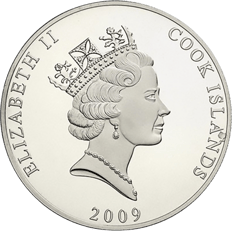
The reverse bears the portrait of Queen Elizabeth II as Head of the Commonwealth, to which the Cook Islands belong. Above the portrait, in large letters, is written COOK ISLANDS, and below it the respective year of minting. This design is typical of Commonwealth issues and appears in similar form on numerous other series, such as the Silver Coins of the Cook Islands or the Gold Coins of the Cook Islands.
Palladium is the youngest of the four classic investment metals. It was only discovered at the beginning of the 19th century and named after the asteroid Pallas, whereas gold has been known to mankind for thousands of years. Its importance as an investment asset is correspondingly young: only in recent decades has it moved more strongly into investors' awareness through its industrial demand.
The largest share of the palladium mined worldwide flows into the automotive industry, above all into catalytic converters for petrol vehicles. Further areas of use are found in electronics, dentistry and jewellery manufacture. Pure palladium deposits, such as those that once existed in the Urals, are largely exhausted; today the metal is mostly obtained as a by-product of mining other metals. This limited availability is one of the reasons why palladium coins are issued with comparatively small mintages. For investors wishing to diversify their portfolio more broadly, palladium can be a sensible addition alongside gold coins and silver coins.
The market for palladium coins is significantly smaller than that for gold or silver. There are fewer designs, fewer issuing countries and, as a rule, smaller mintages. The exact mintage figure of the Palladium Cook Islands has never been officially published, but is considered low. This combination of metal rarity and low mintage gives the coin particular appeal for collectors.
Unlike continually re-minted bullion classics, on the secondary market one mainly encounters early years of issue in good condition. Anyone acquiring such a coin secures not only a metal value but also a piece of minting history. Similarly rare collector potential is offered by limited editions, as grouped together in the Rarities category. For the protected presentation of several pieces, coin cases are suitable, combining order and value preservation.
An important difference compared to investment gold: while investment gold is exempt from VAT, palladium coins in Germany are generally subject to VAT. When purchasing, the standard VAT rate must be taken into account, which increases the entry price compared to VAT-exempt gold products. This aspect should be factored into the calculation.
Also relevant for private investors is the holding period: if at least twelve months lie between purchase and sale, any capital gain is tax-free under current law. This rule applies equally to other physical precious metals. Anyone wishing to benefit from the tax advantage of gold will find VAT-exempt alternatives in the Gold Bars category.
Tax Note
Palladium coins are subject to VAT in Germany. However, a profit from the sale is tax-free for private individuals if more than twelve months lie between purchase and sale. This does not constitute tax advice: for individual cases, expert advice should be sought.
When acquiring a Palladium Cook Islands, it is worth looking at a few criteria. Since the coin has the metal and fineness stamped directly onto it, it can be verified well. Important indicators of authenticity:
The same applies to storage as for other high-quality precious metals: dry, free from vibration and protected from contact. In addition to capsules and cases, for larger holdings storage in a bank safe deposit box or a home safe is advisable. Accessories for collectors and investors can be found bundled together in the Accessories category. At Kettner Edelmetalle, coins on offer undergo an ISO-compliant authenticity verification and are shipped fully insured.
Palladium is primarily suited to diversifying an existing precious metals portfolio. Since it depends heavily on industrial demand, its price development often differs from that of gold and silver, which can be an advantage in terms of diversification. Investors therefore often regard palladium as an addition rather than a core investment. Anyone wishing to invest more broadly likes to combine it with classics from the Bullion Coins category or supplement it with platinum coins as a fourth precious metal pillar.
The emotional component should not be underestimated: the Bounty coin combines investment thinking with a genuine seafaring story. It is precisely this mix of store of value and narrative piece that makes the Palladium Cook Islands so attractive to many collectors.
The obverse shows the legendary sailing ship Bounty, an English three-masted ship that became known through the historic mutiny. The reverse bears the portrait of Queen Elizabeth II as well as the inscription COOK ISLANDS and the year of minting.
The coin is issued exclusively as a 1-ounce edition with a fine weight of 31.103 g and a fineness of 999.5/1,000 palladium. The face value is 50 Cook Islands dollars, the diameter 38.60 mm.
After the Perth Mint discontinued production in 2008, the German refinery Heimerle & Meule took over production of the palladium issue under licence from the Cook Islands.
Palladium coins are subject to VAT at the time of purchase. A capital gain is tax-free for private individuals, provided more than twelve months lie between purchase and sale. This does not replace individual tax advice.
Palladium is a scarce precious metal that is predominantly obtained as a by-product of other metals. The coin market is young and smaller than that for gold or silver, with few designs and low mintages, which increases its appeal to collectors.
Weight, diameter, thickness and the reeded edge must match the specifications. In addition, the marking 1 oz fine Palladium .9995 is stamped on the coin, and palladium does not react to a magnet.
 Cook Islands
Stay informed with product launches, financial news and exclusive offers. Sign up for our free newsletter today.
By entering your email address and clicking the "Submit" button, you give the following consent: "I agree to be informed by email about new products, financial news and exclusive offers, and therefore consent to the processing of my email address for the purpose of sending the newsletter. I can revoke this consent at any time without giving reasons, with effect for the future. The lawfulness of processing carried out prior to revocation remains unaffected."