 280,000
  30 years
  Secure


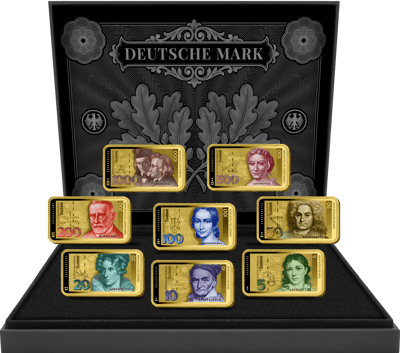


Deutsche Mark Banknotes Silver Set (Mintage: 50 | partially gilded)











 Most Popular Product: Number 1 in category 1 oz Silver Bars
- Rarity: Only a few specimens left in stock
- Shipping costs: Free shipping within Germany available
 Price alert set
 share
share
The D-Mark in Precious Metal: Eight Banknotes as a Strictly Limited Bar Set
- Strictly limited: A very low mintage of only 50 pieces worldwide – the number of pieces is firmly capped
- Growth potential: Very high value appreciation potential due to the strict limitation and the strong demand for D-Mark designs
- Rarity: An exceptionally rare collector's coin in bar format, rarely seen
- Investment goal: An extremely rare collector's set that, thanks to its strict limitation, holds high value appreciation potential – underpinned by the lasting material value of pure silver
- Design: All eight banknotes of the last D-Mark series, from Bettina von Arnim on the five-mark note to the Brothers Grimm on the thousand-mark note – colour-refined on partially gilded silver bars
- Manufacturer: Kettner Edelmetalle, struck on bars by the traditional Pforzheim refinery Heimerle + Meule
- Country of origin: Germany
Who doesn't remember the blue hundred-mark note featuring Clara Schumann? Or the five-mark note with the Brandenburg Gate on the back? For millions of people, the Deutsche Mark was far more than just a means of payment. It stood for reconstruction, reliability, and a good deal of pride. With this set from the "History" series, Kettner Edelmetalle creates a precious metal monument to the good old D-Mark: eight minted bars that reproduce every banknote from the last series. The mintage of just 50 pieces makes this ensemble a genuine rarity.
From 1948 to 2001: A Currency Writes German History
With the currency reform of 20 June 1948, the D-Mark arrived in the three Western zones. Every citizen initially received a "head start payment" of 40 DM – the prelude to the boom that would later go down in the history books as the Wirtschaftswunder (economic miracle). For more than five decades, the Mark accompanied the country. Then, on 1 January 2002, the Euro took over.
The designs of this set come from the fourth and final banknote series of the Deutsche Bundesbank. It was issued in stages starting on 1 October 1990, was designed by Reinhold Gerstetter, and depicts historical figures from German cultural and scientific history. It is precisely these faces that now make their return.
Eight Notes, Eight Personalities
- 5 Deutsche Mark: Writer Bettina von Arnim, with the Brandenburg Gate on the reverse
- 10 Deutsche Mark: Mathematician Carl Friedrich Gauss with a bell curve, a sextant on the reverse
- 20 Deutsche Mark: Poet Annette von Droste-Hülshoff, along with a quill pen and beech tree referencing "Die Judenbuche"
- 50 Deutsche Mark: Baroque architect Balthasar Neumann with views of Würzburg and Neresheim
- 100 Deutsche Mark: Pianist and composer Clara Schumann, with a concert grand piano on the reverse
- 200 Deutsche Mark: Physician Paul Ehrlich and his microscope
- 500 Deutsche Mark: Naturalist Maria Sibylla Merian, along with a dandelion with caterpillar and butterfly
- 1000 Deutsche Mark: Jacob and Wilhelm Grimm, with the "German Dictionary" (Deutsches Wörterbuch) on the reverse
Refinement with an Eye for Detail
The foundation of each note is a minted bar from Heimerle + Meule. Founded in Pforzheim in 1845, the company is considered Germany's oldest gold and silver refinery. Each of the eight bars contains one troy ounce of fine silver with a fineness of 999.9/1,000; the complete set totals a fine weight of 248.8 g.
Then the real artistry begins. Partial gilding gives the bars their warm sheen, while high-quality colour refinement brings back the notes' characteristic tones: the violet of the Gauss portrait, the red of the two-hundred-mark note, the green of the Bettina von Arnim note. The reverse sides show the original notes' imagery in golden relief, complemented by the inscriptions "1 oz" and "9999 fine silver". You can hardly get closer to the old banknotes than this, short of holding the originals in your hand.
The set is presented in Brilliant Uncirculated condition in a dark case, its lid adorned with guilloché ornamentation, oak leaves, and the Federal Eagle, evoking the design of genuine securities.
Where Collector's Value Meets Material Value
A classic 1-ounce bar impresses through its pure metal value alone. This set goes one step further. It combines 248.8 g of fine silver with a very low mintage, an emotionally charged design, and a complete collection – the ideal choice for collectors of Deutsche Mark motifs. Those who already own individual bars, a silver coin, or the silver commemorative coins from the D-Mark era can now complete their collection in one go with the entire banknote series.
Unlike most commemorative coins, which were issued in large numbers over decades, this set remains a small, manageable edition. That gives it a character all its own.
Of course, there are a few points worth knowing. The gilding and colouring are delicate; the bars are best kept in their case and should only be handled with cotton gloves. And the value of such a set is not measured by the silver price alone, but by rarity, craftsmanship, and demand. This is exactly what makes it appealing to collectors – something a standard bar simply cannot offer.
The D-Mark is history. Owning its banknotes in precious metal, however, remains a privilege – for just 50 collectors worldwide.
Why Silver Convinces as a Foundation
Silver has accompanied humanity for millennia as a coin and money metal. It is durable, tradable worldwide, and possesses an intrinsic value that does not depend on any government's promise. Add to that the strong demand from electronics, solar, and medical technology alongside a limited supply. Many investors therefore value the metal as an inflation hedge and as a building block for their personal crisis protection. A tax advantage: profits from the sale of physical silver in Germany are generally tax-free after the one-year holding period has elapsed.
At the heart of this set, however, lies the passion of collecting. Eight notes, one era, strictly limited to 50 pieces. For those who carry the D-Mark in their heart, there is hardly a more beautiful way to preserve it – and later pass it on to children or grandchildren.
Product depiction may differ from the final product.
