




Unfortunately, this item is currently out of stock. We will be happy to send you an e-mail as soon as this product becomes available again.

 100 ounces of pure silver as a stable investment
- Top 20 product for inflation hedge and crisis security
- Free and insured shipping within Germany
- Iconic investment: 100 x 1 ounce silver Krugerrand, the renowned South African investment product in pure silver quality
- Crisis-proof investment: Protect your wealth with the Krugerrand against inflation, a Top 20 product for stability
- Free shipping: Benefit from secure and free delivery within Germany, with 100% insurance
 Price alert
  Share
ShareKrugerrand · 2024 Issue
The leap that began in 1967.
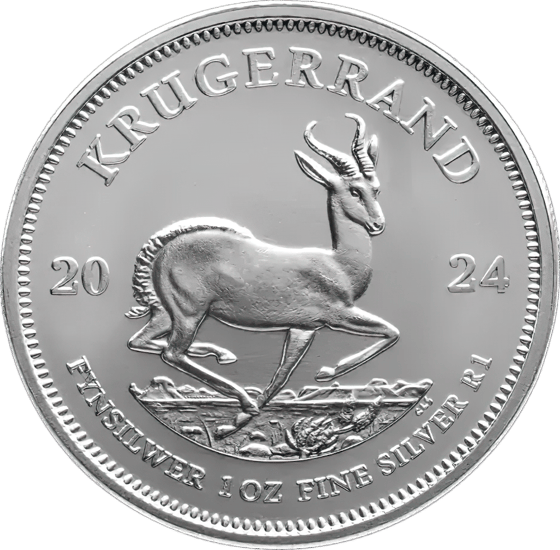

You are looking at the side with the springbok.
Gold for the hands of ordinary people.
In the late 1960s, around three quarters of the western world’s gold came from South Africa. The Chamber of Mines wanted ordinary people, too, to be able to own gold.
With the Krugerrand, a new kind of coin came into being for this purpose: exactly one ounce of fine gold, with no face value struck on it. Its value was meant to come directly from the gold it contains.
6,012,293
Krugerrand bullion coins were issued in 1978 alone, 187 tonnes of gold in all.
A leap through history
1886
Gold on the Witwatersrand
On the Witwatersrand, the ridge of white water, rich gold deposits are discovered. South Africa’s currency is also named after it: the rand.
1947
The springbok
The sculptor Coert Steynberg draws his springbok in 1946 and 1947. It first appears in 1947 on the 5-shilling coin marking the visit of the British royal family.
1967
The first Krugerrand
On 3 July, commissioned by the South African Reserve Bank and the Chamber of Mines, the South African Mint strikes the first Krugerrand.
1980
Smaller sizes
The half ounce, the quarter ounce and the tenth ounce are added so that smaller sums can also be invested in gold.
2017
Fifty years
For the anniversary, the first silver Krugerrand appears, along with the 1/20 and 1/50 ounce in gold. For these coins, the designers go back to the original wax models and designs.
The motif
The springbok and the president
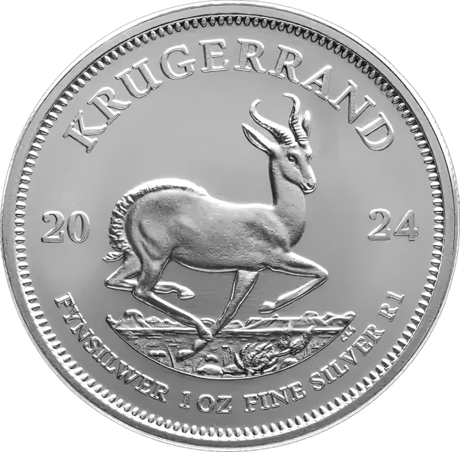

- The springbok
- South Africa’s national animal in mid-leap. The springbok owes its name to its characteristic leaps. It was designed by the sculptor Coert Steynberg.
- The aloe
- The motif includes an Aloe claviflora, one of South Africa’s best-known aloes. It grows in the dry interior of the country, where the springbok is also at home.
- Fynsilwer
- Below the springbok is the weight in fine silver, framed by FYNSILWER in Afrikaans and FINE SILVER in English. Fynsilwer means fine silver.
- Paul Kruger
- The other side shows Paul Kruger in profile. In 1883 he became president of the South African Republic, also known as the Transvaal. The portrait was created by the die engraver Otto Schultz. According to the South African Mint, it goes back to the Kruger half-crown of 1892.
- The name
- Krugerrand combines the name Kruger with the rand, South Africa’s currency.
The silver
Fine silver with a face value
The silver Krugerrand is struck in fine silver, with a fineness of 999 parts per thousand. Unlike the gold coin, it bears a face value in rand: R1 on the one-ounce coin, R2 and R5 on the larger coins.
The South African Mint produces the bullion coins together with the Rand Refinery. The silver bullion coin has existed since 2018. It has no fixed mintage: as many are struck as the market demands.
The same leap since 1967.
This issue too.
By its 50th anniversary in 2017, more than 60 million Krugerrands had been sold. The 2024 issue is part of this story, and the story goes on, in your hand and perhaps one day in the hand of someone you pass it on to.
100 coins, each with 31.1 g of fine silver.
999/1,000 · Brilliant uncirculated
· Münztube
Issuing country: South Africa. The South African Mint is a wholly owned subsidiary of the South African Reserve Bank.
100 x 1 Unze Silber Krügerrand 2023
- Motiv: Ein Bildnis von Paul Kruger
- Material: Silber mit einer Feinheit von 999/1.000
- Versand: erfolgt in mehreren Münztuben
- Herkunft: Südafrika
- Investitionsziel: Krisenschutz, Wertanlage
✔ Die Silber-Variante des Krügerrands
In diesem Paket befindet sich die Silber-Variante des Krügerrands gleich 100 Mal. Die Silbermünzen haben eine Feinheit von 999/1.000. Diverse Informationen zur Münze finden Sie auf der Wertseite des Produktes. Dazu gehört das Prägejahr (2023), die Stückelung (1 Unze) und, ungewöhnlich für den Krügerrand, den Nennwert (1 Rand). Gewöhnlicherweise haben Krügerrand-Münzen keinen Nennwert.
Der Krügerrand ist eine beliebte und begehrte Anlagemünze aus Südafrika mit immer gleich bleibenden Motiven. Die Gold-Variante wurde im Jahr 1967 eingeführt, die Silber-Variante ist jedoch erst seit 2017 im Umlauf. Der Hersteller des Krügerrands ist das Unternehmen Rand Refinery.
Der eigentliche Name der Krügerrand-Münze lautet „Krugerrand“, doch im deutschsprachigen Raum ist die Schreibweise „Krügerrand“ üblich. Der Krügerrand ist in seinem Herkunftsland Südafrika ein offizielles Zahlungsmittel.
Der Versand der Krügerrand-Münzen erfolgt in schützenden Münztuben, damit die Münzen auch sicher und heil bei Ihnen zuhause ankommen.
✔ Wer war Paul Kruger?
Ein Bildnis von einem Mann mit einem langen Bart ziert die Motivseite des Krügerrands. Dieser Mann ist kein geringerer als Paul Kruger. Doch wer war Paul Kruger eigentlich und warum wurde ausgerechnet er als Motiv ausgewählt? Paul Kruger war ein Politiker, der in Südafrika geboren wurde und für sein Heimatland sehr wichtig und bedeutend war. Viele Jahre lang übernahm er das Amt des Präsidenten der Südafrikanischen Republik. Genauer gesagt von 1883 bis 1900. Vier Jahre später starb Paul Kruger im Alter von 78 Jahren in der Schweiz.
Ihm zu Ehren wurde der Krügerrand, zumindest teilweise, nach ihm benannt. Die zweite Hälfte des Namens (Rand) wurde von der gleichnamigen Währung Südafrikas abgeschaut.
✔ Die Wertseite des Krügerrands
Die Wertseite des Krügerrands ist mit einem Springbock geprägt. Springböcke kommen nämlich ausschließlich in Südafrika vor und werden demnach mit dem Land in Verbindung gebracht. Die langen, dünnen Beine des Tieres sind auf dem Motiv gut zu erkennen, genauso wie seine Hörner. Es scheint so, als würde der Springbock zu einem Sprung ansetzen. Springböcke können nämlich bis zu 3,50 Meter hoch springen. Sie sind außerdem unglaublich schnell.
Im Gegensatz zu vielen anderen afrikanischen Tierarten ist der Springbock glücklicherweise nicht vor dem Aussterben bedroht. Wenn Sie also einmal durch die Savanne oder die Halbwüste Südafrikas wandern, kann es gut sein, dass Sie einem Springbock begegnen.
✔ Informationen auf einen Blick
- Der Hersteller ist Rand Refinery.
- Die Stückelung lautet 1 Unze.
- Das Prägejahr lautet 2023.
- Das Gewicht beträgt 31,10 Gramm.
- Der Nennwert beträgt 1 Rand.
✔ Informationen zum Schluss
Bei Fragen zum Krügerrand, oder einem anderen hochwertigen Produkt aus unserem Sortiment, dürfen Sie sich gerne an unseren freundlichen Kundenservice melden.
Product depiction may differ from the final product.