





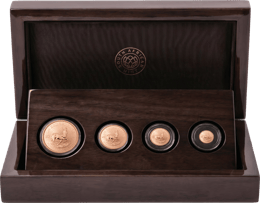

Krugerrand 4 Coin Fractional Set Reverse Proof 2026 (Mintage: 400 | Proof Design)
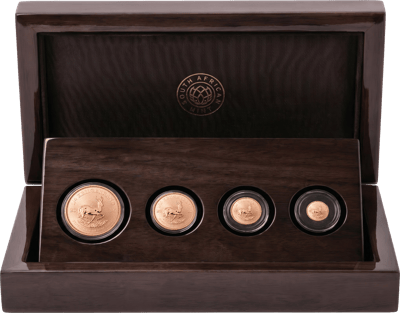










- Mirrored designs: on frosted background
- South Africa's coin: tradition since 1967
- Elegant wooden case: each coin in capsule
- Mirrored designsPaul Kruger and the springbok stand out in relief
- South Africa's coinStruck by the South African Mint in South Africa
- Elegant wooden caseGlossy polished wood, each coin precisely fitted
 Price alert
  Share
ShareThe Krugerrand inverts its light.Reverse Proof
World premiere: for the first time the small Krugerrand sizes appear as a fractional set in inverted light — velvet-matte field, mirrored springbok.
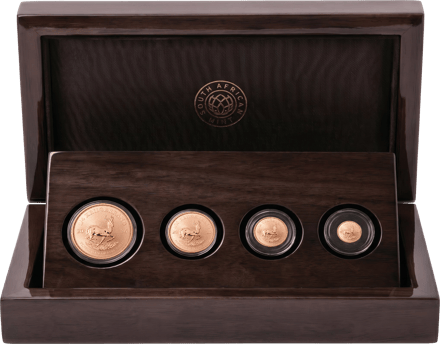
„There are coins you buy. And there are coins you never let go of.“
Take a Krugerrand in your hand and you hold more than an ounce of gold: you hold six decades of trust. The same coin your father knew. The same warm gold resting in millions of vaults around the world.
Yet what you see on this page has never existed in the history of this coin — and once the last capsule is sealed, it will not return any time soon.
The craft behind the fascination
What happens when gold inverts the light?
Reverse proof literally means: proof, inverted. What usually mirrors turns matte. What is usually matte begins to shine.
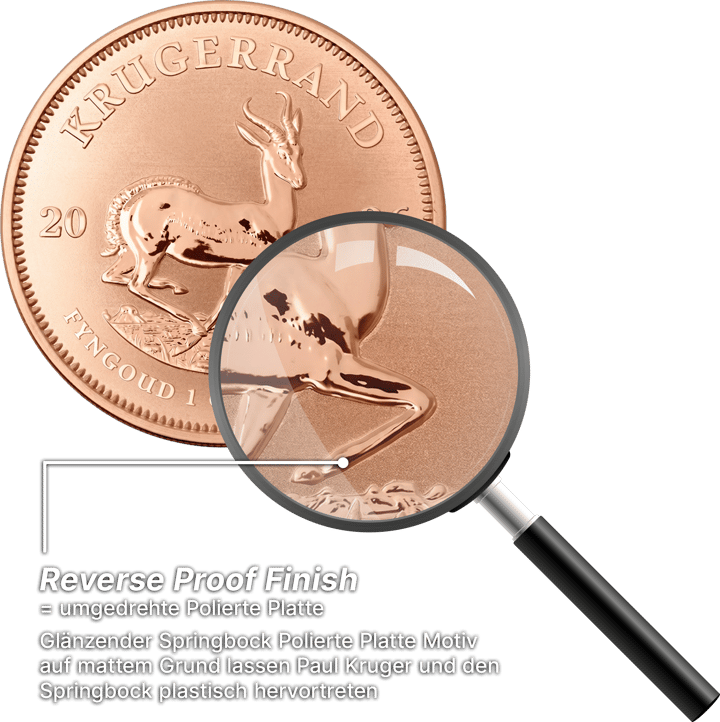
Under the loupe: mirrored relief on a velvet-matte field
The field: still as velvet
The entire surface of the coin is finely frosted. It absorbs the light instead of throwing it back — calm and deep like desert sand just after sunset. Only this quiet field gives the design its stage.
The design: cast from light
The springbok and the Paul Kruger portrait are polished to a mirror finish — like the finest proof coin, only inverted. Turn the coin in the light and the relief flashes, rises, comes alive. You cannot help but look.
The hue: gold you recognise
Krugerrand gold is 22 carat: 91.67% fine gold, hardened with a trace of copper. Hence that unmistakably warm glow connoisseurs recognise at first sight — in reverse proof it appears deeper still.
For the first time in 59 years of the Krugerrand
The small springboks have never existed in inverted light
The 1 oz had its world premiere in 2024. The fractional sets are having theirs now: for the very first time the South African Mint strikes the small Krugerrand sizes in reverse proof — issued in two sets, each of which exists only 400 times.
Contents of this set
1/4 + 1/10 + 1/20 + 1/50 oz
13,06 g of fine gold · mintage 400 worldwide
And a detail collectors understand immediately: the 1/20 and 1/50 oz miniatures are available from us exclusively in these sets — you will search for them individually in vain.
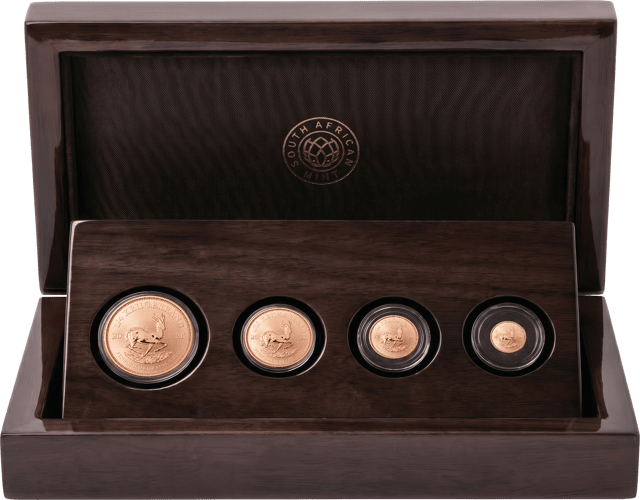
Delivered in the South African Mint case — with certificate of authenticity
A look at the first two issues
What 500 pieces do to a price
The 1 oz gold reverse proof debuted in 2024 as a world first — mintage 500. Today the numbers speak for themselves:
500 pieces — today 67% above the current first-edition price of the 2026 issue.
500 pieces — our stock was gone within a year. Anyone looking today needs luck and patience.
500 pieces — you stand at the beginning of the story, not at its end.
The classic fractional sets show what strict limitation does, too: the 3-coin sets of the Kaiser Wilhelm and Paul Kruger editions were issued at €1,490 each — today they trade at €4,290 and €4,490 respectively. Both: completely sold out at Kettner.
Kettner Edelmetalle dealer prices as of June 2026. Past performance is no guarantee of future results.
2026 edition
The reverse proof first edition at a glance
The official mintage figures of the entire edition — worldwide. Once sold out, gone forever.
| Issue | Fine gold | Worldwide mintage | Availability |
|---|---|---|---|
| 1 oz | 31,1 g | 500 | Available now |
| 1/4 oz | 7,78 g | 500 | Available now |
| 1/10 oz | 3,11 g | 500 | Available now |
| 3-coin fractional set World Premiere | 5,29 g | 400 | Available now |
| 4-coin fractional set This issueWorld Premiere | 13,06 g | 400 | Available now |
| 1/2 oz | 15,55 g | — | Coming soon |
| 5-coin fractional set | — | — | Coming soon |
| 6-coin prestige set | — | — | Coming soon |
The most famous gold coin in the world
59 years. One coin. Four moments.
The first Krugerrand is struck — the world’s first bullion coin. More than 58 million ounces have followed to this day.
For its 50th birthday a Krugerrand appears in reverse proof just once — in silver. A foretaste, nothing more.
For the first time in gold: 1 oz reverse proof, mintage 500. Today it trades far above its original first price.
For the first time the quarter, the tenth and the fractional sets in inverted light — the most extensive reverse proof programme in Krugerrand history.
The collection at Kettner
The complete 2026 first edition
Five issues, one promise: each is limited to 400 to 500 pieces — worldwide, across all markets combined. At launch you secure every issue at a reduced first-edition price.
The ½ oz as well as the 5-coin and 6-coin sets will follow shortly.
400 sets. 500 coins.
One first edition.
What is sold out will never be struck again — the 2025 issue was gone from our stock in less than twelve months. Secure your issue while you still have the choice of which one it should be.
Krugerrand 4-Coin Fractional Set Reverse Proof 2026 – the crowning glory for every collector
- Strictly limited: Very low mintage of only 250 pieces worldwide
- Growth opportunities: High appreciation potential due to strict limitation and high collector demand
- Rarity: An exceptionally rare collector's coin for connoisseurs and enthusiasts
- Minting quality: The highest possible finish in Proof (PP) – in the rare reverse-proof finish
- Special feature: The world's most popular gold bullion coin in an exclusive four-coin set
- Design: The obverse features Paul Kruger, President of the South African Republic from 1883–1902; the reverse is adorned with the elegantly leaping Springbok, South Africa's proud national animal
- Named after: Paul Kruger as well as the South African Rand, legal tender since 1961
- Material / Fineness: Gold with a fineness of 916.67/1,000, alloyed with copper – giving the coin its warm, reddish-golden sheen and making it durable
- Manufacturer: Minted by the South African Mint
- Country of origin: South Africa, home of the Krugerrand since 1967
- Fine weight: 13.06 g of pure gold, distributed across four coins
There are coins – and there are moments when a collector's heart beats faster. This Gold Krugerrand Fractional Set of 2026 undoubtedly belongs to the latter category. Four coins, each a work of art in its own right, united in an elegant case – all with a very low mintage that makes even seasoned collectors sit up and take notice.
Reverse Proof – when brilliance and matte finish dance together
What makes this set so special is its reverse-proof finish. While the classic Proof combines mirror-like surfaces with a matte relief, the reverse-proof technique artfully inverts this interplay: mirrored motifs set against a matte background. This makes Paul Kruger and the Springbok stand out in almost three-dimensional fashion. This technique, executed in the highest Proof quality, is elaborate, fascinating – and turns every piece into a true visual experience.
Gold is humanity's oldest currency. It has outlived every empire, every crisis and every paper currency – and after millennia still gleams as alluringly as it did on the very first day.
Why this rarity is so sought after
With only 250 sets produced worldwide, this is a true rarity. Whoever owns one of these strictly limited pieces holds a piece of South African coin history in their hands. It is precisely this scarce availability that fuels the appreciation potential of such exclusive editions. Collectors know: what is rare and highly sought after at the same time writes its own story in the long run.
Four coins, one irresistible overall picture
The Krugerrand is, not without reason, the world's most popular gold coin. One special feature: it carries no imprinted face value. Its value is redetermined every business day according to the current gold price – a living reflection of this precious metal's intrinsic worth. Investors and collectors worldwide have trusted this coin ever since 1967.
- Gold is exempt from VAT and, when sold after a one-year holding period, is generally tax-free
- A proven store of value that has never been worthless in over 6,000 years
- Tradable worldwide, highly liquid and usable as a means of exchange at any time
Whoever calls this set their own combines the fascination of the finest minting artistry with the timeless allure of gold. Besides its collector's value, it naturally also offers classic inflation hedge and serves many as a reliable crisis protection – yet here the focus is above all on the passion of collecting.
Act now while this limited edition is still available – because with only 250 pieces, the story of this collector's coin will soon be written. Discover more fine gold coins at Kettner Edelmetalle and secure a treasure that can be passed down from generation to generation.
Product depiction may differ from the final product.
