Only 7 left to order
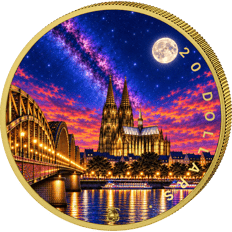
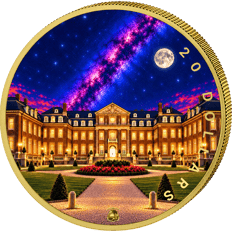
1 oz Silver Bavaria by Night - Neuschwanstein Castle 2026 (Mintage: 100 | Gilded)
€169.00
incl. VAT and excl. shipping
Ships from 20/11/2026

 More than 300,000
 Over 30 years
 Secure shipping
 Google: 4.9/5


Every building gets its form in its own way. For these buildings the way is set down in plans, letters and reports; where no writing survives, the building itself is the source.
Diagram; the radius is given in the text
Diagram; the radius is given in the text
The opera house in Sydney opened in 1973. In 1958 the engineers asked Jørn Utzon to fix the curves of the roof shells, the curved parts of the roof; Utzon bent a plastic ruler against a table and traced them. In the set of plans of March 1958 every shell was different and not structurally sound. At the end of 1961, after three years, there was still no solution.
After twelve calculated trial schemes, all ten shells come from segments of the surface of the same sphere, with a radius of 246 feet, 74.98 m. The concrete ribs, up to 3 m deep, were prefabricated on the building site and lifted into place.
By his own account, one evening Utzon stacked the shells of the large model, alone in the office in Hellebæk, and saw how alike their forms were. Rey‑Rey tells it differently: Utzon went into the factory in Hellebæk, where all the models stood.
There is no unanimous version of these facts
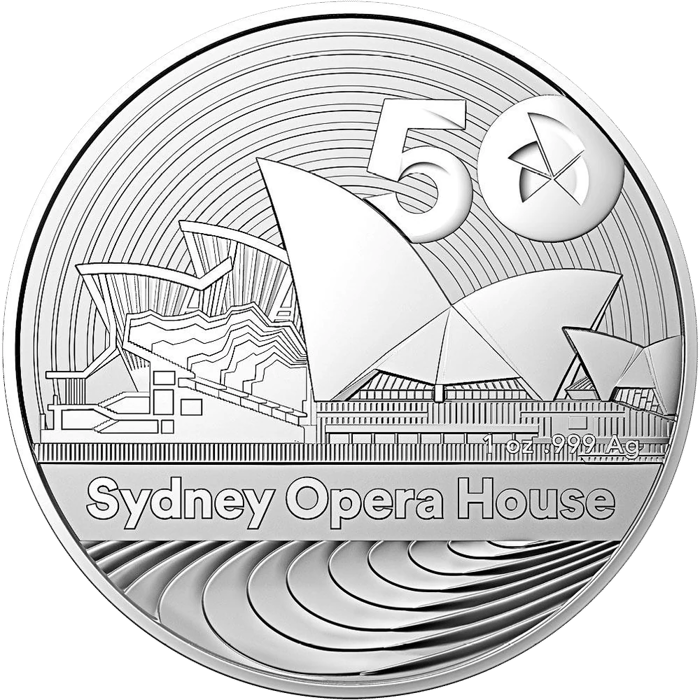
The coin shows the opera house with its large shells, beside it parts of the building as a line drawing, and circular lines behind it.
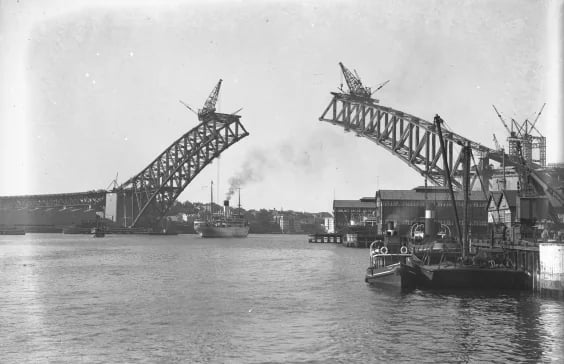
On the same harbour the arch of the Sydney Harbour Bridge was built from 26 October 1928. The sandstone on which Sydney stands made it possible to tie back the cables holding the arch during construction. Two creeper cranes of 580 t, cranes on the arch halves, lifted the parts of the arch. On 19 August 1930 at 22:00 the halves met in the middle of the span; after that, over nine months, the steel deck was hung from the arch.
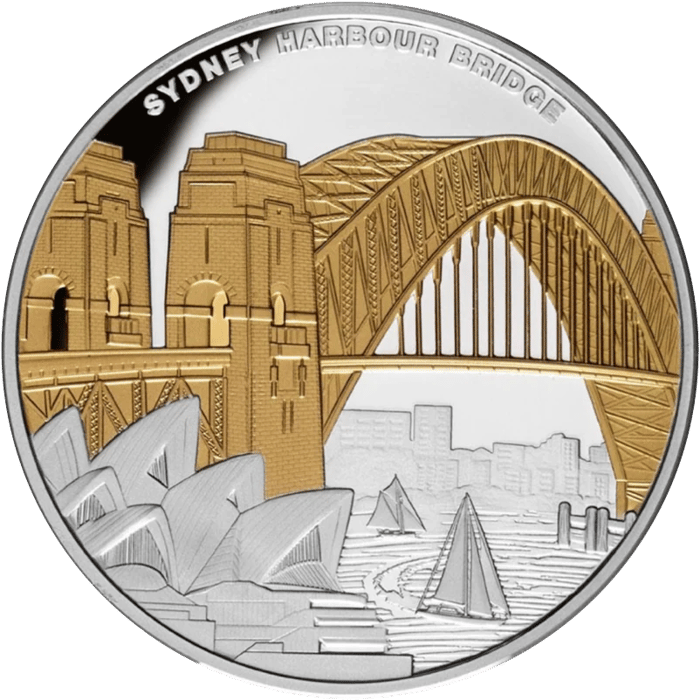
Picked out in gold on the coin are the arch of the bridge and its pylons, the towers faced with granite; beneath them the opera house and boats.
Three buildings have an ancient model, and each departs from it in one part.
Diagram, not to scale
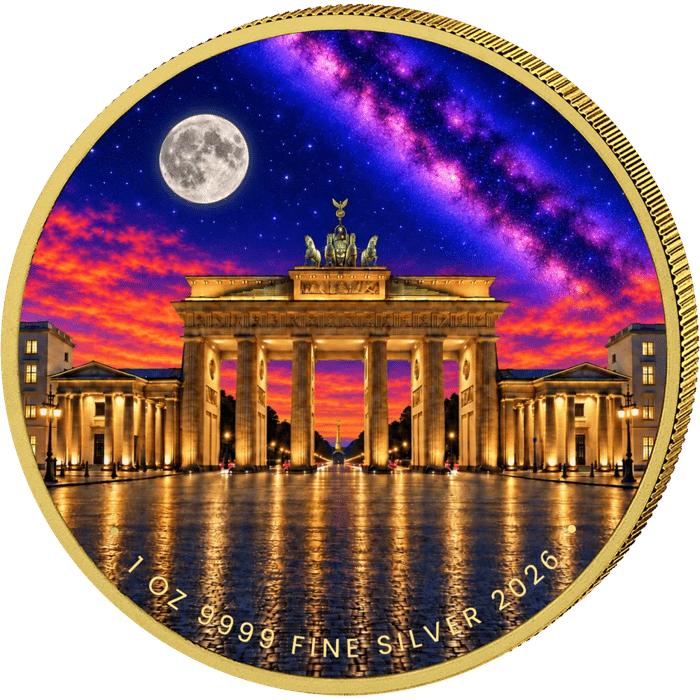
The Brandenburg Gate in Berlin, built from 1788 to 1791 to the design of Carl Gotthard Langhans, has as its model the Propylaea, the entrance to the Acropolis of Athens. Both have five passages and six Doric columns on each front, columns with a plain top. The fronts of the Propylaea end in a pediment, those of the gate do not.
The coloured silver piece shows the gate from the front, with its columns and passages.
Diagram, not to scale
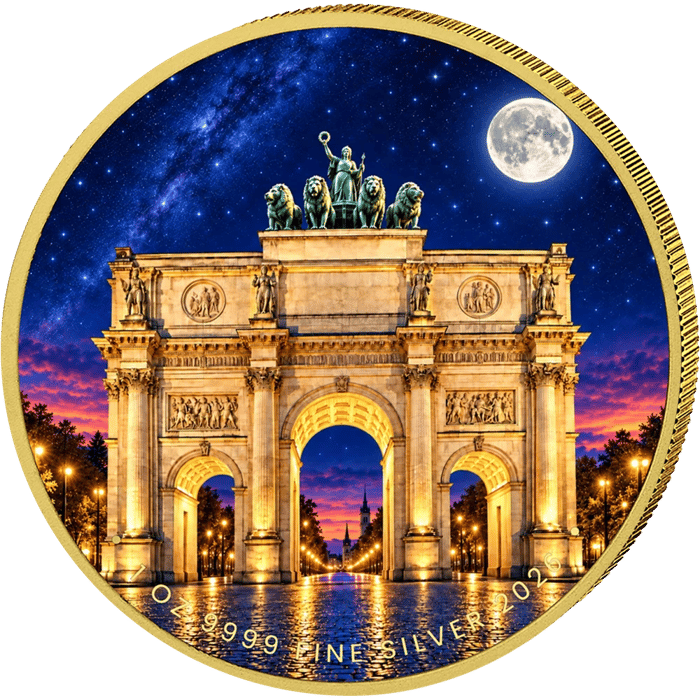
In 1826 King Ludwig I announced in a letter that in later years he wished to have a city gate built of squared stone, like a Roman triumphal gateway. The Siegestor in Munich, completed in 1850 to Gärtner’s plan, has as its model the Arch of Constantine in Rome. Four Corinthian columns on pedestals, with leaves at the top, divide each main front into three sections with three portals. Unlike those of the model, their arches are not semicircles but markedly raised, and decorated with coffers, sunken ornamental panels.
As its motif, the coloured silver piece bears the gate with three arches and four columns.

Diagram, not to scale
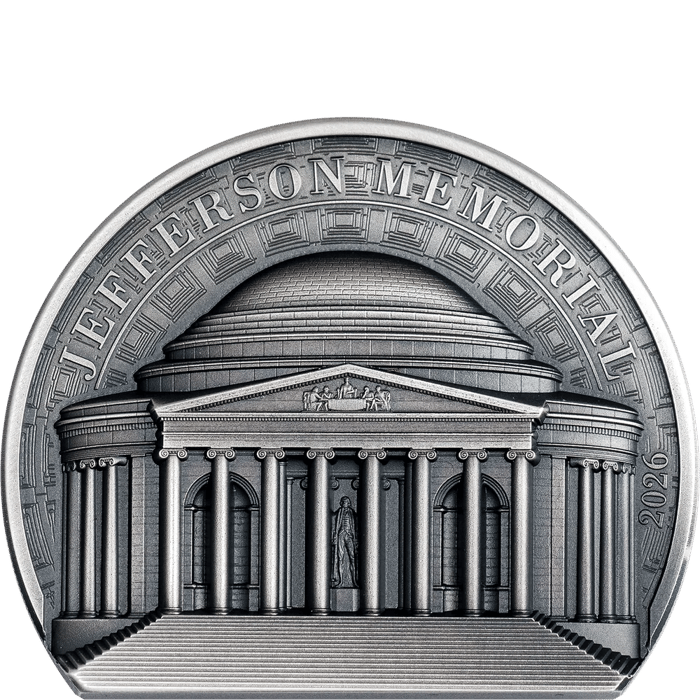
The Jefferson Memorial in Washington, built from 17 November 1938 and inaugurated in 1943, has as its model the Pantheon in Rome. Its present building went up under Hadrian, from 118 to 125; a round wall more than 6 m thick carries its dome. The memorial is an open round building with a flat dome, surrounded by a ring of 26 Ionic columns with rolled scrolls at the top; inside, the dome is coffered in its lower part and smooth in its upper part.
modeled after the Roman Pantheon
The building stands on concrete piles that reach down to the bedrock, 80 feet, 24.4 m, beneath mean low water. In April 1939 the foundation needed more piles, because in the decayed rock lying on the hard bedrock the caissons could be driven straight down only with difficulty. Because of this and the filling of this part of the Tidal Basin, the memorial has had settlement problems ever since; in 1969 it was closed, and concrete struts were meant to stop the settlement.
The coin shows the steps and the portico, a porch on columns, with its pediment; behind it the flat dome.
There are no written sources on the building of the west tower of Freiburg Minster, and its master builder is unknown. With its weather vane it measures 116 m.
Diagram; the heights are given in the text
By about 1290 the base, 37 m high, was built, with the bell frame, the timber structure for the bells, dated to 1290/91 by the tree rings of its wood. By about 1330/40 there followed the octagon, an eight-sided storey 33 m high, and the openwork spire, 46 m high, the tip of the tower.
It is generally assumed that there were two master builders and two plans, with a lengthy pause after the bell frame. Against this stands the thesis of the art historian D. G. Morsch: one unified plan, carried out without a break.
Set into the north-west buttress of the tower, a support of the outer wall, is the Freiburg ell, a measure of length of 54 cm. Without the finial, the ornament at the tip, the tower measures 210 ells, by our own calculation 113.4 m.
The west tower with its openwork tip stands on the coloured silver piece, beside it the nave and choir with two slender towers.
The foundation stone of Ulm Minster was laid in June 1377 by Mayor Ludwig Kraft; with the finial, set in place on 31 May 1890, the building was complete after 513 years. The foundation relief shows the plan of that time: a hall church whose long spaces, the naves, are all the same height, with three towers of equal height.
Diagram, not to scale
The building barely got beyond the square part of the tower, finished in 1494; the reason always given is that the tower was sinking. Burkhard Engelberg divided the aisles, the long spaces at the sides, and so kept the stresses from tearing the church apart. From 1543 construction paused for around 300 years.
The nave swayed strongly in every storm; from 1856 to 1870 Ferdinand Thrän spanned flying buttresses of stone, supporting arches on the outside, 18 m wide across the aisles. August Beyer built the main tower drawing on the plans of Matthäus Böblinger, but a good ten metres higher than the 151 m of the plan, to 161.53 m. As one reason, the city of Ulm names the perspective of viewers on the Münsterplatz.
The coloured silver piece shows the main tower between two lower towers.
The opera house found its form in a sphere, three buildings found theirs in an ancient model. In Freiburg no one knows the master builder, but the ell is set into the wall of the tower; in Ulm many names and two plans from 513 years are known.
A building always tells a story: of claims to power and craftsmanship, of eras, master builders and the dream of creating something that outlasts its own time. Coins featuring building designs capture exactly this fascination: castles, gates, temples and cathedrals are immortalised in gold and silver, retaining their lustre while their real-life counterparts weather away. The following sections place this collecting field in context, from the long tradition of architecture on coins, through popular designs and minting techniques, to authenticity features, tax particulars and proper storage.
The idea of depicting buildings on coins is as old as coinage itself. As early as Roman times, denarii and sestertii honoured emperors by showing temples, triumphal arches and structures on the Forum Romanum: architecture served as a stage for political messages. Numerous Roman buildings survive exclusively through such coinage, since the originals have long since disappeared. Over the centuries, the motif remained alive: castles documented the claims of princely houses, cathedrals the power of faith, and in the modern era landmarks of entire nations came into focus.
In Germany, depicting famous buildings has a special tradition. German commemorative coins from the Deutsche Mark era honoured masterpieces such as the Holstentor in Lübeck, the Semperoper in Dresden and the Old Town Hall in Leipzig, and the 2-euro series of the federal states continued this line, from Berlin's Brandenburg Gate to Sanssouci Palace and the Dresden Zwinger. Southern German landmarks such as the buildings of Munich also shaped the picture. Architecture on coins is therefore not just a collecting theme but a piece of cultural history in metal, portraying entire German cities. Anyone interested in historical coinage will find numerous related designs in the History on Coins section.
This collecting field thrives on its designs. Hardly any building attracts collectors as much as Neuschwanstein Castle: King Ludwig II's fairy-tale castle in the Allgäu is considered one of Europe's most visited buildings and is enormously sought-after as a coin design today. Modern issues show the castle in an expansive side view, embedded in the alpine landscape, with delicate lines that bring towers and battlements to life in relief.
Alongside fairy-tale castles, buildings that represent an entire country are in focus: the Brandenburg Gate as a symbol of reunification, the Jefferson Memorial in Washington as a classicist monument of American architecture, Gothic cathedrals and Roman temples. These designs combine aesthetic appeal with historical depth: they tell of eras, rulers and turning points. Collectors who organise designs by region will also find what they are looking for in the Cities and Landscapes section.
A particular charm lies in architectural detail. Series dedicated to famous portals and entrance structures place the fine interplay of stonemasonry, ornamentation and, in special editions, inlaid coloured glass at the centre. Portals from Milan or Prague, for instance, can be staged especially impressively on a coin surface thanks to high relief and coloured glass inlays. Such issues sit at the intersection with Art and Culture.
Depicting a building convincingly on just a few square centimetres is a minting challenge, and this is precisely where the appeal of many collector issues lies. Modern mints rely on techniques that create depth and plasticity:
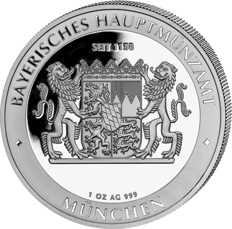
Renowned mints stand behind these demanding designs. Issues with a German connection are often produced by the Bayerisches Hauptmünzamt, while elaborate collector coinage with glass and relief techniques is often crafted by houses such as B.H. Mayer. An overview of all manufacturers is available in the Manufacturers section.
Building designs appear in various precious metals and weights, from a handy silver coin to a heavy kilogram coin. The choice depends on whether the design, the collector's value or the material value is the priority.
Silver is the classic material for architectural designs: the bright surface and the large minting area of larger denominations offer room for fine detail. Issues in 1 oz are common, but also heavy 3 oz or kilo coins in 999 fine silver, in which relief and glass elements come fully into their own. Anyone wanting to broaden their collecting field will find numerous further design worlds in the silver coins range.
In gold, building designs are minted less often and usually in smaller denominations: here, collector appeal combines with the function of a store of value. A gold issue of a famous castle unites the design with the lasting material value of the precious metal. Anyone wanting to emphasise the investment aspect should also consider classic gold coins and gold bars, which primarily serve wealth preservation.
Coins with building designs move between two worlds. As a collector's coin, the design, minting quality, mintage size and emotional connection to the building all matter: a low mintage of just a few hundred or thousand pieces can significantly increase the appeal for enthusiasts. As a bullion coin, by contrast, the precious metal value takes centre stage; the design then becomes more of a decorative addition.
A building can fall into ruin: its coinage in precious metal remains. Therein lies the special charm of architecture on coins.
Many issues can be assigned to both categories: they carry a sought-after design while also being made of fine gold or fine silver. Anyone specifically looking for small mintages and enhanced issues will find them in the collector's coins section; anyone for whom pure material value matters should look to bullion coins. Related technical themes such as Vehicles and Machines also follow this dual logic of design and material value.
Anyone acquiring coins with building designs should be aware of a few practical aspects, from authenticity verification through tax treatment to careful storage.
Reputable coinage carries precise information on fineness (for example 999/1,000), weight and often mintage. Attention should be paid to clean relief edges, even surfaces and, for limited issues, a certificate and numbered case. Kettner Edelmetalle relies on ISO-compliant authenticity verification, so every coin is inspected before shipping. Damage to the sensitive surface can be avoided with suitable accessories such as coin capsules.
Regarding VAT: investment gold is exempt from VAT in Germany under the applicable regulations, while silver coins are generally subject to the margin scheme. In addition, capital gains on physical precious metals are tax-free after the one-year holding period has elapsed. This information does not replace tax advice but reflects the basic principles. Extensive ranges of VAT-exempt investment gold can be found under Gold.
Note on Storage
Especially with issues featuring an Antique Finish, high relief or glass elements, the surface is sensitive. Direct contact with bare fingers, moisture and temperature fluctuations should be avoided. Capsules, cases and cassettes protect the design and value for the long term.
For long-term storage, protective storage solutions from the accessories range are recommended, such as coin cassettes for entire collections or coin cases for secure transport. This way, the special character of every building coin is preserved for years to come.
Particularly sought-after are iconic landmarks such as Neuschwanstein Castle, the Brandenburg Gate, Sanssouci Palace, the Dresden Zwinger or the Holstentor. Internationally, famous portals, cathedrals and monuments such as the Jefferson Memorial also count among the cherished designs. The decisive factors are usually the building's degree of recognition and the quality of the minting execution.
Antique Finish is a deliberate, artificial ageing of the coin's surface. Recesses are darkened, creating contrasts and making fine architectural details stand out in relief. This makes historical buildings appear especially authentic, almost as if they had aged over centuries.
That depends on the issue. Coins made of fine gold or fine silver have an intrinsic material value, so the precious metal content forms a basis. With elaborate collector issues with a low mintage, collector aspects can additionally play a role. Anyone primarily seeking wealth preservation should compare classic bullion coins and bars. No reliable return promises can be made for any form of collecting.
Coins with relief, Antique Finish or glass elements should never be touched on the design with bare fingers, and should be protected from moisture and strong temperature fluctuations. Coin capsules preserve individual pieces, while cassettes and cases are suitable for entire collections. This way, the surface and collector's value are preserved in the long term.
Characteristics include precise information on fineness, weight and mintage, clean relief edges and even surfaces. Limited issues are often supplied with a certificate of authenticity and a numbered case. At Kettner Edelmetalle, every coin undergoes ISO-compliant authenticity verification before being shipped with insurance.
Elaborate collector issues with high relief, Antique Finish or glass elements are demanding to produce and are deliberately limited, sometimes to just a few hundred pieces. The low number of pieces underscores the collector character and makes such coinage especially appealing to enthusiasts.
 TechnologyBuildings
Stay informed with product launches, financial news and exclusive offers. Sign up for our free newsletter today.
By entering your email address and clicking the "Submit" button, you give the following consent: "I agree to be informed by email about new products, financial news and exclusive offers, and therefore consent to the processing of my email address for the purpose of sending the newsletter. I can revoke this consent at any time without giving reasons, with effect for the future. The lawfulness of processing carried out prior to revocation remains unaffected."