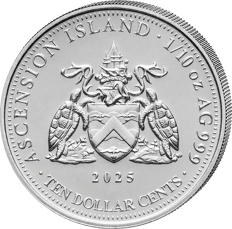
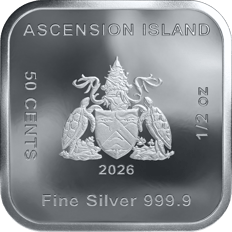
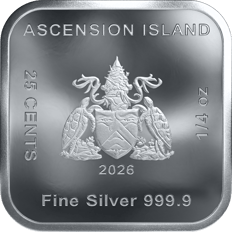
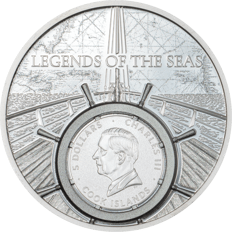
1kg Silver Minted Bar Ascension Island
€2,278.41€2,328.41
incl. VAT and excl. shipping
Available in 2–3 business days

 More than 300,000
 Over 30 years
 Secure shipping
 Google: 4.9/5


Patent specification No. 37435 of 1886 begins with the sentence: Vorliegende Construction bezweckt den Betrieb hauptsächlich leichter Fuhrwerke und kleiner Schiffe, wie solche zur Beförderung von 1 bis 4 Personen verwendet werden. A vehicle needs a force that moves it. A book of 1909, a letter of 1804, museums and two patent specifications describe exactly how wind, steam and a small gas engine do so, often down to the figure.
In English: The present construction is designed chiefly for the operation of light carriages and small ships, such as are used to carry 1 to 4 persons.
How close a sailing ship comes to the wind is measured in points, each a thirty-second of the compass rose. In 1909, E. Keble Chatterton gives a rule of thumb for it, for the square sail, set across the ship on yards, and for the fore-and-aft sail, set along the ship: A squaresail-ship whether ancient or modern will go no nearer the wind than seven points, whereas the fore-and-after will sail as close as five.
One point is 11.25°, so 7 points make 78.75° and 5 points 56.25° (own calculation). After a note in Chatterton, Manwayring gives 6 points for square sails in a seaway, unless tide or current carry the ship towards the wind. Both are rules of thumb. Against the wind a sailing ship therefore tacks in a zigzag.
Diagram based on Chatterton 1909: a compass rose of 32 points, the wind at the top. A filled sector around the direction of the wind shows where a ship with fore-and-aft sails cannot sail: 5 points to either side, 112.5° in all. A thin line outlines the wider sector for the square sail: 7 points to either side, 157.5° in all. The marks at 5 and 7 points from the wind are drawn bolder and numbered on the right. Beneath the rose, a course runs from a point in a zigzag against the wind as far as the bottom point of the rose, each leg 5 points off the wind. 1 point is 11.25°; the degrees are calculated.
Diagram
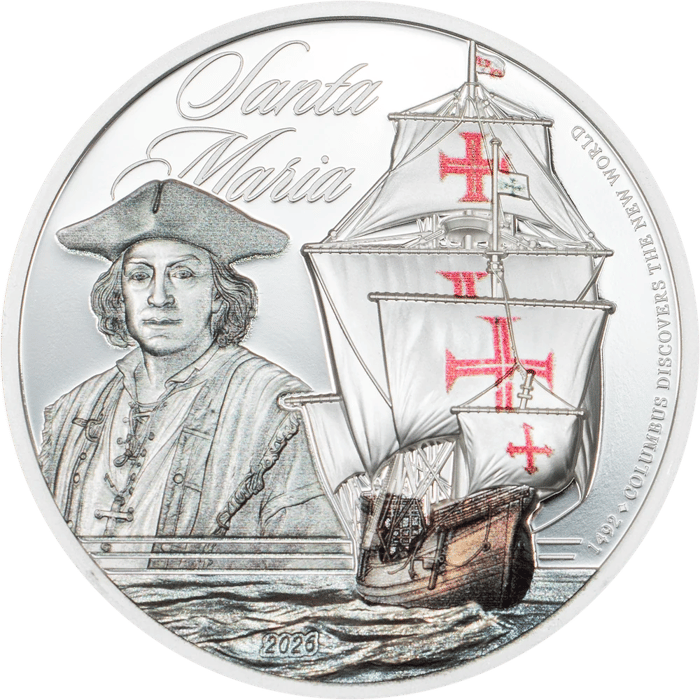
Chatterton reports, after another book, that on the voyage of 1492 the Niña, during a stop, was re-rigged from lateen sails, that is triangular sails, to square sails like those of the Santa Maria, so that the Nina might be able to keep up with the others.
According to Chatterton, a replica of the Santa Maria, built in 1893, sailed across the Atlantic in 36 days: the maximum speed obtained was about 6½ knots. A knot is one nautical mile an hour; 6½ knots is about 12.0 km/h (own calculation).
The silver coin shows a ship under sail with crosses on the sails.
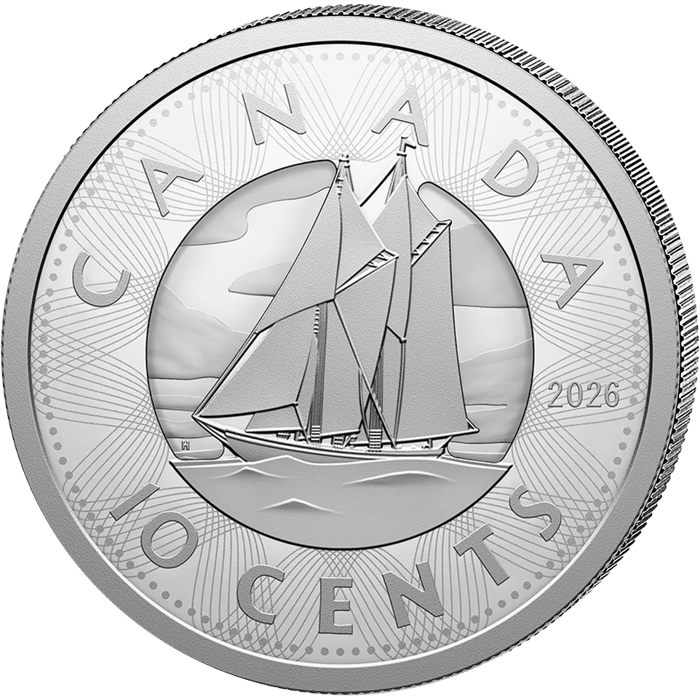
In the autumn of 1920, a planning committee asked William Roué to design a schooner, a ship with at least two masts, to be a fishing vessel and a racing vessel at the same time. Roué drew the plans at night. His first design had 36.6 m of waterline, measured at the level of the water; the rule of the fishermen’s race allowed at most 34 m of waterline and 44.2 m of length. The committee had the waterline shortened. On 26 March 1921 the Bluenose was launched; her 930 m² of sail came afterwards.
The silver coin shows a schooner with two masts under sail at sea.

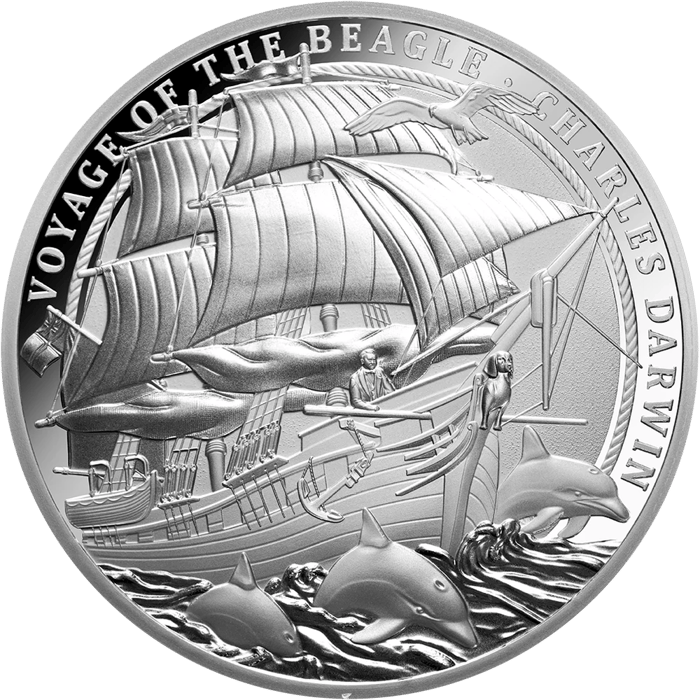
HMS Beagle was launched at Woolwich in 1820 as a brig sloop and refitted as a surveying vessel, under the command of Robert FitzRoy. Later she was given a third mast, the mizzen mast at the stern, so that she was more manoeuvrable in shallow coastal waters.
According to Royal Museums Greenwich, the Beaufort scale was first used for wind observations on her second voyage, with Charles Darwin on board. It describes the strength of the wind by the state of the sea. According to the Met Office weather service, force 8, a gale, means 34 to 40 knots or 17 to 21 m/s, with waves on the open sea probably 5.5 m high.
The silver coin shows a three-masted ship under sail, three dolphins in front of it and a gull over it.
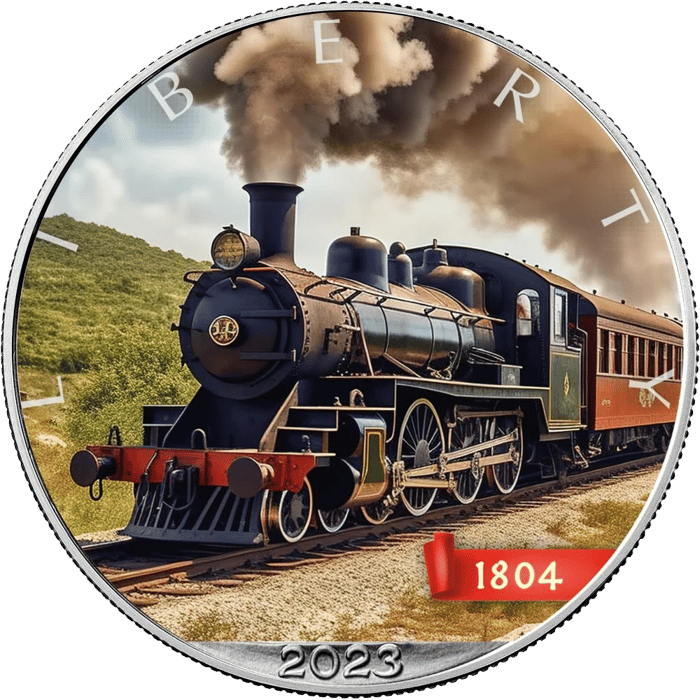
On 21 February 1804, Richard Trevithick’s engine ran on rails at Penydarren in South Wales. In a letter he wrote about the journey: we carried ten tons of iron in five wagons, and seventy men riding on them the whole of the journey.
According to the letter, the engine ran at almost 5 miles an hour, about 8 km/h, and used 2 hundredweight of coal; an English hundredweight (cwt) is 50.8 kg, so about 102 kg in all (own calculation). And he wrote: there was no water put into the boiler from the time we started until our journey’s end.
Diagram, no particular engine: a horizontal rectangle with a block inside that runs back and forth, and a rod from it to a point on a large wheel. While the wheel turns twice, the block runs its way four times. In the rectangle, two bands show the way of the block, one for each turn, in which it runs there and back once. A line shows the circle that the point on the wheel draws, drawn twice and therefore bold. The block stands in the middle of its way.
Diagram
The National Railway Museum describes the engine as a high-pressure boiler on wheels, with pistons that drove the wheels through gears. It was too heavy for regular service on the brittle cast-iron rails. Later, according to Museum Wales, it stood in one place and drove a forge hammer.
The silver coin of 1 ounce shows a locomotive with a carriage in front of hills.
Before each day of the trials at Rainhill in 1829, according to the National Railway Museum, the judges weighed locomotive and load and noted fuel and water. They timed each locomotive over ten runs of 1.5 miles; after fresh fuel, ten more runs there and back followed, then the judges worked out consumption and average speed. What counted was strength, power and reliability, not speed alone: frequent stops for water would have used up any lead over a horse-drawn railway. Rocket averaged 12 mph, about 19 km/h (own calculation).
The Science Museum Group Collection calls Rocket a considerable technical advance on earlier designs, bringing together in one machine such developments as the multi-tube boiler and the blast-pipe. According to the National Railway Museum, the multi-tube boiler has many narrow fire tubes instead of a single wide flue; the blast-pipe, an outlet for the exhaust steam, made the engine self-regulating.
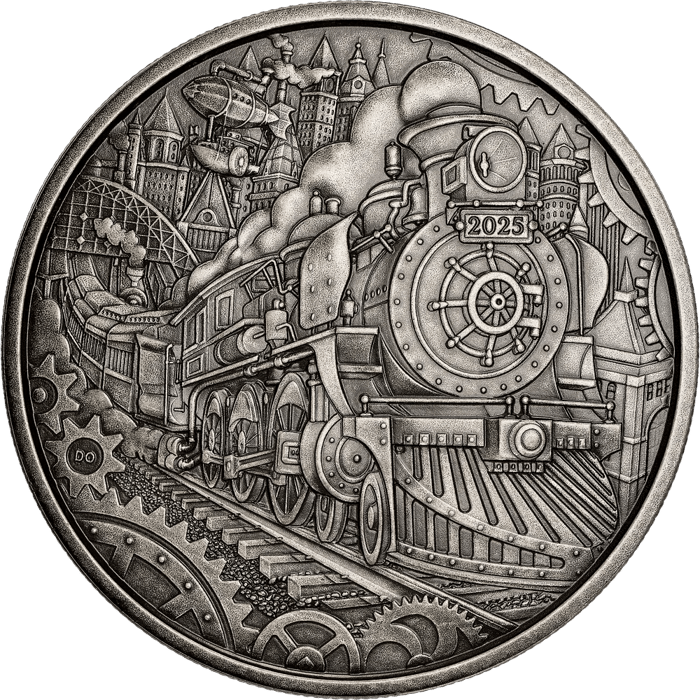
The silver coin of 3 ounces shows a locomotive from the front, an airship over it and the towers of a city behind. The Royal Canadian Mint itself calls its motif more fantasy than fact, its parts freely interpreted, not historically accurate.
Patent specification No. 532 of 1877 for a gas engine requires in claim 4 that four effects take place bei zwei Umdrehungen der Kurbelwelle auf einer Seite des Kolbens: the intake of the gases into the cylinder, Compression derselben, Verbrennung und Arbeit derselben and their exhaust. The crankshaft converts the back and forth of the piston into a rotation.
In English: during two turns of the crankshaft on one side of the piston
In English: their compression
In English: their combustion and work
Diagram of claim 4 of patent specification No. 532 of 1877: on the left an upright rectangle with a block, on the right a circle with two rings, outside the 1st turn, inside the 2nd turn, each ring in two halves. The four halves carry the four effects of the specification in order: outside at the top intake, outside at the bottom compression, inside at the top combustion and work, inside at the bottom exhaust, 180° each, 720° in all; the degrees are calculated. While the arc runs round the rings, the block goes down and up twice; the area over it fills during intake, grows denser during compression, takes on the accent colour during combustion and work and empties during exhaust. At the end the block stands at the top.
Diagram
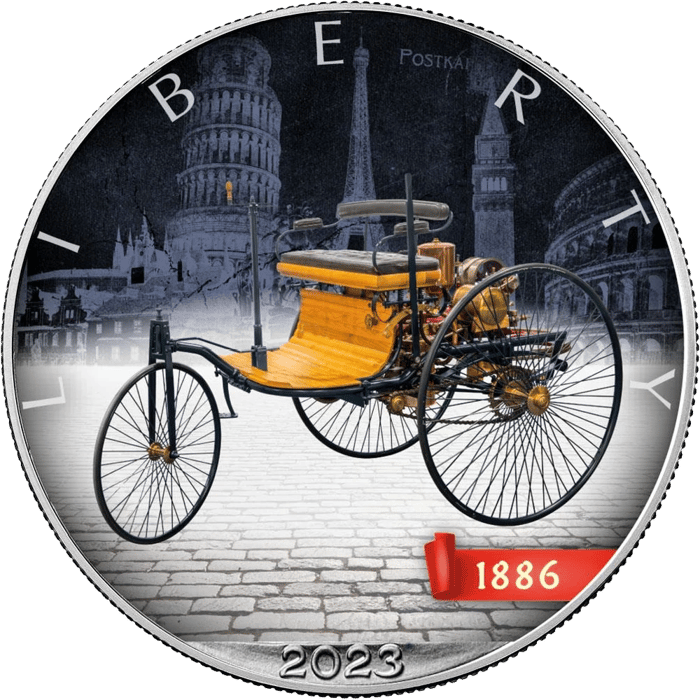
Patent specification No. 37435 of 1886, from Benz & Co. in Mannheim, describes its vehicle: ein kleiner Wagen nach Art der Tricycles, für 2 Personen erbaut. Ein kleiner Gasmotor, gleichviel welchen Systems, dient als Triebkraft. Its flywheel, a heavy wheel that keeps the engine running evenly, turns in einer horizontalen Ebene, and the force passes through bevel gears, that is cone-shaped gears, to the driving wheels; so, the specification says, full steerability of the vehicle and Sicherheit gegen ein Umfallen desselben beim Fahren kleiner Curven are achieved.
In English: a small carriage in the manner of tricycles, built for 2 persons
In English: A small gas engine, of whatever system, serves as the motive force.
In English: in a horizontal plane
In English: safety against its overturning when driving round small curves
Cooling is by water. If it only ran through, there would be ein großer Wasservorrath nöthig, wie ihn leichte Fuhrwerke zu Land nicht gut mitführen können. So the water evaporates around the cylinder, becomes mostly liquid again in the pipes above it and runs back below.
In English: a large supply of water necessary, such as light carriages on land cannot easily carry with them
The claim of the patent specification names a vehicle driven by a gas engine that uses two devices at the same time: at the gas generator, a device zum Erkennen des Functionirens und des Oelstandes im Gasbehälter, and the brake device. Cooling, flywheel and the design of the car appear only in the description.
In English: for recognising the functioning and the oil level in the gas container
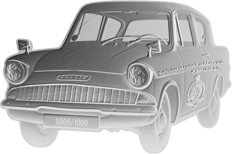
The silver coin shows a three-wheeled motor car with a bench seat and large spoked wheels.
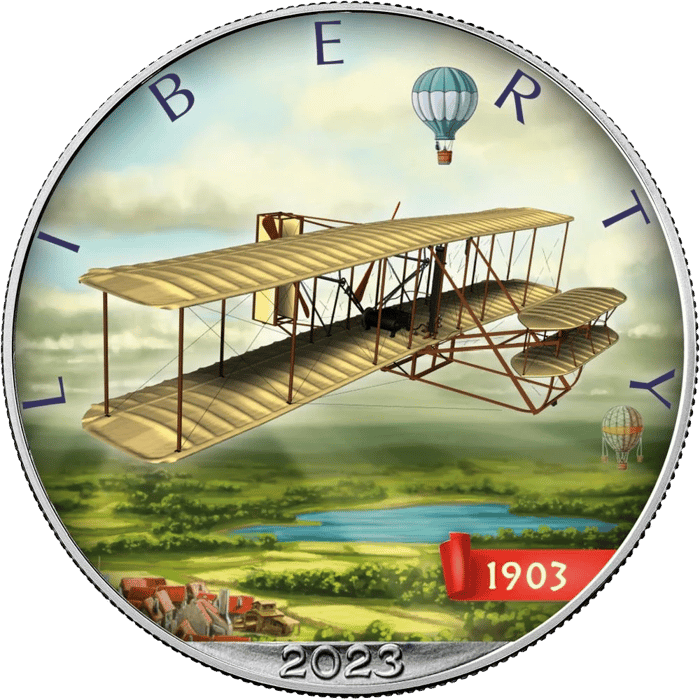
According to the National Park Service, NPS for short, no manufacturer had a suitably light engine for the Wright brothers’ Flyer; Charlie Taylor, their friend and co-worker, built one. It had four cylinders in line and water cooling, and the crankcase was made of aluminium to save weight. It produced 12 hp (horsepower), about 9 kW, and according to the NPS weighed 170 lb, about 77 kg (own calculation). According to the NPS, the propellers worked like rotating wings, driven by a simple yet effective sprocket and chain transmission, not dissimilar to the operation of a bicycle.
The silver coin shows a biplane over a landscape with a lake.
Before the force reaches the wheel or the propeller, it travels a path. In 1804, according to the National Railway Museum, the pistons drove the wheels through gears. In 1886, according to patent specification No. 37435, it runs through a belt, bevel gears, that is cone-shaped gears, and chains to the driving wheels, and in the Flyer, according to the NPS, through sprockets and chains to the propellers. And water comes up again: in 1804, according to the letter, none was added to the boiler, and in 1886 the car was to manage without a large supply of water.
 TechnologyVehicles
Stay informed with product launches, financial news and exclusive offers. Sign up for our free newsletter today.
By entering your email address and clicking the "Submit" button, you give the following consent: "I agree to be informed by email about new products, financial news and exclusive offers, and therefore consent to the processing of my email address for the purpose of sending the newsletter. I can revoke this consent at any time without giving reasons, with effect for the future. The lawfulness of processing carried out prior to revocation remains unaffected."