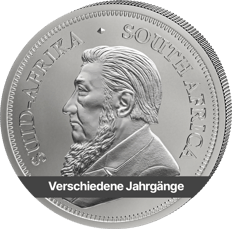
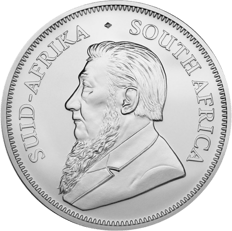
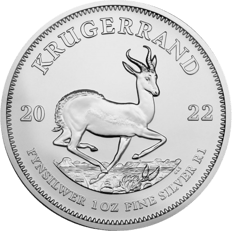
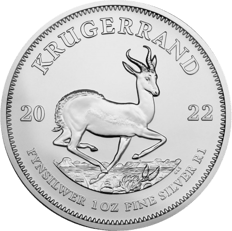
1 Ounce Silver Krugerrand 2026
€62.73
incl. VAT and excl. shipping
Available in 2–3 business days
 +49 7930-2699

 More than 300,000
 Over 30 years
 Secure shipping
 Google: 4.9/5


Silver coins bring together two worlds that rarely sit so close to one another: the sober tangible asset of a globally traded precious metal and the quiet fascination of finely engraved designs that you can actually hold in your hand. From the classic Maple Leaf to the South African Krugerrand and limited animal designs, the spectrum appeals to beginners and collectors alike. The following sections cover denominations, the best-known series, fineness and authenticity, the tax particulars in Germany, as well as proper storage.
Silver has been regarded as a means of payment and store of value for thousands of years, and the modern bullion coin ties directly into this tradition. Unlike a plain bar, a coin carries an official face value, a state minting seal and a design that instantly reveals its origin. It is precisely this combination that creates the appeal: a single piece can be a tangible asset, a collector's item and a small work of art all at once.
The low entry price plays an important role. A common 1 oz silver coin costs only a fraction of a comparable gold coin, which means that even a small budget can build a broadly diversified holding. Anyone who places more emphasis on pure weight will find a complementary option in silver bars, while coins, thanks to their worldwide recognition, are particularly easy to trade again. For those who would also like to add gold, a look at gold coins is worthwhile as a complement.
The range of silver coins is vast, but a few classics have shaped the market for decades and form the backbone of almost every collection. They are recognised worldwide, available in large mintages and therefore particularly liquid.
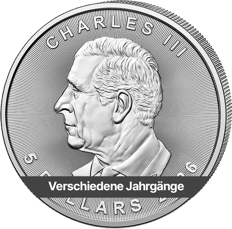
Alongside these bullion classics, a vibrant world of elaborately designed thematic series has established itself. The Lunar series with the twelve Chinese zodiac signs, the vividly coloured Koala editions or the artistic Somalia Elephant coins show just how much creative freedom can fit into a single ounce of silver. Narrative series such as the Queen's Beasts, with their British heraldic creatures, or the world of myths and legends are particularly popular with collectors. Anyone who values Mexican silver will find what they are looking for with the Libertad.
Silver coins are struck in a wide range of weights. By far the most important format is the full ounce (31.1 grams), which is regarded as the standard for trading and offers the fairest price per gram. In addition, there are smaller fractional pieces and considerably heavier collector formats.
As a rule of thumb: the larger the unit, the lower the percentage markup over the pure material value. This markup is also known as the premium and covers minting, distribution and trading margin. Small fractional pieces are flexible and divisible, but carry a higher premium per gram. Anyone wanting to bundle larger quantities compactly will find a cost-effective alternative to the kilo coin in 1 kg silver bars.
Modern bullion coins are predominantly made of 999 or 999.9 fine silver. Historic classics such as the silver Krugerrand, on the other hand, use a more robust alloy with a copper content, which makes the coin more resistant to scratches. The fineness is usually struck directly onto the coin and, together with weight and diameter, allows it to be identified unambiguously.
The grade of preservation significantly influences appearance and price. Mint State (MS) describes the standard, uncirculated finish of bullion coins. Proof (PP), on the other hand, shows mirror-like fields and frosted designs and is usually strictly limited, a feature that mainly distinguishes collector's coins.
The most important authenticity features can be summed up quickly:
At Kettner Edelmetalle, every coin undergoes an ISO-compliant authenticity verification before leaving the fully automated logistics centre, a safety net that complements private testing.
A key difference compared with gold concerns VAT. While investment gold is generally exempt from VAT, investment silver is subject to VAT. For silver coins, the so-called margin scheme frequently applies here.
Tax notice
Under the margin scheme, tax is levied only on the dealer's trading margin, not on the full value of the goods. As a result, the effective tax burden is considerably lower than under standard taxation. This information does not replace tax advice; the current legal situation is always decisive.
Also relevant is the holding period: if a silver coin is held in private ownership for longer than one year, any capital gain on sale is, under current law, tax-free. Anyone wishing to combine silver with gold will find tax-advantaged alternatives among the gold bullion coins.
Silver reacts more sensitively to its environment than gold and, on contact with air and sulphur compounds, can tarnish over time, a dark patina that does not reduce the material value but can affect the collector's value of an otherwise flawless coin. Proper storage protects against this effect.
As a general rule: store coins in a dry, dark and, if possible, cool place, avoid touching the struck surface with bare fingers, and consider a safe or a bank safe deposit box for larger holdings. At Kettner, shipping is 100% insured, so the holding is already protected while in transit.
Silver coins can broadly be viewed in two directions. For pure wealth building, low premiums, high mintages and worldwide tradability matter most, here the major bullion classics in full ounces are the first choice. Anyone who puts the passion for collecting first, on the other hand, pays attention to limited mintages, special years of issue, coloured finishes and Proof strikes.
You don't need to explain a silver coin: you place it in your hand, and its weight speaks for itself.
Many collections grow from a mix of both motivations: a solid base of common silver bullion coins, supplemented with individual highlights from limited series. This creates a holding that has both substance and character. As a family business with more than 200,000 customers, Kettner Edelmetalle supports both approaches with a wide range.
For beginners, globally recognised classics in the 1 oz denomination are recommended, such as the Maple Leaf, Vienna Philharmonic or Krugerrand. They are available in large mintages, carry low premiums and can be resold easily at any time.
Investment gold is exempt from VAT in the EU, whereas investment silver is not. However, many silver coins are subject to the margin scheme, under which tax is only levied on the trading margin. As a result, the effective tax burden is noticeably lower than under standard taxation.
Modern bullion coins are usually made of 999 or 999.9 fine silver. Some classics, such as the silver Krugerrand, use a more durable alloy with a copper content, which makes the coin more resistant to scratches and wear.
A dry, dark and cool environment is ideal. Coin capsules protect individual pieces airtight from tarnishing, while tubes and master boxes are suitable for larger quantities. The struck surface should not be touched with bare fingers, and for valuable holdings a safe or bank safe deposit box is recommended.
The pure material value remains unaffected by tarnishing, since only the surface discolours and no silver is lost. For bullion coins, the patina therefore plays hardly any role. For limited collector's pieces in Proof quality, however, flawless preservation can have a positive effect on the value to enthusiasts.
As a rule, yes. The larger the weight, the lower the percentage premium over the pure silver value. The full ounce offers the best ratio for broad trading, while 1 kilogram coins track the silver price particularly efficiently. Small fractional pieces are more flexible but cost more per gram.
 YouTube OffersSilver Coins
Stay informed with product launches, financial news and exclusive offers. Sign up for our free newsletter today.
By entering your email address and clicking the "Submit" button, you give the following consent: "I agree to be informed by email about new products, financial news and exclusive offers, and therefore consent to the processing of my email address for the purpose of sending the newsletter. I can revoke this consent at any time without giving reasons, with effect for the future. The lawfulness of processing carried out prior to revocation remains unaffected."