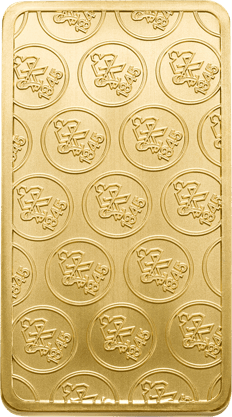
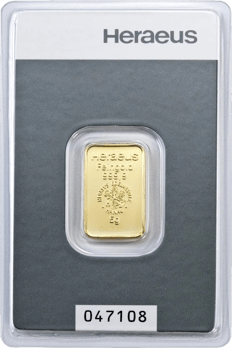
1 Ounce Kinebar® Gold Bar Heraeus
€3,499.14
VAT-free and excl. shipping
Available in 2–3 business days

 More than 310,000
 Over 30 years
 Secure shipping
 Google: 4.9/5


A gold bar is perhaps the clearest form in which wealth can be held: a piece of pure precious metal whose value depends on no year of issue, design or collector's whim. Anyone who wants to buy a gold bar chooses one of the oldest and most honest investment forms in the world: compact, tradeable worldwide and exempt from VAT in Germany. The following sections cover the differences between minted and cast bars, suitable denominations, fineness and authenticity features, tax treatment and secure storage, so that the choice of the right bar is ultimately a deliberate one.
An investment gold bar consists of fine gold with a fineness of 999.9/1,000, also known in trade jargon as four nines. This purity is the international standard and the basis for a bar being traded worldwide at the current daily gold price. Unlike bullion coins, with a bar you pay almost exclusively for the precious metal it contains: the surcharge above the pure material value, known as the premium, is particularly low for larger units.
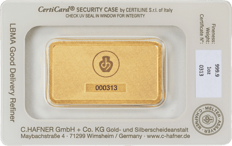
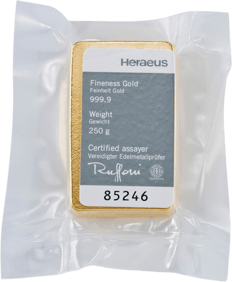
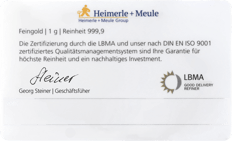
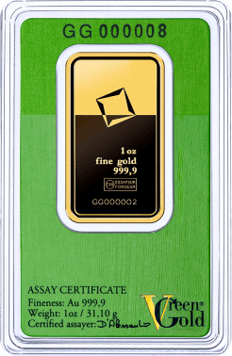
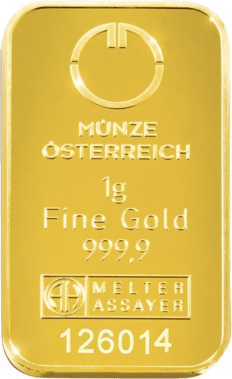
Every reputable bar carries a fixed set of markings: weight, fineness (999.9), the manufacturer's mint mark and, from a certain size onwards, an individual serial number. Renowned manufacturers such as Heraeus, Heimerle und Meule, C. Hafner, Umicore, Valcambi, PAMP or Degussa have their bars produced to the standard of the London Bullion Market Association (LBMA). These quality seals are the reason a bar can be bought back by any dealer worldwide without extensive verification. A wide selection of marked investment forms can also be found in the range of gold bullion coins, which complement the bar nicely as an investment.
Gold bars are produced in two fundamentally different ways, which differ in appearance, feel and sometimes also in price. Both variants contain the same fine gold: the difference lies in the production method, not in the value of the metal.
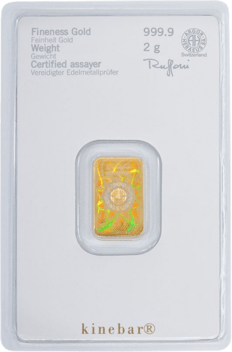
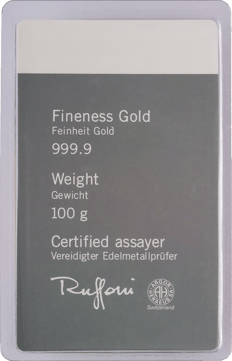
The minted gold bar is the most common form in the small-weight range. Blanks are punched from a rolled gold strip and then minted under high pressure. The result is an immaculately smooth, mirror-like surface with razor-sharp lettering. Minted bars usually come in a sealed blister card that also carries the certificate of authenticity and the serial number. This clean, crisp appearance makes them particularly popular for smaller denominations up to around 100 grams.
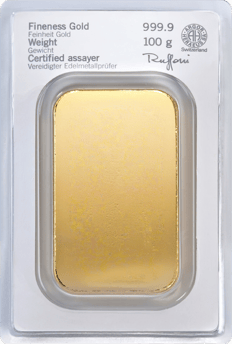
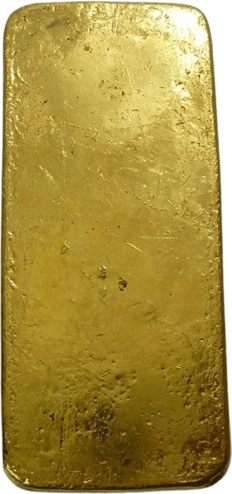
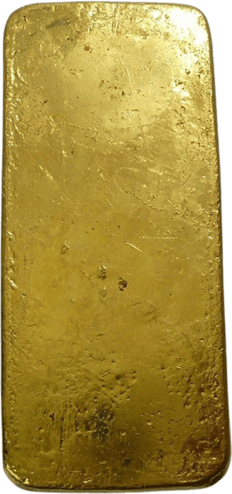
For a cast gold bar, liquid gold is poured into a mould and solidifies there. This gives every cast bar a slightly irregular, individual surface, which for many investors is precisely the appeal of this variant, as it recalls the original, craft tradition of gold smelting. Cast bars are offered mainly in larger units from 100 grams upwards and are often somewhat cheaper to produce. Anyone who values a classic look will find both methods side by side among the 100-gram gold bars.
The range of available weights is the greatest advantage of the gold bar. It spans from the delicate one-gram wafer to the heavy kilo bar, and there is a suitable size for every investment goal. As a rule of thumb: the larger the bar, the lower the percentage premium, but the lower the flexibility for a later partial sale.
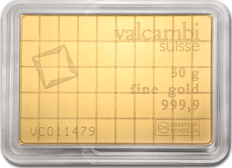
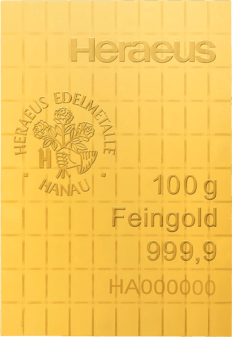
A special form is the CombiBar: a larger bar is divided by perforations into many small one-gram units, which can be broken off individually as needed. This way, the gold CombiBar combines the lower premium of a larger unit with the divisibility of small bars, practical for anyone who wants to hold gold as a flexible reserve. A complete overview of all weights can be found in the category of smaller gram bars as well as the heavy 500-gram bars.
Understanding the Premium
The premium is the difference between the selling price and the pure material value. For a 1-gram bar, it can run into double-digit percentages, whereas for a kilo bar it amounts to only a few percent. Anyone planning long-term wealth building is better off with larger units, while anyone who values flexibility and divisibility deliberately chooses smaller denominations.
Gold attracts covetous attention, which is why the subject of authenticity is crucial for every investor. Reputable gold bars carry several security features that make counterfeiting more difficult. The most important indicators at a glance:
Physical checks of weight, dimensions and density can be roughly carried out at home, but professional methods such as ultrasonic or X-ray fluorescence analysis belong in the hands of experts. Kettner Edelmetalle uses an ISO-compliant authenticity verification process, so that every bar delivered is checked. Anyone who would also like to hold gold in coin form will find similarly counterfeit-proof classics in the Krugerrand or the Maple Leaf.
A weighty argument in favour of the gold bar is its tax treatment. Investment gold is exempt from VAT in Germany and throughout the EU, as set out in §25c UStG. A bar with a fineness of at least 995/1,000 counts as tax-exempt investment gold and can therefore be purchased without VAT, quite unlike silver or platinum, for example. This tax exemption makes the bar one of the most efficient forms of investing in physical gold.
Tax Note
If physical gold is held for longer than one year, any subsequent profit on sale is currently tax-free under the applicable legal situation (holding period pursuant to §23 EStG). This does not constitute tax advice; for your individual situation, you should seek expert guidance.
This combination of VAT-free purchase and potential tax exemption on sale makes physical gold one of the few tangible assets with this dual advantage. Comparable benefits are also offered by the range of gold bullion coins, while silver bars are subject to different tax rules.
Physical gold brings with it a responsibility: it needs to be kept safe. A small bar literally fits in the palm of your hand, and this very compactness is both a blessing and a challenge. A certified safe is suitable for storage at home, while a bank safe deposit box is advisable for larger holdings. In both cases, it is important that the blister card and the certificate are kept undamaged, as they make a later sale considerably easier.
To prevent the shiny surface of minted bars from picking up fingerprints or scratches, additional protection is advisable. Suitable coin capsules and coin cases keep bars and certificates neatly stored and well protected. Anyone systematically collecting precious metals will find suitable solutions throughout the accessories range.
A gold bar does not ask about origin, language or time: its value is understood everywhere in the world.
Gold has been regarded as a store of value for millennia and is valued by many investors as a building block for diversifying their wealth. In periods of economic uncertainty, physical gold has historically played its role as a safe haven, although no promise for the future can be derived from this. The gold bar is the purest form of this investment: no collector's premium, no issuer risk, just the metal itself.
Many investors combine larger bars as a base with small denominations and bullion coins for the necessary flexibility. Anyone who prefers a gradual approach can regularly save small amounts through savings plan products. The topics of inflation hedging and retirement provision further explore the subject of value protection. As a German family business with over 200,000 customers and 100% insured shipping, Kettner Edelmetalle supports the purchase from the smallest gram bar to the kilo bar.
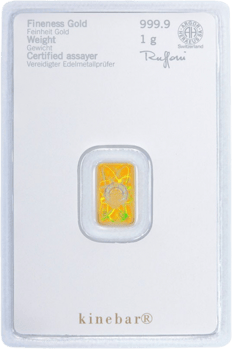
Small denominations of 1 to 10 grams are suitable for getting started. They require little capital, can be sold individually later and also make a good gift. While the percentage premium on these sizes is higher than on the kilo bar, the purchase remains manageable and flexible.
Minted bars are punched from a gold strip and minted under pressure, which produces a smooth, mirror-like surface. Cast bars are produced by pouring liquid gold into a mould, giving them a more individual and original look. Both contain the same fine gold at 999.9 fineness; the difference lies solely in appearance and, in part, in the premium.
Yes. Investment gold with a fineness of at least 995/1,000 is exempt from VAT in Germany and the EU pursuant to §25c UStG. Gold bars with 999.9 fineness meet this requirement and are therefore sold without VAT.
A genuine bar carries a clean minting with the manufacturer's mark, weight and fineness information (999.9), a serial number from around five grams upwards, and a sealed certificate in the blister card. Hologram techniques such as the Kinegram provide additional security. When buying from a vetted dealer with ISO-compliant authenticity verification, authenticity is guaranteed.
It depends on your goal. A large bar such as the kilo bar has the lowest premium per gram but can only be sold as a whole. Several small bars, or a CombiBar with segments that can be broken off, offer more flexibility for a partial sale, albeit at a somewhat higher premium. Many investors combine both approaches.
Smaller holdings can be stored in a certified home safe, larger quantities in a bank safe deposit box. It is important to keep the bar, blister card and certificate together and undamaged, as this makes a later sale easier. Coin capsules and cases provide additional protection for the sensitive surface against scratches and fingerprints.
 YouTube OffersGold Bars
Stay informed with product launches, financial news and exclusive offers. Sign up for our free newsletter today.
By entering your email address and clicking the “Submit” button, you give the following consent: “I agree to be informed by email about new products, financial news and exclusive offers, and therefore consent to the processing of my email address for the purpose of sending the newsletter. I can revoke this consent at any time without giving reasons, with effect for the future. The lawfulness of processing carried out prior to revocation remains unaffected.”