





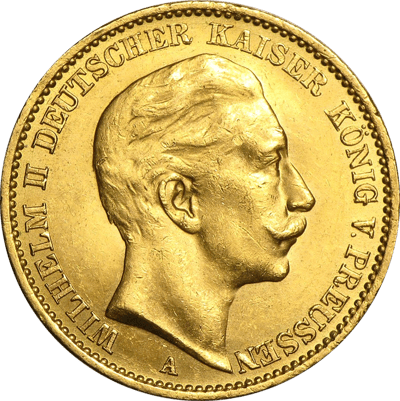

20 Mark Prussia Wilhelm II Gold Coin
- Imperial Era: German Empire
- Gold content: 7.17 g gold
- Securely capsuled: in the coin capsule
- Imperial EraWith the inscription German Emperor, King of Prussia
- Gold contentA gold coin with a fineness of 900/1,000
- Securely capsuledEach coin comes protected in its own capsule








By submitting your order you accept our Terms & Conditions and confirm the Right of withdrawal.
- Imperial Era: German Empire
- Gold content: 7.17 g gold
- Securely capsuled: in the coin capsule
 Price alert
 Share

Original from the German Empire · Wilhelm II
20 marks in gold, with Wilhelm II.Officially it was called the double crown.
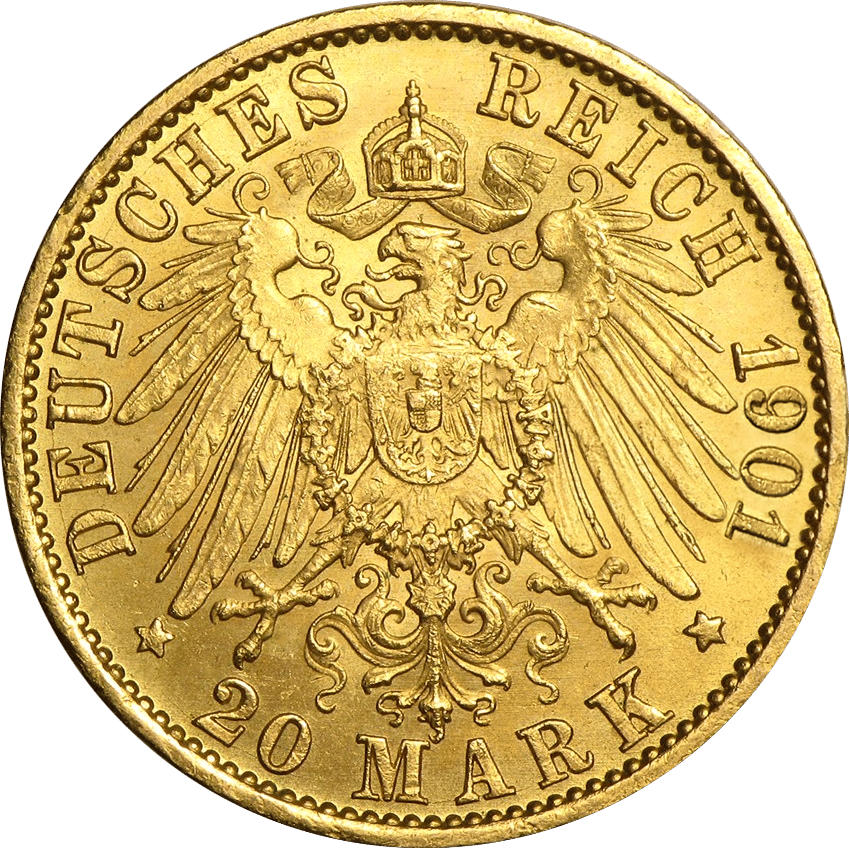
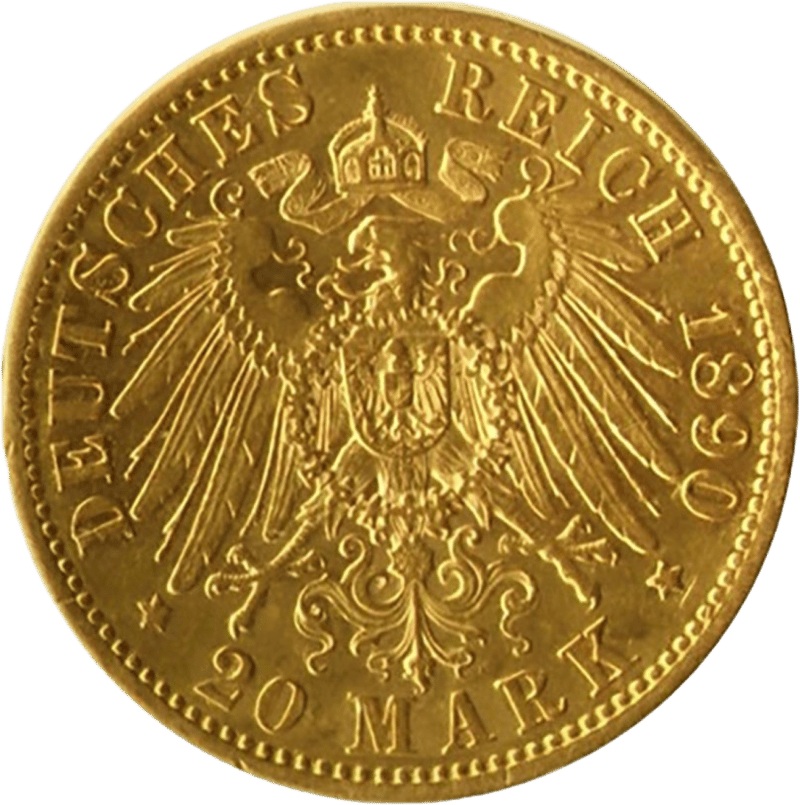
Value, year, imperial eagle and a letter for the mint: all of this was laid down by law.
- Metal
- Gold
- Gross weight
- 7.96 g
- Fineness
- 900/1,000
Value, year, imperial eagle and a letter for the mint: all of this was laid down by law.
- Metal
- Gold
- Gross weight
- 7.96 g
- Fineness
- 900/1,000
Legend, Reich and value
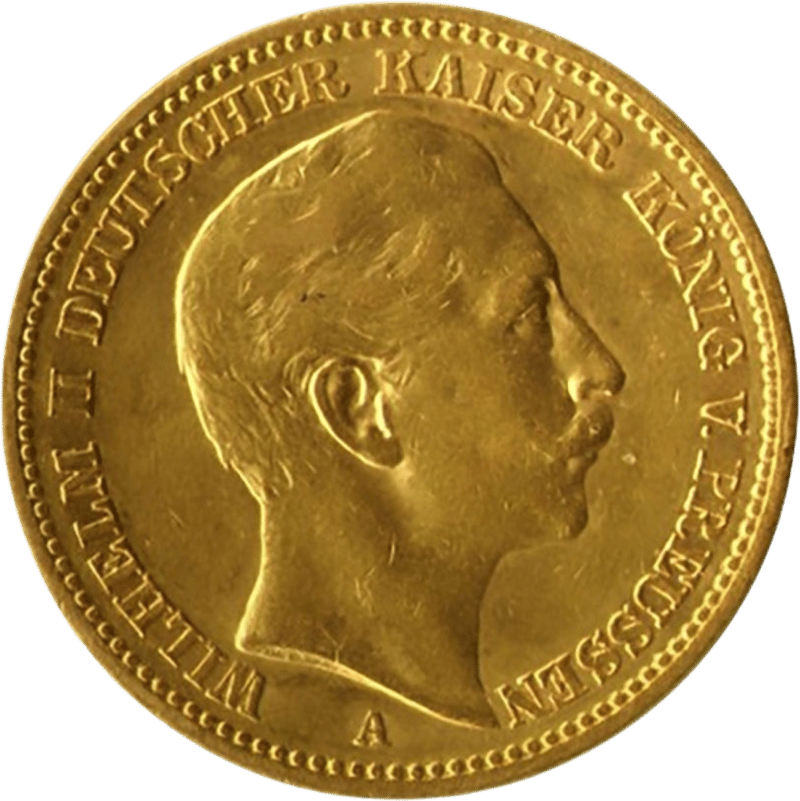
The legend above the portraitLegend
The word REICH above the eagleReich
The value below the eagleValue
What the law prescribes
What a mark had to bear
For every gold coin of the Reich, the law of 1871 laid down what it bears:
“The imperial gold coins bear on one side the imperial eagle with the inscription ‘Deutsches Reich’ and the statement of the value in marks, as well as the year of striking, on the other side the portrait of the sovereign, or the emblem of the free cities, with a corresponding legend and the mint mark.”
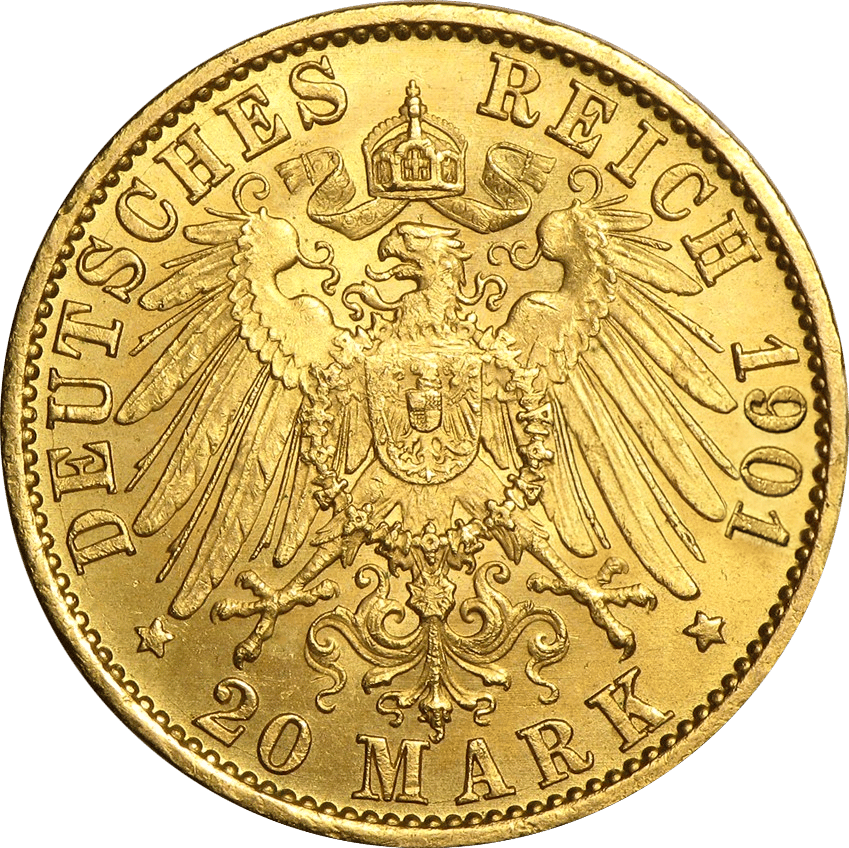
Obverse and reverse
The other side.
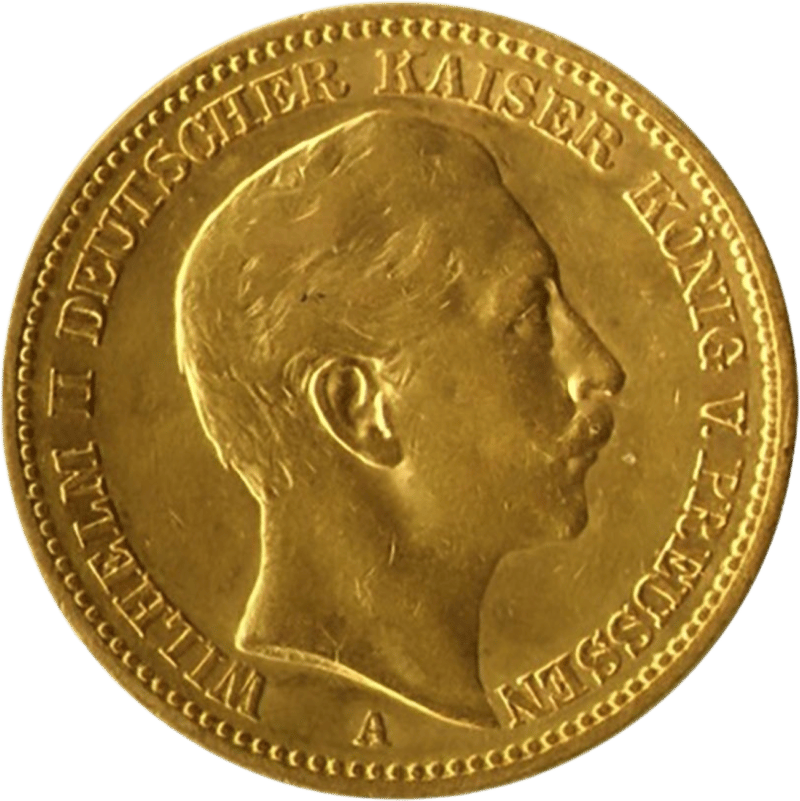
The Münzkabinett Berlin calls the side with the sovereign the obverse and the side with the eagle the reverse. The mint mark is the letter of the mint.
The mint mark
A letter tells where it was struck
The law prescribes a mint mark for every gold coin: a letter that names the mint. A stands for Berlin, J for Hamburg, F for Stuttgart.
“Below, the mint mark J for Hamburg.”
The mints on today’s map.
The mint mark on the shop image
The shop image of this piece shows a A. As it comes from different years, your piece may bear another letter.

The gold of the mark
How heavy the gold had to be
The law of 1871 counted in pounds of fine gold, the pound at 500 grams:
“Imperial gold coins of 20 marks, of which 69¾ pieces are struck from one pound of fine gold.”
In other words: one pound of fine gold yields 69¾ pieces of 20 marks.
Fineness 900/1,000 means: of a thousand parts, nine hundred are pure gold.
The law of 1871 counted in pounds of fine gold, the pound at 500 grams:
“Imperial gold coins of 20 marks, of which 69¾ pieces are struck from one pound of fine gold.”
In other words: one pound of fine gold yields 69¾ pieces of 20 marks.
From the thaler to today
The story of the mark, piece by piece.
Before 1871
Thaler and kreuzer
Before the mark, the thaler counted in the north and the gulden of 60 kreuzer in the south.
To the sixth of a thalerThaler and kreuzer
Before the mark, the thaler counted in the north and the gulden of 60 kreuzer in the south.
1871
This piece stands here
1871
Thalers that commemorate
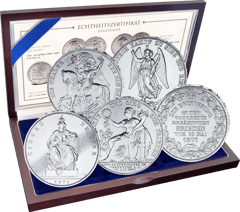
The Victory Thaler of 1871 from Prussia is a commemorative coin in silver. The law of 1871 allowed large silver coins for the time being only as commemorative coins, until the end of 1873.
To the five thalersThalers that commemorate
The Victory Thaler of 1871 from Prussia is a commemorative coin in silver. The law of 1871 allowed large silver coins for the time being only as commemorative coins, until the end of 1873.
1873
The silver mark in the hand
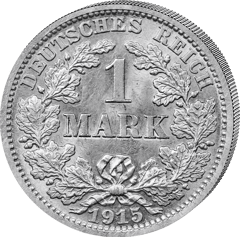
A mark holds 5 grams of fine silver, 900/1,000, and measures 24 millimetres. No one had to accept silver coins for amounts over 20 marks.
To the 1 mark in silverThe silver mark in the hand
A mark holds 5 grams of fine silver, 900/1,000, and measures 24 millimetres. No one had to accept silver coins for amounts over 20 marks.
1920 to 1923
Emergency money in stoneware and from Hamburg
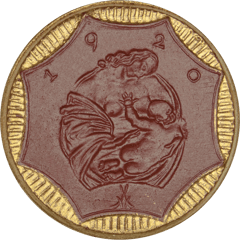
In 1921 Saxony issued emergency money of Meissen Böttger stoneware, and in August 1923 Hamburg issued its own emergency money.
To the emergency money from MeissenEmergency money in stoneware and from Hamburg
In 1921 Saxony issued emergency money of Meissen Böttger stoneware, and in August 1923 Hamburg issued its own emergency money.
1923 and 1924
The Reichsmark from 1924
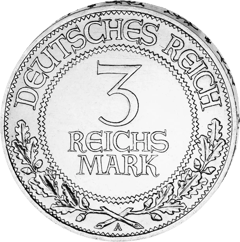
The coinage act of 30 August 1924 introduced the Reichsmark; in October 1924 it came into circulation alongside the Rentenmark, one to one.
To 3 Reichsmark 1926The Reichsmark from 1924
The coinage act of 30 August 1924 introduced the Reichsmark; in October 1924 it came into circulation alongside the Rentenmark, one to one.
1925 to 1930
3 Reichsmark for an occasion
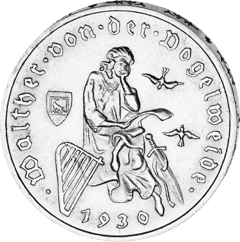
The Weimar Republic struck commemorative coins of 3 Reichsmark, in 1930 for instance for the 700th anniversary of the death of Walther von der Vogelweide.
To Vogelweide 19303 Reichsmark for an occasion
The Weimar Republic struck commemorative coins of 3 Reichsmark, in 1930 for instance for the 700th anniversary of the death of Walther von der Vogelweide.
June 1948
The Deutsche Mark replaces the Reichsmark.
New strikes · 2025 and 2026
What the new strikes take up
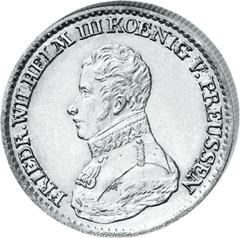
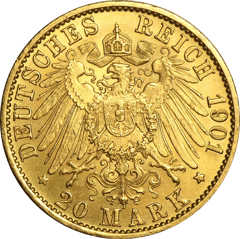
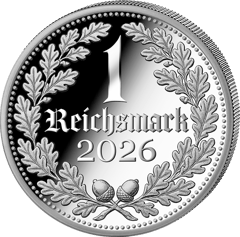
The new strikes bear the lettering 1 Reichsmark or 1 Mark in an oak wreath. They are newly struck, no Reichsmark of the past and no legal tender of the Reich.
What the new strikes take up
The new strikes bear the lettering 1 Reichsmark or 1 Mark in an oak wreath. They are newly struck, no Reichsmark of the past and no legal tender of the Reich.
Side by side
10 and 20 marks in gold, at true size.
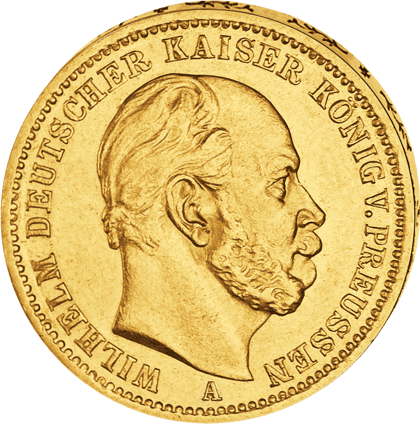 10 marks Prussia, Wilhelm I, 187219.5 mm
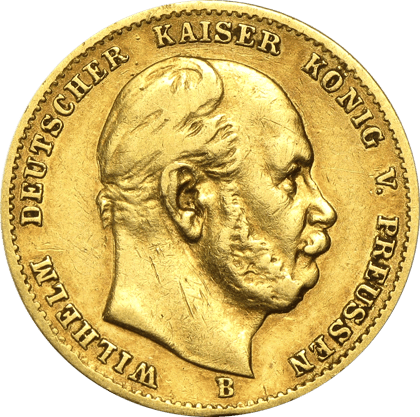 10 marks Prussia, Wilhelm I19.5 mm
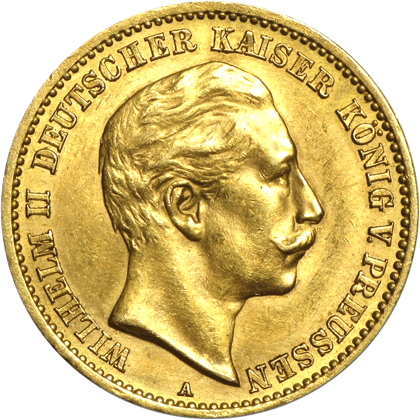 10 marks Prussia, Wilhelm II19.5 mm
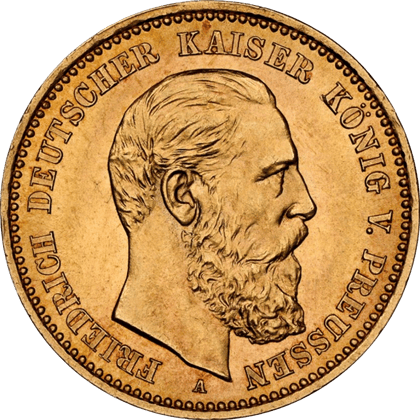 10 marks Prussia, Friedrich III19.5 mm
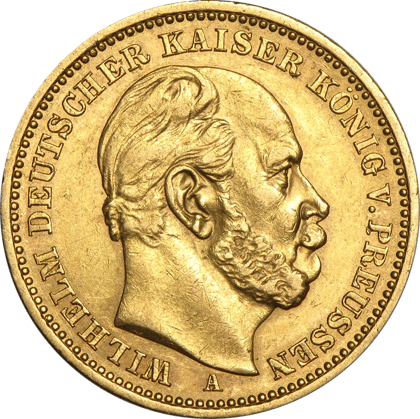 20 marks Prussia, Wilhelm I22.5 mm
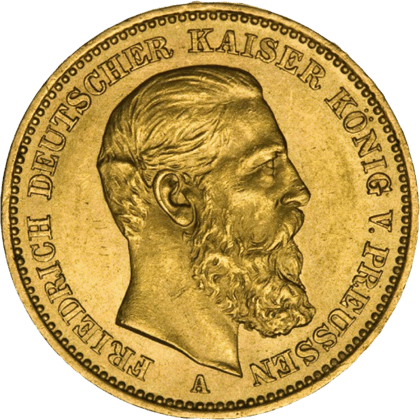 20 marks Prussia, Friedrich III22.5 mm
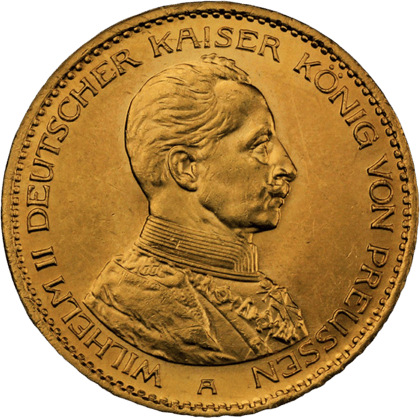 20 marks Prussia, Wilhelm II in uniform22.5 mm
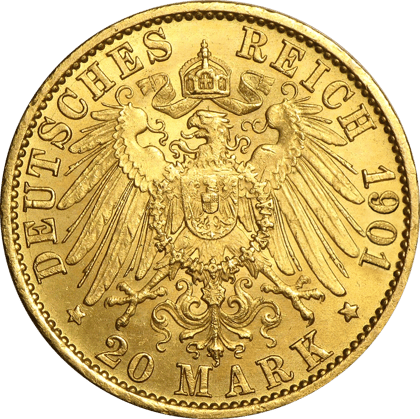 20 marks Prussia, Wilhelm II22.5 mmThis piece
At a glance
The figures of this piece.
- Type
- Original
- Era
- German Empire
- Ruler
- Wilhelm II
- Face value
- 20 marks
- Metal
- Gold
- Packaging
- Coin capsule
Gross weight: the weight of the whole coin. Fine weight: the pure metal in it. Fineness: its share in thousandths.
Details from our product data, the coinage acts and the shop image. The year and mint mark of your piece may differ from the shop image.

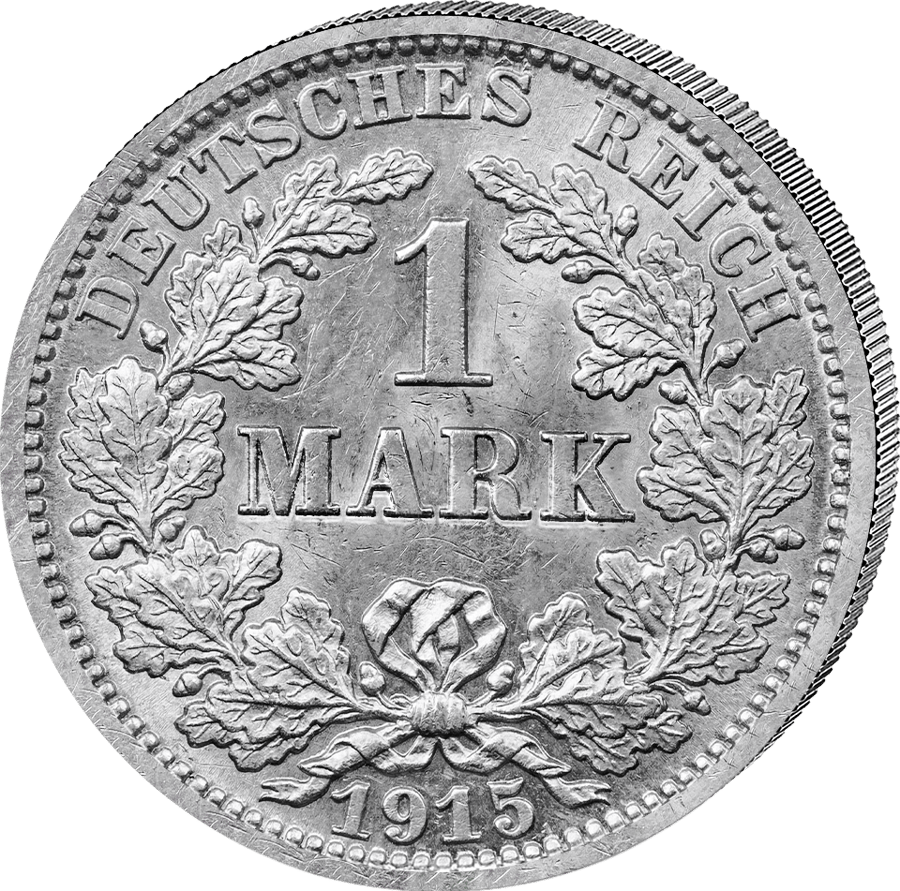
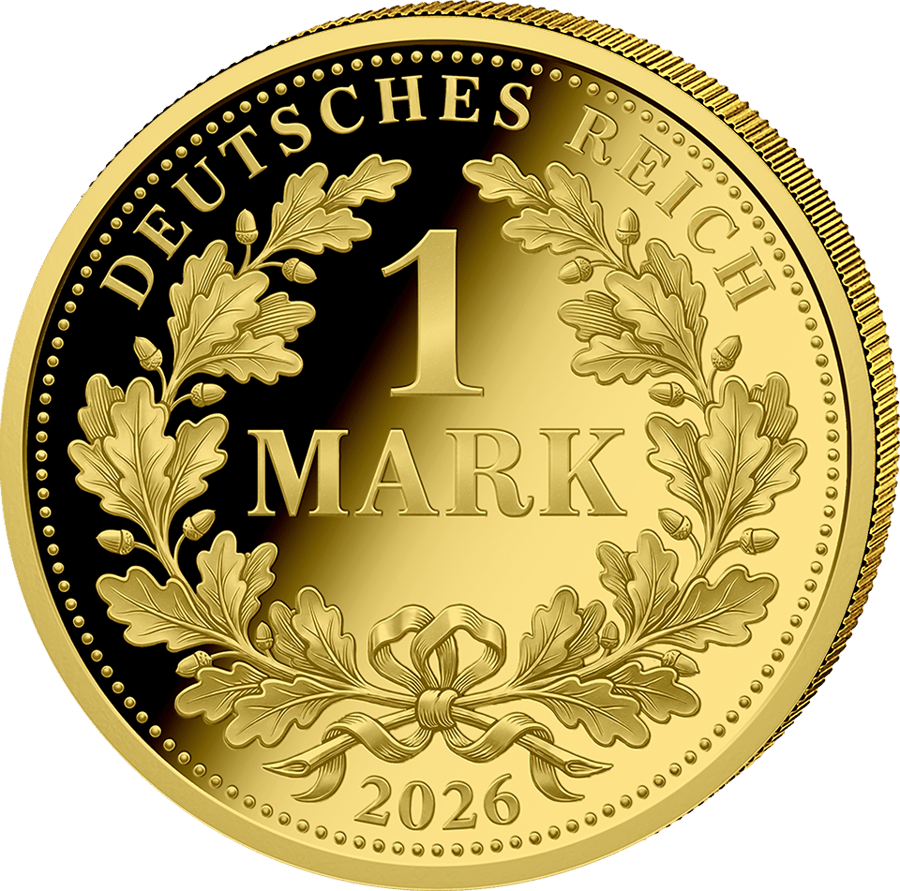
Original and new strike
Every sign on a mark has its reason.
On the left a mark from the German Empire, on the right a new strike of 1/200 ounce of fine gold, which takes up DEUTSCHES REICH and 1 MARK in an oak wreath.
One was money throughout the Reich, the other is newly struck: two pieces, one image.
Buy 20 Gold Mark Wilhelm II: Gold from the German Empire
- Investment objective: With this coin, you invest your wealth in physical gold, which no central bank can multiply.
- Lasting value: Its gold content has survived the Empire, two world wars and several currency reforms unchanged.
- Hedging: In times of inflation, recession and high government debt, you protect your wealth with historical gold coins.
The 20 Mark Prussia Wilhelm II shows the last German Emperor in profile, surrounded by the inscription WILHELM II DEUTSCHER KAISER KÖNIG V. PREUSSEN. This design was minted from 1888 to 1913, during the years when the Empire's currency was firmly tied to gold. You receive an original from this era in bank-grade condition; the minting year varies. Anyone wishing to buy 20 gold marks will find in this type a classic of the German Empire series, as the Prussian royal house provided the Emperor.
Unity and gold: how the imperial currency came about
Before the founding of the Empire, Germans paid with talers, guilders and numerous other regional currencies. Only political unity after the Franco-Prussian War of 1870/71 made a common currency possible. France subsequently had to pay reparations of five billion francs, and part of this money helped the young Empire convert its currency to gold. This gave rise to the Mark, later called the gold mark to distinguish it from the paper money of the inflation years. Our guide to the imperial gold currency tells this story in detail.
Wilhelm II, the Year of the Three Emperors and Bismarck
In 1888, Emperor Wilhelm I and his son Friedrich III, who had reigned for only 99 days, died in quick succession. At the age of 29, Wilhelm II ascended the throne, which is why 1888 went down in history as the Year of the Three Emperors. As early as 1890, the young Emperor parted ways with Otto von Bismarck, who had been Chancellor of the Empire since its founding. Wilhelm II remained on the throne until 1918, thus reigning longer than his two predecessors combined. You will find the coins of his grandfather and his father further below in the overview.
Eagles, coats of arms and sovereign rulers
The value side was designed uniformly throughout the Empire: it shows the crowned imperial eagle and the face value. On its breast, the eagle bears a shield with the Prussian eagle, at the centre of which sits the Hohenzollern shield, the family coat of arms of the imperial house. The design side, by contrast, was created individually by each state. The kingdoms and grand duchies depicted their sovereign ruler, such as King Otto of Bavaria, while the free cities such as Bremen and Lübeck showed their city coat of arms. This gave rise to many different coins of the same weight, and to this day this diversity makes the gold coins of the German Empire a popular collecting area.
Years of issue, mintage and condition
In 1913, a new portrait of the Emperor in uniform followed, which you can find with us as a separate uniform variant. The mintage varies considerably from year to year, and some years are considered rare among collectors. You will receive this coin from one of the common years of issue; you cannot select a specific minting year. Until 1914, the coins circulated in payment transactions, so fine scratches and a slightly worn relief are normal and are part of the history of each individual coin.
What the inflation of the 1920s teaches us
During the inflation of 1923, paper money lost almost all of its purchasing power. Anyone who owned gold coins at the time held a value in their hands that no printing press could dilute. This is precisely where the strength of gold as inflation protection lies to this day. A coin of this size is well suited to your crisis protection, because it is finely divided and its gold content has been fixed for over a hundred years. You can see the current price under current gold price.
The most important facts at a glance
- Country: Kingdom of Prussia in the German Empire
- Gold content: 7.17 g at a fineness of 900/1,000
- Diameter: 22.50 mm
- Years of issue of this type: 1888 to 1913, minting year subject to availability
- Condition: bank-grade, circulated
More gold coins of the German Empire
Many collectors build their holdings across several emperors and denominations:
- 20 Mark Prussia Wilhelm II Uniform
- 10 Mark Prussia Wilhelm II
- 20 Mark Prussia Friedrich III
- 20 Mark Prussia Wilhelm I
- Complete set 24 x 20 Mark gold Wilhelm II (1890 to 1913)
You will find all coins from the imperial era in the category Gold coins German Empire. Our guide to the value of imperial coins explains what a gold twenty-mark piece is worth today and what you should look out for. The guide Gold coins of the German Empire shows how the two face values differ in gold.
The imperial era is long gone, but this coin has not lost a single gram in weight.
Frequently asked questions before buying
Do I have to pay VAT when buying?
No. With its fineness of 900/1,000, the coin qualifies as investment gold and is exempt from VAT under § 25c UStG. Profits from the sale of physical gold are tax-free for private individuals after a holding period of more than one year under § 23 EStG.
Can I choose a specific minting year?
No. You will receive a coin from one of the common years of issue. Anyone wishing to own every year from 1890 to 1913 should choose the complete set of 24 coins.
How can I tell that the coin is genuine?
Our guide Checking gold for authenticity shows how you can check gold coins yourself.
We check every item before it leaves our premises: using X-ray fluorescence analysis, conductivity and eddy current measurement, magnetic scales, as well as acoustic and visual inspection. Two specialists check each order according to the dual-control principle, after which your goods travel in a safe bag that can only be opened once.
How do I store historical gold coins correctly?
It is best to leave the coin in its capsule, which protects the relief from new scratches. Whether a safe at home or a bank safe deposit box: what matters is a dry, discreet location and insurance that covers the value. You can read more about this in our guide Storing precious metals correctly.
Can I sell the coin to Kettner Edelmetalle later?
Yes, we buy back your precious metals. If you wish to sell, you will usually receive a written offer within 24 hours via our buy-back portal; the gold price on the day the goods are received is decisive. A buy-back from Switzerland and Liechtenstein is currently not possible.
Buy the 20 Mark Prussia Wilhelm II now: a piece of gold from a time when people still paid with gold.
Product image may differ from the actual product.
 ManufacturerMünze DeutschlandOfficial state distributor · GermanyAll products
