





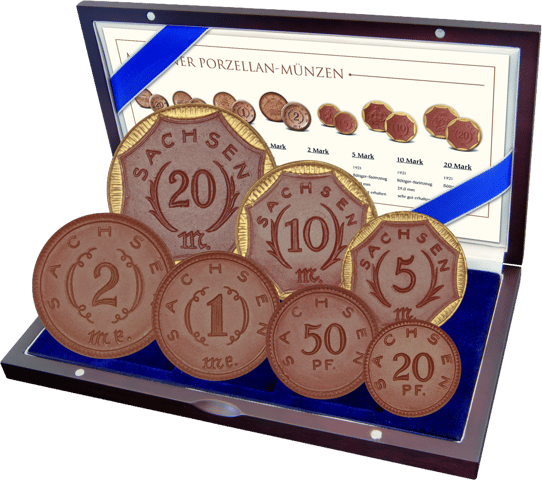
Complete Set Meissen Porcelain (Emergency Money of the Weimar Republic 1920-1921)
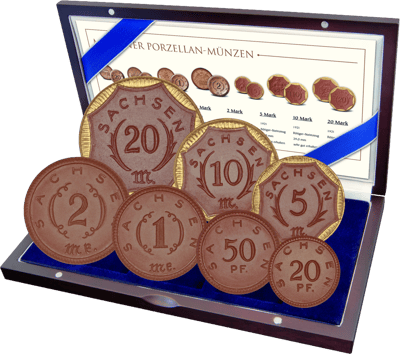











- Manufactory piece: crossed swords
- Historical era: redeemable only until 1922
- Gold decor: on three top denominations
- Manufactory pieceBöttger stoneware, fired at around 1,200 to 1,300 °C
- Historical eraSaxony was the first German state to issue porcelain money
- Gold decor5, 10 and 20 Mark recall the former imperial gold currency
 Price alert
  Share
Share
Weimar Republic · Saxony
What the emergency money bears

In 1921 Saxony was the first state to issue emergency money from the Meissen manufactory, made of brown Böttger stoneware. The case holds seven pieces from 20 pfennig to 20 marks; the pieces of 5, 10 and 20 marks bear the year 1920 and a gold decoration.
On the piece
Value, picture and origin
The value side bears SACHSEN and the value, on the large pieces 5, 10 or 20 with m. for mark.
On every piece a mark with crossed swords shows its origin in the Meissen manufactory.

Emergency money
Emergency money in Böttger stoneware
Böttger stoneware is a brown stoneware body that is also called red porcelain. The Saxon money of the Meissen manufactory was made of it.
“The gold decoration on the five, ten and 20 Mark coins was designed to recall the earlier gold currency of the Reich”
Pieces of 20 and 50 pfennig and of 1 and 2 marks were in circulation. Pieces of 5, 10 and 20 marks were made as well; in this set they bear the year 1920.
The designs are mainly by Emil Paul Börner. On 17 July 1922 any further making of emergency money was prohibited.
 20 marks, mother with child
 10 marks, reaper with sheaf
 5 marks, child between ears of corn
Rentenmark and Reichsmark
The Reichsmark from 1924
The coinage act of 30 August 1924 introduced the Reichsmark; in October 1924 it came into circulation alongside the Rentenmark, one to one.
The gold of the mark
The gold of the German Empire
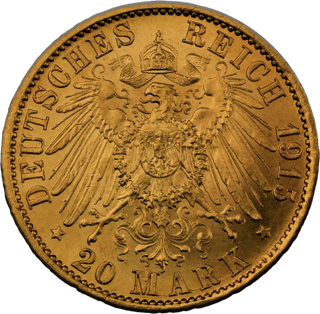
Twenty and ten marks in gold, 900/1,000: a twenty-mark piece weighs 7.96 grams, of which 7.17 grams is fine gold.
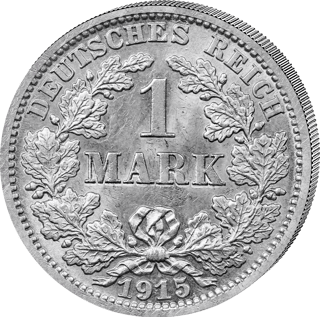
The mark in silver
The silver mark in the hand
A mark holds 5 grams of fine silver, 900/1,000, and measures 24 millimetres. No one had to accept silver coins for amounts over 20 marks.
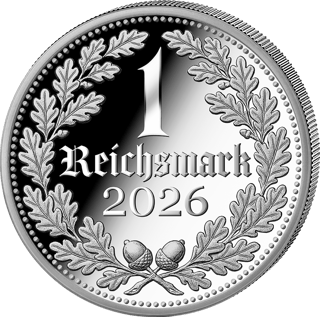
Our strikes
What our strikes take up
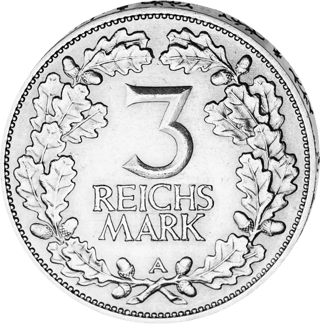
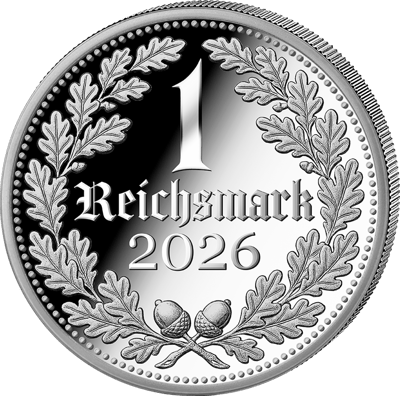
Our strikes bear the lettering 1 Reichsmark or 1 Mark in an oak wreath. They are newly struck, no Reichsmark of the past and no legal tender of the Reich.
At a glance
- Type
- Emergency money
- Era
- Weimar Republic
- Metal
- Böttger stoneware
- Number of pieces
- 7 pieces
- Contents
- seven pieces from 20 pfennig to 20 marks
- Packaging
- Case
Details from our product data and the strike.

Original and new strike
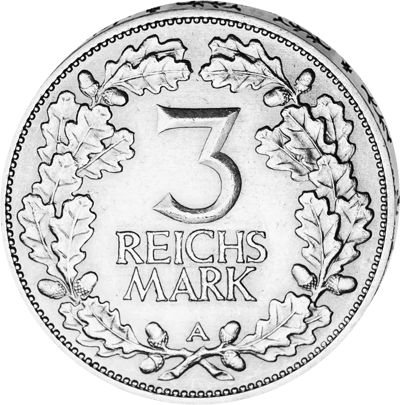
On the left 3 Reichsmark of 1925 with the value in an oak wreath, on the right our ounce, which bears the lettering 1 Reichsmark in an oak wreath.
Complete Set of Meissen Porcelain – Seven Emergency Coins of the Weimar Republic
Seven emergency coins made of brown Böttger stoneware, produced at the State Porcelain Manufactory Meissen, kept in a case and accompanied by a certificate of authenticity: this complete set tells the story of a time when the German Reich literally ran out of small change. Silver and gold had disappeared from circulation – hoarded by people who no longer trusted paper money. What remained was inventiveness. And it came from Saxony.
From Stopgap Measure to Sought-After Collector's Item
After the First World War, there was a shortage of coinage everywhere. Industry needed copper and nickel, and the silver in a mark coin was soon worth more than its face value. From 1919 onward, the Meissen manufactory therefore designed, minted and fired its own coins. In early 1921, the Free State of Saxony became the first German state to actually issue this porcelain money: emergency money tokens made of Meissen brown Böttger stoneware up to a total value of five million marks, in denominations of 20 pfennig, 50 pfennig, 1 mark and 2 marks.
Berlin was less than thrilled. The Reich government considered its sovereign rights violated and instructed all Reich treasuries to refuse the emergency money from Saxony – anyone wanting to buy stamps at the Reich Post came away empty-handed with porcelain coins. Nevertheless, the coins were issued. And shortly after their release, the pieces moved en masse into collectors' hands rather than continuing to circulate from hand to hand. They could only be redeemed until 14 January 1922; on 17 July 1922 the Reich-wide ban on emergency money followed, and with the introduction of the Rentenmark, this ceramic money disappeared for good in 1923.
The Seven Denominations Included in the Set
20 Pfennig – smallest denomination, reverse featuring the year above a scythe and ear of grain (Jaeger N53)
50 Pfennig – classic emergency coin from the 1921 issue (Jaeger N54)
1 Mark – round, with the distinctive lettering SACHSEN (Jaeger N55)
2 Mark – highest denomination officially recognised as a money substitute token (Jaeger N56)
5 Mark – octagonal image field, rim with fired-in gold décor
10 Mark – also gilded, noticeably larger in diameter
20 Mark – the highlight of the set, obverse depicting "Mother with Child"
The gold décor on the three largest denominations had a symbolic purpose: it was meant to recall the earlier Reich gold currency, since these exact face values had circulated as gold coins before 1914. They were never actual means of payment – the 5, 10 and 20 mark pieces held purely collector's value from the outset. The same applies to all pieces bearing the year 1920, early trial strikes produced in tiny quantities. For comparison: around 641,000 examples of the 20-pfennig coin are documented for 1921, but only about 4,200 for 1920.
Böttger Stoneware – the "Red Porcelain" from Meissen
The material is anything but ordinary clay. Böttger stoneware traces back to Johann Friedrich Böttger and Ehrenfried Walther von Tschirnhaus, who developed it in Saxony around 1706. Fired at around 1,200 to 1,300 °C, the material is water-resistant, dirt-repellent and extraordinarily fracture-resistant – ideal for circulating money. Compared to white bisque porcelain, it had two tangible advantages: lower shrinkage during firing and finer internal detail. The designs were largely created by Emil Paul Börner, while the steel dies were cut by Friedrich Wilhelm Hörnlein of the Saxon State Mint Muldenhütten. On every coin, the crossed swords indicate its origin from the Meissen porcelain manufactory.
Typical is the slight, bowl-like concavity on both sides: the material gathers at the rim, stabilising the piece and allowing an astonishingly high relief. Colour variations from light brown to dark brown result from the firing process and are part of the character of these strikings.
Key Facts at a Glance
Quantity: 7 coins, denominations from 20 pfennig to 20 mark
Material: brown Böttger stoneware (Meissen porcelain), three denominations with gold décor
Years of issue: 1920 and 1921
Gross weight: 49.8 g (set)
Origin: Germany, Free State of Saxony
Condition: circulated goods. The pieces are circulated means of payment and show corresponding signs of wear. The pieces may differ from the image shown.
Scope of delivery: case, with certificate of authenticity, insured value shipping
Tangible History – for Collectors and Those Mindful of Tangible Assets
Meissen was not alone: the Pfeffer porcelain factory in Gotha, Rosenthal in Selb and the Krister manufactory in Waldenburg also issued ceramic emergency money and tokens. However, the fame and artistic standing of the Saxon issue remained unmatched – it is the classic of this collecting field. Anyone who collects circulating coinage of the German Empire knows the gap left by the years after 1914: precious-metal coins disappeared, replaced by zinc, iron, paper – and indeed porcelain. Historic silver coins impress with their fineness and material value, whereas Meissen porcelain money impresses with rarity, craftsmanship and storytelling power. In a collection, both worlds complement each other superbly.
Gold is humanity's oldest currency and has outlived all others. This porcelain money vividly demonstrates what happens when paper promises reach their limits.
Therein lies the appeal: the set is a memorial made of fired earth – and an appealing addition for anyone who, when it comes to tangible assets, already pays attention to inflation hedging and crisis protection. Complete sets are in high demand, since the gilded top denominations and the 1920 vintages rarely appear together. Kept in the case, documented by the enclosed certificate: this is how a piece of German monetary history can enter your collection.
Product depiction may differ from the final product.
