Only 6 left to order
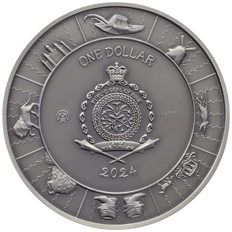
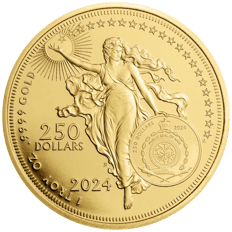
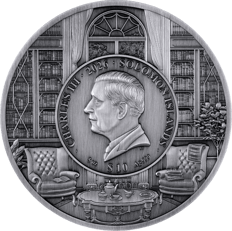
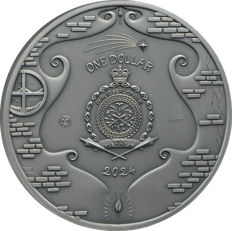
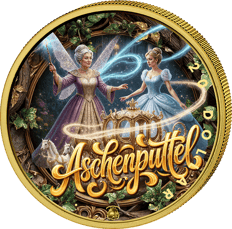
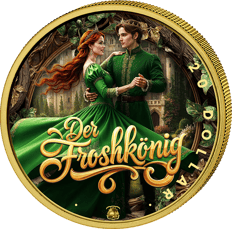
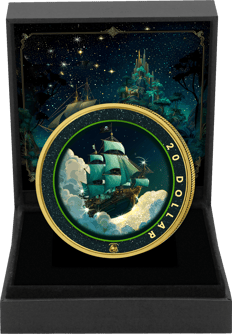
Brothers Grimm Gold Fairy Tale Set 2027 (Mintage: 250 | Proof)
€398.00€599.00
VAT-free and excl. shipping
Ships from 18/12/2026

 More than 300,000
 Over 30 years
 Secure shipping
 Google: 4.9/5


Each of the following stories found its own way onto paper. The sources tell how: the old printings, notes from the days of writing and the words of those who wrote them.
According to Wikisource, Perrault’s Histoires ou Contes du temps passé appeared in Paris in 1697, published by Claude Barbin. In Berlin, a volume came out in 1812 whose title page, the first page with title, place and year, reads: “Kinder- und Haus-Märchen. Gesammelt durch die Brüder Grimm. Berlin, in der Realschulbuchhandlung. 1812.”
In English: Children’s and Household Tales. Collected by the Brothers Grimm. Berlin, at the Realschulbuchhandlung. 1812.
In the preface, or foreword, the Brothers Grimm write that everything was, with few exceptions, “fast nur in Hessen” and along the Main and the Kinzig “nach mündlicher Ueberlieferung gesammelt”. In their notes, the explanations in the appendix, they name Perrault for all three tales of this chapter: in Nos. 21, 26 and 33.
In English: almost only in Hesse
In English: collected from oral tradition
Diagram
On No. 26 the Brothers Grimm write that this tale was “außer unserer mündlichen Sage, was zu wundern ist, nirgends angetroffen, als bei Perrault”. In all four places the two printings read differently.
In English: apart from our oral tradition, which is surprising, found nowhere except in Perrault
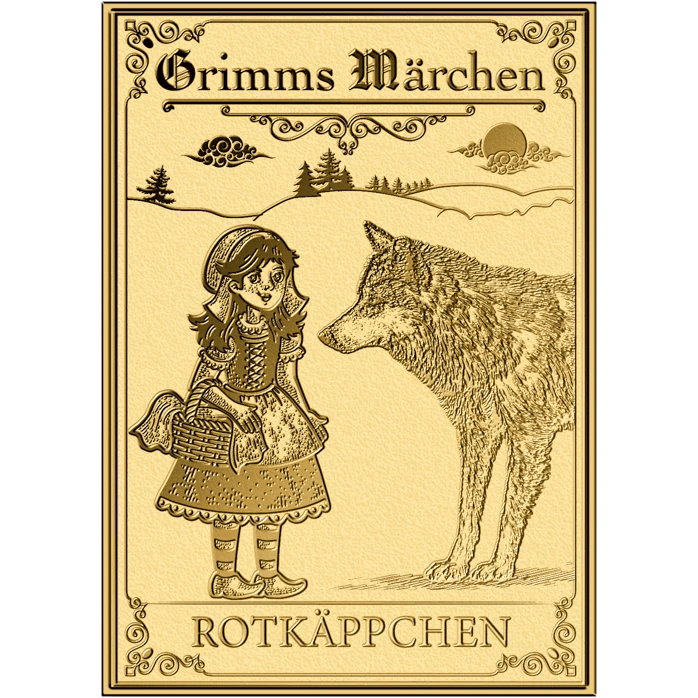
The gold coin shows a girl with a cap and a basket, on the right the wolf in profile, behind them hills with fir trees.

Upper line: Perrault, Paris 1697
Vn Meusnier ne laissa pour tout biens à trois enfans qu’il avoit, que son Moulin, son Asne, & son Chat.
Lower line: the Brothers Grimm, Berlin 1812, No. 33
Ein Müller hatte drei Söhne, seine Mühle, einen Esel und einen Kater…
The same phrases in both sentences: Meusnier and Müller , trois enfans and drei Söhne , Moulin and Mühle , Asne and Esel , Chat and Kater.
Upper line in English: A miller left to the three children he had, as all his goods, only his mill, his donkey and his cat.
Lower line in English: A miller had three sons, his mill, a donkey and a cat
Diagram
In Perrault, the cat asks only for a sack and boots: “me donner un Sac, & me faire faire une paire de Bottes”.
In English: to give me a sack and to have a pair of boots made for me
In Grimm, the cat asks only for boots, “laß mir nur ein paar Stiefel machen”; the sack he gets for himself: he “nahm einen Sack”.
In English: only have a pair of boots made for me
In English: took a sack
On No. 33 the Brothers Grimm note: “Perrault hat es in s. chat botté gut erzählt”. According to a review by Hans-Jörg Uther, they printed the tale only in 1812 and afterwards dropped it from the collection, because it stood too close to Perrault’s tale.
In English: Perrault told it well in his chat botté
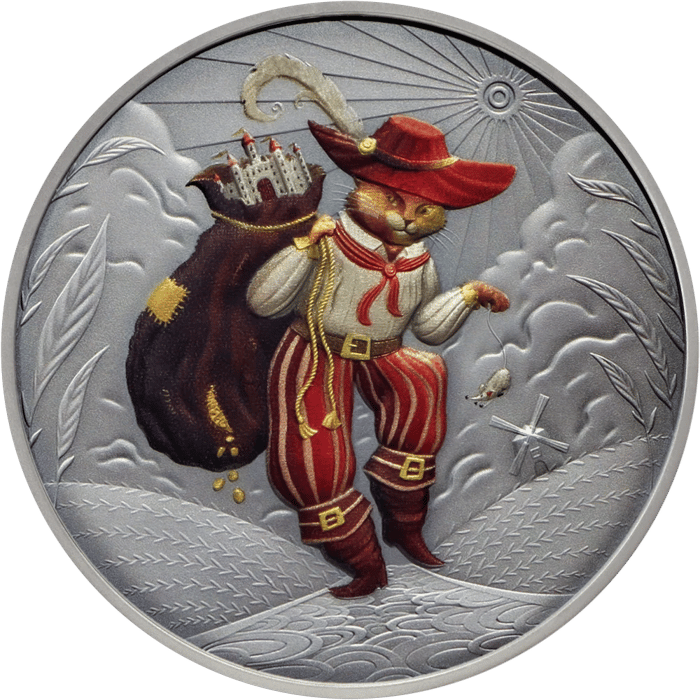
In colour, the coin shows a cat in boots with a plumed hat, the sack over his shoulder and a mouse in his paw; in the background stands a windmill.
Paris 1697: Perrault
Help comes from the godmother, qui estoit FéeIn English: who was a fairy
Deadlinede ne pas passer minuitIn English: not to stay past midnight
Berlin 1812: the Brothers Grimm, No. 21
Help comes from zwei weiße TaubenIn English: two white doves
Deadlinekomm aber vor Mitternacht wiederIn English: but come back before midnight
Diagram
On No. 21 the Brothers Grimm write: “Perraults Cendrillon ou le petite pantoufle de verre gehört nicht unter seine am besten erzählten Märchen”. In Perrault, the godmother, a fairy, transforms a pumpkin, mice and lizards; in Grimm, two white doves help. A deadline at midnight is set by the godmother in Perrault, by the doves in Grimm.
In English: Perrault’s Cendrillon ou le petite pantoufle de verre is not among his best-told tales
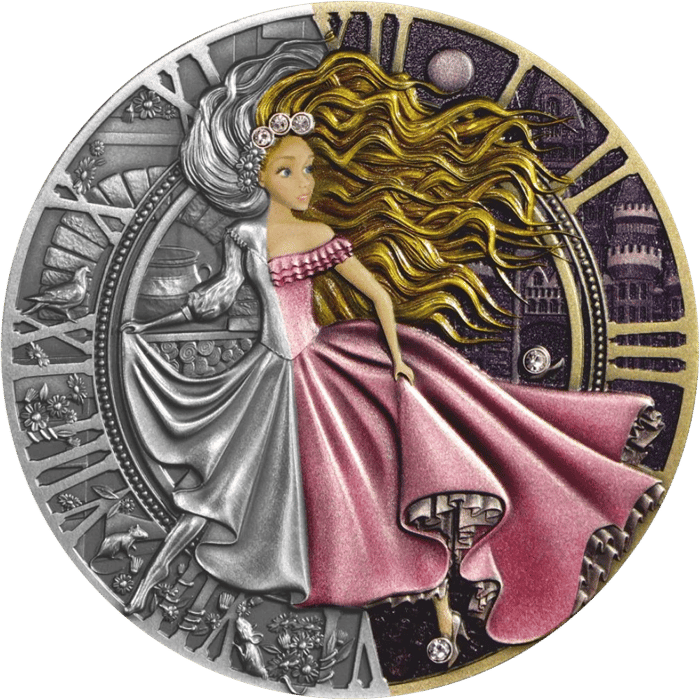
The picture is divided vertically: on the left in silver the kitchen with a cooking pot, a dove and mice, on the right in colour the ball gown, at the edge Roman numerals as on a clock face.
For two tales the sources name the month in which they were written: E. T. A. Hoffmann wrote Nußknacker und Mausekönig in November 1816, and Andersen the tale of the little match girl in November 1845 at Gråsten Palace.
six chapters
three chapters
five chapters
according to Stefanie Junges, E.T.A. Hoffmann Portal
Diagram
The tale was printed that same year, in time for Christmas, in the collection Kinder-Mährchen, edited by Contessa, Fouqué and Hoffmann. According to the E.T.A. Hoffmann Portal, Hoffmann had two of the children of his friend Hitzig appear as characters. According to Stefanie Junges, the first six and the last five chapters enclose the core like a nutshell: the tale of the hard nut, told in three chapters.
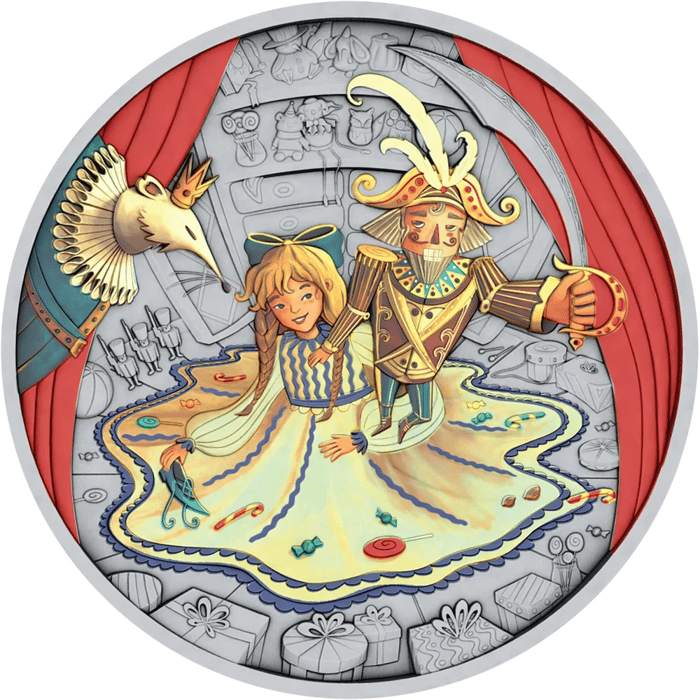
Between red curtains the coin shows a girl with two plaits; the nutcracker with a plumed hat and sabre puts his arm around her, on the left a mouse wears a crown.
a girl holding out a bundle of matches in her hand
Andersen stayed at Gråsten Palace from 2 to 22 November 1845 and noted on 18 and 19 November:
The tale was printed in December 1845 in the Dansk Folkekalender for 1846.
The commentary describes only the picture Andersen chose and gives no order for the three.
Diagram
According to the commentary of the critical edition, the wood engraver A. C. F. Flinch, who cut pictures in wood for printing, asked Andersen in a letter for a tale to go with one of three printed pictures enclosed with it. Andersen chose J. Th. Lundbye’s drawing of a girl holding out a bundle of matches in her hand; it had already been printed in Flinch’s almanac for 1843, a yearbook with a calendar. The tale appeared in December 1845 in the Dansk Folkekalender for 1846 and, according to the commentary, is probably the only one of Andersen’s tales written for a drawing that already existed.
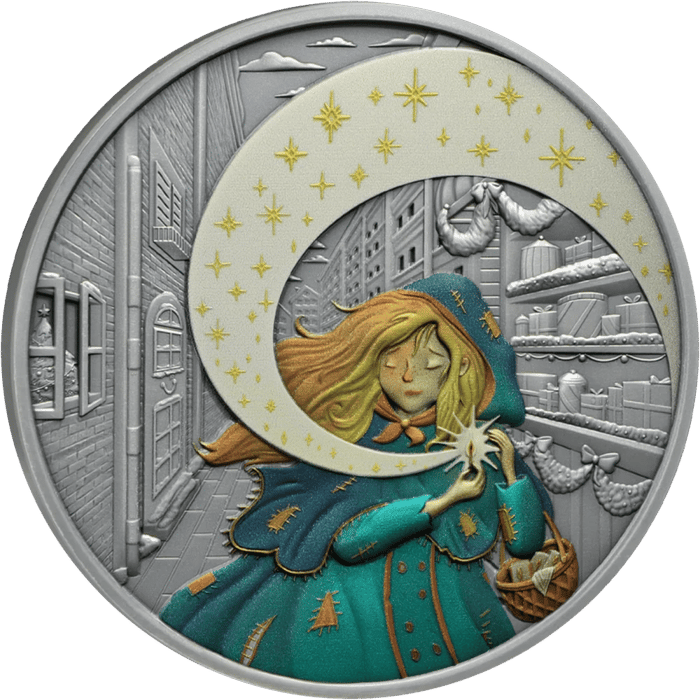
A girl in a patched hooded coat holds a burning match, a basket on her arm; on the left a lane, on the right a shop window.

Frankenstein was printed in London in 1818. For the printing of 1831 Mary Shelley wrote a new introduction, a text of its own before the novel: the publishers had chosen the book for one of their collections and asked her for an account of how the story came about. In it she tells how the novel began and answers a question that, as she writes, she was very often asked: how she, then a young girl, came to think of this idea.
Title page, London 1818
FRANKENSTEIN; OR, THE MODERN PROMETHEUS.
IN THREE VOLUMES.
The author’s name does not appear on the sheet.
Introduction of 1831
In the summer of 1816, we visited Switzerland, and became the neighbours of Lord Byron.
“We will each write a ghost story,” said Lord Byron; and his proposition was acceded to. There were four of us.
On the morrow I announced that I had thought of a story. I began that day with the words, It was on a dreary night of November…
Chapter opening: 1818 Chapter IV, 1831 Chapter V
It was on a dreary night of November, that I beheld the accomplishment of my toils.
Legible on the coin
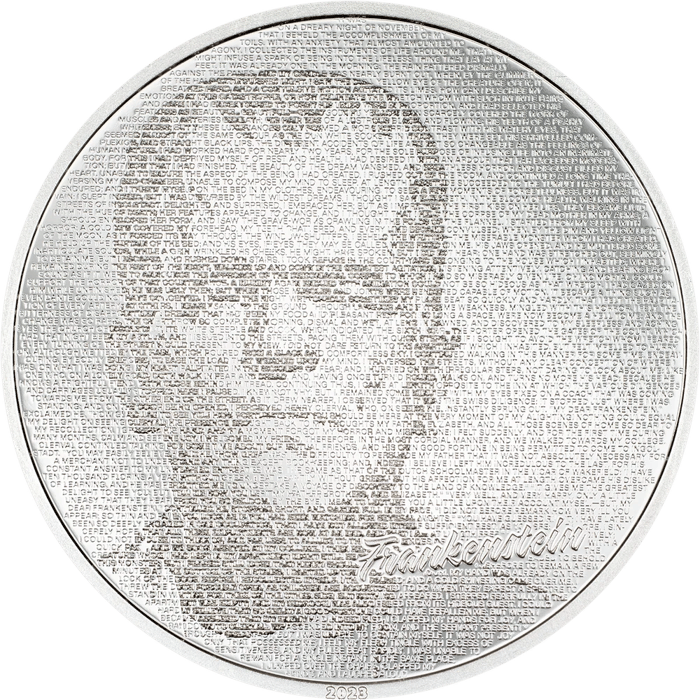
IT WAS ON A DREARY NIGHT OF NOVEMBER, THAT I BEHELD THE ACCOMPLISHMENT OF MY TOILS.
Diagram
Initially, in her own words, she thought of only a few pages: “At first I thought but of a few pages”. The novel then appeared in three volumes. The sentence she began with does not open the book: the novel begins with letters, and the sentence stands in 1818 at the start of Chapter IV, in 1831 at the start of Chapter V.
Tiny capital letters form a head on the coin; the first lines can be read and begin with the sentence from the chapter opening, at the bottom right stands Frankenstein.
FrankensteinSilver, 1 ounce (31.1 g)Silver, 1 ounceIn April 1846 Poe’s essay The Philosophy of Composition appeared in Graham’s Magazine. In it Poe describes how he built the poem The Raven, which had appeared in January and in February 1845. It consists of stanzas, that is, sections of six lines each. He held about a hundred lines to be the right length; it came to 108: “a length of about one hundred lines. It is, in fact, a hundred and eight.”
By his own account, Poe began at the end: “Here then the poem may be said to have its beginning — at the end, where all works of art should begin”.
Template of the poem: 108 lines in 18 stanzas of six lines each. Stanzas 8 to 18 end on Nevermore, that is eleven. By his own account, Poe wrote the sixteenth stanza first. Our own count, from the printing of February 1845.
Diagram
In the template, each stroke is one line of the printing of February 1845, as long as the number of its characters. By our count, the stanza with which Poe, by his own account, began is the sixteenth.
Searching for the refrain, the word that keeps coming back, Poe, by his own account, hit upon Nevermore.
Poe writes of this: “In fact, it was the very first which presented itself.”
For a creature that can speak but cannot think, a parrot, according to Poe, initially suggested itself and was at once replaced by a raven: “a parrot, in the first instance, suggested itself, but was superseded forthwith by a Raven, as equally capable of speech, and infinitely more in keeping with the intended tone”.
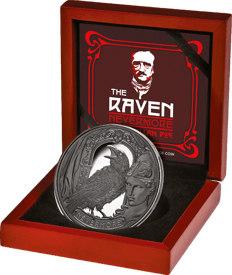
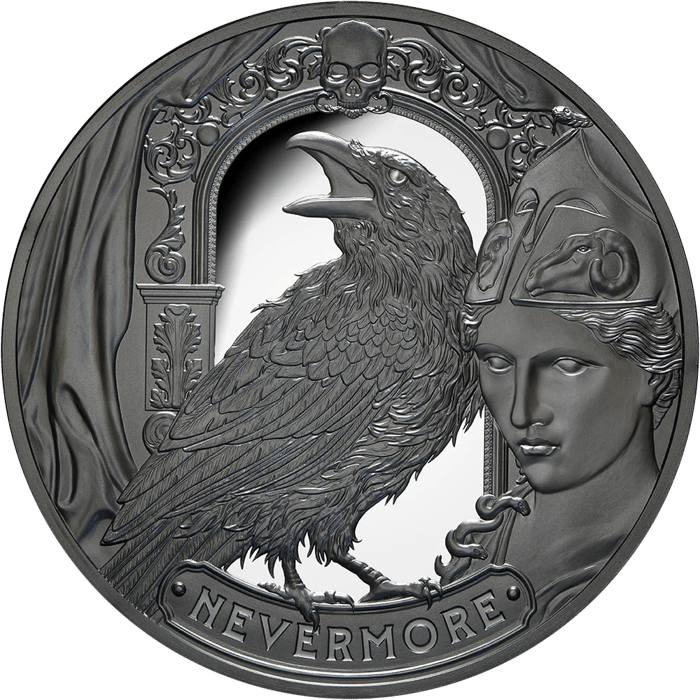
Kept in black and grey: a raven with an open beak on a ribbon reading “NEVERMORE”, on the right a bust of Pallas with a helmet, and a curtain and an arched window.
Perrault and the Brothers Grimm printed the same tales and differed in small places. Hoffmann and Andersen wrote in November, Mary Shelley started with a sentence, and Poe, by his own account, began at the end.
Coins and bars featuring literary designs unite two worlds that, at first glance, have little in common: the permanence of precious metal and the transience of the written word. From the official 100 Euro gold coins of the Masterpieces of German Literature series to world-famous characters such as the Little Prince and the fairy tales of the Brothers Grimm, the Literature category forms an independent collecting field with its own series, minting qualities, mintages and materials, as well as particular tax and practical characteristics of literary collector's and bullion coins.
Literary designs are among the most popular themes in modern collector's coins. The reason lies in the emotional connection: anyone who has read a novel, a fairy tale or a poem throughout their life finds a tangible symbol of that story on a minted coin. Unlike pure bullion coins, whose value is based almost entirely on metal content, literary editions carry an additional intrinsic and collector's appeal.
The spectrum ranges from official commemorative coins issued by state mints to privately released editions from international mints. The range of materials is correspondingly wide: gold, silver and copper-nickel are used, as are enhancements such as partial gilding, colouring or special finishing techniques. Beginners may find it worthwhile to look at commemorative coins, while experienced collectors specifically search for limited mintages.
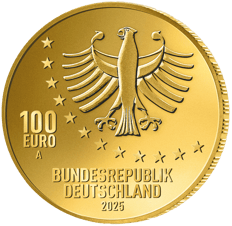
A centrepiece of this collecting field is the German series Masterpieces of German Literature. These official 100 Euro gold coins honour classics of German-language literature, including Die Judenbuche by Annette von Droste-Hülshoff, Aus dem Leben eines Taugenichts by Joseph von Eichendorff and Der zerbrochne Krug by Heinrich von Kleist.
The coins in this series are struck from 999.9 fine gold and each weigh half a troy ounce (around 15.55 grams). As official issues, they carry a face value of 100 euros and are released in Mint State (MS) quality. Minting takes place at several German locations, identifiable by the respective mint mark, the so-called letter (A, D, F, G or J).
Typical for this series is a total mintage of 66,000 pieces per issue, distributed across the five German mints. Since investment gold is exempt from VAT in Germany, the series combines the charm of a literary design with the advantages of a classic gold coin. Anyone looking specifically for German issues will also find them among the German gold coins.
Alongside the official gold euro coins, a second trend shapes this collecting field: international editions dedicated to world-famous stories. Particularly sought after are editions featuring the Little Prince, whose 80th anniversary is honoured in various materials and formats, ranging from the small 2 Euro commemorative coin to the enhanced silver edition in collector's quality.
Fairy tale designs form their own sub-field. Series dedicated to Little Red Riding Hood, Cinderella, Puss in Boots, Snow White or The Little Match Girl are frequently issued as 1 oz silver coins with an antique finish, often coloured and in mintages of around 1,000 pieces. These editions are closely related to silver coins and appeal to collectors and gift-givers alike.
English-language literary history is represented as well: editions featuring Frankenstein by Mary Shelley, The Raven by Edgar Allan Poe, William Shakespeare or the crime novels of Agatha Christie demonstrate how broadly this subject area is defined. Thematically related design coins can also be found among personalities and in the TV and Comics section, whenever literary works have been adapted for the screen.
Literary coins are issued in a wide variety of formats. The choice of material and denomination influences both the price and the character of the collection.
Two processes dominate in terms of minting quality: Proof (mirror-like finish with a frosted design, the highest collector's quality) and Mint State (MS), also known as the Brilliant Uncirculated finish. In addition, there are special enhancements such as an antique finish, partial gilding or colouring, which are particularly widespread for fairy tale and fantasy designs. Anyone wishing to expand their collecting field will find further points of connection among the literature-inspired film designs.
Tax information
Investment gold is exempt from VAT in Germany under the applicable regulations, which also applies to the 100 Euro gold coins of the literature series. Silver coins, by contrast, are subject to VAT; for imported collector's coins, margin scheme taxation is frequently applied. This information does not replace professional tax advice.
The appeal of literary collector's coins stems largely from their mintage size. As a general rule: the lower the mintage, the more exclusive the issue. While official commemorative coins such as the 2 Euro editions are issued in large quantities, enhanced special editions are often limited to just a few hundred pieces.
It is important to distinguish between material value and collector's value. For strictly limited editions, the premium can exceed the pure precious metal value, however performance is never guaranteed and depends on demand, condition and subject matter. Related strictly limited editions can also be found among the limited rarities.
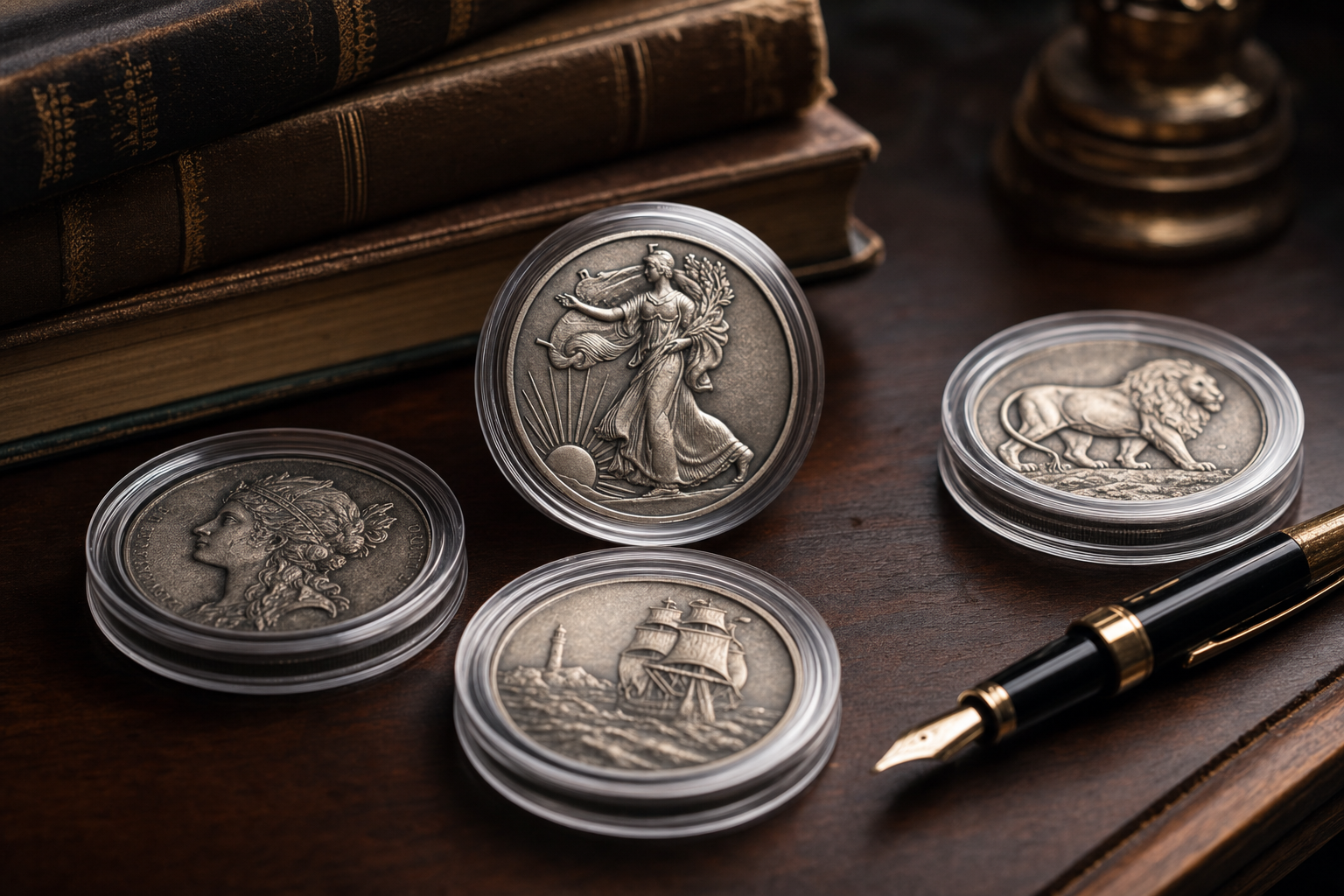
The condition is one of the price-determining factors for literary collector's coins, especially for editions in Proof quality, whose mirror finish is sensitive to fingerprints and scratches. For this reason, such coins typically remain in their original packaging, in a case or in a suitable coin capsule within the collector's market.
For larger collections, systematic solutions are used. Suitable storage can be found in the coin cassettes section as well as among the coin cases, which hold several capsules in an orderly manner. The Books category brings together additional specialist literature on numismatics.
Thanks to their narrative designs, literary coins are particularly well suited as gifts, for example a fairy tale coin for a birth, an edition featuring the Little Prince for a graduation, or a classic edition for well-read individuals. At the same time, the material value ensures that the present retains a lasting tangible value. The gift ideas category brings together further suggestions.
For those who wish to use literature as a starting point for a broader precious metals collection, the transition to classic investment gold coins or a savings plan range is a natural step. This allows the emotional access provided by the theme to be combined with a long-term value preservation strategy. As a German family business with ISO-compliant authenticity verification, Kettner Edelmetalle places particular importance on verified provenance.
A literary coin preserves a story in metal, readable for generations, independent of the paper on which it was once printed.
The series comprises official 100 Euro gold coins made of 999.9 fine gold, each weighing half a troy ounce, honouring classics of German-language literature, including Die Judenbuche, Aus dem Leben eines Taugenichts and Der zerbrochne Krug. Each issue has a total mintage of around 66,000 pieces, distributed across the five German mints.
Investment gold is, in principle, exempt from VAT in Germany, which also applies to the 100 Euro gold coins of the literature series. Silver coins, on the other hand, are subject to VAT, often in the form of margin scheme taxation for imported collector's pieces. For binding information, professional tax advice is recommended.
With bullion coins, the material value is the primary focus, whereas the price of collector's coins is additionally shaped by the design, mintage size and condition. Literary editions frequently combine both aspects, for example when a gold coin also features a classic literary design.
Proof denotes the highest minting quality, with a mirror-like background and a frosted, raised design. Such coins are struck with particular care and should only be touched by the edge, as fingerprints can permanently affect the delicate mirror finish.
Yes, precisely because of their narrative designs, literary coins make a popular gift. A fairy tale coin for a birth or a classic edition for book lovers combines the intrinsic value of the story with a lasting tangible value in precious metal.
Silver coins should be stored dry and at a stable temperature, in a coin capsule or the original case, to prevent tarnishing and scratches. For larger collections, coin cassettes and coin cases provide organised and protective storage.
 Art and CultureLiterature
Stay informed with product launches, financial news and exclusive offers. Sign up for our free newsletter today.
By entering your email address and clicking the "Submit" button, you give the following consent: "I agree to be informed by email about new products, financial news and exclusive offers, and therefore consent to the processing of my email address for the purpose of sending the newsletter. I can revoke this consent at any time without giving reasons, with effect for the future. The lawfulness of processing carried out prior to revocation remains unaffected."