Only 5 left to order
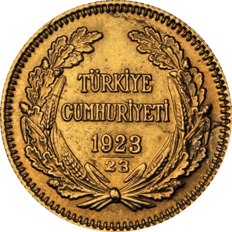
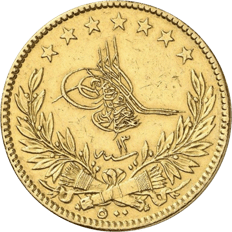
100 Piastres Turkey old
€905.02
VAT-free and excl. shipping
Available in 2–3 business days

 More than 310,000
 Over 30 years
 Secure shipping
 Google: 4.9/5
Gold coins have a long tradition in Turkey and have been minted in a wide variety of currency denominations. In recent years, commemorative gold coins for collectors and investors have also been added. Turkish gold coins are popular with investors because they are often traded very close to the current gold price. Most commonly, you will find the 25 Kurush-Piastre coins minted in Latin letters at precious metals dealers, in denominations of 25, 50, 100, 250 and 500.

Few gold coins tell as much about an entire culture as Turkish gold coins. At a wedding on the Bosphorus, they gleam on the groom's lapel, on the bride's wrist and in the hands of the guests, as a visible promise of prosperity, protection and togetherness. At the same time, the classic Kurush and piastre coins are solid investment gold, often traded very close to their pure material value. The following sections cover history, denominations, designs, the 22-carat fineness, the tax treatment and the typical authenticity features of gold coins from Turkey.
In hardly any other country is gold as deeply embedded in everyday life as in Turkey. For generations, the precious metal on the Bosphorus has served as protection against recurring currency devaluation, a role that traditional savings accounts there were never able to take on. Anyone who owns gold coins holds a value in their hands that cannot be diluted by any central bank.
This cultural significance is most evident at weddings. Traditionally, gold coins are pinned to a ribbon or presented to the bridal couple in small pouches, a custom that is far more than a mere gift. It combines lasting value with the wish to give the young couple a solid start. Small gold coins are also the gift of choice at engagements, henna nights, births and circumcision celebrations.
A Turkish gold coin is rarely just metal, it carries within it a story of family, celebration and provision.
Because several million people with Turkish roots live in Germany, many of these coins have long been in circulation here and are regularly offered for purchase. For investors and collectors outside the Turkish community, however, they remain a relatively undiscovered field, and that is precisely where their appeal lies.
The heart of this category consists of the state-minted Kurush gold coins (written Kuruş in Turkish), usually referred to in the trade as piastres. They appear in five graduated face values and all share the same fineness of 916.58/1,000, equivalent to 22 carats. The weights scale linearly, allowing the coins to be combined neatly from a small gift to a larger investment position.
The small units score points with their divisibility: a 25-Kurush coin is easier to give as a gift or sell if needed than a large bar. Larger denominations, in turn, reduce the premium per gram of gold. Anyone who appreciates this graduated weight system will find a similar approach with small gold bars or with internationally established investment classics such as the Krugerrand.
As a traditional gift, the 25-Kurush coin dominates because it remains affordable while still embodying real gold. For pure wealth building, many opt for the 100-Kurush coin, since the ratio of material value to premium is favourable here. The heavier 250 and 500 coins are aimed at anyone who wants to bundle a larger amount of gold compactly, comparable to the idea behind a bullion gold coin.
The modern Kurush coinage is inextricably linked to Mustafa Kemal Atatürk, the founder of the Republic of Turkey and its first president from 1923 to 1938. His profile adorns most of the coins minted in Latin script. On some issues, the portrait of his successor İsmet İnönü appears instead.
Considerably older, and of particular appeal to collectors, are the Arabic-inscribed coins from Ottoman times. They bear the tughra, the intricately intertwined monogram of the respective sultan, comparable to a ruler's seal. This historical imagery gives the older pieces a collector's value that goes beyond the pure gold price.
The classic range is complemented by modern issues from the state mint Darphane. Under names such as Ata Altın, Ziynet Altın and Reşat Altın, gift-worthy coins continue to be issued today in the familiar sizes of Çeyrek (quarter), Yarım (half) and Tam (full). Anyone looking for modern, design-rich coins from other nations will find what they are looking for at the Vienna Philharmonic or the Vreneli.
Turkish gold coins are made from a 22-carat alloy (916.58/1,000). The admixed copper content makes them more scratch-resistant than pure fine gold and gives them their characteristic warm colour, a feature they share with the Krugerrand and the Sovereign. The pure gold content of a coin is always determined by the fine weight, not the gross weight.
One advantage of Kurush coins lies in their low premium: because they are widely circulated and traded investment goods, they are often sold very close to the current gold price. Pure fine gold coins with a fineness of 999.9/1,000, such as the Maple Leaf or the Britannia, do achieve a higher fineness, but there is hardly any practical difference in value retention, in the end, what counts is the gram of gold they contain.
Good to know: fine weight instead of gross weight
A 100-Kurush coin weighs about 7.2 grams gross, but contains only around 6.61 grams of pure gold. For valuation purposes, the fine weight is always decisive, the rest is copper, which makes the coin more robust.
In Germany, Turkish Kurush and piastre gold coins are classed as investment gold coins. Investment gold is exempt from VAT under § 25c UStG, provided the coin meets the statutory criteria, a significant advantage over silver coins, which are subject to the margin scheme.
For private investors, the following also applies: after a holding period of more than one year, any capital gain is exempt from income tax (private disposal transactions, § 23 EStG). This rule makes physical gold, whether as a coin or as a gold bar, a tax-attractive building block for long-term retirement provision. Specific tax questions should always be clarified with a tax advisor; this text does not replace professional advice.
Particular caution is warranted with historical coins and those bearing Arabic inscriptions. In the past, well-made counterfeits have also circulated at street markets and among dubious sellers, in the worst case, the core consists of worthless sheet metal. Anyone who wants to secure the material value should pay attention to a few objective characteristics.
The safest route is to buy from a certified precious metals dealer. Kettner Edelmetalle relies on ISO-compliant authenticity verification and insured shipping, so that every coin traded is checked for its material quality. For subsequent storage, suitable coin capsules or a coin case are recommended, which protect the delicate strike from scratches.
Turkish gold coins can be stored at home in a safe, in a bank safe deposit box, or in special security containers. A dry, dust-free environment is important; an individual capsule prevents several coins from scratching one another. Anyone who owns pieces with collector's value should keep the original packaging and, if available, certificates.
When reselling, the wide circulation of Kurush coins pays off: they are easily traded and bought back by specialist dealers at fair conditions oriented to the gold price. Kettner Edelmetalle buys back common Turkish gold coins; it is also worth looking at related ducats or crowns from the historical coin segment for anyone collecting classic circulation gold coins.
The classic Kurush and piastre coins are made from a 22-carat alloy with a fineness of 916.58/1,000. The copper content makes them more resistant than pure fine gold and gives them their warm gold tone.
A full 100-Kurush coin (Tam Altın) contains around 6.61 grams of fine gold with a gross weight of about 7.2 grams. Smaller denominations scale accordingly: 50 Kurush around 3.30 grams, 25 Kurush around 1.65 grams.
In Turkish culture, gold coins are considered a symbol of prosperity and a protection against currency devaluation. At weddings, engagements and henna nights, they are presented to the bridal couple to give them a start that retains its value.
As investment gold, the Kurush and piastre coins are exempt from VAT under § 25c UStG, provided they meet the statutory requirements. After a holding period of more than one year, a capital gain is also exempt from income tax for private individuals. A tax advisor can clarify specific questions.
These are modern minting series from the Turkish state mint with different designs and names. They come in the same sizes as the classic Kurush coins, Çeyrek (quarter), Yarım (half) and Tam (full), and are bought mainly as gifts and small investments.
Reliable indicators are the exact weight, the correct diameter, a sharp strike and the fact that gold is not magnetic. For valuable or historical pieces, a professional authenticity verification and purchase from a certified dealer are recommended.
 Turkish Gold Coins
Stay informed with product launches, financial news and exclusive offers. Sign up for our free newsletter today.
By entering your email address and clicking the “Submit” button, you give the following consent: “I agree to be informed by email about new products, financial news and exclusive offers, and therefore consent to the processing of my email address for the purpose of sending the newsletter. I can revoke this consent at any time without giving reasons, with effect for the future. The lawfulness of processing carried out prior to revocation remains unaffected.”