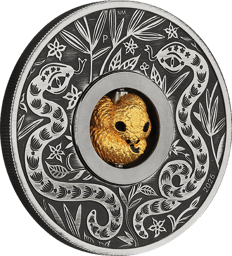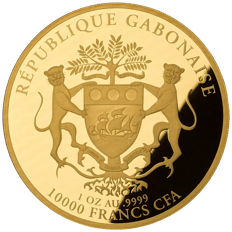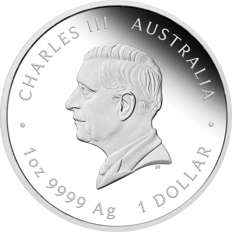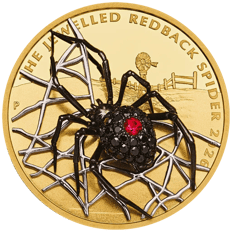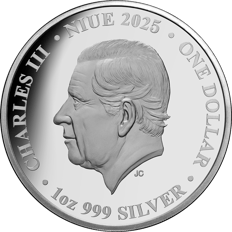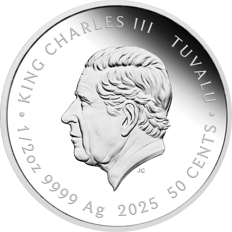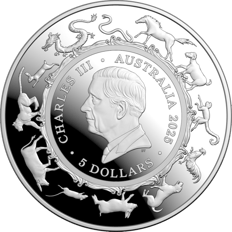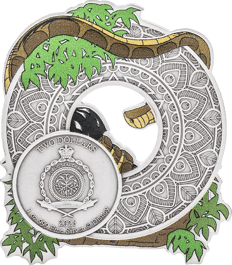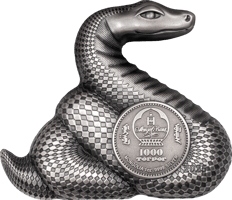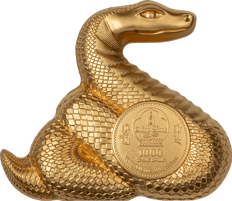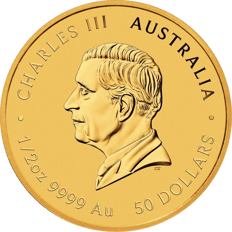
1/2 oz Gold Lunar III Snake 2025
€1,858.47
VAT-free and excl. shipping
Available in 2–3 business days

 More than 310,000
 Over 30 years
 Secure shipping
 Google: 4.9/5


Researchers counted, measured and described snakes, from 1804 to 2020. The following sections retell what they found, close to their own words.
The forked tongue of snakes has occupied people for thousands of years, but what it does long remained unclear. In 1994 Schwenk described a hypothesis, that is, a reasoned assumption: that the forked tongue is a sensor for the edges of scent trails, with which a snake can follow such trails, including those of its own kind.
Diagram after Schwenk’s hypothesis: over a field stands a fork, a stem with two prongs, each with a tip at its end. The left side of the field carries a scent trail, the right is empty, and between them lies a straight edge. When the fork stands over the edge, one tip lies in the trail and reports scent, the other lies beside it and reports no scent. The tips report different things; the trail ends between them.
Diagram
According to the hypothesis, the two tips take samples at two points at the same time, along a scent gradient, that is, where the scent grows stronger or weaker from place to place. According to Schwenk, this is the basis for telling at once where the trail runs. In his view, the hypothesis is supported by theory, anatomy, nerve pathways, function and behaviour.
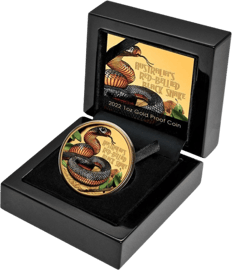
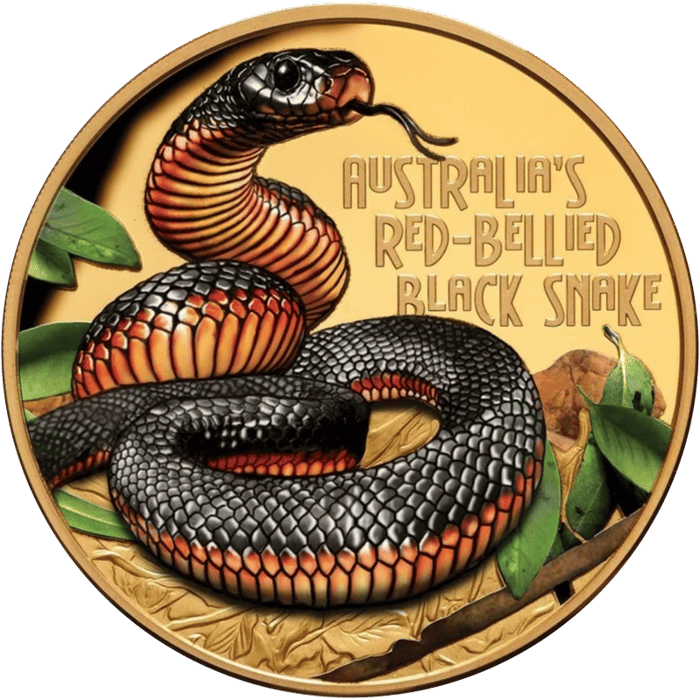
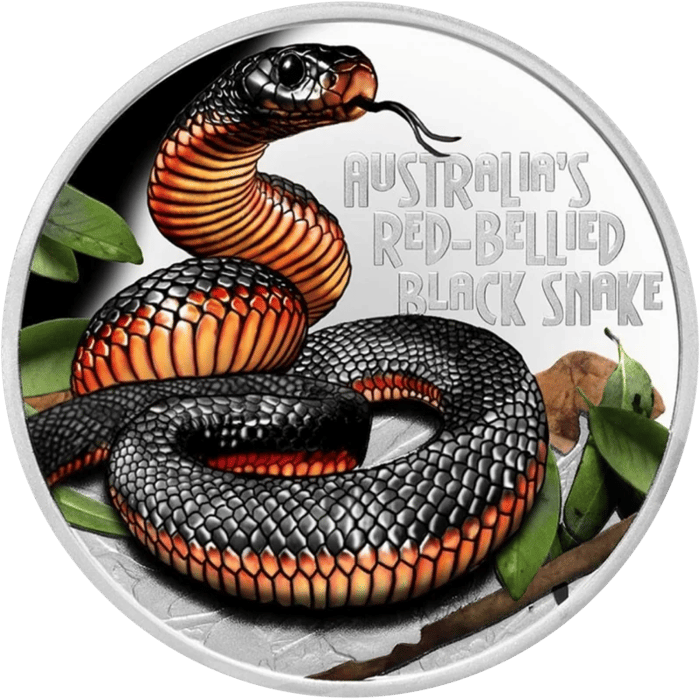
Colour on gold: a red-bellied black snake with its front body raised, head and forked tongue to the right; the back black, in the coils red-orange ventral scales, and some leaves.
In 2015 Khannoon and Evans described how the skull develops in the embryo of the Egyptian cobra, the young animal before it hatches. They followed it through a whole sequence of developmental stages, the sections into which growth is divided, and noted soft parts of the head where relevant. On the tongue they write: The tongue shows incipient forking at stage 5, and becomes fully bifid at stage 6.
According to Schwenk, forked tongues arose in the squamates, the lizards and snakes, at least twice, perhaps four times.
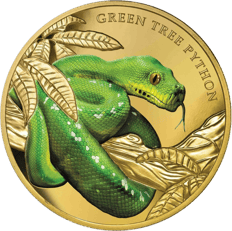
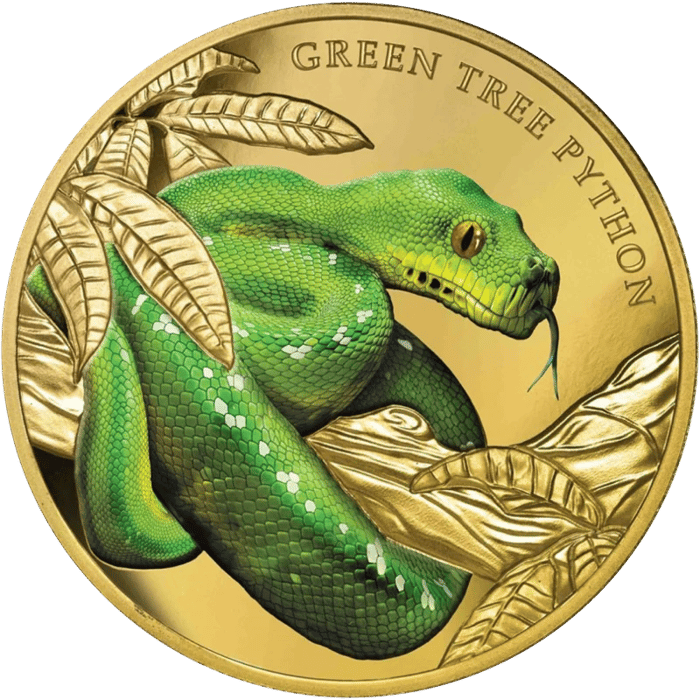
A green tree python in loops over a branch, in colour on gold: the head to the right, the forked tongue hangs down; white spots along the back, golden leaves.
On 14 June 1804 a paper was read, a learned essay, on the hood of the cobra, the spread skin of its neck. In it Patrick Russell described the spreading, and Everard Home the structure of the parts that bring it about. Russell writes: It is a voluntary action, totally distinct from that inflation which all serpents, when irritated, are more or less capable of …

Diagram after Home and after Young and Kardong: from a vertical spine, with the head at its upper end, 20 ribs branch off on each side, drawn in the diagram as straight lines and mirrored. The first is short; up to the tenth and eleventh they grow longer, then shorter again up to the twentieth. Extended, the ribs form an oval whose centre line is the spine; in the diagram a dot marks the tip of each.
Diagram
According to Home, the cervical ribs, the 20 ribs next to the head on each side, have a different shape from the rest. The first is shorter than the following ones; up to the tenth and eleventh they grow longer, both being the longest, then shorter again up to the twentieth, which is almost as long as the first. Extended, the ribs of each side form an oval whose centre line is the spine, the chain of vertebrae in the back. According to Home, they are raised by four groups of muscles. Of the skin he writes:
In the extended state of the ribs, the skin of the back is brought over them, forming the hood; and, in their depressed state, the hood disappears.
According to Home, the round shape of the hood gives the skin the appearance of being inflated. Yet on the most careful examination he found no connection between the windpipe or the lung and the tissue under the skin.
In 2010 Young and Kardong studied how the hood forms. In their view, it is an active process in which the skin, muscles and ribs of the neck take part. The raising begins at the head and continues backwards, often in stages. As long as the hood stays raised, the muscles keep working, and the shape of the fully raised hood reflects the dimensions of the ribs beneath it.
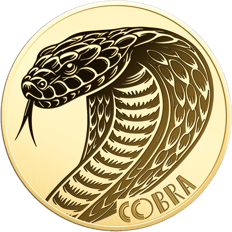
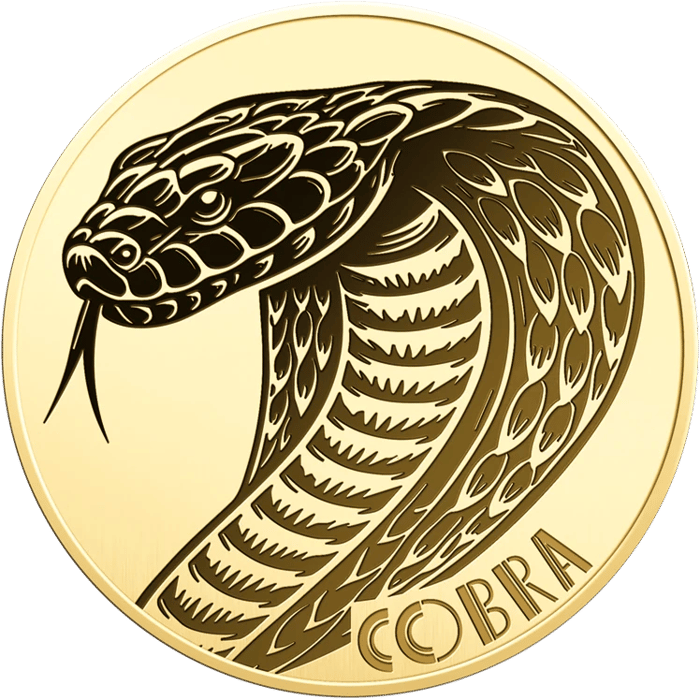
Turned to the left: a cobra’s head in gold with a spread hood marked in crossbands, the forked tongue pointing down to the left.
The scales on the belly side of a snake are called ventral scales. Wu and colleagues describe fine fibres on them, about a thousandth of a millimetre in size, with far finer steps that point towards the tail: The ventral scales of most snakes feature micron-sized fibril structures with nanoscale steps oriented towards the snake's tail.

Diagram after Wu and colleagues: a band of ventral scales from the head to the tail. From head to tail the friction is lower, from tail to head higher. In the snakes studied, the difference between the two directions is lower near the head, medium in the middle and largest near the tail.
Diagram
Wu and colleagues moved a sharp tip up and down the steps and measured the friction, the resistance when sliding over a surface: … friction along the head to tail direction is lower than in the opposite direction.
In the snakes studied, the difference in friction between the two directions is largest near the tail, medium in the middle and lower near the head. The height of the steps differs from snake to snake, but their distribution along the body follows a common pattern.
Earlier studies assumed that snakes slither forward by pushing sideways against stones and branches. According to Hu and colleagues, progress on flat ground, possibly in general, depends crucially on the friction of their scales having a direction.
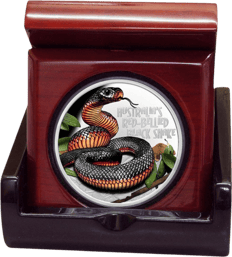
Row upon row of red-orange ventral scales in the coils of a red-bellied black snake, in colour on silver; the front body raised, and some leaves.
For decades, the locomotion of snakes has been sorted into four main types. In 2020 Jayne proposed a finer distinction, by gaits, the ways of moving along: … I propose recognizing five and four distinct types of lateral undulation and concertina, respectively, resulting in a total of 11 distinct gaits previously recognized as only four.
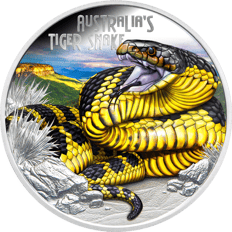
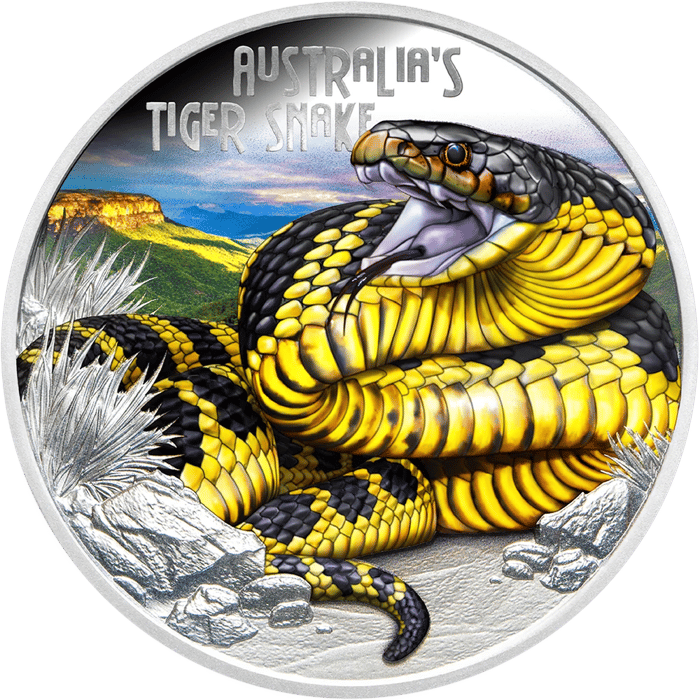
According to the Australian Museum, tiger snakes have 140 to 190 ventral scales. Their name refers to the yellow and black crossbands that are typical of some populations; not all tiger snakes have them.
Raised up over its coils: a tiger snake with yellow and black crossbands, in colour on silver; behind it mountains under a blue sky.
According to Schwenk’s hypothesis, the tongue takes samples with two tips at the same time; according to Home, the skin of the back is drawn over 20 ribs on each side to form the hood; and according to Wu and colleagues, the friction of the ventral scales has a direction. Between the paper of 1804 and the article of 2020 lie more than two centuries.
Snakes are among the most expressive designs in modern coin minting. As a symbol of wisdom, transformation and new beginnings, they appear on classic bullion coins as well as on high-quality collector editions, ranging from the globally traded Lunar series to richly coloured design coins depicting well-known venomous snakes. The following overview explores the cultural significance of the snake motif, the most important series and denominations, material questions concerning gold and silver, authenticity features, tax particulars, and proper storage.
Hardly any animal carries such multifaceted meaning across cultures as the snake. In many cultures it stands for renewal and immortality, because it regularly sheds its skin. In East Asian astrology, the snake is regarded as a sign of wisdom, intuition and elegance. This rich symbolism makes the motif attractive to mints worldwide and explains why snake coins are so popular among both collectors and enthusiasts of thematic precious metals.
Within the broad theme of Land Animals, the snake occupies a special position: it appears not only as a pure wildlife motif, but also as a zodiac sign in the Chinese lunar calendar and as a mythological figure. Those interested in further land animal designs will find thematically related coins among, for example, the predators or the amphibians.
The snake shedding its skin has been a symbol of change and rebirth since antiquity, a motif that still lends timeless depth to coin minting today.
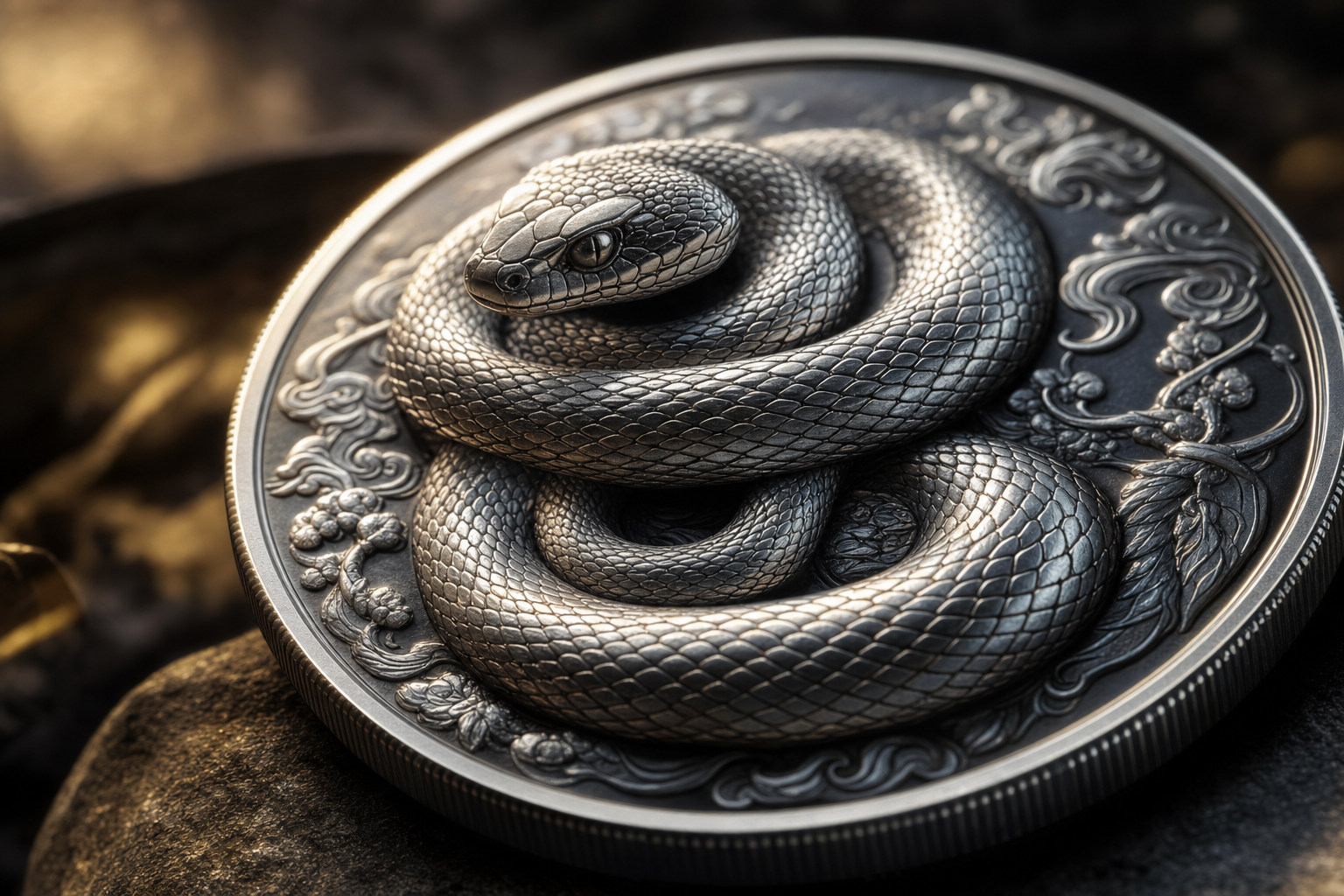
The Chinese lunar calendar shapes the largest part of the snake range. The snake is the sixth of the twelve zodiac signs; a Year of the Snake recurs every twelve years, most recently in 2025. Around this themed year, numerous mints release their own editions, above all the renowned Lunar series.
With the Lunar Series III in silver and the corresponding Lunar Series III in gold, the Australian Perth Mint produces one of the most closely followed zodiac series in the world. Each year the design changes according to the Chinese calendar. The snake editions are available in a wide range of denominations and finishes, from the classic bullion strike to the elaborate high-relief version in Proof quality.
As early as 2013, the Lunar Series II was dedicated to the Year of the Snake and is now a sought-after classic. Collectors wishing to build a complete series often also turn to the current Lunar Series 3 in order to assemble a full set across several years.
Snake coins are available in an exceptionally wide range of weights. The choice of denomination depends on whether the focus lies on the pure material value or on the collector's aspect.
Alongside classic bullion strikes, snake motifs feature a particularly large number of enhanced variants: partially gilded editions, coloured strikes and antique-finish editions. Anyone interested in colourfully designed pieces will find what they are looking for among the coloured silver coins and the partially gilded silver coins.
Beyond the astrological Lunar editions, numerous editions are dedicated to specific snake species. These true-to-life design coins are usually issued in very limited numbers and appeal to collectors of thematic series.
Pop culture motifs are also part of this range: characters such as the python Kaa from The Jungle Book combine the snake theme with licensed Disney designs. Those who are more enthusiastic about exotic wildlife depictions will find further suitable coins in the jungle theme section.
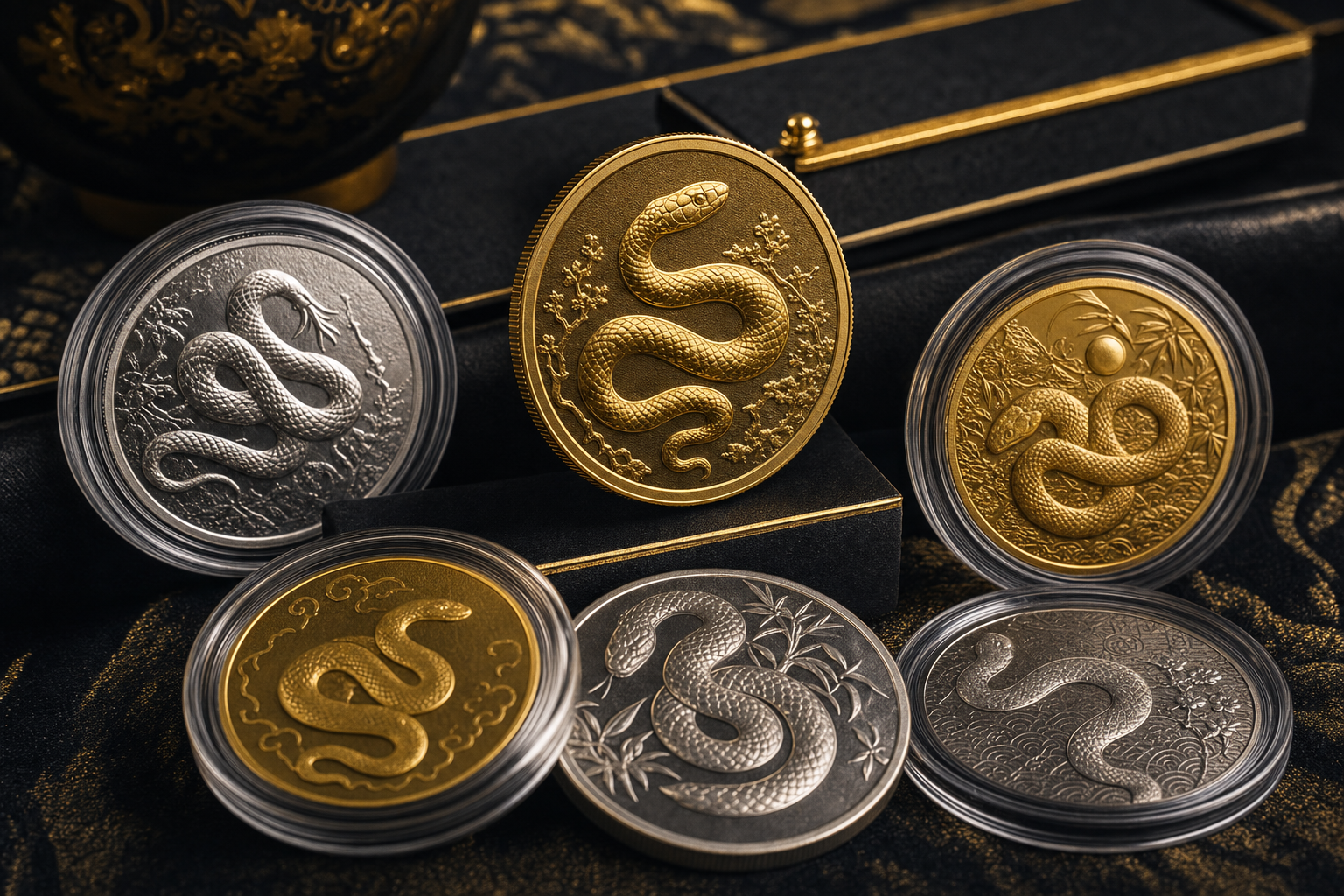
Authenticity and condition significantly determine the value of snake coins. Bullion strikes carry a state-guaranteed fineness, usually 999/1,000 for silver and mostly 999.9/1,000 for gold editions. This fineness, together with the weight and face value, is struck into the coin.
At Kettner Edelmetalle, every coin undergoes an ISO-compliant authenticity verification before it is shipped. Anyone wishing to check the features themselves should inspect weight, diameter and sharpness of strike; coloured and partially gilded editions should additionally show a clean, burr-free finish. For the long-term preservation of the condition, suitable coin capsule accessories are recommended.
The tax classification differs considerably between the metals and is an important criterion when buying snake coins.
Tax Note
In Germany, investment gold is exempt from VAT pursuant to §25c UStG. Silver coins, on the other hand, are generally subject to VAT; for collector coins, the so-called margin scheme taxation may apply. This information is general in nature and does not replace individual tax advice.
For investors primarily focused on material value, the VAT exemption on gold is a significant argument. A broad overview of tax-privileged gold products is offered by the gold bullion coins as well as the classic gold coins. Those paying attention to low premiums on silver will find suitable alternatives among the silver bullion coins. A possible one-year holding period for private sales transactions should also be taken into account.
Especially with coloured and polished snake coins, proper storage determines the long-term condition. Fingerprints, moisture and temperature fluctuations can damage sensitive surfaces.
The right organisation and protection system can be found together in the accessories range. Careful storage is the basic prerequisite for preserving the collector's value of a limited coin over the years.
Snake motifs unite two worlds: the emotional appeal of collecting and the sober material value. Collectors value the low mintages and the artistic design, ranging from just a few hundred pieces for high-relief editions to higher mintages for classic bullion strikes. Those who, on the other hand, primarily want to invest in precious metal focus on the fineness and the premium over the pure metal value.
A sensible approach can be to combine both aspects: a solid base of gold bars or silver bars for the material value, supplemented by selected design coins with collector appeal. Structured approaches from the range of savings plan products are also suitable for continuous wealth building. Those with a collecting focus can build up a series across several zodiac years, gradually completing the Lunar series.
The snake stands across cultures for transformation, wisdom and renewal, because it regularly sheds its skin. In East Asian astrology, it is also the sixth zodiac sign of the Chinese lunar calendar and is honoured every twelve years in dedicated Lunar editions.
The most recent Year of the Snake in the Chinese calendar was 2025. Since the twelve zodiac signs repeat cyclically, the Year of the Snake returns every twelve years. Around these years, numerous new strikes from the Lunar series are released each time.
In Germany, investment gold is exempt from VAT pursuant to §25c UStG. Silver coins, on the other hand, are subject to VAT, although the margin scheme taxation may apply to collector editions. A tax advisor should be consulted for a binding assessment.
For getting started, 1 oz silver coins are particularly popular due to their favourable ratio of design surface to price. Those wishing to invest in gold can start with smaller denominations such as 1/10 oz or 1/2 oz and expand the collection later.
Coloured and polished editions should be stored individually in coin capsules and handled only by the edges. Dry, light-protected storage protects the sensitive surfaces; coin cases or a coin box are suitable for larger collections.
Lunar editions follow the Chinese lunar calendar and depict the snake as a zodiac sign in an ongoing series. Design coins of individual species such as the cobra, green mamba or tree python, on the other hand, depict specific reptiles true to life and are usually released as highly limited collector editions.
 Land AnimalsSnakes
Stay informed with product launches, financial news and exclusive offers. Sign up for our free newsletter today.
By entering your email address and clicking the "Submit" button, you give the following consent: "I agree to be informed by email about new products, financial news and exclusive offers, and therefore consent to the processing of my email address for the purpose of sending the newsletter. I can revoke this consent at any time without giving reasons, with effect for the future. The lawfulness of processing carried out prior to revocation remains unaffected."