




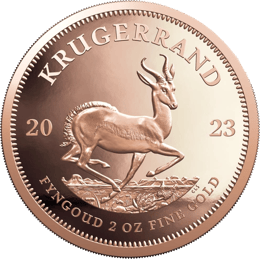


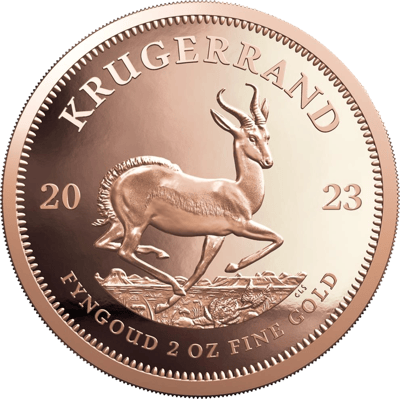


2 oz Gold Krugerrand 2023 PP (Mintage: 400 | Proof)









 Strictly limited to 400 pieces, a collector's dream
- Highest minting quality, Proof (PP)
- Free shipping and 100% insured
- Exclusive limited edition: Strictly limited to only 400 pieces worldwide, a must-have for collectors and connoisseurs
- Exquisite minting quality: The 2 oz gold Krugerrand 2023 PP impresses with the highest minting quality in Proof
- Free shipping: Enjoy the convenience of free shipping via value courier within Germany
 Price alert
  Share
ShareKrugerrand · 2023 Issue
The leap that began in 1967.
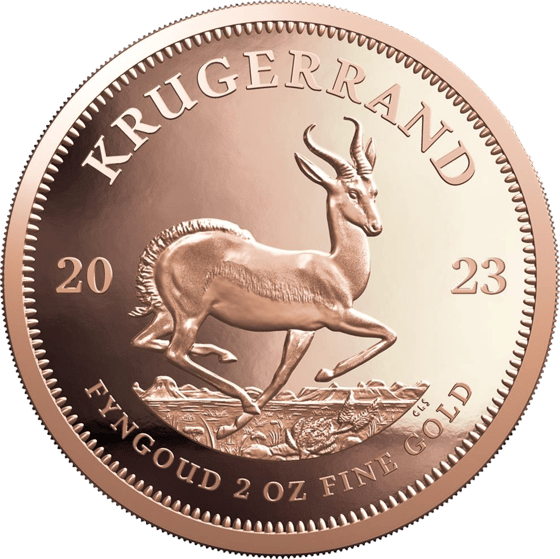
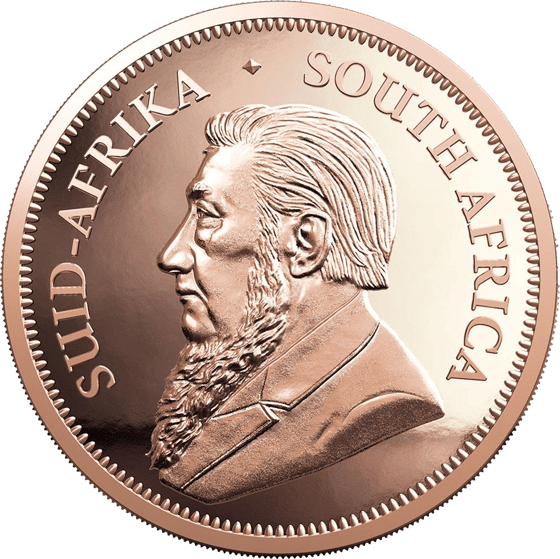
You are looking at the side with the springbok.
Gold for the hands of ordinary people.
In the late 1960s, around three quarters of the western world’s gold came from South Africa. The Chamber of Mines wanted ordinary people, too, to be able to own gold.
With the Krugerrand, a new kind of coin came into being for this purpose: exactly one ounce of fine gold, with no face value struck on it. Its value was meant to come directly from the gold it contains.
6,012,293
Krugerrand bullion coins were issued in 1978 alone, 187 tonnes of gold in all.
A leap through history
1886
Gold on the Witwatersrand
On the Witwatersrand, the ridge of white water, rich gold deposits are discovered. South Africa’s currency is also named after it: the rand.
1947
The springbok
The sculptor Coert Steynberg draws his springbok in 1946 and 1947. It first appears in 1947 on the 5-shilling coin marking the visit of the British royal family.
1967
The first Krugerrand
On 3 July, commissioned by the South African Reserve Bank and the Chamber of Mines, the South African Mint strikes the first Krugerrand.
1980
Smaller sizes
The half ounce, the quarter ounce and the tenth ounce are added so that smaller sums can also be invested in gold.
2017
Fifty years
For the anniversary, the first silver Krugerrand appears, along with the 1/20 and 1/50 ounce in gold. For these coins, the designers go back to the original wax models and designs.
The motif
The springbok and the president
- The springbok
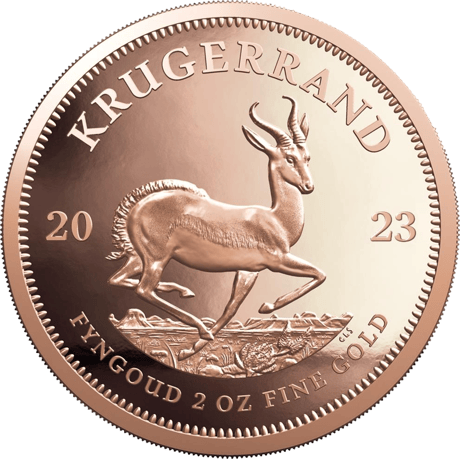
- South Africa’s national animal in mid-leap. The springbok owes its name to its characteristic leaps. It was designed by the sculptor Coert Steynberg.
- The aloe
- The motif includes an Aloe claviflora, one of South Africa’s best-known aloes. It grows in the dry interior of the country, where the springbok is also at home.
- Fyngoud
- Below the springbok is the fine gold content, framed by FYNGOUD in Afrikaans and FINE GOLD in English. Fyngoud means fine gold.
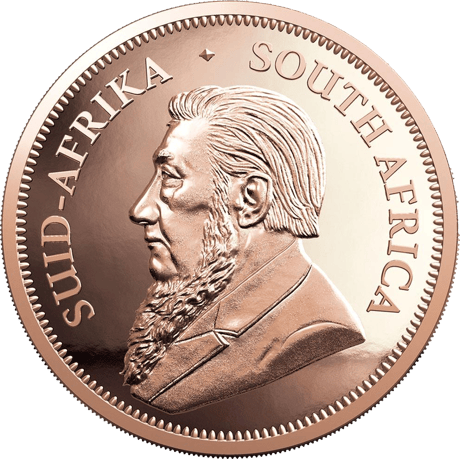
- Paul Kruger
- The other side shows Paul Kruger in profile. In 1883 he became president of the South African Republic, also known as the Transvaal. The portrait was created by the die engraver Otto Schultz. According to the South African Mint, it goes back to the Kruger half-crown of 1892.
- The name
- Krugerrand combines the name Kruger with the rand, South Africa’s currency.
The alloy
Eleven parts gold, one part copper
The Krugerrand is made of 22-carat gold: eleven twelfths fine gold and one twelfth copper. The copper makes the coin harder and more resistant to scratches. It also gives the coin its warm, reddish sheen.
Every coin contains its full weight in fine gold, and the copper is added on top. That is why the one-ounce coin weighs 33.93 grams and yet contains exactly one ounce of fine gold.
Proof
Placed by hand
The proof finish has accompanied the Krugerrand since the very first year of issue: in 1967, 10,000 gold Krugerrands were made in this quality.
For the 2017 anniversary, the South African Mint described its process as follows: the coins are placed by hand and struck several times at lower pressure, so that every detail is transferred flawlessly.
Each coin is then packed by hand and protected in a capsule, so that it stays just as it left the press.
The same leap since 1967.
This issue too.
By its 50th anniversary in 2017, more than 60 million Krugerrands had been sold. The 2023 issue is part of this story, and the story goes on, in your hand and perhaps one day in the hand of someone you pass it on to.
400
pieces in the edition
62.21 g fine gold · 916.67/1,000
· Proof · Case
Issuing country: South Africa. The South African Mint is a wholly owned subsidiary of the South African Reserve Bank.
2 Unze Gold Krügerrand 2023 PP (Auflage: 400 | Polierte Platte)
- Motiv: Paul Kruger
- Material: Gold mit einer Feinheit von 917/1.000
- Höchste Prägequalität: Polierte Platte (PP)
- Die Gesamtauflage ist auf 400 Stück weltweit limitiert
- Investitionsziel: Sammlermünze
- Versand: erfolgt in einem Original-Etui
✔ Eine limitierte Sammlermünze
Der Krügerrand ist eine Anlagemünze, die höchstwahrscheinlich jedem Investor ein Begriff ist. Der Krügerrand ist nicht nur die älteste Anlagemünze der Welt, sondern gehört auch zu den absoluten Klassikern und begehrtesten Münzen überhaupt. Die Motive des Krügerrands werden nie abgeändert, sondern bleiben immer gleich und sind daher ein Erkennungsmerkmal der Münze. Doch diese Goldmünze ist anders als die typischen Krügerrand-Münzen, die Sie wahrscheinlich gewohnt sind. Sie wurde mit der höchsten Prägequalität gefertigt, die möglich ist: Polierte Platte (PP). Die Gesamtauflage der Münze ist außerdem auf 400 Exemplare weltweit limitiert. Es handelt sich hier also um eine Sammlermünze.
Durch die Prägequalität sieht das bekannte Design sehr edel aus. Beibehalten wurde jedoch die kupferrote Farbe, die bei dieser Goldmünze richtig glänzt. Zu verdanken ist die Farbe der Tatsache, dass die Münze nicht nur aus Gold besteht, sondern auch aus Kupfer. Wenn auch nur zu einem sehr kleinen Anteil. Doch dieser Anteil ist wichtig, denn so wird die Münze kratzfester.
✔ Kein Nennwert
Beim Betrachten der Rückseite des Krügerrands fällt auf, dass der Nennwert fehlt. Krügerrand-Münzen haben üblicherweise keinen Nennwert. Der aktuelle Wert des Materials, hier Gold, bestimmt den Nennwert. Trotzdem gelten alle Krügerrand-Münzen in Südafrika, ihrem Herkunftsland, als offizielles Zahlungsmittel.
Auf der Rückseite sind allerdings das Prägejahr (2023), die Stückelung (2 Unze) sowie das Material (Gold) eingeprägt. Am auffälligsten ist wohl aber das Motiv eines Springbocks. Springböcke sind ein Wahrzeichen von Südafrika, denn das Land ist der einzige Ort, in dem Springböcke beheimatet sind. Nirgendwo anders werden Sie einen Springbock finden. Zumindest nicht in freier Wildbahn. Der Springbock hier bewegt sich sprunghaft durch die steinige Savanne. Einige Berge sind im Hintergrund zu sehen. Ein paar Gräser und Pflanzen wachsen auf dem Boden. Davon ernähren sich Springböcke.
✔ Das Porträt eines besonderen Mannes
Die Motivseite des Krügerrands zeigt einen älteren Mann mit einem langen Bart. Die Haare sind nach hinten gekämmt. Dieser Mann hat den Namen Paul Kruger. Paul Kruger war für viele Jahre der Präsident der Südafrikanischen Republik. Er diente auch als Inspiration für die Namensgebung des Krügerrands.
✔ Informationen auf einen Blick
- Der Hersteller ist South African Mint.
- Der Durchmesser beträgt 40 mm.
- Das Prägejahr lautet 2023.
- Die Stückelung beträgt 2 Unze.
- Das Herkunftsland lautet Südafrika.
✔ Informationen zum Schluss
Die hohe Qualität unserer Produkte ist uns genauso wichtig wie ein exzellenter Kundenservice. Bei Fragen zu einem unserer hochwertigen Produkte stehen wir Ihnen deshalb sehr gerne zur Verfügung. Nutzen Sie gerne unser kostenfreies Kontaktformular.
Product depiction may differ from the final product.
