





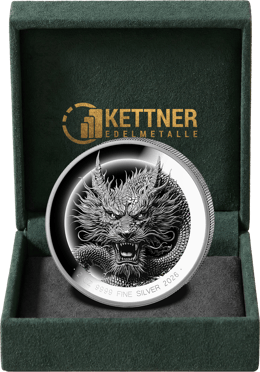


2 oz Silver Chinese Dragon 2026 (Mintage: 99 | Proof)
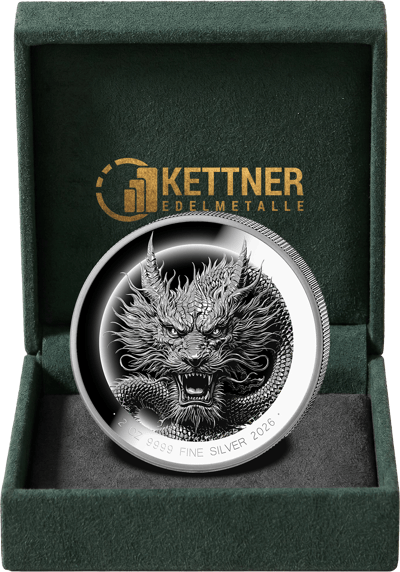













- Striking Design: Dragon head front view
- Purest Silver: Fineness 999.9/1,000
- Gift with Style: in a green velvet case
- Striking DesignEvery scale of the dragon is individually detailed
- Purest SilverFirst-class fine silver that never ages over generations
- Gift with StyleIdeal for birthdays, anniversaries or Chinese New Year
 Price alert
  Share
Share
Own minting · 2 ounces fine silver
It breathes no fire. It brings the rain.
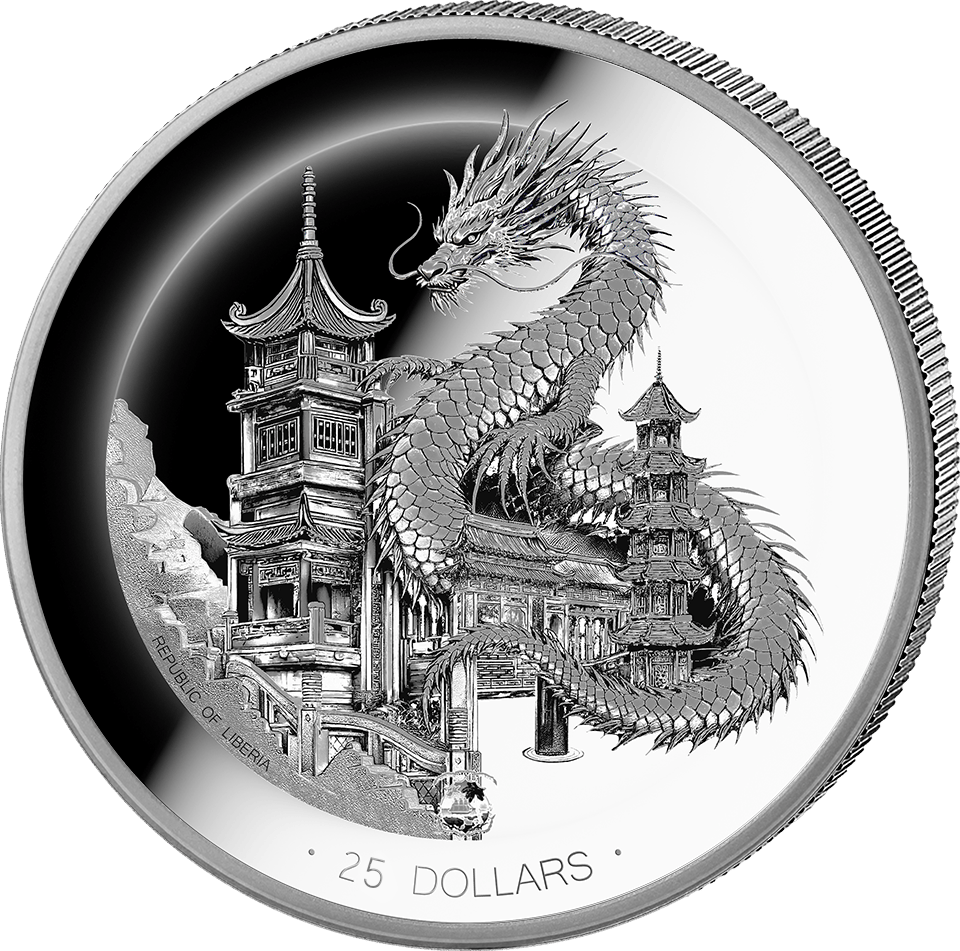
Chinese Dragon 2026, side with the dragon
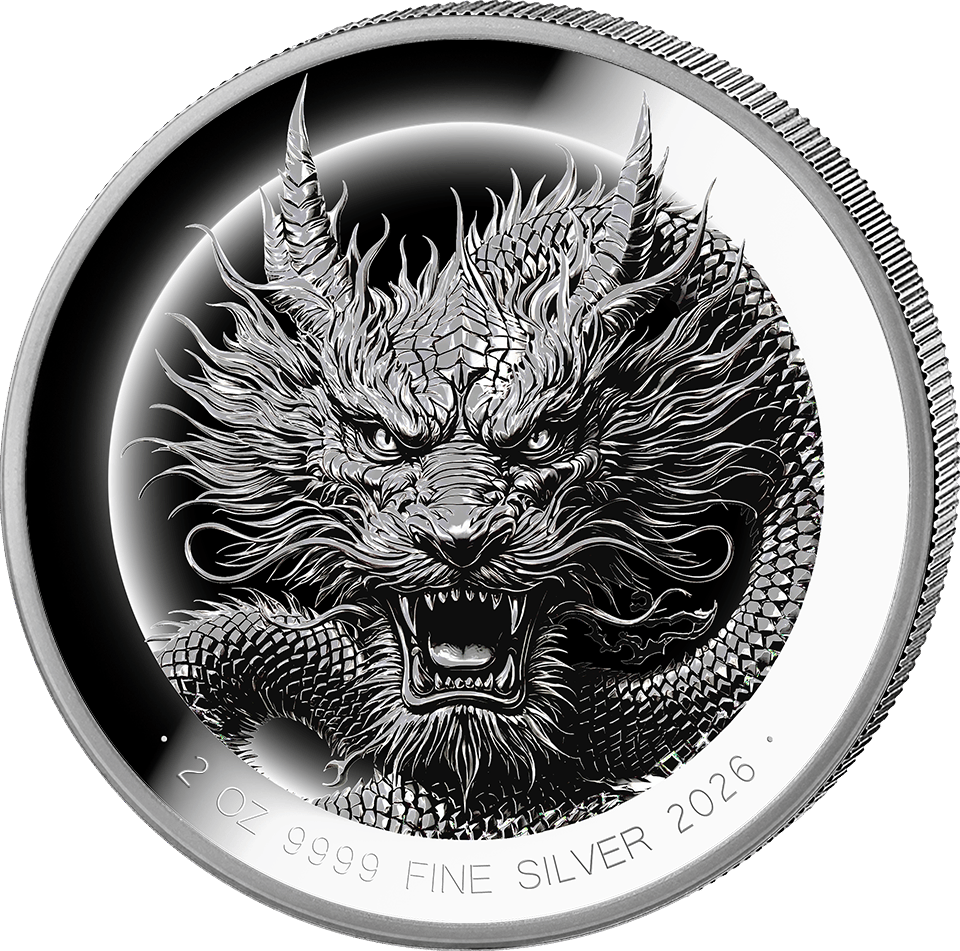
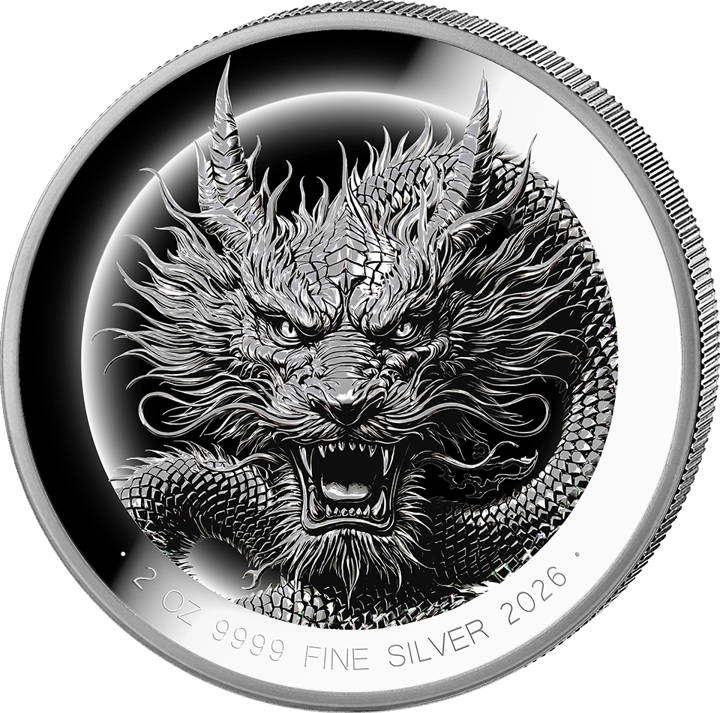
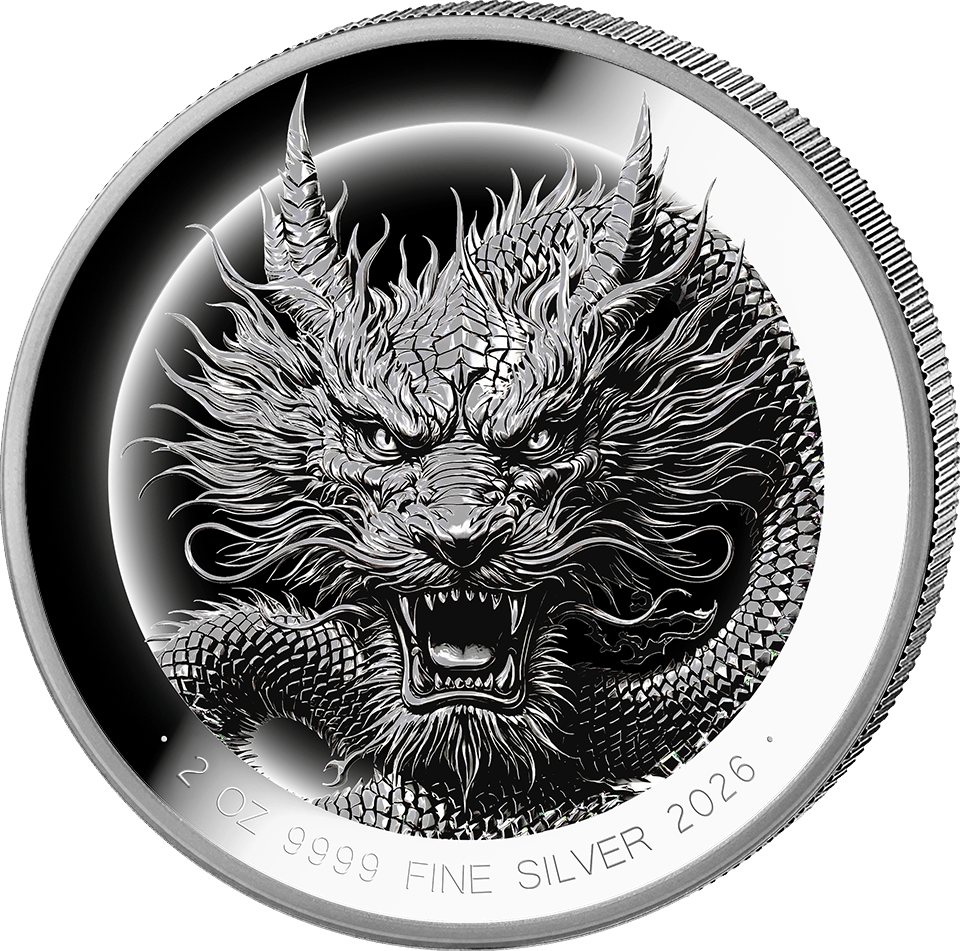
Our own minting shows the dragon’s head from the front, with mane and scales, in Proof.

From the water into the clouds
It lives in the water and rises into the clouds.
Dragons have appeared in Chinese art since Neolithic times. No later than the Han dynasty, from 206 BC to AD 220, they were regarded as beings of water: they live in rivers and seas, fly up into the clouds, govern the weather and bring the life-giving rain.
This is how old books tell it: the dragon’s breath becomes clouds, and the clouds become rain or lightning. In winter it sleeps beneath rivers and ponds, in the first month of spring it rises, and then it thunders, and rain falls.
In China it stands for the beneficence of heaven. The dragons of Europe are mostly winged and breathe fire, while in East Asia the dragon is regarded as a benevolent being, usually without any wings.
“Above all things the dragon in China is a rain-maker.”

A dragon made of many animals
The antlers of the stag, the scales of the carp.
According to old tradition, the dragon is made up of parts of many animals: the antlers of the stag, the scales of the carp, the claws of the eagle and the body of the snake. Learned Chinese books also name whiskers at the mouth and a luminous pearl beneath the chin.
The magnifying glass reveals how finely the design is struck here.
HeadThe head with mane and scales
ScalesScales like those of a carp
Enlarged from the pictures in our gallery.

The legend of the Dragon Gate
The carp, which becomes a dragon.
A legend tells of the Yellow River: a carp that swims upstream through the Dragon Gate becomes a dragon.
In China the image stood for passing the civil service examination. On a Yuan dynasty inkstone in the Metropolitan Museum, the grinding surface and the ink well lie between carp and dragon; their diligent use might well decide success.

The phoenix
Dragon and phoenix, emperor and empress.
On a porcelain plate of the Wanli period in the Metropolitan Museum, the five-clawed dragon is the emblem of the emperor. At its side appears the phoenix, which often stands for the empress.
On a wedding robe from the 1930s in the Victoria and Albert Museum, too, dragon and phoenix form the basic pattern, as the male and female elements of marriage. By tradition, the bride was “empress of the day.”
More companions of the dragon
 The phoenixThe phoenix often stands for the empress, the dragon for the emperor.
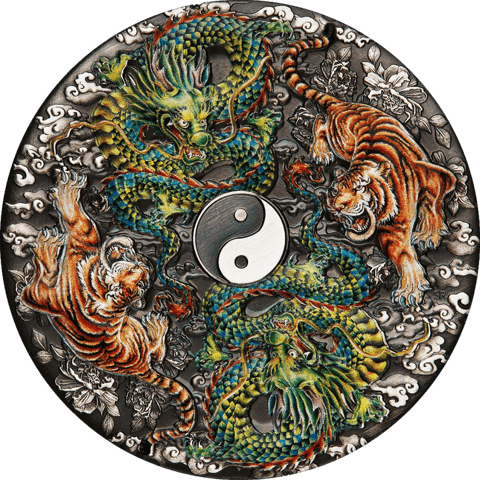 The tigerThe dragon stands for the east, the white tiger for the west.
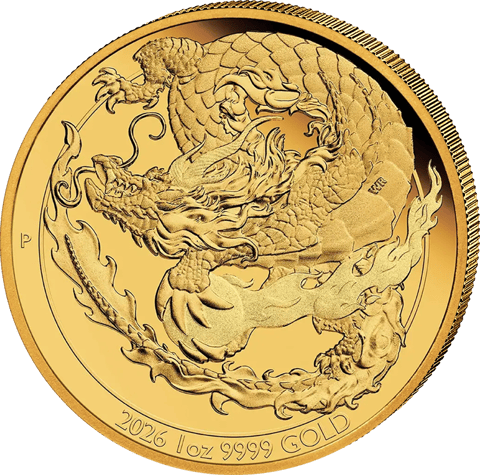 The pearlIn art, the dragon often chases a pearl, a symbol of wisdom.
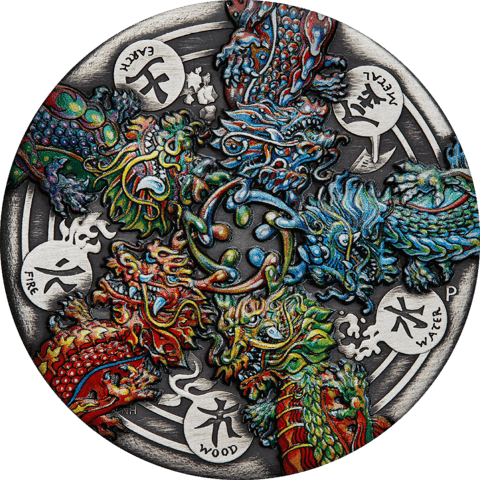 The five elementsEarth, wood, metal, fire and water follow one another in a cycle.
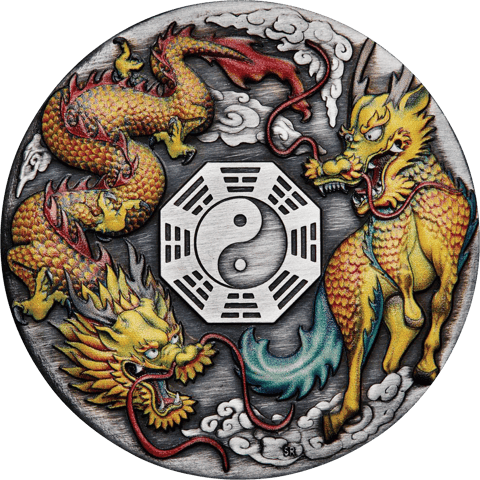 The qilinWith the dragon, phoenix and tortoise, one of the four spiritual beings.
The emblem of the emperor
From the waves at the hem to the pearl.
An imperial robe of yellow silk from the Qianlong period, shown at the Palace Museum in Beijing in 2019, follows the usual arrangement from bottom to top: water lines form the waves of the ocean, from them rises Mount Kunlun, and at chest height the five-clawed dragon chases the flaming pearl.
The claws mattered: the five-clawed dragon, long, was distinguished from the four-clawed one, mang, which stood for lower ranks.
“Only the emperor and empress were allowed to wear bright yellow.”

The craft
What sets this piece apart.
- Proof
- The field is polished to a mirror finish, with the design set on it in matte. This makes the dragon stand out clearly against the gleaming background.
Our dragons to scale
Dainty in gold, mighty in silver.
From 1/200 ounce of gold to 5 ounces of silver, side by side to the scale of their dimensions. The piece on this page is marked.
Whatever is available links to its product.
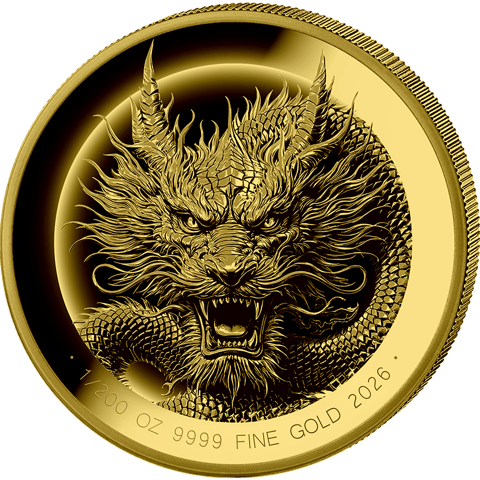 1/200 ounceGold, 14 mmGold14 mm
- 1 ounceGold, 32.6 mmGold32.6 mm
 1 ounceSilver, 40 mmSilver40 mm
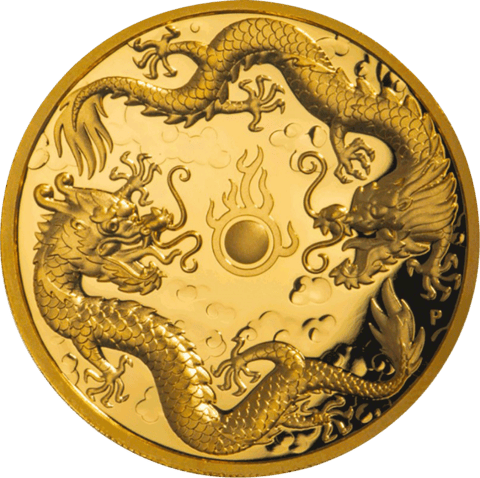 2 ouncesGold, 36.6 mmGold36.6 mm
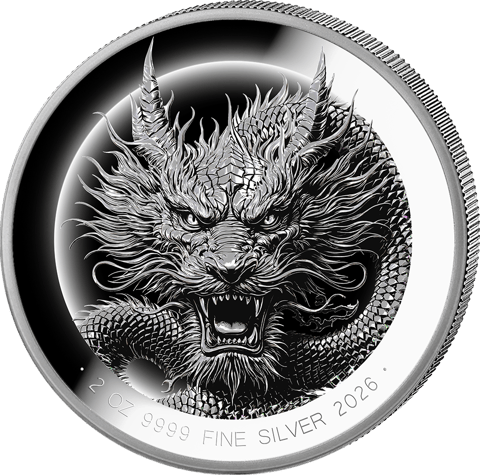 2 ouncesSilver, 55 mmSilver55 mm
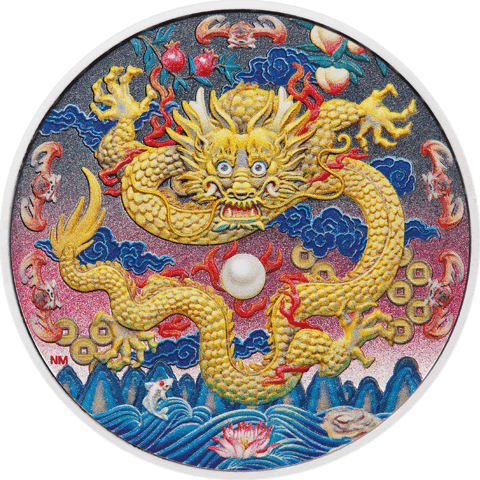 3 ouncesSilver, 50 mmSilver50 mm
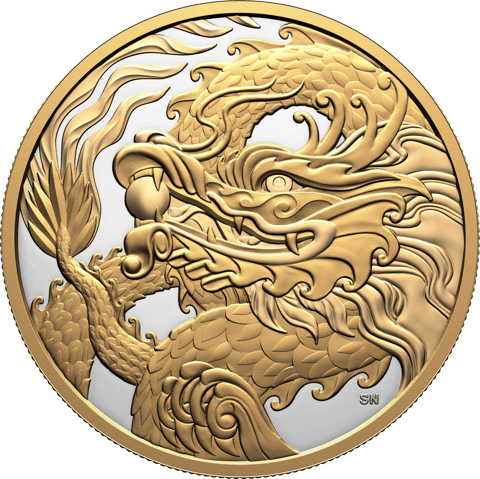 5 ouncesSilver, 65.25 mmSilver65.25 mm
At a glance
- Type
- Coin
- Metal
- Silver
- Design
- Dragon’s head from the front
- Weight
- 2 ounces fine silver
- Fineness
- 999.9/1,000
- Face value
- 25 Dollars
- Country of issue
- Liberia
- Diameter
- 55 mm
- Year
- 2026
- Quality
- Proof
- Mintage
- 250 pieces
- Manufacturer
- Kettner Edelmetalle
- Packaging
- Case

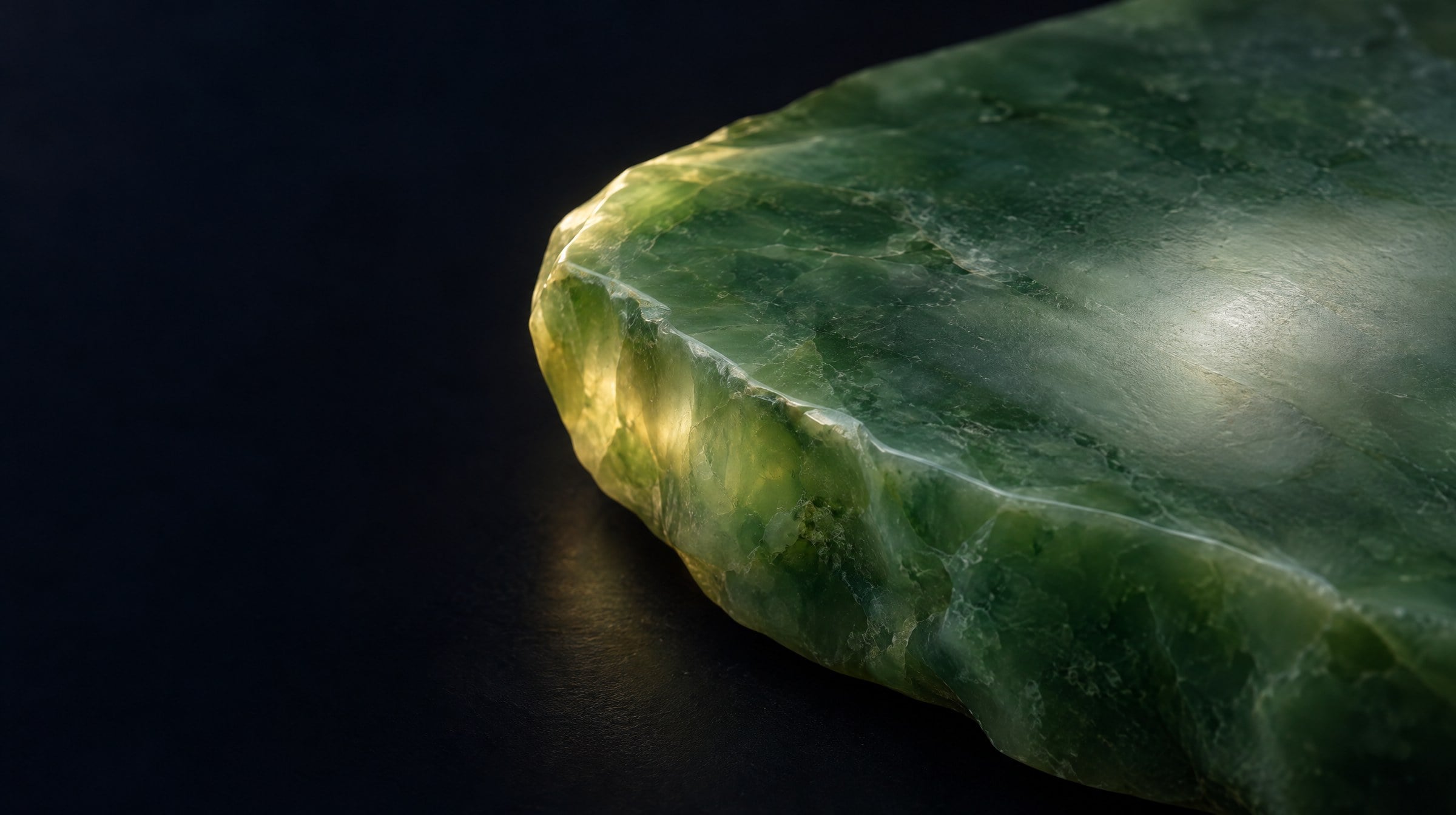
A coiled dragon of jade, made in the Shang dynasty, in the 13th or 12th century BC.
Pendant in the Metropolitan Museum of Art, New York
Chinese Dragon 2026: 2 oz Fine Silver, Only 99 Pieces Worldwide
- Strictly limited: There are only 99 pieces worldwide. Such an extremely low mintage is rare even among collectors.
- Rarity: An exceptionally rare collector's coin from the "Mythical Creatures" series
- Growth opportunities: High appreciation potential due to the strict limitation and international demand for dragon designs
- Investment goal: A collector's item that combines precious metal with genuine rarity. The limited number of pieces holds potential beyond the pure material value.
- Minting quality: Highest possible minting quality Proof (PP) with mirrored fields and frosted relief
- Design: A dragon's head viewed from the front with its jaws wide open. On the reverse, a dragon winds around a Chinese pagoda landscape.
- Material: 62.21 g (2 oz) silver with a fineness of 999.9/1,000, diameter 55.00 mm
- Manufacturer: Kettner Edelmetalle, an exclusive proprietary mintage
- Country of origin: Germany. The issuing country is the Republic of Liberia, with a face value of 25 dollars.
- Presentation: Delivered in a dark green case with velvet lining
Ninety-nine. There is no more. Many silver coins featuring dragon designs are minted as bullion coins in large quantities. This Chinese Dragon 2026, by contrast, is deliberately designed as a micro series. It brings two full troy ounces of fine silver to a diameter of 55 millimeters, and its design practically snarls at the viewer. Whoever owns this silver coin holds one of only 99 pieces worldwide in their hands.
A Dragon That Looks You Right in the Eye
The obverse shows the dragon's head from the front in exceptional detail. The jaws are wide open, with sharp fangs and the tongue clearly visible. Above sit furrowed brows, piercing eyes, and powerful, ridged horns. The mane, beard, and whiskers flare outward like flames. Below and to the right, the scaly body coils around the head, with every scale individually crafted.
Behind the dragon lies a mirrored background that appears dark and shines brightly toward the edge. This gives the relief an almost three-dimensional appearance. Along the bottom edge is the inscription "2 OZ 9999 FINE SILVER 2026." A broad, ridged rim frames the coin's design.
The Reverse: Dragon Above Pagodas
On the other side, the dragon is shown in full length. Its body winds upward in front of a traditional Chinese temple complex. On the left stands a multi-story pagoda with sweeping roofs, and on the right a slenderer second pagoda. Between them lies a hall with fine timberwork, stairs, and columns, while a rock face frames the scene on the left. The inscriptions "REPUBLIC OF LIBERIA" and "25 DOLLARS" identify the coin as legal tender.
A Myth Spanning Millennia
Dragons have appeared in Chinese art since the Neolithic period. By the Han dynasty (206 BC to 220 AD) at the latest, they were regarded as creatures of water. They dwell in rivers and seas, rise into the clouds, and bring the rain that gives life. European dragons usually have wings and breathe fire. The Chinese Long, by contrast, is regarded as a benevolent creature.
According to ancient tradition, it is composed of parts from many animals: the antlers of a deer, the scales of a carp, the claws of an eagle, and the body of a snake. For centuries, the five-clawed dragon was the emblem of the emperor, and the imperial throne was called the Dragon Throne. To this day, the dragon stands for strength, wisdom, and good fortune. Known worldwide as the "Chinese Dragon," it is one of the most popular coin designs.
Proof Quality: Brilliance Down to Every Scale
For Proof quality, dies and blanks are specially polished and struck with particular care. The result is a mirrored field on which the frosted design stands out clearly and with strong contrast. This is especially worthwhile for a design with so many strands of hair and scales.
To preserve the shine, it is best to handle the coin only by its edge, ideally while wearing cotton gloves. In its case, it is well protected and beautifully presented. Shipping is carried out as insured shipping.
A True Rarity for Your Collection
A mintage of only 99 pieces is exceptional even among limited design coins. For comparison: the 1 oz version of the Chinese Dragon 2026 in Proof quality is limited to 1,000 pieces and measures 40 mm. The 2 oz silver edition thus offers significantly more surface area for the relief, at roughly a tenth of the mintage. Even popular bullion coins from China, such as the China Panda or the 10 Yuan dragon coin, are issued in far higher mintages.
Their advantage lies in the low premium and high liquidity. However, they never achieve the exclusivity of this special edition. With a collector's coin like this one, you are also paying for design, minting quality, and rarity.
It is precisely this scarcity that underpins the appreciation potential of this edition. Once the mintage sells out, interested buyers will only be able to find new pieces on the secondary market. This also illustrates why limitation is so important to collectors.
Silver: The Solid Foundation Beneath the Artwork
- Monetary metal with tradition: For thousands of years, silver has served as a means of payment and a symbol of prosperity in many cultures.
- Sought-after raw material: Electronics, solar technology, and medical technology drive high demand from industry.
- Limited supply: Reserves are finite. This is an important basis for long-term value stability.
- Intrinsic value: Fiat money depends on trust in governments. The value of silver, by contrast, is based on its physical properties.
- Durable: Fine silver retains its properties permanently and can be passed down through generations.
- Tax advantage: In Germany, profits from private sales are generally tax-free after a holding period of at least one year.
This coin is primarily made for collectors, yet it remains physical precious metal. Many buyers also value silver as an inflation hedge and as crisis protection. Compared to gold, it is also often more affordable.
Gold is humanity's oldest currency and has outlived all others. Silver has accompanied it through much of history. In this form, it is also a small work of art.
Who This Dragon Is Made For
This coin suits collectors of the "Mythical Creatures" series, fans of Asian mythology, and anyone who appreciates unusual mintages produced in the smallest numbers. It also makes an impressive gift for a birthday, an anniversary, or Chinese New Year when presented in its case. With only 99 pieces available, however, you shouldn't wait too long. Secure your dragon while it is still available.
Product depiction may differ from the final product.
