







6 Kreuzer Kingdom of Württemberg (1806-1814 | in the Confederation of the Rhine alongside Napoleon)













- Genuine Original: circulated currency
- Royal Coat of Arms: lions and stag antlers
- Gift Idea: history you can touch
- Genuine OriginalOnce passed through the hands of farmers and soldiers
- Royal Coat of ArmsFriedrich I linked it to the Hohenstaufen emperors
- Gift IdeaFor collectors and lovers of old German coins
 Price alert
  Share
Share
Before the mark · Kingdom of Württemberg
Before there was the mark


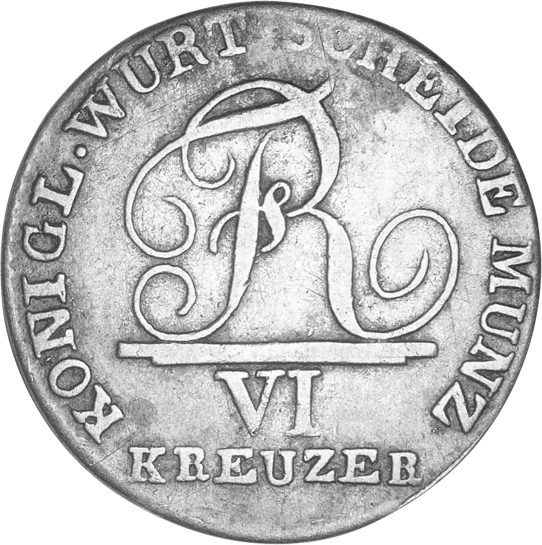
6 kreuzer Württemberg, obverse
Before the mark, the north counted in thalers and the south in gulden of 60 kreuzer. Six kreuzer from the Kingdom of Württemberg: the obverse bears VI KREUZER below a monogram.
On the piece
What the coins bore before the mark
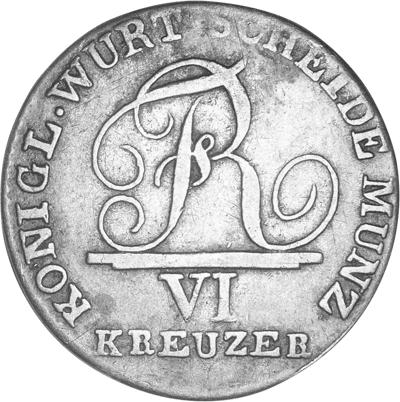
The obverse bears a monogram and the value, VI KREUZER, around it the legend with the abbreviated name of the kingdom.
The reverse shows the arms of Württemberg and the year.

LegendThe name of the state in the legend, abbreviated
ValueThe value, VI KREUZER

Before the mark
By law: a sixth of a thaler as half a mark
“counting the ⅓ thaler piece as one mark and the 1/6 thaler piece as half a mark”
In other words: a third of a thaler counts as one mark, a sixth of a thaler as half a mark.
So the old pieces were accepted until they were withdrawn from circulation. The single thaler remained valid until 1907.
Six kreuzer were a tenth of a gulden.
The gold of the mark
The gold of the German Empire
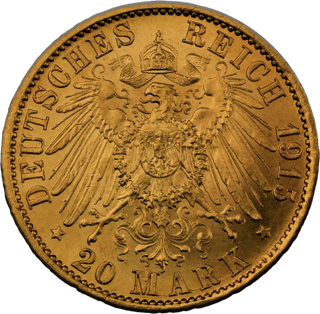
Twenty and ten marks in gold, 900/1,000: a twenty-mark piece weighs 7.96 grams, of which 7.17 grams is fine gold.
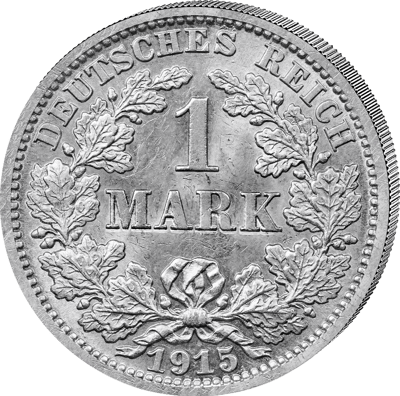
The mark in silver
The silver mark in the hand
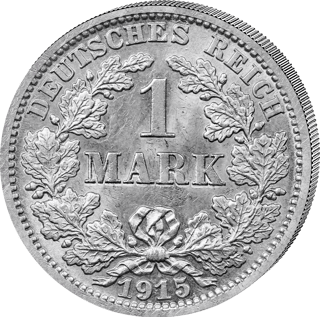
A mark holds 5 grams of fine silver, 900/1,000, and measures 24 millimetres. No one had to accept silver coins for amounts over 20 marks.
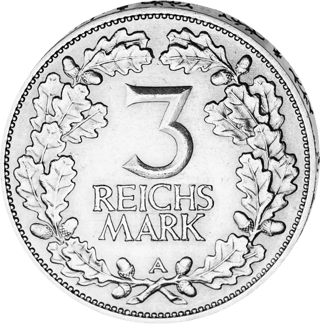
Rentenmark and Reichsmark
The Reichsmark from 1924
The coinage act of 30 August 1924 introduced the Reichsmark; in October 1924 it came into circulation alongside the Rentenmark, one to one.
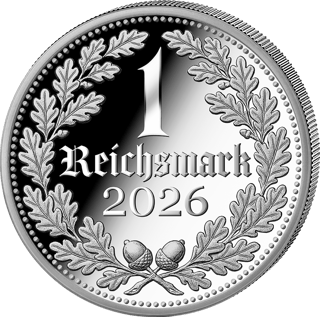
Our strikes
What our strikes take up
Our strikes bear the lettering 1 Reichsmark or 1 Mark in an oak wreath. They are newly struck, no Reichsmark of the past and no legal tender of the Reich.
At a glance
- Type
- Original
- State
- Kingdom of Württemberg
- Face value
- 6 kreuzer
- Metal
- Billon, a silver and copper alloy
- Gross weight
- 2.1 g
- Diameter
- 20 mm
Gross weight: the weight of the whole coin. Fine weight: the pure metal in it. Fineness: its share in thousandths.
Details from our product data and the photo. The year and mint mark of your piece may differ from the photo.

Original and new strike
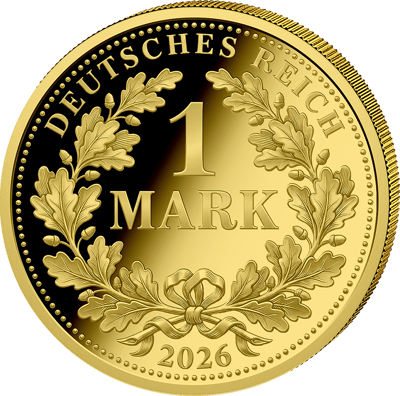
After the thaler came the mark: on the left a mark from the German Empire, on the right our strike of 1/200 ounce of fine gold, which takes it up.
6 Kreuzer Kingdom of Württemberg – Small Change from Napoleon's Shadow
Twenty millimetres in diameter, around two grams in weight, a dark, naturally grown patina: the six-kreuzer coin of the Kingdom of Württemberg looks unassuming – yet it is a first-rate witness to history. These historic silver coins passed between 1806 and 1814 through the hands of farmers, craftsmen, market women and soldiers, while the map of Europe was being redrawn. Whoever holds such a Württemberg coin in their hand holds a piece of the Napoleonic era.
A Kingdom by the Grace of Napoleon
On 1 January 1806, Friedrich – previously duke, elector since 1803 – accepted the royal title bestowed upon him by Napoleon. A few months later, on 12 July 1806, envoys of German princes signed the Confederation of the Rhine Act in Paris; Württemberg was among the founding members. Shortly afterwards, Emperor Franz II laid down the crown, and the Holy Roman Empire of the German Nation ended after almost 900 years. The price for crown and sovereignty was high: at its core, the Confederation of the Rhine was a military alliance, and its members had to provide troops in the event of war.
Württemberg regiments marched for France – in 1806/07 against Prussia and Russia, in 1809 against Austria and finally in 1812 to Russia. Of that contingent, only a vanishingly small part returned. After the Battle of Leipzig, the alliance fell apart: with the Treaty of Fulda of 2 November 1813, Württemberg switched to the side of Napoleon's opponents. It is precisely in these dramatic years that this six-kreuzer coin was minted.
Design and Claim to Power: What the Coin Shows
- Obverse: the interwoven monogram "FR" for Fridericus Rex, below it the denomination "VI KREUZER", surrounded by the legend "KÖNIGL. WÜRT. SCHEIDE MÜNZ".
- Reverse: the crowned, split heart shield – heraldically on the right the three antler branches of the Württemberg family coat of arms, on the left the three striding lions of the Duchy of Swabia.
- Accompanying marks: branches flank the shield, with the year date in the exergue.
- Message: With the Staufer coat of arms, Friedrich I deliberately placed himself in the tradition of the Swabian imperial dynasty – a claim to power struck in metal.
Small Change Coin: Everyday Money of the Time
The word "Scheidemünz" on the obverse is no mere decoration. Scheidemünzen (small change coins) were low-denomination coins meant to "settle" (scheiden) small value differences between buyers and sellers. Because minting small pieces was comparatively labour-intensive, they were made from lower-grade silver alloys – so-called billon, a copper-silver alloy. The standard numismatic catalogues list the Württemberg 6 kreuzer of this type (AKS 51, J. 9, KM 495) as billon with a fineness of 333/1000 and a raw weight of approximately 2.0 to 2.2 grams. Please refer to the data table in this shop for the exact values recorded for your item.
At the time, accounts were kept in gulden and kreuzer. The six-kreuzer coin was everyday currency for daily needs, not a representative piece. Mintage figures were correspondingly high: catalogues cite over 8.5 million pieces for 1809, around 7.1 million for 1807, and just over 3 million for 1812. The fact that comparatively few attractive specimens survive today is simply because these coins worked hard for decades.
Key Facts at a Glance
- Face value: 6 Kreuzer
- Country: Kingdom of Württemberg, King Friedrich I
- Minting period: 1806 to 1814 (various years of issue)
- Metal: silver alloy (billon), minted in Stuttgart
- Diameter: 20.00 mm
- Raw weight: approx. 2.10 g
- Condition: circulated, bank-standard quality
Genuine Circulated Coinage – Every Piece a One-of-a-Kind
You are acquiring genuinely circulated currency here, not a modern mass-produced item. Its appearance is correspondingly individual:
- darker patina developed over two centuries
- individual centring of the strike
- nicks, edge flaws and traces of wear
- legend sections that are sometimes more faintly struck
- varying years of issue, mints and reverse variants
This is exactly what makes them appealing. Please understand that the image shown in the shop is an example: due to the historical circumstances, the specimen delivered may differ individually in appearance and condition. You will receive an original – with signs of use that tell its own story.
Silver: A Store of Value with a Long Tradition
Gold is humanity's oldest currency and has outlived all others – silver, for centuries, was the money people actually carried in their pockets.
Silver has an intrinsic value that does not depend on trust in governments. The metal is scarce, durable, tradeable worldwide as a raw material, and in demand for electronics, solar and medical technology. Physical precious metal in small denominations is regarded by many investors as an inflation hedge and as crisis protection, because it can be held outside the banking system and, if necessary, divided and exchanged. An old silver coin like this six-kreuzer piece vividly demonstrates this principle: it was once made precisely to function in everyday life.
A note on taxation: under current law, profits from the sale of physical silver are tax-free provided at least one year has passed between purchase and sale. For binding information, please consult your tax advisor.
For Collectors, Gift-Givers and Lovers of Old German Coins
Compared to the later Württemberg kreuzer coins under King Wilhelm I, which appeared with a ruler's portrait from 1816 onwards, Friedrich I's six-kreuzer coin is strictly heraldic in style: no portrait, but instead a striking monogram and a coat of arms with a message. Anyone collecting Old Germany of the 19th century will find here an accessible entry point into the era of the Confederation of the Rhine. Anyone collecting by theme can add to the Napoleonic era a piece that people of those years truly held in their hands. And anyone who simply appreciates old silver receives European history you can touch – a gift that tells a story.
Product depiction may differ from the final product.
