





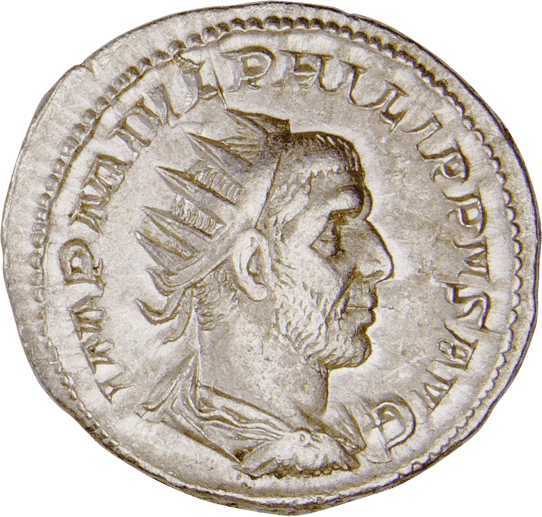


Silver Antoninianus Emperor Philip I the Arab (244-249 AD | Rising Star from Arabia)
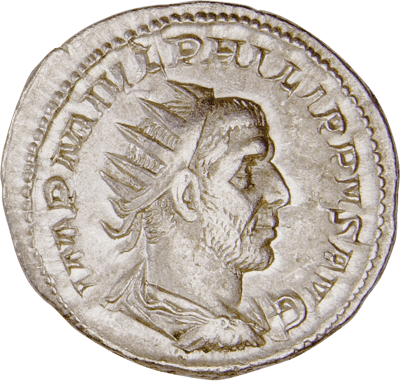













- Genuine Original: around 1,800 years old
- Emperor's Portrait: with radiate crown
- Gift Idea: with real storytelling value
- Genuine OriginalEach piece is unique and passed through Roman hands
- Emperor's PortraitDraped, armored bust with striking features
- Gift IdeaA gift for history lovers, emperor included
 Price alert
  Share
ShareAncient original
Crisis of the third centuryAntoninianus of Philip I the Arab
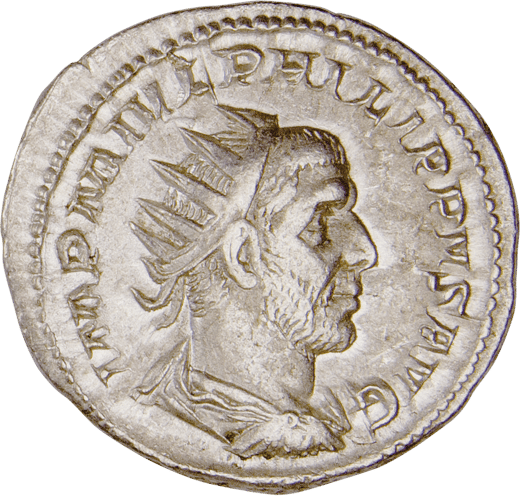
You are looking at the front.
Between the day someone struck this piece with a single hammer blow and the day you hold it, there are roughly
1,800years
- Struck by hand
- Original, not a restrike
- ca. 22 mm across
- 30 days return policy
Where it belongs
Eleven epochs, a thousand years, one shelf.
In fifty years more than twenty men held the imperial title and most of them died violently. At the same time the money collapsed: the antoninianus began as a double denarius with decent silver and ended as a bronze piece with a thin silver wash. Hold a coin from these decades and you are holding an inflation.
7th to 5th century BC
Archaic Greece
5th to 4th century BC
Classical Greece
6th century to 330 BC
Achaemenid Persia
5th to 2nd century BC
Carthage
336 to 30 BC
The hellenistic age
3rd to 1st century BC
Celtic tribes
27 BC to AD 235
The Roman empire
AD 235 to 284
Crisis of the third century
Your piece
AD 284 to 313
The tetrarchy
AD 306 to 363
The Constantinian dynasty
AD 395 to 1453
The eastern Roman empire
Keeping it
First things first: do not clean it.
The dark layer on bronze and the matte grey on silver are called patina. It has grown over centuries and collectors treat it as a mark of authenticity. Polishing it away does not give you a nicer piece, it gives you a damaged one: auction houses regularly value a brightly cleaned coin below the same coin with its patina intact.
Hold it by the edge
Fingerprints contain acid and salt. Take the piece between thumb and forefinger by the rim, over a soft surface.
Store it dry and dark
Moisture is the only real enemy. A pouch or a capsule in a dry place is enough; PVC sleeves are not, they attack the surface.
No agents, no brush
No vinegar, no silver cloth, no ultrasound. If you want a crust removed, let a conservator do it, not the kitchen sink.
Silver Antoninianus of Philip I the Arab – the Upstart from Arabia in Your Hands
- Precious metal: genuine silver from ancient coinage – fineness varies depending on issue and mint
- Minting quality: not a modern collector's edition, but historical circulated coinage with naturally developed patina
- Weight & format: 4.2 g gross weight at approx. 22 mm diameter
- Face value: Antoninianus – the double denarius of the Roman imperial era
- Origin: Roman Empire, reign 244 to 249 AD
- Design: imperial portrait with radiate crown, reverse designs vary
- One-of-a-kind character: every specimen is an original – not a modern mass-produced item
- Tax-interesting: capital gains on silver are generally tax-free after a minimum holding period of one year
- Delivery: as insured shipping, insured and discreetly packaged
Some coins were simply money. This one is a witness to history. Whoever holds an Antoninianus of Emperor Philip I the Arab between their fingers is holding a piece of the 3rd century AD – minted under a ruler whose life story reads like an ancient tale of rags to riches.
From an Officer in the Province of Arabia to the Imperial Throne
Marcus Iulius Philippus, known as Philip the Arab, was born around 204 in Shahba – a city he later had refounded as Philippopolis in the province of Arabia. Coming from comparatively humble origins, he rose swiftly through the ranks of the Roman professional army and, under Gordian III, rose to become Praetorian prefect. When Gordian died in 244 during the Persian campaign, the soldiers proclaimed Philip emperor. He first raised his son of the same name to Caesar, later to co-emperor; his wife Marcia Otacilia Severa became Augusta. In 249, Philip fell in the Battle of Verona against his former governor Decius.
His greatest moment, however, came in April 248: Rome celebrated the millennium of the city's founding – with lavish games, exotic animals and generous cash gifts. The upstart from the East staged the millennium of the Eternal City. Rich in symbolism, rich in coin imagery.
The Antoninianus: Double Denarius of a Turbulent Era
The Antoninianus is a Roman silver coin introduced through Caracalla's coinage reform in 215 AD. The name itself is, incidentally, a modern creation by collectors. It is distinguished from the denarius by one unmistakable feature: the emperor's radiate crown on the obverse. Nominally the coin was valued at two denarii, though by weight and silver content it corresponded more to roughly one and a half denarii. After Gordian III, this denomination gradually replaced the denarius as the Empire's leading silver coin.
The silver content declined significantly over the course of the century: around 238 it averaged about 40 percent, and by around 270 it had fallen below three percent. Coins struck during the reign of Philip therefore date from a phase in which the Antoninianus still carried a noticeable silver content – one of the reasons why these particular pieces are so sought after among collectors of ancient coins. Compared to a heavy bronze sestertius, the Antoninianus offers genuine precious metal in pocket format; compared to an early denarius, it is larger, more substantial, and often more expressive in its portraiture.
Design: Radiate Crown, Legend, Reverse Variety
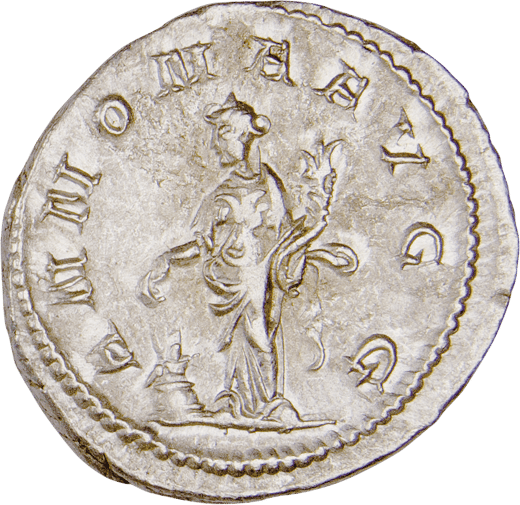
The obverse shows the emperor's portrait facing right – draped, cuirassed, with the characteristic radiate crown. The legend states name and titles, such as IMP M IVL PHILIPPVS AVG. The reverses feature personifications of Roman civic virtues: Moneta with scales and cornucopia, along with Annona, Aequitas, Fides or Concordia depending on the type. Coins were struck in, among other places, Rome and Antioch; the types are catalogued in the standard reference work Roman Imperial Coinage (RIC).
Condition: Traces That Make Up the Appeal
Those familiar with modern collector's editions in Proof (PP) quality should consciously rethink their expectations here. Ancient Antoniniani were never struck in Proof quality – they were circulated legal tender and bear corresponding traces: darker patina, individual centering, nicks, wear, and sometimes weaker areas of the legend. That is precisely what makes them appealing.
Since the year of minting, mint, and reverse variant can vary, the specimen delivered will differ from the image shown – you receive an original, not a mass-produced item. We therefore ask for your understanding that the image in the shop serves as an example and may individually differ from the delivered item in terms of appearance and condition due to historical circumstances.
Silver as a Tangible Asset – Then as Now
For millennia, silver has served as coinage metal, medium of trade, and symbol of wealth and prestige. This Antoninianus vividly illustrates that. Physical precious metal remains scarce, durable, and tradable worldwide, while industrial demand from electronics, solar and medical technology meets a limited supply. Unlike fiat money, which relies on trust in institutions, silver possesses intrinsic value derived from its physical properties. Many investors and collectors therefore value it as an inflation hedge and as crisis protection – a tangible asset that can be passed down through generations.
The Roman Empire has passed, its currency long since history – the silver in this coin has endured for around 1,800 years.
Who This Piece Is Made For
- Collectors of ancient coins seeking a tangible entry point into the Roman imperial era
- History enthusiasts who want not just to read about antiquity, but to hold it in their hands
- Newcomers who prefer silver coins with historical depth over modern mass-produced coinage
- Gift-givers looking for a present with genuine narrative value – emperor included
An Antoninianus of Philip the Arab is thus both: a numismatic collector's item from our "History" series and a piece of honest precious metal that has already passed through Roman hands.
Product depiction may differ from the final product.
