





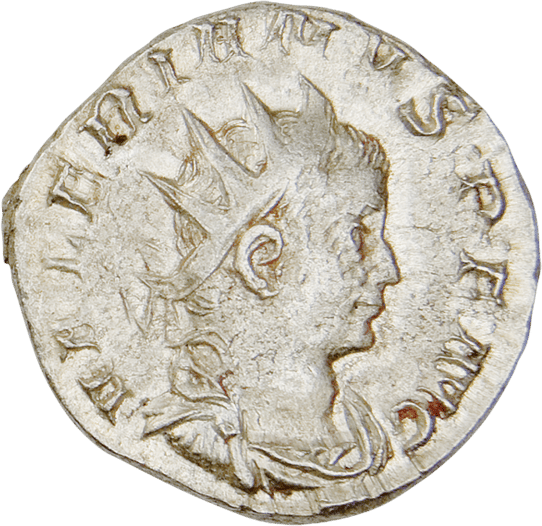


Silver Antoninianus Emperor Valerian II (256-258 AD | Age of the Soldier Emperors)
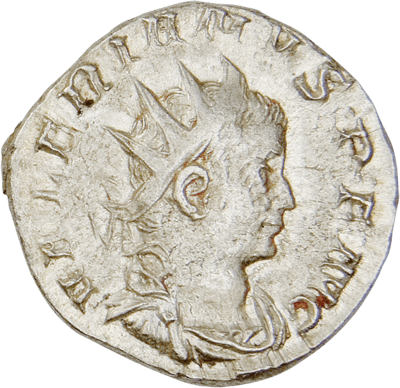













- Genuine Original: around 1,770 years old
- Rare and sought-after: short minting period
- One of a kind: every coin unique
- Genuine OriginalNot a replica, but a genuine Roman coin
- Rare and sought-afterHis name appeared on coins for barely two years
- One of a kindPatina and reverse design make each piece unique
 Price alert
  Share
ShareAncient original
Crisis of the third centuryAntoninianus of Valerian II


You are looking at the front.
Between the day someone struck this piece with a single hammer blow and the day you hold it, there are roughly
1,750years
- Struck by hand
- Original, not a restrike
- 22 mm across
- 30 days return policy
Where it belongs
Eleven epochs, a thousand years, one shelf.
In fifty years more than twenty men held the imperial title and most of them died violently. At the same time the money collapsed: the antoninianus began as a double denarius with decent silver and ended as a bronze piece with a thin silver wash. Hold a coin from these decades and you are holding an inflation.
7th to 5th century BC
Archaic Greece
5th to 4th century BC
Classical Greece
6th century to 330 BC
Achaemenid Persia
5th to 2nd century BC
Carthage
336 to 30 BC
The hellenistic age
3rd to 1st century BC
Celtic tribes
27 BC to AD 235
The Roman empire
AD 235 to 284
Crisis of the third century
Your piece
AD 284 to 313
The tetrarchy
AD 306 to 363
The Constantinian dynasty
AD 395 to 1453
The eastern Roman empire
Keeping it
First things first: do not clean it.
The dark layer on bronze and the matte grey on silver are called patina. It has grown over centuries and collectors treat it as a mark of authenticity. Polishing it away does not give you a nicer piece, it gives you a damaged one: auction houses regularly value a brightly cleaned coin below the same coin with its patina intact.
Hold it by the edge
Fingerprints contain acid and salt. Take the piece between thumb and forefinger by the rim, over a soft surface.
Store it dry and dark
Moisture is the only real enemy. A pouch or a capsule in a dry place is enough; PVC sleeves are not, they attack the surface.
No agents, no brush
No vinegar, no silver cloth, no ultrasound. If you want a crust removed, let a conservator do it, not the kitchen sink.
Silver Antoninianus of Valerian II – an Original from the Age of the Soldier Emperors
Some coins are beautiful. This one is more than that: it is a witness to history. The silver Antoninianus of Emperor Valerian II (256–258 AD) comes from that dramatic era in which the Roman Empire fought for its survival on multiple fronts at once. Whoever holds this piece in their hand is holding around 1,770 years of history between their fingers – a genuine original, not a re-strike, not a replica, but an ancient coin with character.
The Antoninianus – a Silver Denomination from an Era of Upheaval
The Antoninianus was introduced as official currency under Emperor Caracalla around 214 AD. Its face value was nominally two denarii, with an initial weight of about 5.5 grams. Its distinguishing feature is the radiate crown on the ruler's portrait. Over the course of the 3rd century, the Antoninianus became the most widely minted coin of the Empire – and at the same time a mirror of galloping inflation, as weight and silver content declined steadily over the decades. This is precisely why this small disc tells us more about ancient monetary policy than many a history book.
Key Facts at a Glance
Face value: Antoninianus
Country / country of origin: Roman Empire
Precious metal: Silver, fineness varies (typical for the period)
Gross weight: approx. 4.1 g
Diameter: approx. 22 mm
Year of issue & mint: varies (minted 256–258 AD)
Condition: These pieces are circulated currency and bear corresponding traces: darker patina, individual centering, nicks, wear, and in some cases weaker sections of the legend. This is exactly what gives them their appeal. Since the year of issue, mint, and reverse variant can vary, the piece you receive will differ from the image shown – you receive an original, not a mass-produced item. We therefore ask for your understanding that the image in the shop serves as an example and may differ individually from the delivered item in terms of appearance and condition due to historical circumstances.
Series: History – a collector's item with substance
Valerian II – the Caesar Who Never Became Emperor
Publius Licinius Cornelius Valerianus, usually referred to in numismatics as Valerian II, was the eldest son of Emperor Gallienus and grandson of Emperor Valerian. In the autumn of 256, he was raised to the rank of Caesar, i.e., designated heir to the throne; from 257 onward he also bore the name and title of Imperator. He was given responsibility for securing the Danube frontier – an enormous task for a young man, which is why the officer Ingenuus was appointed to assist him. In 258, Valerianus died in a military camp. After his death he was deified, and the title of Caesar passed to his brother Saloninus.
His minting period therefore spans barely more than two years. For any coin collection, this means that the window of time in which coins bearing his name could have been struck was extremely short. Within the series of the Soldier Emperors, this young Caesar is therefore considered comparatively rare and correspondingly sought after.
Designs, Legends, and Mints
The obverse regularly depicts the draped, sometimes armored bust facing right with the characteristic radiate crown, accompanied by inscriptions such as VALERIANVS CAES or P LIC COR VALERIANVS CAES. On the reverse, you will encounter various pictorial themes, including:
IOVI CRESCENTI – the infant Jupiter on the goat Amalthea, a reference to the young heir to the throne
PRINCIPI IVVENTVTIS – the young Caesar as "First of the Youth," holding a standard and scepter
VICTORIA PART – a victory theme from the eastern mints
CONSECRATIO – posthumous coinage honoring the deified Valerianus
Coins were struck, among other places, in Rome, Colonia Agrippinensis (Cologne), and Antioch. Which reverse variant reaches you is a matter of historical chance – and this is precisely where the charm of this offer lies.
Silver: A Monetary Metal for Millennia
Ancient coins such as this Antoninianus vividly demonstrate why silver has served as a monetary and coinage metal across cultures and centuries and has been regarded as a symbol of wealth. Paper currencies have come and gone; the metal has endured. Physical precious metal possesses an intrinsic value derived from its physical properties and global demand – today primarily from electronics, solar, and medical technology. Supply is limited, while industry continuously consumes material.
For investors and collectors, this results in an attractive dual role: silver coins are both a tangible asset and a cultural artifact. They are divisible, highly liquid, usable as a medium of exchange in small units, and often more accessible than gold. As an inflation hedge and as crisis protection, precious metals have built trust across generations. Gold is humanity's oldest currency and has outlasted every paper money system – silver, as a monetary metal, is hardly inferior to it.
An Antoninianus of Valerian II is both a tangible asset and a historical document in one – a piece of the Roman Empire that can be passed on to the next generation.
Taxation, Comparison, and Suitability
Profits from the sale of silver are generally tax-free provided the holding period is at least one year. Those who collect ancient coins tend to think in longer timeframes anyway – not infrequently spanning generations.
Compared to the older denarius, the Antoninianus offers a larger format and the striking radiate crown, but at the cost of a typically lower and fluctuating fineness for its time. Compared to modern bullion coins such as the Maple Leaf or the Vienna Philharmonic, it scores not through fine weight, but through history, rarity, and individuality: no two specimens are alike. Those who rely exclusively on pure fine silver can sensibly combine ancient pieces with modern bars or bullion coins – the two complement each other excellently.
For newcomers to ancient numismatics – an affordable entry point into the Roman Imperial era
For collectors of Soldier Emperor coinage and thematic collections on the Crisis of the Third Century
For investors who value tangible assets with cultural added value
As an impressive gift with genuine storytelling value
Secure an authentic testimony to Roman coinage history: an original from an era that shaped Europe for the long term.
Product depiction may differ from the final product.
