





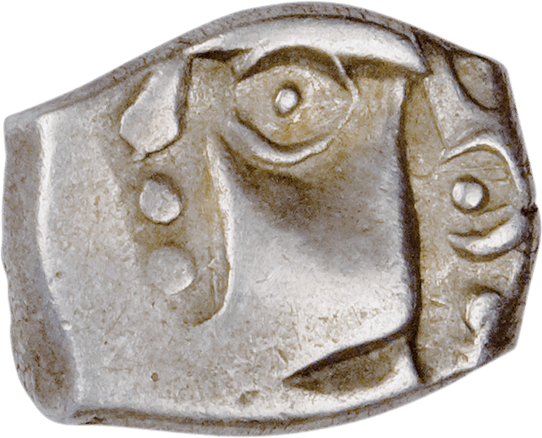


Silver Drachm of the Celts (1st Century BC | Tribe of the Volcae Tectosages)
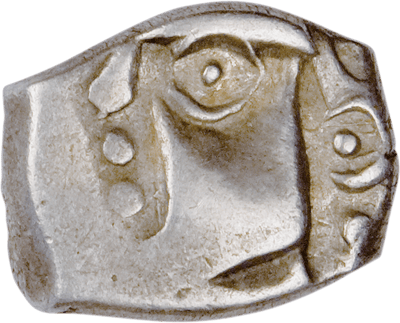












- Genuine Original: hand-struck
- Abstract Design: head and cross
- Special Gift: a real conversation piece
- Genuine OriginalEvery piece unique, preserved for over two millennia
- Abstract DesignAn angular head and a cross with symbols in the angles
- Special GiftMoney that was already in circulation when Toulouse was Tolosa
 Price alert
  Share
ShareAncient original
Celtic tribesDrachm of the Volcae Tectosages

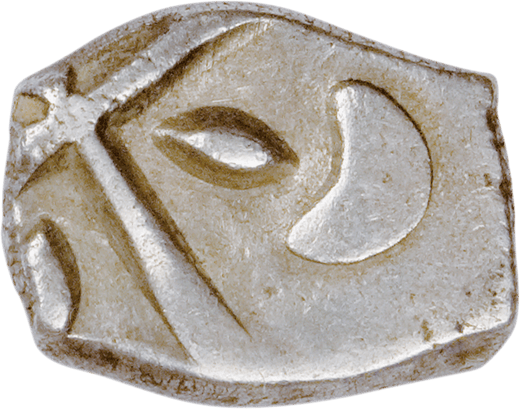
You are looking at the front.
Between the day someone struck this piece with a single hammer blow and the day you hold it, there are roughly
2,100years
- Struck by hand
- Original, not a restrike
- 12mm across
- 30 days return policy
Where it belongs
Eleven epochs, a thousand years, one shelf.
The Celts took Greek models and reshaped them over generations, until a head of Apollo became a pattern of arcs and dots and a chariot team became a single horse. That is not incompetence, it is a language of its own. The Vindelici sat between the Alpine foothills and Lake Constance, the Volcae Tectosages around Tolosa, today Toulouse.
7th to 5th century BC
Archaic Greece
5th to 4th century BC
Classical Greece
6th century to 330 BC
Achaemenid Persia
5th to 2nd century BC
Carthage
336 to 30 BC
The hellenistic age
3rd to 1st century BC
Celtic tribes
Your piece
27 BC to AD 235
The Roman empire
AD 235 to 284
Crisis of the third century
AD 284 to 313
The tetrarchy
AD 306 to 363
The Constantinian dynasty
AD 395 to 1453
The eastern Roman empire
Keeping it
First things first: do not clean it.
The dark layer on bronze and the matte grey on silver are called patina. It has grown over centuries and collectors treat it as a mark of authenticity. Polishing it away does not give you a nicer piece, it gives you a damaged one: auction houses regularly value a brightly cleaned coin below the same coin with its patina intact.
Hold it by the edge
Fingerprints contain acid and salt. Take the piece between thumb and forefinger by the rim, over a soft surface.
Store it dry and dark
Moisture is the only real enemy. A pouch or a capsule in a dry place is enough; PVC sleeves are not, they attack the surface.
No agents, no brush
No vinegar, no silver cloth, no ultrasound. If you want a crust removed, let a conservator do it, not the kitchen sink.
Celtic Drachm of the Volcae Tectosages: 2,000 Years of Monetary History in Your Hand
A small, irregularly shaped flan of silver, barely larger than a fingernail – yet a testament from a time when Rome was still fighting for supremacy in Gaul. This drachm was struck in the 1st century BC by the Celtic tribe of the Volcae Tectosages in the south of present-day France: hand-struck, carried in circulation, preserved for over two millennia. Each specimen is a one-of-a-kind piece with its own die image, its own toning, its own history.
The Tectosages: Celts Between Toulouse and Narbonne
The Volcae Tectosages were a sub-tribe of the Volcae and settled in what later became Languedoc, in the area around Narbo Martius (Narbonne) and Tolosa (Toulouse), which became their capital. Caesar places the origin of the tribe in the Hercynian Forest. Between 121 and 118 BC, the Romans subjugated the Tectosages and incorporated their territory into the new Roman province of Gallia Narbonensis – they retained a certain degree of autonomy. Another part of the Tectosages had already migrated via Thrace to Asia Minor in 279/278 BC, forming the Galatians together with the Tolistobogii and Trocmi; their settlement area lay around Ankyra, present-day Ankara. Whoever owns such a coin of the Volcae Tectosages holds in their hands the money of a culture whose traces reach from southern France to Anatolia.
From the Rose of Rhoda to the Cross
The model came from the Greek world: the Hellenistic polis of Rhoda in present-day Catalonia minted silver drachms with a woman's head on the obverse and a rose seen from above on the reverse. The Celts adopted both the denomination and the design – and over generations transformed both into something entirely their own. The portrait became an angular, abstract head facing left, which French numismatics aptly calls the "tête cubiste". The four rose petals became crescent-shaped bosses, then sickles with dots, and finally that striking cross with symbols in the angles: spheres, crescents, axes, or grains. Specialists therefore classify such pieces as "monnaies à la croix", or cross drachms. Hardly any ancient culture designed its money in a more abstract way.
Key Facts at a Glance
Material: Silver
Gross weight: 2.3 g
Diameter: approx. 12 mm, hand-struck, irregular flan
Denomination: Drachm – the classic silver denomination of the ancient world
Minting period: 1st century BC, tribal coinage of the Volcae Tectosages
Design: stylized head facing left / cross with symbols in the quadrants, type variants possible
Condition: circulated coinage, bank-standard – circulated originals
Delivery: in a case
Quality, Condition and the Charm of the Unique Piece
Ancient hand-struck coins were made without a coin collar and without mechanical control. Die alignment, centering, flan shape, and design placement therefore vary from piece to piece; slight striking weaknesses are part of the character of this series and do not diminish the numismatic quality. Each piece delivered is in bank-standard, naturally aged condition – selection of specific types or dies is not possible. This is precisely where the charm lies: you receive an original that no one else possesses in identical form.
Why Silver Still Convinces After Two Thousand Years
Silver is one of humanity's oldest monetary metals, and this drachm proves it more impressively than any chart: the metal has outlasted empires, currencies, and rulers while fully retaining its physical properties. This durability makes precious metal a classic inflation hedge and a proven crisis protection.
Intrinsic value: Unlike fiat money, silver does not depend on trust in governments, but on its physical properties.
Industrial demand: Electronics, solar, and medical technology require silver – amid limited availability and limited supply.
High liquidity: Silver is traded worldwide as a commodity and can be easily resold.
Small units: Small denominations in particular are well suited as a means of exchange in times of currency instability.
Tax-attractive: Profits from the sale of physical silver are generally tax-free after a holding period of at least one year.
Generational value: Tangible assets can be passed down – this drachm has long since proven that.
Condition: These pieces are circulated means of payment and bear corresponding traces: darker patina, individual centering, nicks, wear, and in some cases weaker legend areas. This is exactly what makes them appealing. Since the year of minting, mint, and reverse variant vary, the specimen delivered will differ from the image shown – you receive an original, not a mass-produced item. We therefore ask for your understanding that the image in the shop represents an example and may individually differ from the delivered item in terms of appearance and condition due to historical circumstances.
Two thousand years after it was struck, this coin still weighs 2.3 grams of silver. No paper money in the world can claim that.
For Collectors and Investors: Where This Coin Stands
Compared to modern bullion coins such as the Maple Leaf or the Vienna Philharmonic, this piece serves a different purpose. Bullion coinage lives on its fine silver content and its slim premium, whereas the Celtic cross drachm derives its value from age, rarity, and cultural significance. Its value is drawn from the collector's market for ancient silver coins, not solely from its metal content – which is why it is offered as a fixed-price item rather than being priced daily according to the silver spot price. Compared to Roman denarii or Greek tetradrachms, it stands out with a wholly distinctive stylistic vocabulary that should not be missing from any collection of ancient cultures.
This piece is recommended for newcomers to Celtic numismatics, enthusiasts of the "History" series, and anyone who understands precious metal not merely as weight, but as cultural heritage. The included case protects the surface, and insured shipping ensures secure delivery. And as a gift with real conversation value, the silver drachm of the Volcae Tectosages is hard to beat: genuine money that was already circulating when Toulouse was still called Tolosa.
Product depiction may differ from the final product.
