





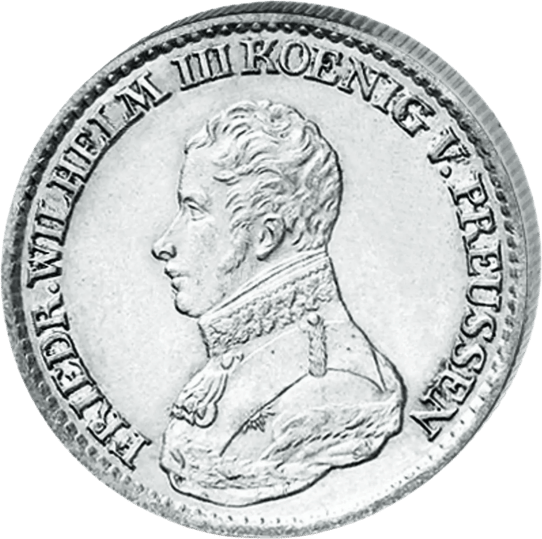


Silver 1/6 Thaler King Friedrich Wilhelm III (1816-1818 | Prussia in the Biedermeier Era)













- Genuine currency: for bread and rent
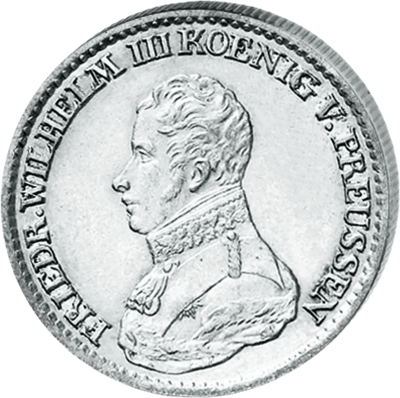
- Fine portrait: monarch in uniform
- Rarely preserved: many were melted down
- Genuine currencyAn original used to pay for goods some 200 years ago
- Fine portraitBust with sash, epaulette and medals finely detailed
- Rarely preservedOnly a fraction of millions of pieces survived
 Price alert
  Share
Share
Before the mark · Prussia
Before there was the mark

1/6 thaler Prussia, Friedrich Wilhelm III, obverse
Before the mark, the north counted in thalers and the south in gulden of 60 kreuzer. A sixth of a thaler from Prussia, with the portrait of Friedrich Wilhelm III.
On the piece
What the coins bore before the mark
The obverse shows King Friedrich Wilhelm III with the legend FRIEDR. WILHELM III KOENIG V. PREUSSEN.
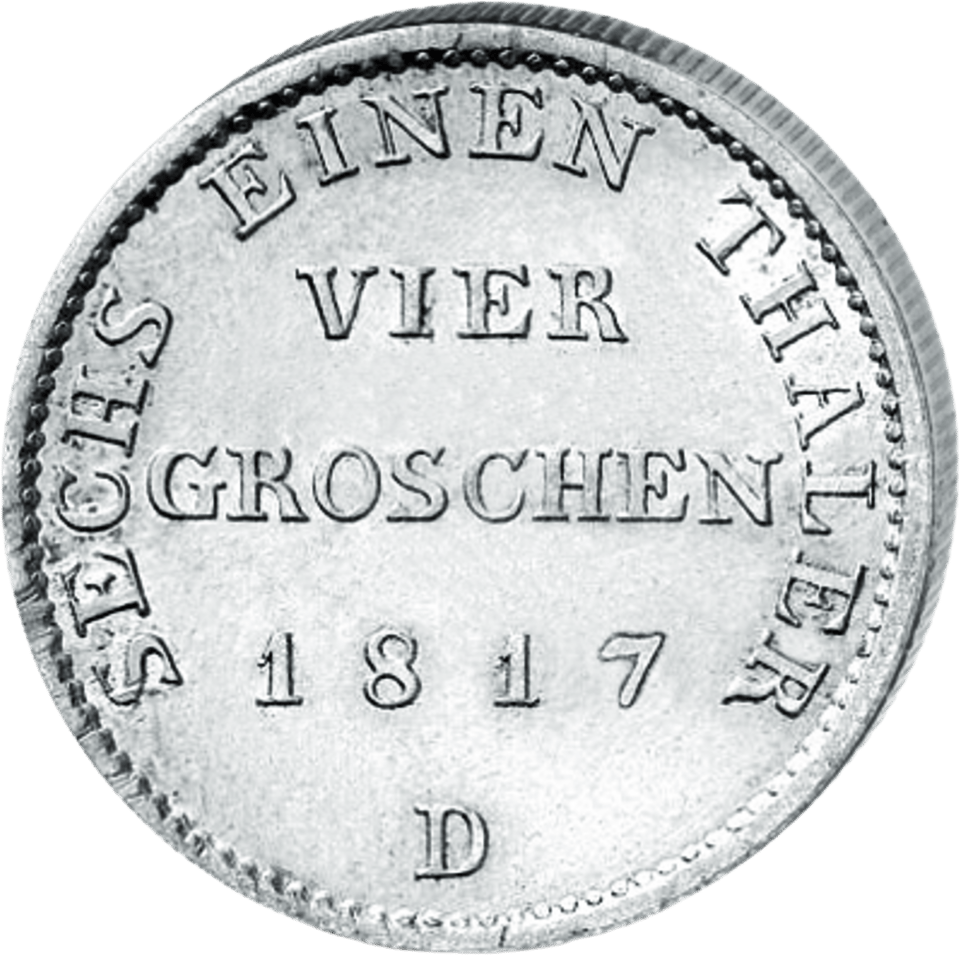
The reverse gives the value as a fraction of the thaler and in groschen, together with year and mint mark.
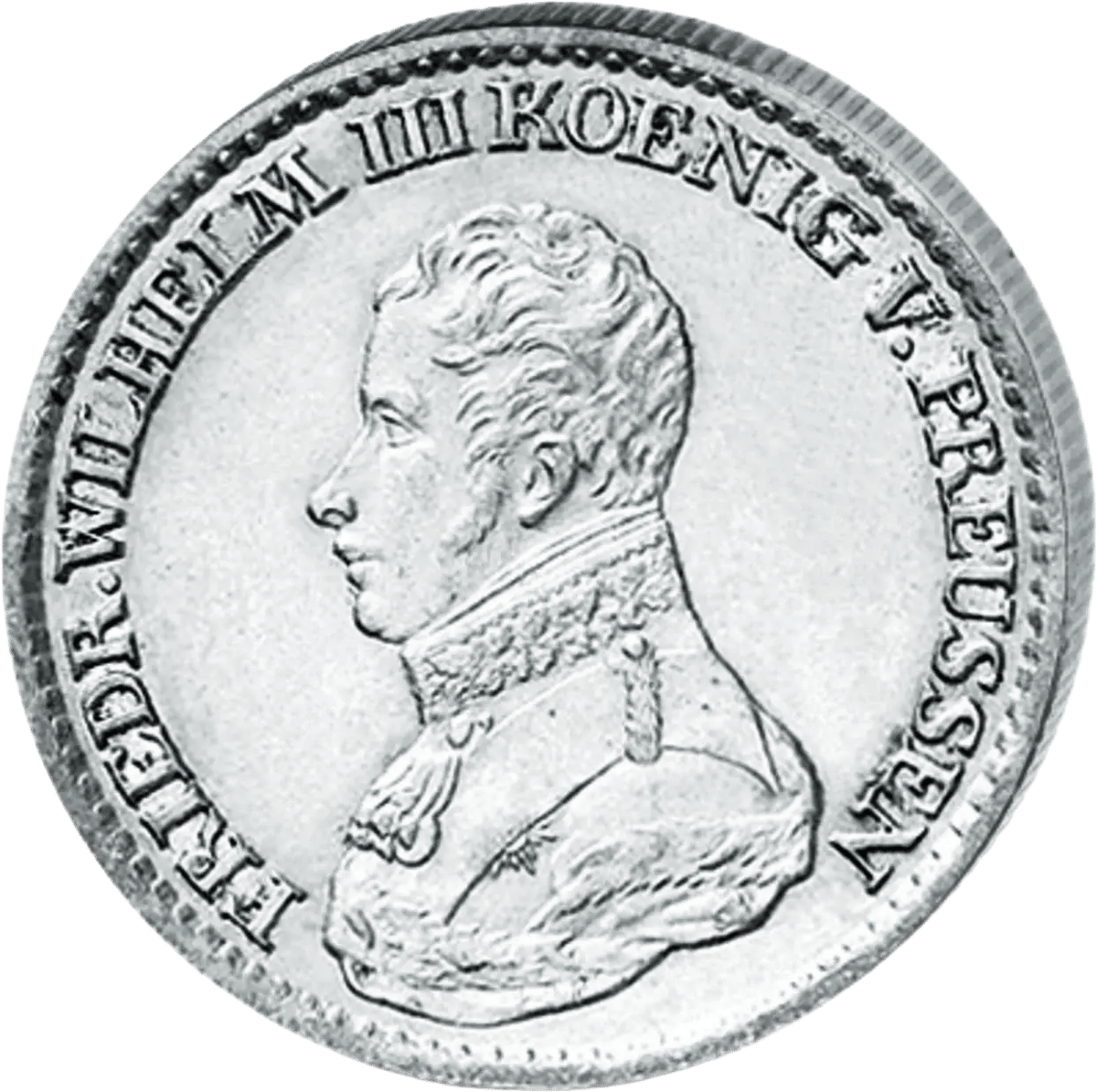
LegendThe legend with the name of the king
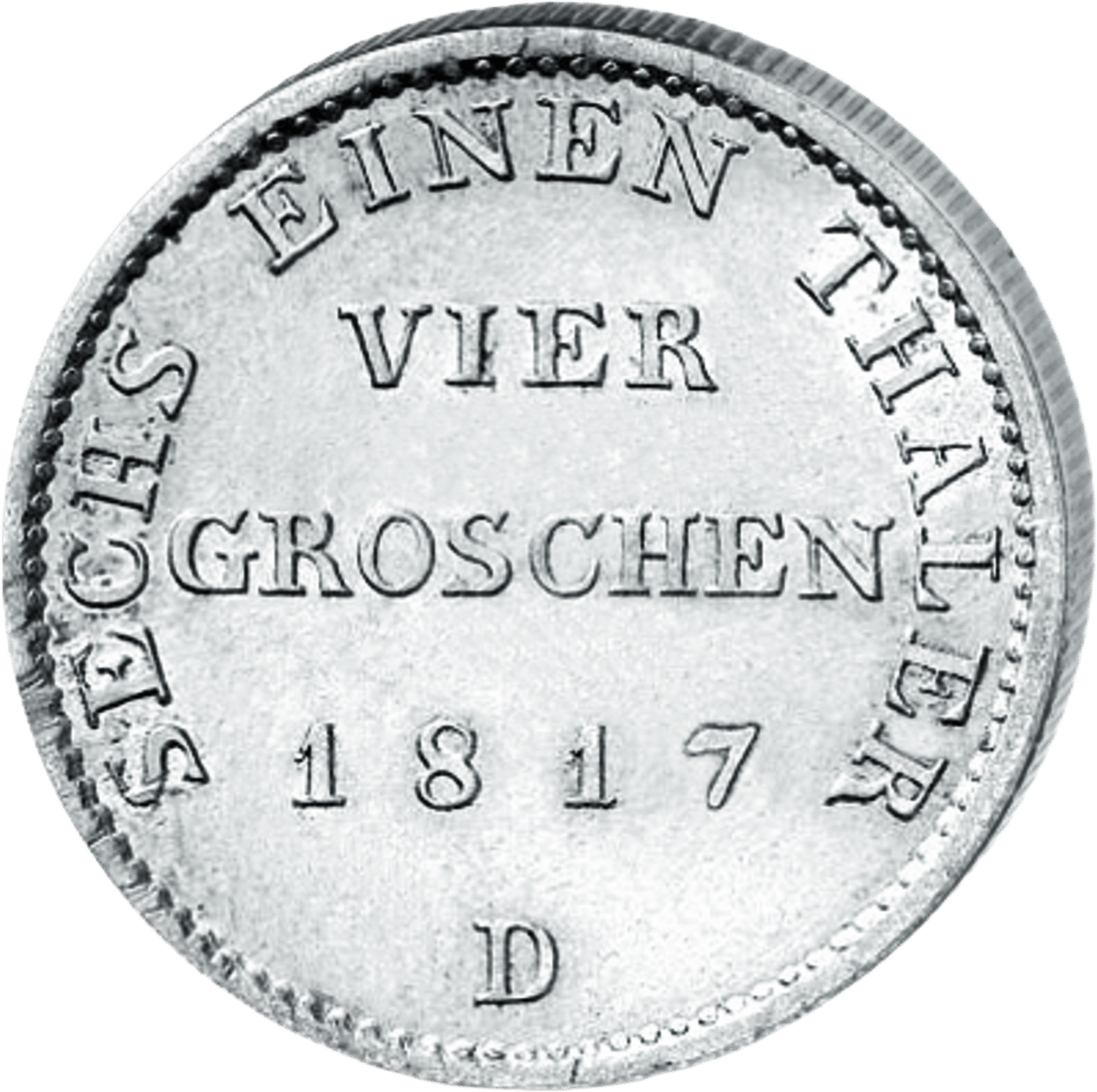
YearYear and mint mark on the photo

Before the mark
By law: a sixth of a thaler as half a mark
“counting the ⅓ thaler piece as one mark and the 1/6 thaler piece as half a mark”
In other words: a third of a thaler counts as one mark, a sixth of a thaler as half a mark.
So the old pieces were accepted until they were withdrawn from circulation. The single thaler remained valid until 1907.
The mint mark
A letter for the mint
This piece also bears a letter for its mint, on the photo a D.
The gold of the mark
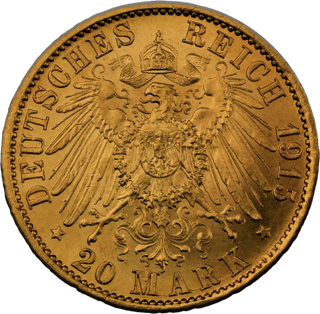
The gold of the German Empire
Twenty and ten marks in gold, 900/1,000: a twenty-mark piece weighs 7.96 grams, of which 7.17 grams is fine gold.
The mark in silver
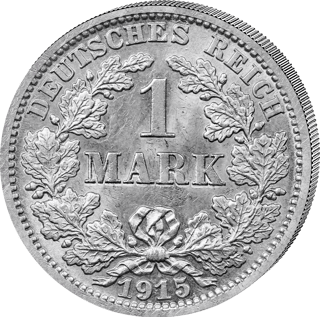
The silver mark in the hand
A mark holds 5 grams of fine silver, 900/1,000, and measures 24 millimetres. No one had to accept silver coins for amounts over 20 marks.
Rentenmark and Reichsmark
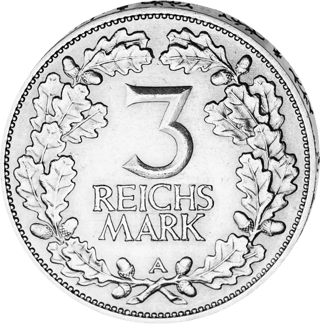
The Reichsmark from 1924
The coinage act of 30 August 1924 introduced the Reichsmark; in October 1924 it came into circulation alongside the Rentenmark, one to one.
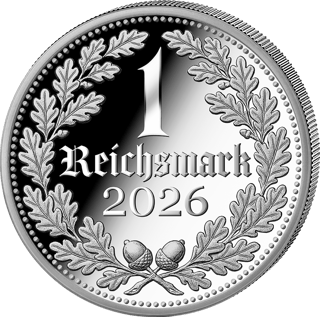
Our strikes
What our strikes take up
Our strikes bear the lettering 1 Reichsmark or 1 Mark in an oak wreath. They are newly struck, no Reichsmark of the past and no legal tender of the Reich.
At a glance
- Type
- Original
- State
- Kingdom of Prussia
- Ruler
- Friedrich Wilhelm III
- Face value
- 1/6 thaler
- Metal
- Silver
- Fineness
- 520/1,000
- Gross weight
- 5.345 g
- Diameter
- 25 mm
Gross weight: the weight of the whole coin. Fine weight: the pure metal in it. Fineness: its share in thousandths.
Details from our product data and the photo. The year and mint mark of your piece may differ from the photo.

Original and new strike
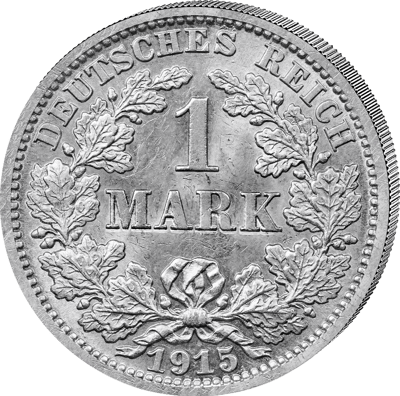
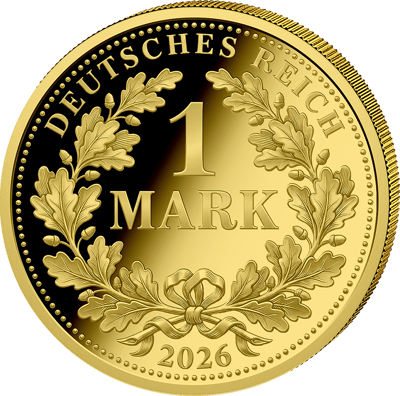
After the thaler came the mark: on the left a mark from the German Empire, on the right our strike of 1/200 ounce of fine gold, which takes it up.
1/6 Thaler King Friedrich Wilhelm III – Prussian circulating currency from the Biedermeier era
Four Groschen. That was the value of this piece when it left the mints of the Kingdom of Prussia between 1816 and 1818. Not a showpiece for the display case, but silver for everyday life: for bread, freight charges, rent and craftsmen's bills. That is exactly what makes the 1/6 Thaler so appealing – it is genuine everyday money from an era that reordered Europe.
The coin at a glance
- Face value: 1/6 Thaler = 4 Groschen = 48 Pfennig
- Issuing authority: King Friedrich Wilhelm III of Prussia (1797–1840)
- Years of issue of this type: 1816 to 1818; mint mark A (Berlin) or D (Düsseldorf)
- Material: Silver, fineness 520/1,000
- Gross weight: 5.345 g – calculated at around 2.78 g fine silver when new
- Diameter: approx. 25 mm
- Catalogue references: AKS 25, Jaeger 36, KM 394
- Condition: circulated coin; years of issue, mints and grades of preservation vary
- Country of origin: Kingdom of Prussia
Four Groschen between the Congress of Vienna and the March Revolution
1815 marked the end of the Congress of Vienna. With it began the era later known as the Biedermeier period, which lasted until the Revolution of 1848: bourgeois, domestic, politically subdued – and economically in motion. Prussia had emerged from the Wars of Liberation as a great power and had to supply its newly acquired western provinces with coinage. That is why these fractional pieces of the Reichsthaler were minted not only in Berlin but also in Düsseldorf, whose mint letter D appears on the reverse of the piece pictured.
Demand was enormous, and mintages were correspondingly high: catalogues list 11,652,000 pieces for 1816 A, around 14,484,000 for 1817 A, and 5,146,284 pieces for 1818 A. Coins were struck according to the old standard – 84 pieces of this denomination made up one fine Cologne Mark. Millions of these coins were melted down again in the 19th century or lost through circulation. Only a fraction has survived, and today these are in the hands of collectors.
Portrait, clear denomination, motto on the edge
The obverse shows the bust of the king in uniform facing left, surrounded by the legend FRIEDR. WILHELM III KOENIG V. PREUSSEN. The reverse dispenses with heraldic splendour and is entirely plain: SECHS EINEN THALER, below it in bold script VIER GROSCHEN, along with the year and mint mark. The edge bears the Prussian motto GOTT MIT UNS. Money could hardly be designed more simply – nor could its purpose be shown more clearly.
Condition: not flaws, but biography
These pieces are circulated coinage – and they look the part. Darker patina, individual centring, small nicks, wear, and in places weaker legend details: these are not flaws but biography. Every trace comes from hands that, centuries ago, used it to settle goods, freight or debts.
Since the year of minting, mint and reverse variant can vary, the piece supplied may differ from the illustration. Please understand the photo in the shop explicitly as a sample image: appearance, exact weight and condition vary from piece to piece for historical reasons. You are purchasing an original.
Classification: small, historical, tangible
Compared to a large Prussian Thaler, the 1/6 Thaler is the lighter and more affordable entry-level piece, yet historically just as authentic – the same era, the same minting authority, only a smaller denomination. Next to a Silbergroschen, on the other hand, it appears noticeably heavier and carries more precious metal. And compared to modern silver coins made of fine silver, it does contain less silver, but offers something no new minting can replicate: around two centuries of history in the palm of your hand.
For collectors of historical coins, this opens up an interesting field. One can lay the years 1816, 1817 and 1818 side by side, compare the mint marks A and D, and study die varieties and lettering styles. Anyone who simply wants to own a genuine piece of Prussia, however, already reaches that goal with a single specimen. Both approaches work – and both begin with this small silver piece.
Why silver – then as now
For centuries, silver was the everyday money metal because it was divisible, durable and universally accepted. It has not lost these properties. It is long-lasting, retains its physical characteristics across generations, is traded worldwide as a raw material, and is in strong industrial demand in electronics, solar and medical technology. Supply is limited. Physical silver carries its value within itself – unlike fiat money, which relies on trust in governments.
- Value retention: tangible asset with intrinsic material value, independent of issuers and accounting systems
- Inflation hedge: precious metal cannot be created at will
- Crisis protection: small denominations are also conceivable as a means of exchange in times of currency instability
- Tax-attractive: profits from the sale of silver are generally tax-free after a holding period of at least one year
- Intergenerational thinking: coins of this kind outlast currencies and can be passed down
Gold is humanity's oldest currency and has outlived all others. The silver of the Thaler era tells the same story – only in a smaller coin and with more fingerprints on it.
Shipping is carried out as insured value shipping. Anyone wishing to combine collector's joy, Prussian history and genuine precious metal in a single piece will find in this fractional Thaler a wonderfully characterful candidate for their own collection.
Product depiction may differ from the final product.
