





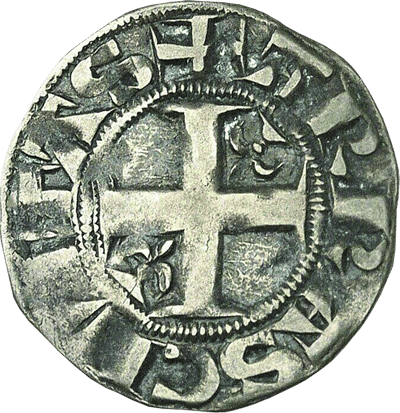

Silver Denier Kingdom of France (1180-1223 | King Philip II)
- Collector coin: Especially interesting for collectors
- Secure shipping: 100% insured & anonymous delivery
- Kettner Bullion: Already over 300,000 satisfied customers
- Collector coinEspecially interesting for collectors
- Secure shipping100% insured & anonymous delivery
- Kettner BullionAlready over 300,000 satisfied customers








- Collector coin: Especially interesting for collectors
- Secure shipping: 100% insured & anonymous delivery
- Kettner Bullion: Already over 300,000 satisfied customers
 Price alert
 Share
Silver Denier Philip II Augustus – a piece of the High Middle Ages from the Kingdom of France
- Authenticity: An original denier from the reign of King Philip II (1180-1223) – no cast reproduction, no replica
- Material: Silver with a fineness of 833/1,000 at 1.1 g gross weight
- Minting quality: Deliberately not Proof (PP), but authentic circulated issue whose signs of use tell a living history
- History: Minted under the rival of Richard the Lionheart and victor of Bouvines
- Collector's value: An ideal entry point into the coins of the European Middle Ages and a highlight for any "History" collection
It has been around 800 years since this small silver denier first changed hands. Perhaps at a market in Paris, Arras or Tours. Perhaps in the hand of a cloth merchant, a pilgrim or a royal tax collector. Among the silver coins in our range, it is one of those pieces you don't simply own, but truly experience.
Philip II Augustus: The king who made France great
Philip – known in France as Philippe Auguste – was born in Paris in 1165 as the son of Louis VII. From 1180 he reigned as king from the House of Capet, for 42 years. At the start of his reign, the royal domain was essentially limited to the Île-de-France. By the time of his death in 1223, the royal territory had multiplied many times over. The chronicler Rigord gave him the epithet "Augustus", a deliberate allusion to the first Roman emperor.
His biography reads like an adventure novel. Together with Richard the Lionheart, he set out on the Third Crusade in 1190 and stood before Acre in 1191. Shortly afterwards, the former allies became bitter rivals. In 1204, Philip wrested Normandy from the English king John Lackland. And on 27 July 1214, victory at the Battle of Bouvines cemented France's position as the leading power in Europe.
Denier parisis and Denier tournois – two currencies, one king
Coinage history, too, was shaped lastingly by Philip. Under him, two monetary standards became established: first the denier parisis in the Paris region and the northern territories, and after 1204 increasingly the denier tournois, named after the city of Tours. The tournois would go on to shape France's monetary system for centuries to come.
The example piece shown is a France denier of the parisis type from Arras. The obverse bears the inscription PHILIPVS REX. In the field are the letters FRA/OCN arranged in two lines, read in "boustrophedon" style, alternating from left and right – an abbreviation for Francorum, "of the Franks". The reverse shows a cross with two fleurs-de-lis in the angles, surrounded by the legend ARRAS CIVIS. In the 12th century, Arras was a thriving centre of Flemish cloth production and came under royal control after the death of Count Philip of Flanders in 1191.
Condition: Traces that tell stories
These pieces are circulated issue – and they look it. Darker patina, individual centring, small nicks, wear, and legend portions that are faintly struck in places: these are not flaws, but biography. Every trace comes from hands that, centuries ago, used them to settle goods, freight or debts.
As the year of minting, mint and reverse variant can differ, the specimen delivered will differ from the illustration. Please understand the photo in the shop explicitly as a representative image: appearance, exact weight and condition vary from piece to piece for historical reasons. You are purchasing an original.
Technical data at a glance
- Face value: Denier
- Country: Kingdom of France
- Ruler: King Philip II Augustus (1180-1223)
- Manufacturer: Mints of France (various)
- Fineness: 833/1,000 silver
- Gross weight: 1.1 g
- Fine weight: 0.9163 g
- Diameter: 19.50 mm
- Condition: Circulated issue (used), degree of preservation varies
- Year of issue: various, undated
- Series: History
Medieval denier or modern collector's coin?
Those familiar with modern collector's coins in Proof quality value flawless mirror surfaces, exact year dates and identical pieces. The denier of Philip II plays in a different league. It was not created for the display case – it actually served as money.
Compared to a Roman denarius, it is admittedly younger, but it stands at the very beginning of French national history. Compared to later silver coins of the Capetians and Valois, it scores points with its prominent issuing ruler. To be candid: anyone expecting a specimen that exactly matches the photo will not find it among historical circulated issues. But this very individuality is what makes it so appealing. No two pieces are alike.
Silver – a monetary metal with a thousand-year tradition
This denier proves it impressively: the white metal was the backbone of monetary transactions in Europe for centuries. Unlike paper money, which relies solely on trust in governments, silver possesses an intrinsic value. It is durable, tradable worldwide, affordable compared to gold, and in demand in electronics, solar and medical technology. Many investors value the metal as a building block for their inflation hedge and their crisis protection – and as wealth that can be passed down from generation to generation.
A tax advantage: profits from the sale of physical silver in Germany are, in principle, tax-free after a minimum holding period of one year. For this denier, however, it is clearly the collector's and historical value that takes centre stage. A piece that brings joy, sparks conversation, and makes an excellent gift for history enthusiasts.
A denier of Philip II is more than a coin: it is a piece of the French Middle Ages that you can truly hold in your hand.
Product image may differ from the actual product.
