





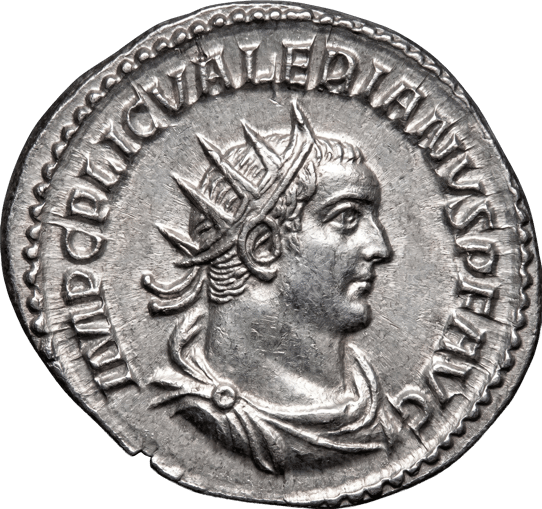


Silver Antoninianus Emperor Valerian I (253-260 AD | Emperor in Persian Captivity)













- Historic Era: money from the imperial crisis
- Genuine Original: around 1,700 years old
- Emperor's Portrait: with radiate crown
- Historic EraIssued in the years leading up to the Battle of Edessa
- Genuine OriginalCurrency hand-struck with die and hammer
- Emperor's PortraitArmored bust encircled by the Latin inscription
 Price alert
  Share
ShareAncient original
Crisis of the third centuryAntoninianus of Valerian I
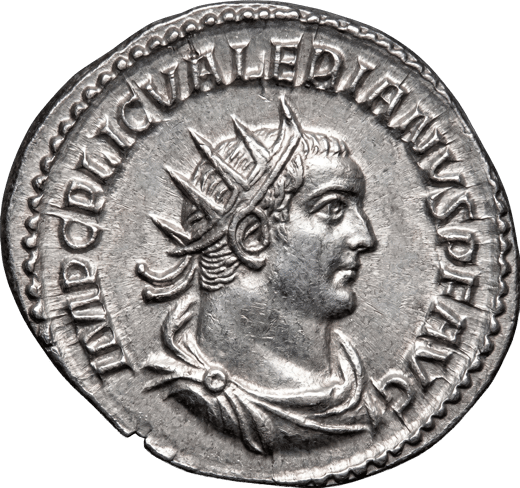
You are looking at the front.
Between the day someone struck this piece with a single hammer blow and the day you hold it, there are roughly
1,750years
- Struck by hand
- Original, not a restrike
- 21-23 mm across
- 30 days return policy
Where it belongs
Eleven epochs, a thousand years, one shelf.
In fifty years more than twenty men held the imperial title and most of them died violently. At the same time the money collapsed: the antoninianus began as a double denarius with decent silver and ended as a bronze piece with a thin silver wash. Hold a coin from these decades and you are holding an inflation.
7th to 5th century BC
Archaic Greece
5th to 4th century BC
Classical Greece
6th century to 330 BC
Achaemenid Persia
5th to 2nd century BC
Carthage
336 to 30 BC
The hellenistic age
3rd to 1st century BC
Celtic tribes
27 BC to AD 235
The Roman empire
AD 235 to 284
Crisis of the third century
Your piece
AD 284 to 313
The tetrarchy
AD 306 to 363
The Constantinian dynasty
AD 395 to 1453
The eastern Roman empire
Keeping it
First things first: do not clean it.
The dark layer on bronze and the matte grey on silver are called patina. It has grown over centuries and collectors treat it as a mark of authenticity. Polishing it away does not give you a nicer piece, it gives you a damaged one: auction houses regularly value a brightly cleaned coin below the same coin with its patina intact.
Hold it by the edge
Fingerprints contain acid and salt. Take the piece between thumb and forefinger by the rim, over a soft surface.
Store it dry and dark
Moisture is the only real enemy. A pouch or a capsule in a dry place is enough; PVC sleeves are not, they attack the surface.
No agents, no brush
No vinegar, no silver cloth, no ultrasound. If you want a crust removed, let a conservator do it, not the kitchen sink.
Silver Antoninianus of Valerian I – when the Emperor of Rome became a prisoner
Hardly any ancient coin tells a more dramatic story than the antoninianus of Publius Licinius Valerianus. Here you receive an original means of payment that once circulated in the Roman Empire, made of silver – minted between 253 and 260 AD, in an era when the Empire was reeling on every front. Approximately 3.47 g raw weight, 21–23 mm in diameter, struck by hand with die and hammer. And a portrait depicting the only Roman emperor ever to fall alive into the hands of a foreign enemy.
The Antoninianus: leading coin of a shaken world power
The antoninianus was introduced around 214/215 AD under Caracalla. His actual name – Marcus Aurelius Antoninus – gave the coin its now-common designation; the ancient name has not survived. Nominally the piece was valued at two denarii, but based on its silver fineness it corresponded from the outset to only about one and a half. Its distinguishing feature is the radiate crown on the emperor's head, the ancient signal for a double denomination.
In the 3rd century the antoninianus rose to become the most widely minted coin of the Roman imperial era – and at the same time became a mirror of galloping inflation. The silver content of imperial coinage fell between 194 and 260 AD from nearly 50 percent to under ten percent. Around 258, the silver content in the coinage of Valerian and his son Gallienus declined particularly sharply; many pieces show a visibly high copper content. This is precisely why the fineness here is variable and cannot be pinned to a single figure. A numismatic fingerprint of the crisis – not a flaw, but part of the story.
Key facts at a glance
- Face value: Antoninianus
- Precious metal: Silver, fineness variable (ancient alloy)
- Raw weight: approx. 3.47 g
- Diameter: 21–23 mm
- Issuing authority: Valerian I (253–260 AD)
- Country / country of origin: Roman Empire
- Year of issue & mint: variable – attested mints include Rome, Antioch on the Orontes, and Samosata
- Condition: circulated coinage, grade of preservation variable
- Series: History
- Shipping: as insured value shipment
Obverse and reverse: propaganda in silver
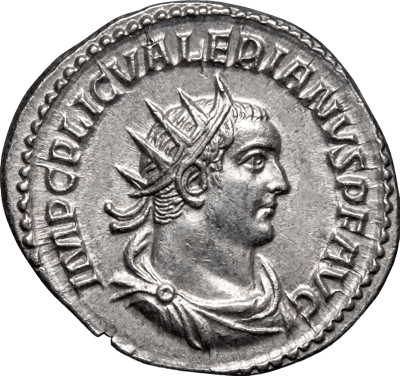
The obverse shows the draped and cuirassed bust of Valerian facing right, crowned with the radiate crown. The legend, in its classic form, reads IMP C P LIC VALERIANVS P F AVG – Imperator Caesar Publius Licinius Valerianus Pius Felix Augustus, "the Pious, the Fortunate." A title that invoked piety and fortune, while the Empire burned at its edges.
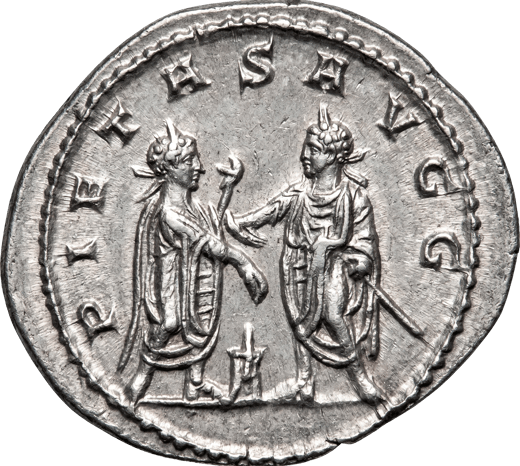
On the reverse we frequently encounter the type PIETAS AVGG: Valerian and his co-emperor Gallienus face each other, jointly making a sacrifice at an altar. The doubled ending "AVGG" stands for two Augusti – the message to the army and the provinces was unambiguous: the imperial house is united, and the gods stand by Rome. Other reverses from the same reign show Sol with the legend ORIENS AVGG, Apollo with the lyre, Annona, or Fides Militum. Which variant ends up in your coin collection is part of the appeal.
Edessa 260 – the event that shook the ancient world
Valerian came to power in 253 through the legions, elevated Gallienus to co-emperor with equal rank, and divided responsibilities regionally: the son took the West, the father the East. There, the Sassanid Empire under the Great King Shapur I had risen as an opponent openly challenging Rome's claim to world dominion. The Syrian metropolis of Antioch had already been plundered. In early summer 260, Valerian marched with an army reportedly 70,000 strong into the plain between Carrhae and the city of Edessa in northern Mesopotamia. The Persian armored cavalry crushed the Roman force – and the emperor himself was taken captive.
It remained the only instance in Roman history in which a reigning emperor fell alive into the hands of a foreign enemy. Shapur had the triumph carved in stone: on the rock relief of Naqsh-e Rustam near Persepolis, the wearer of the purple kneels before the King of Kings.
Valerian died in Persian captivity, and Gallienus assumed sole rule. Whoever holds such an antoninianus today holds money from precisely those years – issued to instill confidence that events had long since overtaken. Contemporary history you can hold in your hand, and at a fraction of what a comparable gold aureus commands.
Preservation: circulated money with character
These pieces are circulated means of payment and bear corresponding traces: darker patina, individual centering, nicks, wear, and in some cases weaker portions of the legend. This is exactly what gives them their appeal. Since the year of issue, mint, and reverse variant may vary, the delivered specimen will differ from the illustration – you receive an original, not a mass-produced item. We therefore ask for your understanding that the image in the shop serves as an example and may individually differ from the delivered item in terms of appearance and condition due to historical circumstances.
Why ancient silver coins belong in every collection
Silver has been a coinage metal, medium of trade, and store of value for millennia – the antoninianus is a particularly eloquent testament to this. Anyone thinking in terms of silver coins also values the white metal for its tangible properties:
- Tangible asset instead of a promise: Unlike fiat money, which depends on trust in institutions, silver possesses intrinsic value derived from its physical properties.
- Industrial demand: Electronics, solar, and medical technology all require silver – amid limited availability and limited supply.
- Divisibility and liquidity: Silver can be exchanged in small units and is traded worldwide as a commodity.
- Durability: An antoninianus roughly 1,700 years old vividly demonstrates just how enduring this metal is.
- Well-known inflation hedge: In times of dwindling purchasing power, precious metals traditionally come into focus.
- Substance for crisis protection: Physical goods that you own – not merely a bookkeeping entry.
For tax purposes, the following applies to physical silver in Germany: profits from sale are generally tax-free, provided a minimum holding period of one year is observed. And as with gold – humanity's oldest currency, which has outlived all others – the idea of preserving value across generations also takes center stage with silver.
Antoninianus, denarius, or modern bullion coin?
A comparison is worthwhile. The older denarius, such as one from Septimius Severus, has a finer silver content and is usually more sharply struck, but in good condition costs considerably more. The later follis from the time of Diocletian – the coinage reform that replaced the antoninianus at the end of the 3rd century – is larger, but only silver-plated. And modern bullion issues, with 999 fine silver, offer the clear weight calculation that an ancient piece naturally lacks.
Valerian's antoninianus plays in a league of its own: genuine silver content, a historical moment of world significance, and a rarity that no mint can ever replenish. An ideal entry point into the numismatics of the soldier emperors – and a collector's item whose story never grows old in the telling.
Product depiction may differ from the final product.
