





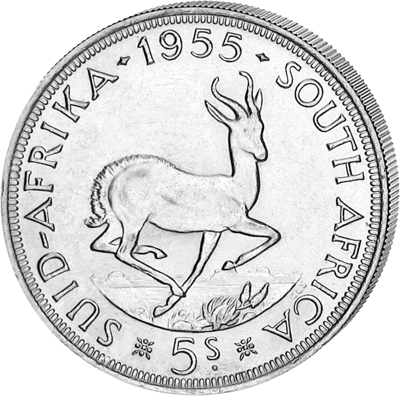


5 Shilling Silver Springbok 1958 (Legendary Springbok of the Krugerrand | First Portrait of Elizabeth II.)











- Original Design: by Coert Steynberg
- Young Queen: with laurel wreath
- Genuine Original: from circulation
- Original DesignMinted since 1947, twenty years before the Krugerrand
- Young QueenMary Gillick's early portrait is popular among collectors
- Genuine OriginalMinted in Pretoria, valid as legal tender until 1961
 Price alert set
 share
shareThe Original Springbok: 5 Shilling South Africa with Queen Elizabeth II
Long before the Springbok travelled the world on the Krugerrand in 1967, it could already be seen on a stately Crown made of silver. This is exactly the coin we are offering you here. The South African 5-shilling coin bears the Springbok on the reverse and the youthful portrait of Queen Elizabeth II on the obverse. Its history extends far beyond South Africa. Anyone collecting historic silver coins gains an important piece for their collection with this one. Anyone who loves the Krugerrand should almost certainly own it.
Why? This silver coin doesn't just show a similar animal. It is the very same design.
Coert Steynberg and the Birth of an Icon
The South African sculptor Coert Laurens Steynberg (1905–1982) designed the Springbok in 1946/47 for a new 5-shilling coin. It first appeared in 1947, at that time still bearing the effigy of King George VI. Steynberg sketched the animal in several leaping poses. In the end, he chose the "pronking" Springbok: stiff legs, arched back, caught mid-display leap. To this day, his initials "CLS" appear in the lower right field. Above, the bilingual legend "SUID-AFRIKA" and "SOUTH AFRICA" runs around the date, while below the face value "5S" is shown.
The design was used again and again afterwards:
- from 1947 on the silver 5-shilling Crown (until 1952 with George VI, from 1953 with Elizabeth II)
- 1952–1960 on the gold coins of ½ Pound and 1 Pound
- 1961–1983 on the gold coins of 1 Rand and 2 Rand
- since 1967 on the Krugerrand in gold, and since 2017 also on the silver Krugerrand
In 1967, South Africa launched a bullion coin for its gold. For this, Steynberg's proven Springbok was used, which was already twenty years old at the time. What was new was mainly the addition of the legend "KRUGERRAND". So on your 5-shilling coin, you see exactly the Springbok that later became the emblematic animal of what is probably the world's most famous bullion coin.
A small irony of history: Coert Steynberg also created the famous statue of President Paul Kruger at the entrance to Kruger National Park. So he designed both the coin's namesake and its emblematic animal—just about twenty years apart.
The First Portrait of the Young Queen
George VI died in 1952. From 1953 onwards, the South African Crown showed Queen Elizabeth II for the first time. The portrait was created by the British sculptor Mary Gillick. She also designed the Queen's first official coin portrait for Great Britain. The young Queen wears a laurel wreath in her hair. The legend simply reads "ELIZABETH II REGINA", with the initials "M.G." placed at the base of the neck. The later, more mature portraits only came years afterwards. This early, almost girlish depiction is therefore very popular among collectors.
This era did not last long. With the introduction of the Rand, the 5-shilling coin lost its status as legal tender on 31 March 1961. The Springbok Crowns bearing the Gillick portrait were minted at the Pretoria Mint from 1953 to 1959. In 1960, only a commemorative coin with a different design was issued.
Technical Details at a Glance
- Country: South Africa (Union of South Africa)
- Face value: 5 Shilling
- Metal: Silver, fineness 500/1,000
- Gross weight: approx. 28.20 g (nominal weight per catalogue 28.28 g)
- Fine weight: approx. 14.10 g silver
- Diameter: approx. 38.6 mm (catalogue value)
- Obverse: Queen Elizabeth II, design by Mary Gillick
- Reverse: Springbok, design by Coert L. Steynberg
- Condition: circulated coin, condition varies
Condition: Traces That Tell Stories
These pieces are circulated coins, and it shows. Darker patina, individual centring, small nicks, wear, and in places softer, less distinct lettering: these are not flaws but biography. Every trace comes from hands that, decades ago, paid for goods, freight, or debts with these coins—perhaps at a market in Johannesburg, Cape Town, or Durban.
The year of issue and condition may vary, so the piece you receive may look different from the photo. Please understand the photo in the shop explicitly as a sample image. Appearance, exact weight, and condition differ from piece to piece for historical reasons. You are purchasing an original.
5 Shilling or Silver Krugerrand?
Anyone wishing to own the Springbok in silver today has two options. The modern silver Krugerrand contains one troy ounce of fine silver and comes fresh from the mint. The 5-shilling Crown contains less silver, at around 14 g. However, it offers something no new coin can: genuine history from circulation, and it is the origin of the design. The 1947 issue with George VI is made of 800 fine silver and is usually significantly more expensive. The Elizabeth Crown in 500 fine silver is easier to obtain, making it well suited for building a Springbok collection arranged by year over time.
Silver with Substance – For Collectors and Investors
For thousands of years, silver has served as coinage metal, medium of exchange, and symbol of wealth. Many cultures have used it as money. Paper money depends on trust in governments, whereas silver has its own intrinsic value. In addition, industry needs the metal for electronics, solar technology, and medical technology, and it is traded worldwide as a commodity. Many buyers therefore see silver as a tangible building block for inflation hedging and crisis protection. And as a value that can be passed on to children and grandchildren.
- Historic: original circulated coin from the era of the Union of South Africa
- Design history: the Springbok, with which the Krugerrand had its beginning
- Affordable: an inexpensive entry into genuine silver with history
- Tax advantage: in Germany, profits from the sale of silver are generally tax-free after a holding period of at least one year
A Springbok, a young Queen, and almost seven decades of history: with this 5-shilling coin from South Africa, you secure the beginning of a legend.
Product depiction may differ from the final product.
