






50 Kopecks Silver Blacksmith (1924-1927 | USSR | Hero of Labor)











- Powerful design: hammer and anvil
- Edge lettering: 9 g fine silver in the edge
- Historic survivor: escaped the melt
- Powerful designIndustry and agriculture united in one image
- Edge letteringThe silver content is stamped directly into the coin's edge
- Historic survivorMany pieces were melted down in the 1930s
 Price alert set
 share
shareA Poltinnik forged in the young Soviet Union
A man, a hammer, an anvil. And a shower of sparks that almost seems to leap out of the coin's round. Hardly any design from the early Soviet era feels as powerful as the blacksmith on the 50 Kopecks of 1924–1927. On the coat-of-arms side stands the official face value "ОДИН ПОЛТИННИК", meaning "one poltinnik", or half a ruble. The coin was struck in silver at the classic fineness of 900/1,000. With a gross weight of 10 g, each piece contains 9 g of fine silver. If you are looking for historical silver coins with a genuine story, here you hold an original from the founding era of the USSR in your hand.
Hero of Labour: The design
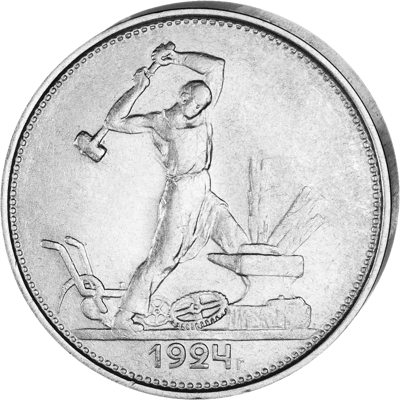
The obverse shows a worker swinging his heavy hammer high above his head. Before him stands the anvil, above which the sparks of the final blow scatter. On the ground lie a plough, a gear wheel, and finished workpieces. Industry and agriculture are united here in a single image. Below is the year of minting, with the Cyrillic "г" for "год" (year). The scene feels so alive it's as if one had glimpsed a workshop of the 1920s for a single moment. The engraver is believed to be the Leningrad medallist Anton Vasyutinsky.
The reverse displays the state emblem of the Soviet Union: a hammer and sickle over the globe, framed by bundles of wheat ears and crowned with a star. To the left and right are the letters СС and СР, together forming СССР. Below that follows the value. Around the rim runs the famous slogan "ПРОЛЕТАРИИ ВСЕХ СТРАН, СОЕДИНЯЙТЕСЬ!", in English: "Workers of all countries, unite!"
The edge inscription states the fineness
One detail delights numismatists in particular: the silver content is struck directly into the edge of the coin. There it reads "ЧИСТОГО СЕРЕБРА 9 ГРАММ", meaning "pure silver 9 grams". On early pieces, this is followed additionally by the old Russian weight measurement in solotnik and dolya. The initials of the mint master complete the inscription. П•Л stands for Pyotr Latyshev in Leningrad, while Т•Р marks the pieces from 1924 that were struck in Great Britain.
Struck for a stable currency
Russia has known the poltinnik for centuries. As early as under Peter the Great, the half ruble was struck in silver from 1699 onward. The Soviet issue emerged during the final phase of the currency reform of the 1920s. The new ruble was meant to regain public trust. And what inspires more confidence than genuine precious metal in hand?
The coins therefore followed exactly the standard of the tsarist 50 kopecks, with the same weight and the same fineness. The Leningrad Mint could barely keep up with the enormous demand. A large part of the 1924 mintage was therefore struck in Great Britain, commonly attributed to Birmingham. Across all four years, around 150 million pieces were produced in total. In the 1930s, many specimens were withdrawn from circulation and melted down. Anyone who owns a poltinnik today therefore holds a piece that has survived this era.
- Face value: 50 Kopecks (1 Poltinnik)
- Material: Silver, fineness 900/1,000
- Gross weight: 10.00 g
- Fine weight: 9.00 g
- Diameter: 26.60 mm
- Years of issue: 1924, 1925, 1926 or 1927 (year of issue cannot be selected)
- Edge initials: П•Л (Leningrad) or Т•Р (British minting, 1924)
- Condition: circulated coin (used), condition varies
Condition: Traces that tell a story
These pieces are circulated coins, and it shows. Darker patina, individual centring, small nicks, wear, and in places weaker areas of the legend are not flaws but biography. Every trace comes from people who, roughly a century ago, used these coins to pay for goods, freight, or debts.
Year of issue, mint, and reverse variant may vary. The item delivered may therefore differ from the picture shown. Please understand the photo in the shop explicitly as a sample image: appearance, exact weight, and condition differ from piece to piece for historical reasons. You are purchasing an original.
The blacksmith in comparison
The tsarist 50 kopecks bearing the portrait of Nicholas II have the same metal values as the Blacksmith Poltinnik. However, they tell a completely different chapter of Russian history. The 1924 silver ruble contains double the amount of silver and depicts a worker and a farmer. Those who prefer collecting in small denominations will find more flexibility with the poltinnik. A run of years from 1924 to 1927, including both edge initials, is also a rewarding collecting goal.
- Advantage: a genuine document of its era with a striking design and a clearly stated fine silver content
- Advantage: small denomination, ideal for entering Soviet numismatics
- To note: the 900 alloy contains less fine silver per gram than modern bullion coins with 999 fineness.
- To note: each specimen is unique; the exact appearance cannot be selected in advance.
Precious metal with substance
Silver has served as money for centuries and has never lost its intrinsic value. Unlike paper money, it requires no promise from any government. Industry needs the white metal for electronics, solar technology, and medical technology, yet supply remains limited. Many investors therefore value silver as an inflation hedge and as tangible crisis protection for turbulent times. Small denominations such as the poltinnik are also well suited as a means of exchange for smaller amounts.
Good to know: In Germany, profits from the sale of physical silver are generally tax-free after a holding period of at least one year.
Whether as a collector's item, a gift with history, or a keepsake for the next generation: the 50-Kopeck Blacksmith combines precious metal, the art of coinage, and world history in a single piece of silver.
Product depiction may differ from the final product.
