 280,000
  30 years
  Secure




Silver Denier Crusader State Antioch (1162-1232 | Age of the Crusades)


Unfortunately, this item is currently out of stock. We will be happy to send you an e-mail as soon as this product becomes available again.
 Collector coin: Especially interesting for collectors
- Secure shipping: 100% insured & anonymous delivery
- Kettner Bullion: Already over 280,000 satisfied customers
 Price alert set
 share
shareSilver Denier from Antioch: hand-struck original from the era of the Crusades
Some coins are simply beautiful. This one is something else – it is a witness to history. The silver denier of the crusader state of Antioch was struck between 1162 and 1232 in the Principality of Antioch, right in the heart of the Holy Land, in an era that interlinked Europe and the Orient for almost two centuries. Whoever holds this piece in their hand is not holding a modern commemorative product, but genuine money from the High Middle Ages: small, irregular, bearing the traces of a long life.
The technical data at a glance
- Face value: Denier (Denar)
- Material: Silver – billon, i.e. a silver alloy; fineness varies
- Gross weight: approx. 0.83 g
- Diameter: approx. 17 mm
- Issuing authority: Principality of Antioch, Antioch-on-the-Orontes mint
- Year of issue: varies, from the period 1162–1232
- Production: hammer-struck on a hand-made flan
- Condition: varies, circulated coin (used)
- Delivery: in a case, shipped as insured shipping
Because the fineness of medieval deniers varied depending on the minting period and mint master, it is deliberately listed here as "varies". This is not a lack of precision, but historical reality: billon was the working metal of the region, robust enough for daily circulation.
Norman helmet and cross: the coin design in detail
In numismatics, this type carries its own name – helmet denier. It is regarded as the most famous coin of the Crusaders of all.
Obverse
A prince's head in a pointed Norman helmet with chainmail coif faces left. In front of the face is a crescent moon, behind the head a star. The legend reads BOAMVNDVS, naming Prince Bohemond: Bohemond III, called the Stammerer, ruled from 1163 to 1201, his son Bohemond IV the One-Eyed continued the type until 1233. The lettering consists of coarse majuscules struck into the die with wedge-shaped punches – letters that almost resemble cuneiform script, yet are still reliably legible to a trained eye.
Reverse
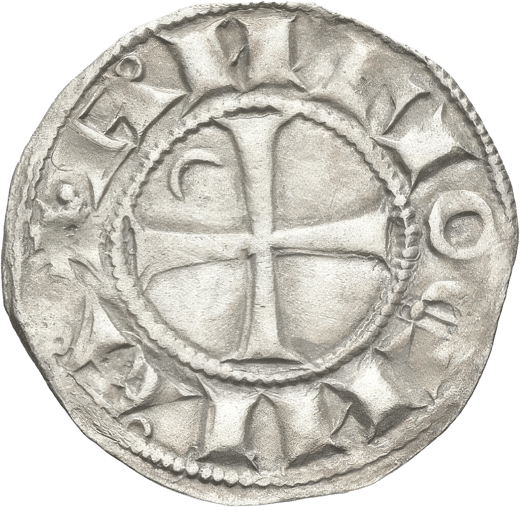
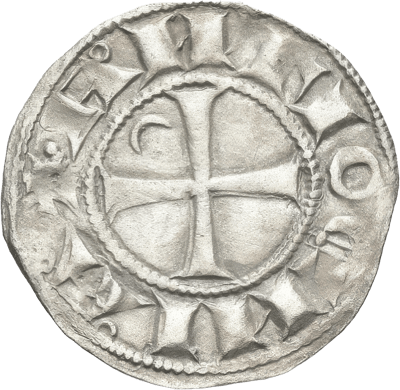
At the centre sits a bold, equal-armed cross with paw-like flared ends, framed by a raised beaded circle. It divides the field into four angles; in the second angle lies a small crescent moon opening downward as a mint mark. Around it runs the legend ANTIOCHIA, interrupted by annulets and pellets. Cross and crescent on a single coin – hardly any image captures this era more fittingly.
Antioch: a principality between two worlds
Antioch on the Orontes, today's Antakya in Turkey, fell to the army of the First Crusade in 1098 after a months-long siege. Bohemond of Taranto, a Norman prince's son from southern Italy, made the city the centre of his own state. Alongside the Kingdom of Jerusalem, the County of Edessa, and the County of Tripoli, Antioch was thus one of the four great crusader states of the Levant. The principality survived until 1268, when the Mamluks under Sultan Baibars ended its history.
In the years in between, the city was a trading hub of the first order. Genoese merchants, Armenian traders, Byzantine officials, Syrian farmers, knights, and pilgrims – all of them needed small change. That is precisely what these deniers were struck for: no splendour, but working money for markets, tolls, mercenary pay, and church dues.
Condition: circulated coin with a biography
These pieces are circulated coins – and they look the part. Darker patina, individual centring, small nicks, wear, and in places weaker-struck sections of the legend: these are not flaws, but biography. Every trace comes from hands that, centuries ago, used it to settle goods, cargo, or debts.
Since the year of minting, the mint, and the reverse variant can vary, the piece delivered may differ from the image shown. Please understand the photo in the shop expressly as a sample image: appearance, exact weight, and condition vary from piece to piece for historical reasons. You are purchasing an original.
A hand-struck flan is never exactly round, never perfectly centred, never identical twice. Therein lies precisely the appeal of medieval numismatics.
Why silver convinces as a tangible asset
Silver has accompanied mankind as a monetary metal for thousands of years, and this denier is tangible proof of that. The metal is durable, tradable worldwide as a commodity, and retains its physical properties over centuries – unlike any paper currency, which relies solely on trust in governments. Add to that the real industrial demand from electronics, solar, and medical technology, coupled with limited supply.
Historic silver coins combine two levels: the material value of the precious metal and the collector's value of history. As a tangible asset in one's own hands, they serve many people as an inflation hedge and as a building block for crisis protection. From a tax perspective: profits from the sale of silver are generally tax-free, provided the minimum holding period of one year is observed. And whatever once travelled through Antioch as a denier can today be passed on to the next generation just as easily.
In comparison: crusader denier or modern bullion coin?
- Compared to modern bullion coins such as the Maple Leaf or Vienna Philharmonic, the denier does not score through fine weight, but through age, rarity, and storytelling power. Its price follows collector demand far more than the silver price.
- Compared to modern-era talers and crowns, the Antioch denier is significantly smaller and lighter – but around 300 to 600 years older and far harder to obtain in Central Europe.
- Compared to Roman denarii, it represents an entirely different world: not an emperor's portrait and antiquity, but a knight's helmet, a cross, and the Holy Land.
Who this piece is intended for
For collectors of medieval coins who wish to expand their collection with a genuine crusader state piece. For history enthusiasts who prefer to hold an era in their hand rather than merely read about it. And for anyone who wants to show a child or grandchild what money actually looked like around 800 years ago. Delivered in a case and shipped as insured shipping, this denier is at the same time an extraordinary gift with substance.
Product depiction may differ from the final product.