


Sold out

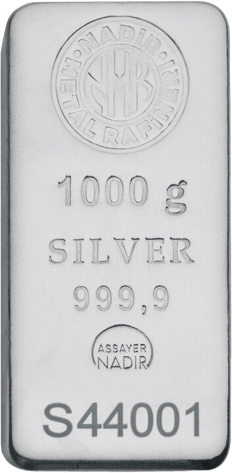
1 kg Silver Bar Nadir
€2,240.25
incl. VAT and excl. shipping
currently not available
 +49 7930-2699

 More than 300,000
 Over 30 years
 Secure shipping
 Google: 4.9/5
Behind the brand name Nadir stands Nadir Metal Rafineri from Istanbul: the only Turkish silver refinery listed on the Good Delivery List of the London Bullion Market Association. The silver bars from this manufacturer are considered affordable, bank-grade investment products with a fineness of up to 999.9/1,000. This guide examines the refiner's origin and certification, the available denominations, authenticity features, the tax treatment of silver, and proper storage, and places Nadir bars within the broader range of precious metal investment products.
Nadir Metal Rafineri was founded in 1967 in Istanbul and began refining precious metals in 1975. In 1996, the company opened Turkey's first gold refinery. Since 2006 the refiner has operated as a joint-stock company and, with an annual capacity of around 200 to 250 tonnes of silver, now ranks among the country's largest precious metal processors. At its Istanbul site, the company carries out refining, recycling, laboratory analysis, as well as production and trading of gold, silver, platinum, palladium and rhodium.
In the Kettner range, Nadir is listed under the category Münze Österreich AG, as many European minting and trading partners carry bars from various accredited refineries together. The investment products of the house appear under the brand NadirGold and range from small denominations up to kilo bars. Anyone wishing to compare the full spectrum of cast and minted bars will find the complete selection sorted by weight in the overarching category silver bars.
What is decisive for a bar's bank-grade status is the manufacturer's inclusion on the Good Delivery List of the London Bullion Market Association (LBMA). Nadir received LBMA accreditation for gold in 2011 and, from 2012, also for silver, making it the only Turkish silver refinery to do so to date. This is complemented by approvals from the Singapore Bullion Market Association as well as status as an Approved Brand on COMEX. This international recognition means that Nadir bars can be traded and resold worldwide without the need for renewed authenticity verification, a practical advantage over bars from unlisted manufacturers.
Nadir silver bars are available in a wide range of weights. Smaller units are usually minted and delivered in an airtight blister card, while larger units are cast and packaged in protective film with an enclosed certificate. The common formats at a glance:
As a rule of thumb: the larger the bar, the lower the price per gram of fine silver, as manufacturing costs are spread across more material. Smaller denominations, in turn, offer greater flexibility for later partial resale. Anyone looking for the largest possible format can best compare kilo bars directly in the category 1 kg silver bars; more manageable units can be found under 100 g silver bars.
A cast bar is produced by pouring liquid fine silver into a mould; it appears more rustic and has a slightly irregular surface. A minted bar is punched from a rolled blank and shows sharp contours, smooth surfaces and a clear minted design. Both variants contain the same fine silver; the choice is primarily a matter of appearance, format and premium. A more detailed comparison with minted bars and coin bars is available in the section minted bars.
Every Nadir silver bar carries several security and identification features that allow for clear identification. On the obverse are the stylised NMR mark, the name Nadir Metal Rafineri, the weight indication and the fineness. In addition, there is an individual serial number, which makes each piece uniquely identifiable and is documented by an accompanying certificate.
For additional verification in the trade, physical methods such as determining weight and dimensions, ultrasonic time-of-flight measurement or conductivity testing are used. Kettner Edelmetalle relies on an ISO-compliant authenticity verification, so the declared purity is reliably confirmed. Anyone wishing to keep bars in their original condition over the long term should not open the packaging; suitable protective material can be found in the section coin capsules.
Unlike investment gold, which is exempt from VAT in Germany, silver bars are generally subject to VAT. When purchased through a dealer, the margin scheme is often applied, whereby tax is levied only on the dealer's margin rather than on the full value of the goods, which lowers the effective surcharge compared with standard taxation.
Tax note
For private sales of physical silver, a one-year speculation period applies: if a bar is held for longer than twelve months, any profit from the sale is, under current law, tax-free. This does not constitute tax advice; the individual situation and the applicable regulations in each case are decisive.
Anyone wishing to factor tax aspects into their allocation often compares physical silver with VAT-exempt gold investments. An overview of the investment gold range is provided by the category gold bars, while silver bullion coins presents margin-scheme-taxed coin alternatives.
Silver reacts more sensitively to environmental influences than gold and can tarnish when exposed to air and moisture. Proper storage therefore preserves not only the value but also the visual appearance. In principle, three options are available:
Since large quantities of silver take up considerable volume, value density plays a role: a kilo bar concentrates significantly more material in a small space than numerous small bars. For the orderly storage of several units, storage solutions from the range of coin cases and capsule safes are suitable. The original packaging should remain as untouched as possible.
Silver is in demand both as an investment metal and as an industrial raw material, which tends to make its price fluctuate more strongly than that of gold. This higher volatility opens up opportunities but also brings greater price swings. Bars are particularly suited to investors who wish to hold physical precious metal as a long-term tangible asset and for diversification alongside other asset classes.
A bar carries no year of issue and no collector's design; its value is derived solely from the weight and fineness of the precious metal it contains.
Compared with collector's and bullion coins, bars score with a lean premium, since neither a minted design nor a mintage limit factors into the price. Anyone who, on the other hand, values designed motifs and international recognition should compare the offering with classic bullion coins such as the Vienna Philharmonic or the Maple Leaf. A combination of bars and coins spreads the premium across different product types. Anyone who saves regularly will find suitable approaches in the section savings plan products.
Before purchasing, it is worth considering a few points that affect long-term resale value:
Kettner Edelmetalle delivers all precious metals 100% insured from a German high-security logistics centre. Anyone wishing to compare the Turkish refiner's range with bars from other renowned manufacturers will find further LBMA-accredited producers, for instance, under Heraeus or Argor Heraeus.
Nadir is the brand of Nadir Metal Rafineri, a precious metal refinery founded in Istanbul in 1967. It is the only Turkish silver refinery on the LBMA's Good Delivery List and processes around 200 to 250 tonnes of silver annually.
Depending on the denomination, the fineness is 999/1,000 or 999.9/1,000 silver. The kilo bar is typically listed at 999.9, while smaller minted units are often listed at 999.
Yes. Since Nadir Metal Rafineri has been LBMA-accredited for silver since 2012, the bars qualify as Good Delivery and can be traded internationally without renewed authenticity verification. An intact original packaging with serial number and certificate is an advantage in this regard.
Unlike investment gold, silver bars are subject to VAT, often in the form of the margin scheme. For private sales after a holding period of more than twelve months, any profit is, under current law, tax-free. This does not constitute tax advice.
In terms of price per gram of fine silver, the 1 kg bar is the most cost-effective, as manufacturing costs are spread across a large quantity of material. Smaller formats carry a higher premium but offer more flexibility for later partial resale.
A dry, closed storage in the original packaging is recommended to prevent tarnishing. Options include home storage in a safe, a bank safe deposit box, or external custody. Coin cases and capsule safes additionally provide organised protection.
Stay informed with product launches, financial news and exclusive offers. Sign up for our free newsletter today.
By entering your email address and clicking the "Submit" button, you give the following consent: "I agree to be informed by email about new products, financial news and exclusive offers, and therefore consent to the processing of my email address for the purpose of sending the newsletter. I can revoke this consent at any time without giving reasons, with effect for the future. The lawfulness of processing carried out prior to revocation remains unaffected."
