





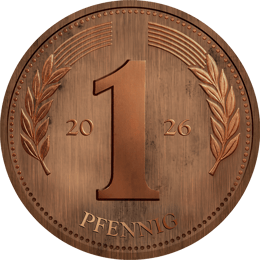


5 oz Copper Pfennig 2026 (Mintage: 1,000 | Antique Finish)













- Iconic design: a piece of coin history
- One of a kind: warm glowing relief
- Guaranteed genuine: with certificate
- Iconic designAdolf Jäger's 1948 design has passed through millions of hands
- One of a kindNo two pieces are alike due to natural ageing
- Guaranteed genuineOfficially issued by the Republic of Liberia with 1 dollar face value
 Price alert
  Share
Share5 oz Copper Pfennig 2026 – Cult Classic in Antique Finish, Strictly Limited to 1,000 Pieces
Strictly limited: Only 1,000 pieces of this copper coin are being issued worldwide – an exceptionally small collector's mintage.
Growth potential: The strict limitation and the sustained high demand for German nostalgia designs create an exciting appreciation potential.
A true rarity: A collector's issue for enthusiasts seeking designs with history, character, and a tiny mintage.
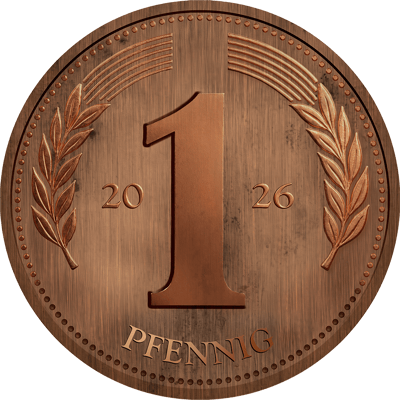
Design: The legendary German 1 Pfennig – the large value numeral "1" with the inscription "PFENNIG", framed by two ears of wheat, monumentally enlarged to 65 mm.
Antique Finish: Artificially aged surface with dark recesses and warmly glowing highlights – each piece a one-of-a-kind item.
Material: Five full ounces (155.52 g) of fine copper, fineness 999/1,000, reeded edge.
Manufacturer: Struck by various mints
Country of origin: Issued by the Republic of Liberia with a face value of 1 dollar.
Includes certificate of authenticity: Each piece is delivered with a certificate, shipped via insured value shipping.
Few coins have shaped everyday life in Germany quite like the humble Pfennig. It jingled in every pocket, made its way into piggy banks, was sought after, stacked, and given as gifts. This collector's coin brings back exactly that feeling – only in a dimension the original never had: 65 millimeters in diameter, five ounces of solid fine copper, and a very low mintage of just 1,000 pieces.
The Design: A Classic of German Coin History
Depicted is the value side of the original Pfennig: the bold numeral "1", below it the inscription "PFENNIG", flanked on the left and right by two ears of wheat, their awns opening upward into a fine radiant wreath. Encircling the design is a beaded border, familiar from historic small-denomination coins. The design comes from Frankfurt medalist Adolf Jäger, who in 1948 won the competition held by the Bank deutscher Länder to redesign the 1, 5, and 10 Pfennig coins. The obverse of the original featured the well-known oak branch with five leaves.
The historical model weighed exactly two grams and was made of copper-plated steel – pure copper would have exceeded the face value. This first Pfennig of the new currency was issued starting January 24, 1949, at that time bearing the inscription "BANK DEUTSCHER LÄNDER". The design remained in circulation until the introduction of the euro. The contrast could hardly be more striking: what once passed through millions of hands as the smallest denomination now appears here as a heavy five-ounce giant of solid fine copper.
Antique Finish: Patina with a Story to Tell
The Antique Finish is the real highlight of this issue. The surface is treated and artificially aged so that dark shading collects in the recesses while the raised areas take on a warm reddish glow. This gives the ears of wheat, the value numeral, and the beaded border tremendous depth. No two pieces are exactly alike – each one carries its own individual character, as if it had survived for decades in an old tin box.
Technical Specifications at a Glance
Material: Copper, fineness 999/1,000
Fine weight: 155.52 g (5 oz), gross weight 155.52 g
Diameter: 65.00 mm
Edge design: reeded
Face value: 1 dollar, Country: Liberia
Year of issue: 2026, Condition: brand new
Grade: Antique Finish, Purpose: collector's item
Mintage: 1,000 pieces, with certificate of authenticity
Copper Coins: A Tangible World of Design Diversity
Copper is the collector's metal with the greatest creative freedom. Because the metal is comparatively inexpensive, mints dare to use designs that are rarely found on gold coins or silver coins. In the USA, this has given rise to its own culture: countless copper rounds – essentially copper medallions – are produced there featuring Native American portraits, coats of arms, replicas of historic dollars, and purely imaginative designs.
This is exactly why copper is so well suited for beginners. Anyone wanting to experience the feel of a 65 mm strike for the first time, sense its weight in hand, and examine the sharpness of the relief in raking light will find an ideal entry point here. Most buyers of copper coins and copper bars are classic collectors who enjoy building their own collection – series by series, design by design. And anyone buying a new issue today often lays the foundation for an entire thematic collection.
A Pfennig was never worth much. As a keepsake, it is priceless – and in this quantity, simply hard to come by.
Comparison: Five Ounces of Copper Versus Other Collector's Issues
Compared to the 1 oz version of the same design, this format stands out above all for its presence: at 65 millimeters, it appears far more substantial in a display case, and the relief comes across in a much more three-dimensional way. Compared to common US copper rounds, which often appear in mintages of five or six figures, the mintage of just 1,000 pieces is nearly minuscule. The drawback is obvious: such an issue cannot be reordered, and those who hesitate will miss out. While 5 oz silver coins require significantly higher amounts, entry into the red metal remains pleasantly affordable – the appeal clearly lies in the design, format, and rarity.
Who This Rarity Is Suited For
For nostalgics, for enthusiasts of German coin history, for design collectors with an eye for detail – and for anyone specifically assembling rarities with small mintages. As a gift for birthdays or company anniversaries, the copper Pfennig also works wonderfully with a wink of humor. A practical tip: copper reacts to skin oils and humidity, so a capsule and gloves are worthwhile, and the coin should only ever be handled by its edge. This way, the characteristic Antique Finish stays exactly as the mint intended for years to come.
Product depiction may differ from the final product.
