


















From Dürer to the Blue Rider - German Painting in Gold Collection











- Eight Masterpieces: three great eras
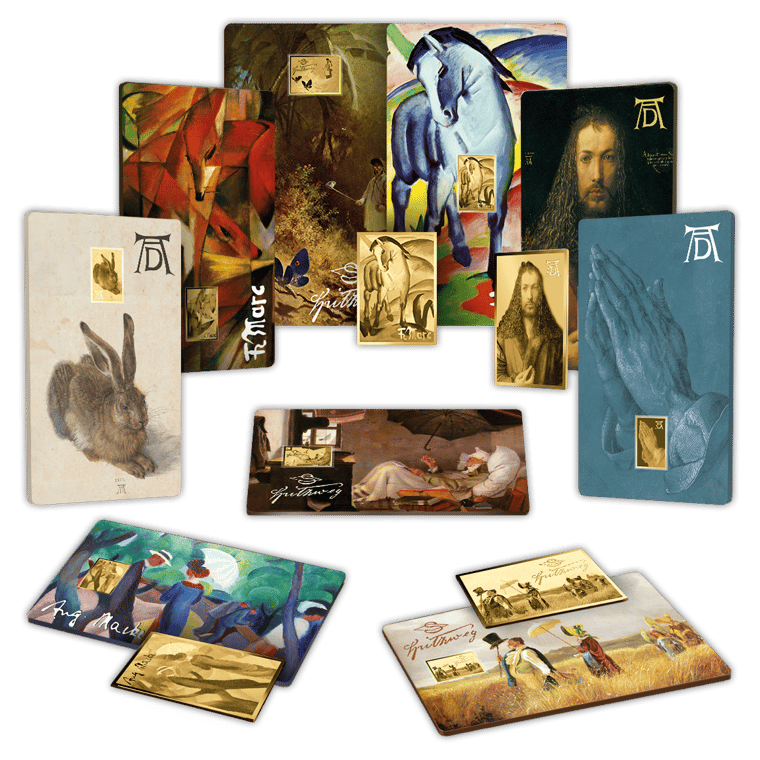
- Motif Cards: paintings in full color
- Fineness 999/1000: in every coin
- Eight MasterpiecesRenaissance, Biedermeier and Expressionism in one set
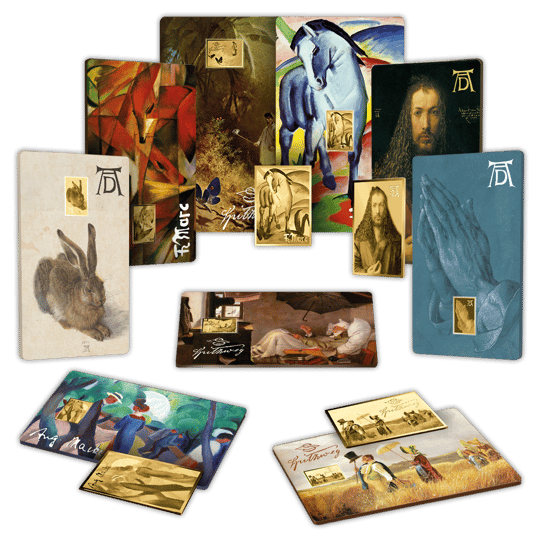
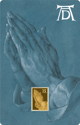
- Motif CardsEach coin framed by its painting in full color
- Fineness 999/1000All eight coins are made of pure fine gold
Total discount in this bundle
55,00 €
- 45,00 € discount on the included products
- 10,00 € promotional discount on the bundle
- 1 xGold Albrecht Dürer The Hare Coin (Mintage: 50,000)
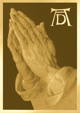
- 1 xGold Albrecht Dürer The Praying Hands Coin
- 1 xGold Albrecht Dürer Self-Portrait Coin
- 1 xGold Carl Spitzweg The Poor Poet Coin
- 1 xGold Carl Spitzweg The Butterfly Catcher Coin
- 1 xGold Carl Spitzweg Der Sonntagsspaziergang Coin
- 1 xGold Franz Marc The Foxes Coin
- 1 xGold August Macke Promenade Coin
- 1 xGold Franz Marc Blue Horse Coin
 Price alert set
 share
shareCurated collection
German painting
Motifs everyone recognises at a glance, struck in precious metal.
A collection usually takes years to grow. This one arrives complete.
9
pieces in this collection
Why as a collection
Put together, not hunted down.
Anyone collecting a subject one piece at a time buys whatever happens to be in stock. Older years, small mintages and strikes from other countries turn up later, or never again.
- One common thread
- The pieces were chosen for a subject, not for what happened to be available.
- A subject closed
- Instead of filling gaps over time, the subject stands whole from the first day.
- No hunting needed
- Gathering what lies together here one piece at a time costs time and attention over years.
What the additions in the name mean.
These terms appear in the article names of the collections. They describe how a coin was made.
- Proof
- The most elaborate way of striking. The die is polished, the field of the coin mirrors, the motif stands matt on top of it.
- Antique finish
- The finished strike is treated afterwards until it looks dark and uneven, like a piece that lay in the ground for a long time.
- High relief
- The motif stands noticeably higher above the field than usual. For that the coin passes through the press several times.
- Partial gilding
- A thin layer of gold is applied to parts of a silver coin so that single areas stand out.
Collecting usually takes years.
Here everything is together on day one.
Different mints, different years, different formats. Gathered one by one, that would be the work of many evenings.
- Pieces
- 9
- Fine weight
- 0.27 g
- Subject
- German painting
From Dürer to Der Blaue Reiter – four centuries of German painting in pure gold
A hare that seems to breathe. A poet freezing beneath an open umbrella. Foxes dissolving into glowing fields of colour. The collection "From Dürer to Der Blaue Reiter – German Painting in Gold" brings together eight masterpieces of German art history on eight gold coins made of 999 gold. Renaissance, Biedermeier, Expressionism: whoever holds this set in their hands walks, in a sense, through a museum – except that every exhibit is made of fine gold.
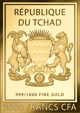
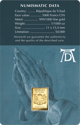
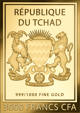
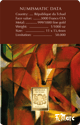
The issuing country of all coins is the Republic of Chad, with a face value of 3000 CFA francs each. Each individual gold coin weighs 1/1000 ounce, or roughly 0.03 g of fine gold with a fineness of 999/1000. Together this amounts to 0.24 g of pure gold, spread across eight rectangular coins measuring 11 x 15.4 mm. They are presented on large-format motif cards that display the respective original painting in full colour splendour and frame the small gold coin like a jewel.
Eight designs, three eras: what's inside the collection
Albrecht Dürer – the genius of the German Renaissance
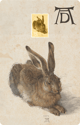
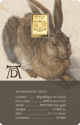
- Gold Albrecht Dürer Der Hase (The Hare) Coin: The watercolour "Young Hare" from 1502 is considered a milestone in the depiction of nature. Every hair, every whisker sits perfectly. The mintage of this gold coin is limited to 50,000 pieces.
- Gold Albrecht Dürer Die Betende Hände (Praying Hands) Coin: The famous study from 1508, drawn on blue-primed paper, remains to this day one of the most reproduced motifs in art history.
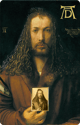
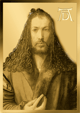
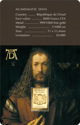
- Gold Albrecht Dürer Selbstbildnis (Self-Portrait) Coin: Dürer's frontal self-portrait from the year 1500 – self-assured, almost icon-like, and marked with his unmistakable AD monogram.
Carl Spitzweg – the endearing chronicler of the Biedermeier era
- Gold Carl Spitzweg Der Arme Poet (The Poor Poet) Coin: The 1839 painting depicting the poet in his draughty garret is one of the most beloved images among Germans of all time.
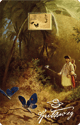
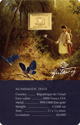
- Gold Carl Spitzweg Der Schmetterlingsfänger (The Butterfly Hunter) Coin: A collector with a net in a lush, almost tropical thicket, created around 1840 – full of subtle, tongue-in-cheek irony.
- Gold Carl Spitzweg Der Sonntagsspaziergang (The Sunday Walk) Coin: A middle-class family strolling through a summer cornfield, the father leading the way in a top hat. Painted in 1841.
Der Blaue Reiter – the dawn of Modernism
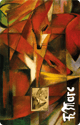
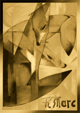
- Gold Franz Marc The Foxes Coin: "The Foxes" from 1913, a key work by the co-founder of the artist group "Der Blaue Reiter". Cubist-interlocked animal bodies in red, orange and yellow.
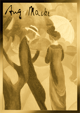
- Gold August Macke Promenade Coin: Macke's park scene from the same year, 1913 – rich green tones, strolling figures, pure joie de vivre in colour.
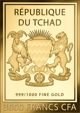
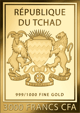
On the reverse, every coin bears the state emblem of Chad, flanked by an ibex and a lion, along with the inscriptions "REPUBLIQUE DU TCHAD", "999/1000 FINE GOLD" and "3000 FRANCS CFA". Several designs in the series, including Spitzweg's Poet, Marc's Foxes and Macke's Promenade, come from the renowned Swiss mint Valcambi.
Artistic pleasure with substance: why gold in particular?
As fascinating as this historical selection of designs may be – the true foundation is the metal itself. Gold is humanity's oldest currency. It has outlasted kingdoms, paper currencies and entire monetary systems, and its lustre is as coveted today as it was thousands of years ago. Whoever owns gold holds a real tangible asset in their hands. Not a figure on a bank statement, but precious metal.
- Value preservation: Physical gold has been regarded as a reliable store of value for thousands of years.
- Inflation and crisis protection: A tangible asset, independent of banks and money printing.
- Flexibility: Eight individual coins can be stored separately, given as gifts, or passed on as a keepsake for special occasions.
- Collector's appeal: Limited mintages and world-famous designs make the "Art & Culture" series especially attractive to collectors.
Set or individual coin? An honest comparison
Of course, it is possible to purchase each of these gold coins individually. However, the collection has a clear advantage: it tells a story. From Dürer's Nuremberg workshop to the colour experiments of Marc and Macke, an arc spans roughly 400 years of German painting – complete, coherent, and ready for the display case straight away.
Anyone looking purely for the maximum amount of fine gold per gram is better served by larger gold coins or bars; with miniature coins like these, the design, craftsmanship and joy of collecting take centre stage. That is exactly where their charm lies. Those who prefer to collect art motifs in a larger format and with more metal weight will find an appealing complement in silver coins. For anyone starting out in the world of precious metals, or as a gift with depth, this gold set is hard to beat.
Great art does not fade. Neither does gold. In this collection, the two meet – preserving a piece of German cultural history in its most enduring form.
Note on condition and design
Since this is a bundle of eight independent coins, the year of issue, packaging and condition may vary depending on the design. The exact condition of each coin is described in detail in the respective individual product listings – worth a look for anyone wishing to document their collection down to the last detail.
Product depiction may differ from the final product.
