






India - Crown Jewel of the Empire (Gold & Silver)
- New arrival: Product is new in the shop
- Secure shipping: 100% insured & anonymous delivery
- Kettner Bullion: Already over 310,000 satisfied customers
- New arrivalProduct is new in the shop
- Secure shipping100% insured & anonymous delivery
- Kettner BullionAlready over 310,000 satisfied customers








By submitting your order you accept our Terms & Conditions and confirm the Right of withdrawal.
- New arrival: Product is new in the shop
- Secure shipping: 100% insured & anonymous delivery
- Kettner Bullion: Already over 310,000 satisfied customers
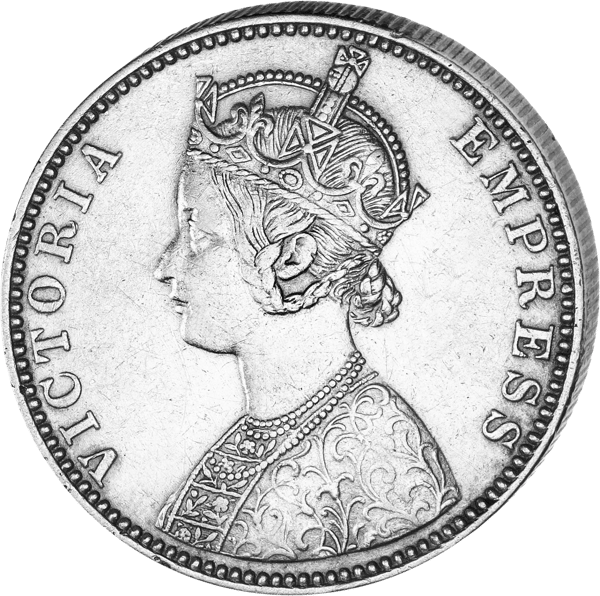 1 ×1 Rupee Silver Queen Victoria Empress of India (1862-1876)
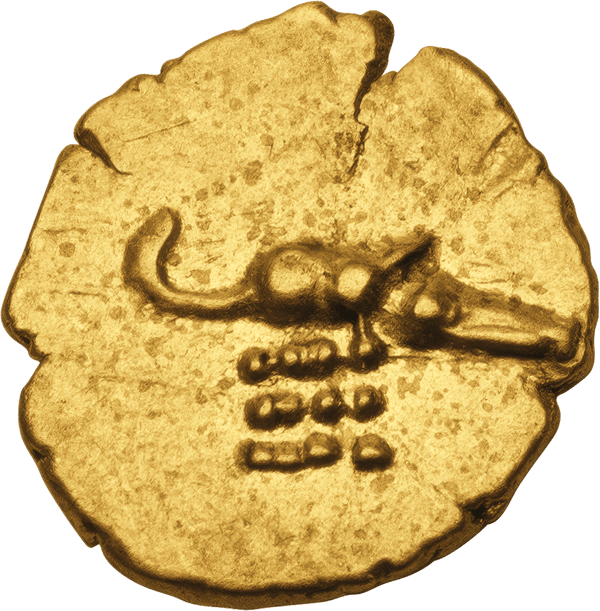 1 ×Gold Fanam Ancient India (1600-1750 | Gold of the Maharajas)
This package saves you €3.00
 Price alert
 Share
India - Crown Jewel of the Empire: Gold of the Maharajas Meets Silver of the Empress
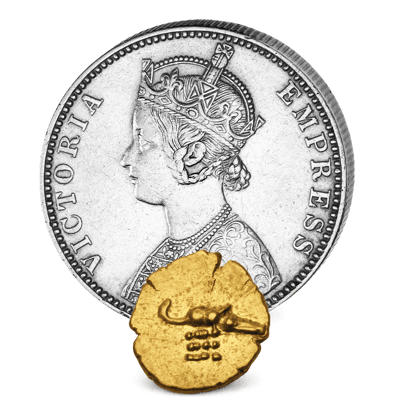
Two coins, two worlds, one country. This set brings together two great epochs of Indian monetary history: a hand-struck gold fanam from the South Indian kingdoms of roughly 1600 to 1750, and a 1 rupee silver coin bearing the crowned portrait of Queen Victoria as Empress of India. On one side stands the archaic gold of the maharajas, on the other the precisely struck silver of British India. Anyone wishing to tell the story of India through coins can hardly do without these two pieces.
Both are genuine historical originals. They are neither replicas nor medals, but real money that people on the subcontinent actually used to pay with.
What's in the Set?
- 1x 1 Rupee Silver Coin, Queen Victoria Empress of India: British India, silver 917/1,000, nominal weight 11.66 g, approx. 30.8 mm diameter, reeded edge. The obverse shows Victoria's crowned bust with the inscription VICTORIA EMPRESS, the reverse ONE RUPEE · INDIA and the year within a floral wreath.
- 1x Gold Fanam, Old India (1600-1750 | Gold of the Maharajas): genuine gold in a historical coin alloy, approx. 0.3 g in weight, around 8 mm small and hand-struck. One side shows a stylised animal figure above rows of dots, the other fan and ring motifs.
The Silver Rupee: Victoria Becomes Empress of India
After the Uprising of 1857, rule over India passed directly from the East India Company to the British Crown. In 1876, Queen Victoria additionally assumed the title "Empress of India", and in early 1877 she was ceremonially proclaimed empress in Delhi. The coins reflect this change directly: on the rupee, the inscription "VICTORIA QUEEN" became "VICTORIA EMPRESS". India was henceforth regarded as the crown jewel of the Empire, and the rupee was the silver backbone of this vast economic area. The rupees of Edward VII and George V followed later, but the portrait of the first empress remains the defining image of this era to this day.
The rupee was struck at the great mints of Bombay and Calcutta, today's Mumbai and Kolkata. The portrait is a small work of art: a crown topped with a cross, braided hair, a pearl necklace and a richly embroidered robe whose scroll pattern still fascinates today. On the reverse, flowers and scrollwork frame the denomination. With a fineness of 917/1,000, the Victoria rupee ranks among the classic historical silver coins of the 19th century and is, for collectors of British India, a fixed point in every collection.
The Gold Fanam: Tiny, Ancient and Unmistakable
The fanam is a very different matter. This gold piece measures just around 8 mm, and yet it holds a piece of South Indian history within it. Kingdoms such as Mysore, Calicut, Cochin and Travancore had fanams struck. Within the monetary system of the south, the fanam was a fractional piece of the golden pagoda. Traders on the Malabar Coast, temple towns and princely courts used it as small everyday gold money, long before the British introduced their rupee.
Every fanam was struck by hand. That is why the design never sits in quite the same place, the edges run irregularly, and some blanks show cracks from the striking process. This is not a flaw. It is the signature of an era in which mint masters still worked with hammer and die. Exactly how much gold a fanam contains depends on the mint and the period of striking.
Gold and Silver: Value That Outlasts Empires
Gold is humanity's oldest currency. It has outlasted the realms of the maharajas, the British Empire, and countless paper currencies besides. Silver stood alongside it for centuries as everyday money. This permanence is what makes the set so appealing:
- Genuine material value: Both coins are made of precious metal. Their intrinsic value is based on the gold and silver price.
- Inflation hedge with history: Physical precious metals have long been regarded as a means of preserving value in uncertain times.
- Double collector appeal: A hand-struck pre-modern coin and a machine-struck coin from the colonial era form an exciting contrast within a single set.
- Ideal gift: For history enthusiasts and travellers to India, or as an introduction to the world of historical coins.
Set or Individual Pieces?
The advantage of the set lies in the story it tells. Only together do the fanam and the rupee show how India's money evolved from the tiny gold piece of princes to the unified silver currency of the Empire. Anyone looking for standardised fine gold with an exact, fixed weight, however, is better served by modern bars or bullion coins. In doing so, though, they forgo genuine, tangible history.
Condition: Originals Bearing the Marks of Time
These pieces are coins that once circulated as currency and bear corresponding traces: darker patina, individual centring, nicks, wear and, in places, weaker areas of the legend. This is exactly what gives them their charm. As the year of minting, mint and reverse variant can vary, the item supplied will differ from the illustration, you will receive an original, not a mass-produced item.
We therefore ask for your understanding that the image in the shop is explicitly a sample image and may differ individually from the item supplied in terms of appearance and condition due to historical circumstances.
From the gold of the maharajas to the silver of the empress: with this set, you hold several centuries of Indian monetary history in your hands.
Product image may differ from the actual product.
