




Change nothing
For more than five hundred years the zecchino kept its weight, its fineness and its image. That stubbornness is exactly what made it the trading currency of the Mediterranean: whoever took one did not have to test it.

 More than 280,000
 Over 30 years
 Secure shipping
 Google: 4.9/5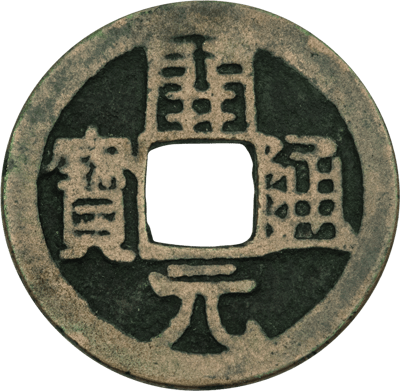












 Price alert
  Share
ShareMedieval original
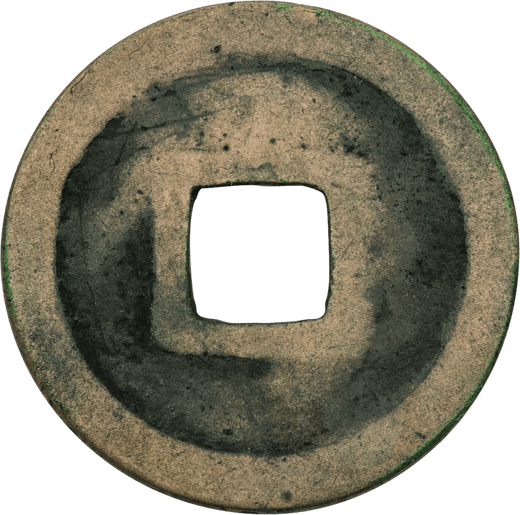
You are looking at the obverse.
Between the day this piece was made and the day you hold it there are roughly
1,250years
Where it belongs
The Middle Ages had no world currency. What counted a day's ride away was a separate question, and anyone trading converted constantly. These seven pieces stand for seven answers to that.
621 to 907
Imperial China
China cast its money instead of striking it: molten bronze into moulds, the result a round piece with a square hole so a thousand of them could go on one string. In 621 Emperor Gaozu had the Kaiyuan Tongbao introduced and prescribed a weight for it that later became the Chinese unit qian. For almost three hundred years this piece stayed the standard.
Your piece
8th to 9th century
Abbasid caliphate
From Baghdad ruled the greatest power of the day, and its silver dirham ran from Central Asia to Scandinavia. It carries no image, only script: creed, mint, year and ruler. Viking graves in Sweden are full of them, because trade reached down the Russian rivers all the way to the Baltic.
1099 to 1268
Crusader states
After taking Antioch in 1098 the new princes struck their own money, and it looks exactly like their position: a western denier, a cross, a helmeted head, and legends wavering between Latin and Greek. The money of a state that lay between two worlds and lasted less than two hundred years.
1284 to 1797
Republic of Venice
In 1284, under Doge Giovanni Dandolo, Venice introduced the gold ducat, later called the zecchino, at 3.545 grams of the purest gold medieval metallurgy could make. The Republic changed nothing about that standard until its end in 1797. Over five hundred years, the same weight and the same image: that is why the zecchino was good from Alexandria to Antwerp.
1371 to 1463
Rhenish gold gulden
In the Empire the archbishops of Cologne, Mainz and Trier struck alongside the Palatinate on the model of the Florentine florin and agreed their coins among themselves. Cologne put the apostle Peter on the front and the city arms on the back. The Rhenish gulden became the leading money of the Empire, the one prices were quoted in even when people paid in pennies.
1381 to 1407
Meissen groschen
The prince's groschen came from the silver of the Ore Mountains and was meant to hold against the Rhenish gulden: around twenty-three of them to one gulden. From 1396 it was struck with markedly less silver, and the blanks were boiled in tartar so the surface stayed white. From the outside the groschen looked the same as before.
14th to 15th century
Hollow penny
The smallest denominator of daily life: a leaf of silver, struck on one side into a soft bed so the image stands proud at the front and stays hollow at the back. Schweidnitz in Silesia put a boar on it, the arms of the town. Fourteen millimetres, a fifth of a gram, and with it people paid for cloth, grain and carting.
For more than five hundred years the zecchino kept its weight, its fineness and its image. That stubbornness is exactly what made it the trading currency of the Mediterranean: whoever took one did not have to test it.
In some regions hollow pennies were called in at regular intervals, in places twice a year: old money became void and had to be exchanged for new. The fee for that was often the mint lord's only tax income, and whoever came late lost part of their money. Money with an expiry date, six hundred years before the term.
Keeping it
Medieval coins are not modern blanks. A hollow penny is a fifth of a gram of sheet silver and bends between two fingers, gold is soft enough for a fingernail to leave a mark, and the dark layer on silver and bronze is patina: grown over centuries, a sign of authenticity among collectors, and not recoverable once it is polished away.
Thin flans need support across their whole surface. A capsule or a coin frame, not a loose bag in which the sheet props itself up on an edge.
Fingerprints contain acid and salt. Take the piece between thumb and forefinger at the edge, over a soft surface.
No vinegar, no silver cloth, no ultrasound. If a crust has to come off, let a conservator do it, not the kitchen sink.
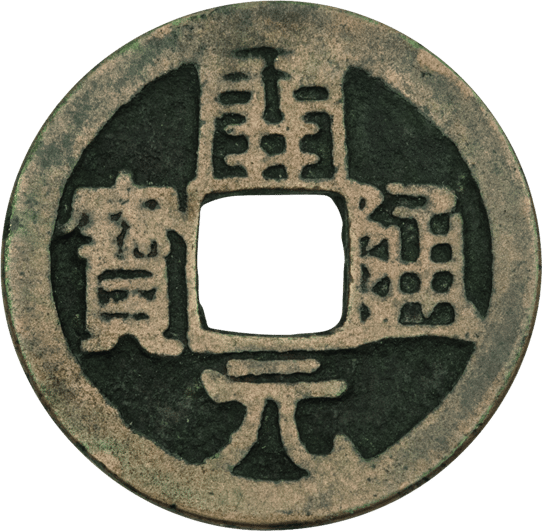
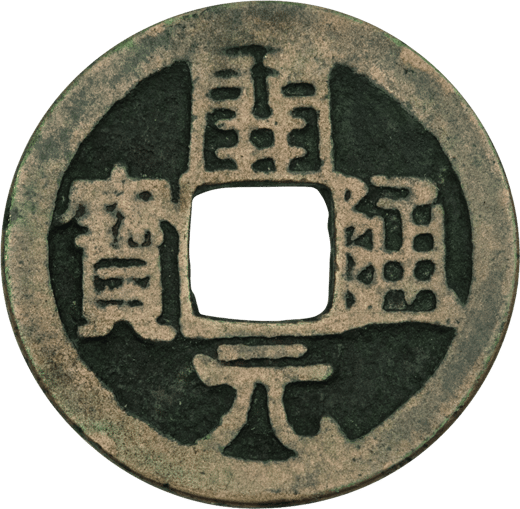
A piece of imperial history you can hold in your hand: this Chinese cash coin made of bronze dates from the Tang dynasty (618–907 AD) and bears the most famous inscription in East Asian numismatic history – Kaiyuan Tongbao (開元通寶). Four characters, a square hole in the centre, a warm, naturally grown patina. Nothing more is needed to bridge over a thousand years.
This coin type was introduced in the year 621 under Emperor Tang Gaozu, the founder of the dynasty, who was originally named Li Yuan, overthrew the Sui dynasty in 618, and ruled until his abdication in 626. What he decreed at the time was far more than a new coin: it was a change of system. Until then, the value of Chinese coins had been determined by their weight – from the Kaiyuan Tongbao onward, the state determined the value. A concept that seems self-evident to us today, and one that had its premiere in China around 1,400 years ago.
The inscription roughly translates as "circulating treasure of the beginning of a new era." It is read in the classical order top – bottom – right – left and was designed by Ouyang Xun, one of China's most famous calligraphers. For the first time ever, a renowned calligrapher designed the appearance of a Chinese coin – a detail that still fascinates collectors today.
Material: bronze or copper alloy – not struck, but cast in moulds according to Chinese tradition
Diameter: 24 mm
Raw weight: 2.6 g
Face value: 1 Cash – the basic unit of ancient China
Country of issue: China, Tang dynasty
Condition: circulated coinage with authentic signs of use. These pieces were actual currency in circulation and carry corresponding traces: darker patina, individual centring, nicks, wear, and in places weaker legend details. That is exactly what makes them appealing. Since the year of minting, mint, and reverse variant can differ, the piece delivered will differ from the image shown – you receive an original, not a mass-produced item. Please understand that the image in the shop serves as an example and may differ individually from the delivered item in terms of appearance and condition due to historical circumstances.
The square hole served a purely practical purpose: hundreds of such cash coins were strung together on cords and transported as a "string." This is precisely why many pieces show wear – every nick, every tone tells of the marketplace, of caravan trade, of everyday life in a world power. The reverse of this type is, as a rule, plain and without inscription.
The Kaiyuan Tongbao was not produced at a single location, but in numerous state foundries throughout the empire – initially around Chang'an, present-day Xi'an, the starting point of the Silk Road, and later also in Luoyang and many provincial towns. This type remained in production for over 280 years. Its influence extended far beyond China: the coinage of Japan, Korea, the Ryūkyū Islands, and Vietnam adopted its form and inscription logic for centuries.
Gold is the oldest currency of mankind – yet the money that people held in their hands every day for centuries was bronze. This cash coin is an original from exactly that world.
Newcomers to ancient numismatics: a genuine, over 1,100-year-old original – without the entry barriers that many ancient silver or gold coins bring with them.
Theme collectors: an ideal addition to Roman bronze coins, Celtic coinage, or later Chinese cash coins from the Ming and Qing periods.
Fans of tangible assets: a tangible, independently existing collector's value made of metal, requiring nothing more than a display case.
Compared to a modern bullion coin made of gold or silver, the focus here is not on fineness but on historical substance: the value of this bronze cash coin derives from age, rarity of condition, and cultural significance. Those seeking pure precious metal weight, on the other hand, will find classic bars and bullion coins for that purpose – both complement each other perfectly in a well-considered collection.
As this is historical circulated coinage, the variant, patina, and level of detail vary from piece to piece. That is exactly what makes it appealing: you do not receive a mass-produced item, but an individual witness to time from China's golden age. Securely packaged and dispatched as insured shipping.
Product depiction may differ from the final product.

Stay informed with product launches, financial news and exclusive offers. Sign up for our free newsletter today.
By entering your email address and clicking the "Submit" button, you give the following consent: "I agree to be informed by email about new products, financial news and exclusive offers, and therefore consent to the processing of my email address for the purpose of sending the newsletter. I can revoke this consent at any time without giving reasons, with effect for the future. The lawfulness of processing carried out prior to revocation remains unaffected."