





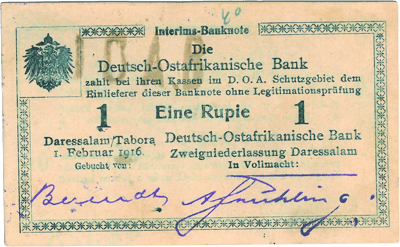

1 Rupie Banknote 1915-1916 (Emergency Money in the 1st World War | German East Africa Colony)
- Secure shipping: 100% insured & anonymous delivery
- Kettner Bullion: Already over 310,000 satisfied customers
- Secure shipping100% insured & anonymous delivery
- Kettner BullionAlready over 310,000 satisfied customers
Only available in a package
This item is not sold on its own. It comes with this package:
- Secure shipping: 100% insured & anonymous delivery
- Kettner Bullion: Already over 310,000 satisfied customers

1 Rupie 1915-1916: Original Emergency Money from German East Africa in the First World War
A piece of paper barely ten centimetres wide. Yet this interim banknote for 1 Rupie holds an entire era within it. It was printed in the middle of the First World War, in a colony completely cut off from the German Empire. The note tells a story of improvisation, of scarcity, and of the firm determination to keep a functioning monetary system alive. For collectors of German colonial paper money, this note is one of the classics.
Money, When No More Money Comes
German East Africa was the largest German colony. It covered the territory of today's Tanzania, Rwanda and Burundi, as well as part of Mozambique. The Indian Rupie had traditionally circulated in the region. For this reason, the Rupie remained the currency unit even under German administration, divided into 100 Heller. The banknotes were issued by the Deutsch-Ostafrikanische Bank, which was headquartered in Dar es Salaam and began operations in 1905.
When war broke out in 1914, supplies from Germany stopped. No more coins, banknote paper or printing plates arrived from Europe. The solution was home-made emergency money. The so-called interim banknotes were produced locally in East Africa, printed by the Deutsch-Ostafrikanische Zeitung G.m.b.H. in Dar es Salaam and at other locations such as Tabora. Whatever was available at the time was printed on, from cardboard to pressed jute to oil paper. This is how the wide variety of variants emerged, for which this collecting field is known today.
What You'll Discover on the Note
The note shown, dated 1 February 1916, shows just how much history fits into a few square centimetres:
- Obverse: small imperial eagle at the top left, the inscription "Interims-Banknote" (Interim Banknote), the denomination "Eine Rupie" (One Rupie) with a large figure 1 on the left and right, and the place names Dar es Salaam/Tabora
- Payment promise: the bank "zahlt bei ihren Kassen im D.O.A. Schutzgebiet dem Einlieferer dieser Banknote ohne Legitimationsprüfung" (pays, at its counters in the D.O.A. Protectorate, the bearer of this banknote, without verification of identity)
- Signatures: purple stamped signatures, on this specimen Berendt and A. Frühling for the Dar es Salaam branch
- Reverse: backing notice in German and Swahili, control number with series code, purple diagonal stamp with ornaments and the face value
- Penalty warning: "Wer Banknoten nachmacht oder verfälscht … wird mit Zuchthaus nicht unter 2 Jahren bestraft" (whoever counterfeits or falsifies banknotes ... shall be punished with no less than 2 years of penal servitude)
- Printer's mark: Deutsch-Ostafrikanische Zeitung G.m.b.H., Dar es Salaam
The bilingual reverse is particularly appealing. It shows that these notes circulated in the everyday life of the entire population: at markets, among traders, and as wages for porters and askari.
Printing Under Wartime Conditions and Its Traces
The control numbers were mostly stamped on by hand. As a result, you will find crooked, incomplete, upside-down or hand-completed digits. Added to this are different paper types, secret marks, stamp variants and, occasionally, a genuine misprint. Specialists classify their pieces according to the standard reference work by Hans-Ludwig Grabowski ("Die deutschen Banknoten ab 1871"), according to Rosenberg, or internationally according to the Krause/Pick catalogue. A single series or combination of signatures can hide its own catalogue number.
Every Specimen a Unique Piece
Please note: the interim notes for 1 Rupie were issued in several editions during 1915 and 1916. Your specimen may therefore differ from the product image in date, series, control number, signature, stamp and paper tone. It is precisely these differences that collectors value.
Technical Data at a Glance
- Denomination: 1 Rupie
- Issuer: Deutsch-Ostafrikanische Bank
- Years of issue: 1915-1916 (interim issues)
- Material: paper, natural colour
- Weight: approx. 1 g
- Size: approx. 102-105 × 63-64 mm, depending on the edition
- Validity: until the end of German rule in November 1918
Peace Issue, Bush Note or Interim Note?
Compared to the peacetime issues of the Deutsch-Ostafrikanische Bank from 1905, the interim note looks plain. The bank had these peacetime notes printed by Giesecke & Devrient in Leipzig, some of which depict Kaiser Wilhelm II. This simplicity is part of the interim note's charm. Peacetime notes are pieces for advanced collections and are correspondingly sought after. The 1 Rupie interim banknote, on the other hand, is readily accessible and makes a good entry point into the German East Africa collecting field. Even simpler are the "bush notes" of 1917, some of which were printed using rubber type. Anyone wanting to fully depict the war years in Africa can supplement the note with the colony's Heller coins, or hope for a specimen of the famous 15-Rupie gold coin from Tabora, dated 1916.
When the Schutztruppe under General Paul von Lettow-Vorbeck laid down its arms in November 1918, the askari and porters still received around 1.5 million Rupies in interim notes. The German government later redeemed these notes.
For Collectors, History Lovers and as a Gift
This historical paper money combines numismatics with contemporary history. It fits into any collection on the German Empire, the First World War or emergency money. As a gift for people who like to hold history in their hands, it quickly becomes a talking point. Emergency money also shows why, in uncertain times, people have trusted gold and silver for thousands of years. Gold is humanity's oldest currency and has outlasted every paper currency.
Store your banknote flat, dry and protected from light, ideally in an acid-free banknote sleeve. This way, this testimony from German East Africa will be preserved for future generations too.
Product image may differ from the actual product.
 ManufacturerMünze DeutschlandOfficial state distributor · GermanyAll products