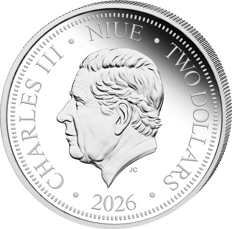
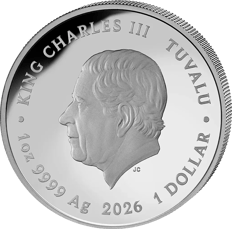
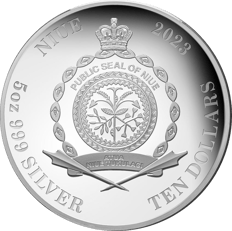
Only 3 left to order
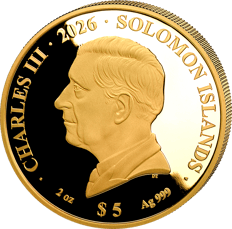
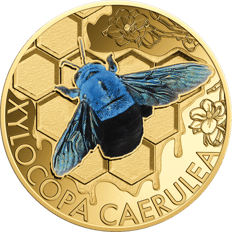
1/4 oz Gold Honey Bee 2026 (Mintage: 299 | Proof)
€1,490.00€1,990.00
VAT-free and excl. shipping
Available in 2–3 business days
 +49 7930-2699

 More than 300,000
 Over 30 years
 Secure shipping
 Google: 4.9/5


An insect has a body of head, thorax and abdomen, one pair of antennae, six jointed legs on the thorax and an exoskeleton, a firm casing around the outside of the body; most adult insects also have one or two pairs of wings. More than a million species have been described, and many more are probably still undiscovered. Five chapters each show in one animal what one part of this body plan can do, the sixth shows animals that are built in a different way.
Monarch butterfly
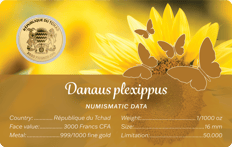
Monarch butterflies Danaus plexippus fly with a sun compass: they orient themselves by the sun and allow for the way it moves through the day. The clock for this was thought to be in the brain. A trial showed that the butterflies need their antennae for it; clocks of their own run there and probably set the most important rhythm.
In autumn they fly thousands of kilometres south from eastern North America. From November to March they stay in forests in central Mexico above 3,000 m and live mainly on stored fat. In spring they lay eggs on the Gulf coast. The north is then settled for the most part by the first generation, the butterflies from these eggs: in one study about 90%.
Diagram, not a measurement
On the picture side of this coin, a monarch butterfly spreads its wings, with a fine network of veins and the lettering “Monarch Butterfly”.
Dragonfly
The subject was one dragonfly Erythemis simplicicollis flying freely in a turn: filmed with high-speed cameras, rebuilt as a spatial model, the airflow calculated. The inner wings beat differently from the outer ones, more slowly and at a steeper angle on the downstroke, faster and flatter on the upstroke. The tips of the inner wings trace an oval, those of the outer wings a figure of eight.
The calculation shows that the forewings carry about 64% of the lift, the force that holds the body up in the air, and the hindwings 36%. Working together with the forewings, the hindwings can manage with 13% less power without losing force. This applies to this one dragonfly in this turn.
Dragonflies have a strong body and two unequal pairs of wings. Their metamorphosis is incomplete, without a pupa: their larvae live in water.
Diagram, not a measurement; the figures are calculated and apply to a dragonfly in a turn
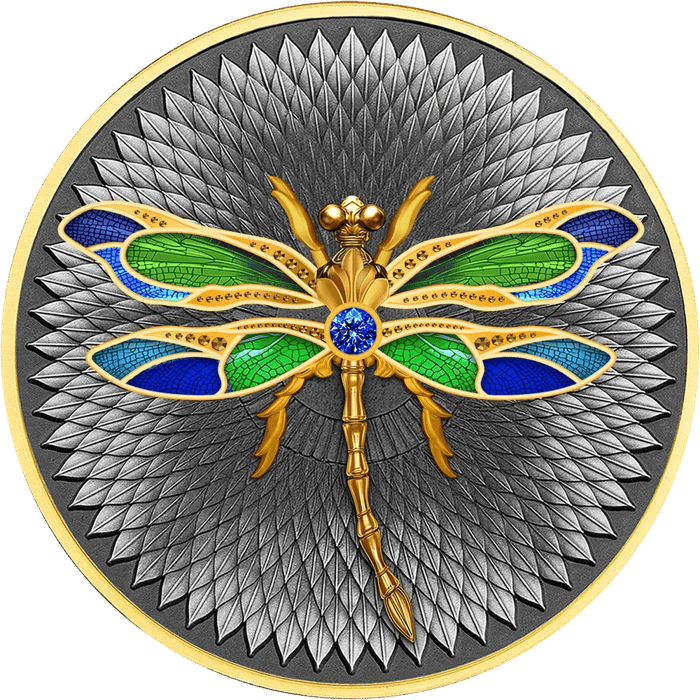
On the picture side of this coin lies a dragonfly seen from above, with four wings in colour.
Peacock butterfly
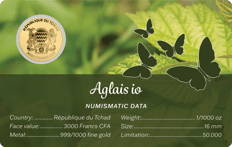
The peacock butterfly Aglais io spends the winter as an adult butterfly. At rest, with its wings closed, it looks like a leaf, and its eyespots, spots made of rings of colour, are hidden. When disturbed, it opens its wings again and again, shows the four spots and hisses at the same time.
In the trial, blue tits met live butterflies. Of 34 butterflies with eyespots, 33 came through the trial; of 20 butterflies with painted-over spots, only 7. The butterflies are edible, so the defence can be a bluff: “intimidation by bluffing”.
Whether the spots work as eyes or because they stand out is debated. A trial with great tits supports the eyes, one with paper models of another butterfly the idea that what counts above all is whether the spots form a pair.
Diagram, not a measurement
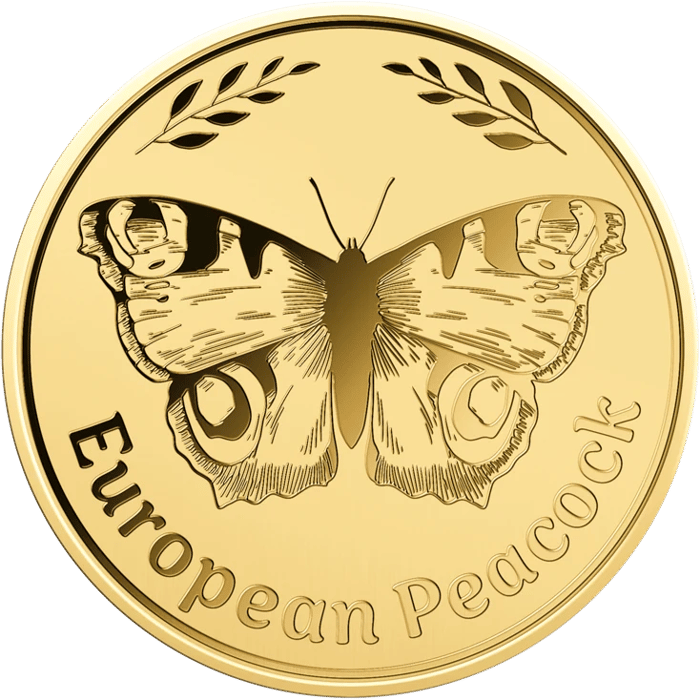
On the picture side of this coin, a peacock butterfly opens its wings and shows four eyespots, along with the lettering “European Peacock”.
Western honey bee
Workers of the western honey bee Apis mellifera make wax in glands of their own; how the gland works depends on the bee’s stage of life.
The cells, the chambers of the comb, are round at first when they are built and soon become rounded hexagons. One study explains this by wax that softens in the warmth of the workers and flows where three cells meet.
It is now accepted that bees build cylindrical cells that later transform into hexagonal prisms through a process that it is still debated.
In one trial, pieces of wax narrowed the space: where only 180° was free at a corner, the bees built angles of 90°; as the obstacles shrank during further building, the angles approached 120°. The shape arranges itself, without any need to assume complex thinking.
Diagram, not a measurement
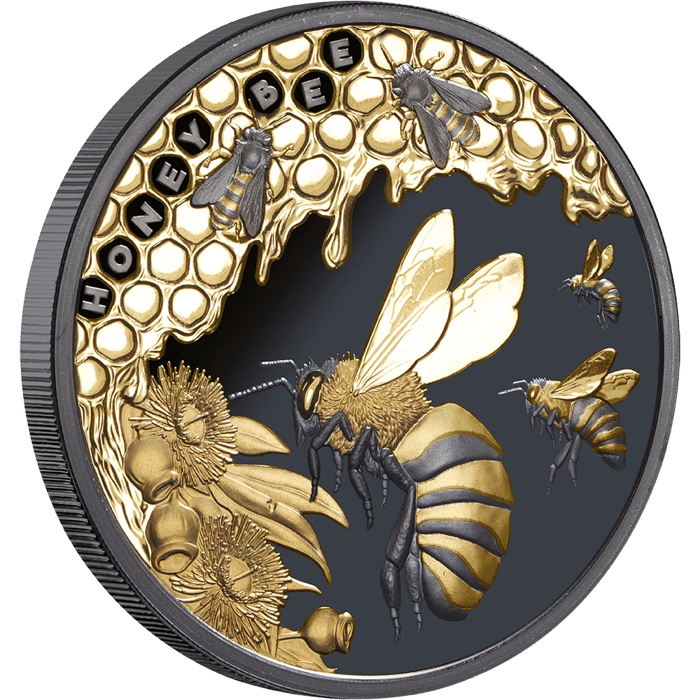
On the picture side of this coin, bees sit on a comb, set off in a golden tone on a dark background.
Morpho butterfly
Scales, fine platelets on the wings, are characteristic of butterflies and moths. During metamorphosis, hundreds of thousands of them grow on the wings of a butterfly, as shown in the painted lady Vanessa cardui. Unlike dragonflies, butterflies and moths go through a complete metamorphosis, with a pupa.
Not all morpho butterflies are blue; some are whitish or even brown. How the blue looks depends on the shape of the scales; this was measured in three species other than Morpho menelaus.
wings with flat scales produce highly directional reflections, whereas wings stacked with curved scales scatter light into a wider angular space
A further measurement, in four species, showed in 2026 that the stacking of the scales widens the angle. In flight the blue flashes; according to a review from 2025, this confuses pursuers and probably makes it easier for the butterflies to escape.
Diagram, not a measurement
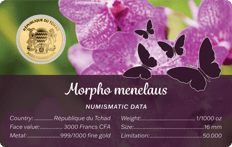
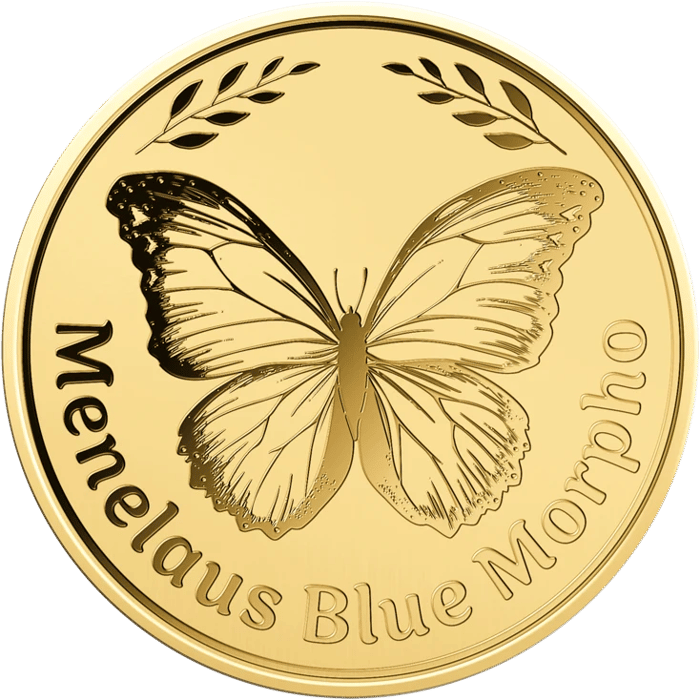
On the picture side of this coin, a morpho butterfly spreads its wings wide, along with the lettering “Menelaus Blue Morpho”.
Scorpion and spiders
Scorpions and spiders are not insects but arachnids, with eight legs.
Under UV light, light beyond the visible violet, most scorpions glow blue‑green. This has been known for more than 60 years; what it is for remains open. In 24 species from four families, the pincers and the tail glowed more strongly than the broad part of the abdomen, in all of them in practically the same colour.
After the moult, the shedding of the old casing, the glow returned in stages in a trial with young scorpions under UV‑A light: in the pincers and the end segment after about 6 hours, in the tail after about 12, in the broad part of the abdomen after about 24 hours. Under UV‑B and UV‑C light it took longer.
Diagram, not a measurement; times after the moult, under UV‑A light
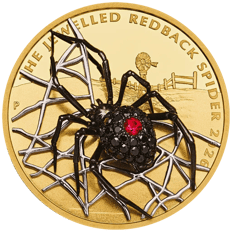
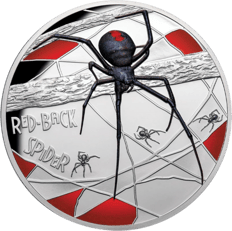
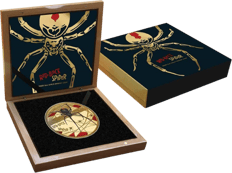
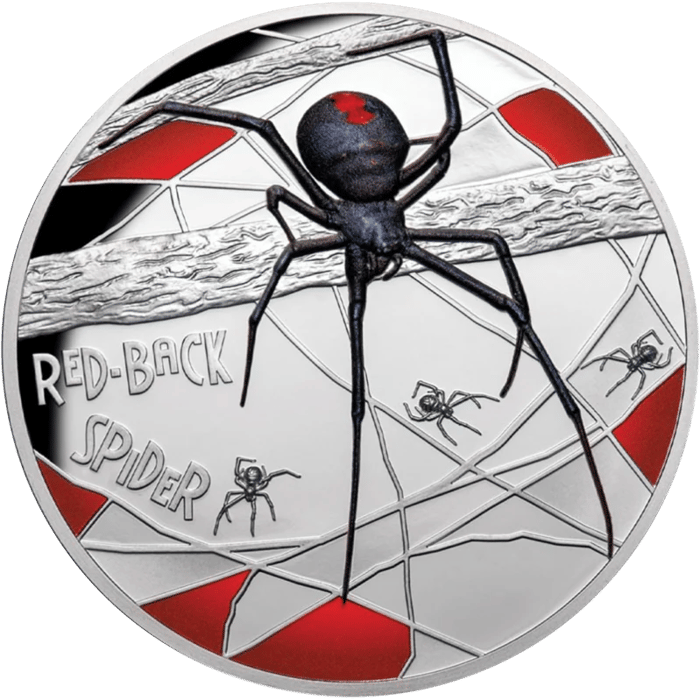
On the picture side of this coin sits a black spider with a red spot, with red fields at the rim and the lettering “Red‑Back Spider”.
A body plan of six legs, three body parts and an exoskeleton carries a compass with a clock, four wings that beat differently on the inside of a turn than on the outside, a bluff, wax for the comb and scales that direct the light. Alongside them, most scorpions, animals with eight legs, glow under UV light.
 Land AnimalsInsekten
Stay informed with product launches, financial news and exclusive offers. Sign up for our free newsletter today.
By entering your email address and clicking the "Submit" button, you give the following consent: "I agree to be informed by email about new products, financial news and exclusive offers, and therefore consent to the processing of my email address for the purpose of sending the newsletter. I can revoke this consent at any time without giving reasons, with effect for the future. The lawfulness of processing carried out prior to revocation remains unaffected."