Only 7 left to order
1/200 oz Gold Little Prince 2026 (Mintage: 1,000 | Proof)
€69.00€99.00
VAT-free and excl. shipping
Ships from 30/11/2026
 +49 7930-2699

 More than 300,000
 Over 30 years
 Secure shipping
 Google: 4.9/5


In 1798 Georges Cuvier wrote that the pachyderms, one of the large groups in his classification of mammals, had an extremely thick skin that must constantly be kept moist. He meant the pig, the tapir, the rhinoceros and the hippopotamus, not the elephant. What follows traces the word: which animals belonged to the pachyderms, how the skin of the African bush elephant holds water and what the horn of the rhinoceros is made of.
In the Tableau élémentaire of 1798, Georges Cuvier also divides the mammals by their feet. In three orders, the large groups of his classification, the part of the toes that touches the ground is enclosed in a hoof of horn: in the ruminants, which chew their food a second time, in the solipeds with only one complete toe, and in the order “celui que nous nommerons pachydermes”. Their mark: more than two hooves on each foot.
In English: the one we shall call pachyderms
The elephant does not belong to them. Cuvier places it in its own order: it could not be fitted properly into any other and “doit en faire un à lui seul”.
In English: must make one on its own
Diagram: in 1798 Cuvier counts the pig, the tapir, the rhinoceros and the hippopotamus among the pachyderms; he places the elephant in its own order, the horse with the solipeds, and the hyrax, which Cuvier calls daman, with the rodents. In 1817 the elephant, the horse and the hyrax are added. The Cape buffalo stands with the ruminants in both versions.
Diagram
Cuvier describes the pachyderms of 1798, the pigs, the tapir, the rhinoceroses and the hippopotamus, as belonging together in everything else: “une famille entièrement naturelle”. In the pigs he counts four toes on each foot, of which only the two middle ones touch the ground. According to Cuvier, the elephant has five toes, but on the outside they are so enclosed in the callused skin that only the nails are visible at the rim of a kind of hoof.
In English: an entirely natural family
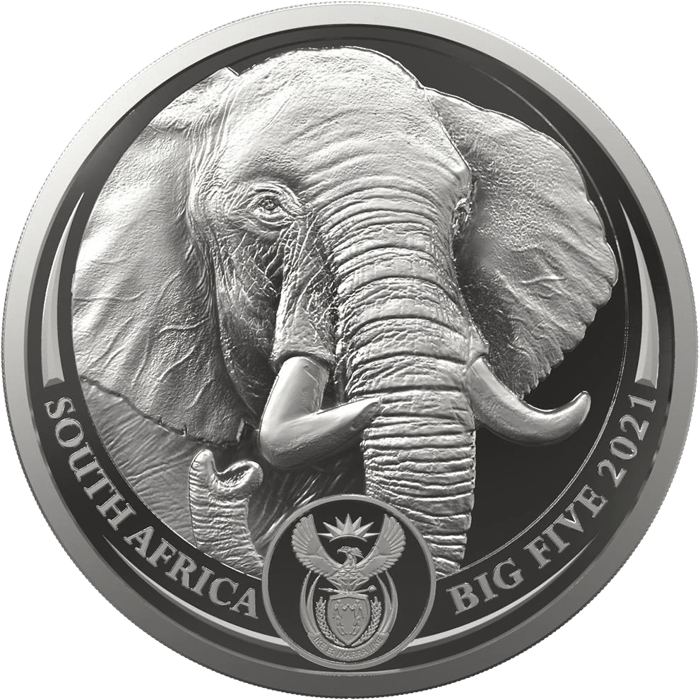
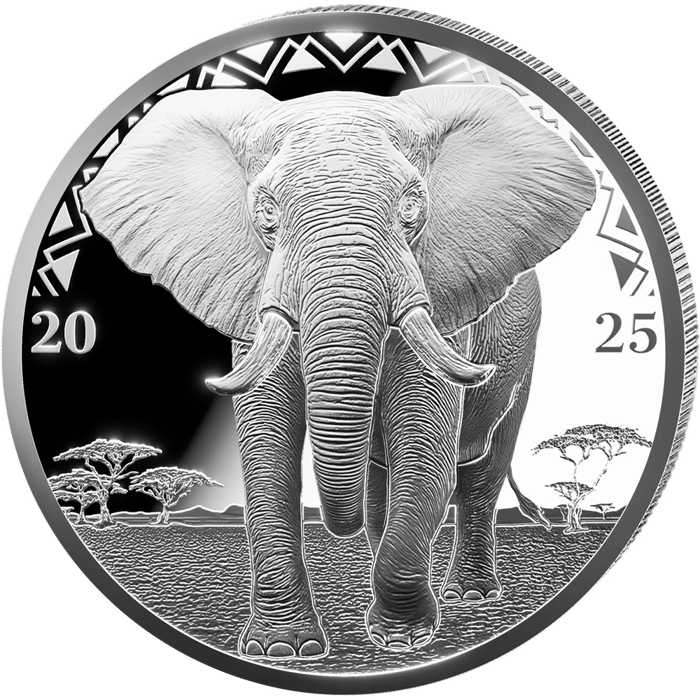
The silver coin shows an elephant from the front, its ears spread wide, folds on its trunk and legs, trees behind it.
Georges Cuvier, Tableau élémentaire de l'histoire naturelle des animaux, 1798, p. 155

In 1817, in the Règne animal, Cuvier draws the line differently. Among the animals with hooves, according to him, hardly more than two orders can be formed: “ceux qui ruminent et ceux qui ne ruminent point; mais ces derniers, que nous désignons en commun sous le nom de pachydermes …”. With that, the elephant and the horses belong to them as well.
In English: those that ruminate and those that do not ruminate; but the latter, which we together call pachyderms …
Then there is the hyrax, which Cuvier calls daman, in 1798 still among the rodents. Because of their very small size, Cuvier writes in 1817, the hyraxes had long been placed there; apart from the horn they were, so to speak, “des rhinocéros en miniature”, at least with the same cheek teeth.
In English: rhinoceroses in miniature
In the table in which Asher and Helgen compile names of large groups of mammals in 2010, the hippopotamus stands with the whales; they write:
The first published name for the hippo-whale clade was Whippomorpha Waddell et al. 1999 …
According to the Animal Diversity Web, horses, rhinoceroses and tapirs form the order of the odd-toed ungulates. According to Foley and colleagues, most of the molecular studies place the elephant with the Afrotheria, one of four large groups of placental mammals.
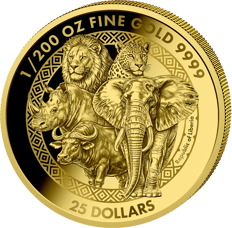
The gold coin shows a rhinoceros walking, at an angle from the side, with two horns; stones lie on the ground.

In 1798 Cuvier places the Cape buffalo with the ruminants and calls its horns “extrêmement larges à leur base”, and in 1817 it stands there again. By the mark of 1817 it does not belong to the pachyderms: it chews the cud.
In English: extremely broad at their base
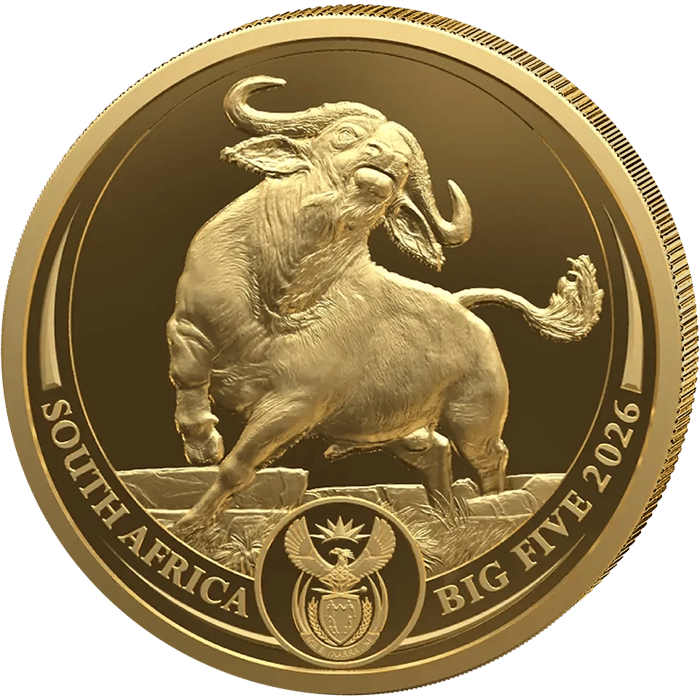
In gold, a buffalo at an angle from the front, its head raised, its horns curved upwards.
In 2018 Martins and colleagues begin the abstract of their paper on the skin of the African bush elephant with the sentence:
An intricate network of crevices adorns the skin surface of the African bush elephant …
They also call the crevices channels. According to them, the channels are about 100 µm wide, a tenth of a millimetre; a micrometre is a thousandth of a millimetre. According to earlier work that Martins and colleagues cite, the skin with the network holds 5 to 10 times more water than a smooth surface. According to them, the network is found only in African elephants.
Diagram: a surface of skin with a network of narrow channels. Water covers the surface; on the fields between the channels it disappears, in the channels it stays. How the skin dries, one part after another, is not shown. Not to scale.
Diagram
According to Martins and colleagues, the African bush elephant cools itself most effectively through water evaporating on its skin; for that, the skin must be kept moist, because it lacks the sweat glands and the sebaceous glands that keep the skin moist and supple in many mammals. African elephants therefore bathe regularly, spray themselves and wallow in mud. The channels hold water and mud on the skin. According to a simulation by Dunkin and colleagues for two places in southern Africa, the water needed for cooling on one day in a warm climate can be more than 4.5 times as high as in a mild one.
On the silver coin, the head of an elephant with spread ears, the trunk deeply folded and curled in.
Heat also leaves through the ears. In 1992 Phillips and Heath measured the surface temperature of the ears of four African elephant cows at 14 to 32 °C by infrared thermography and calculated the heat loss from it. By their calculation, one ear gave off 0.65 to 4.64% of the standard metabolic rate over one of its sides, the energy the body uses at rest. Cuvier wrote in 1798 that in the elephant from the Cape the ears were extremely wide, “elles couvrent toute l'épaule”, and in the elephant from India much smaller.
In English: they cover the whole shoulder
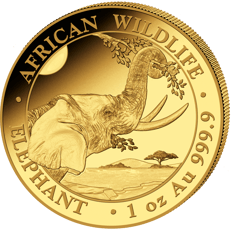
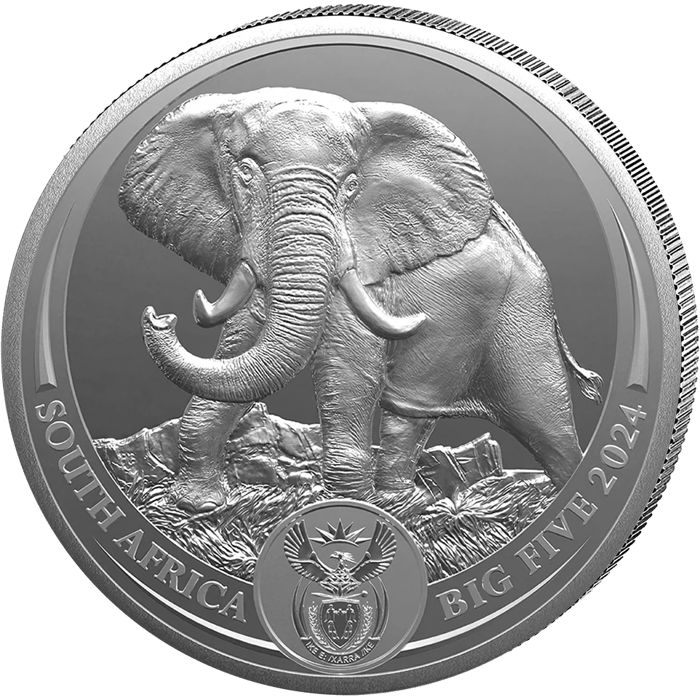
The silver coin shows an elephant walking, at an angle from the front, with its ears spread out and its trunk curved forward, rocks behind it.
The hippopotamus has a secretion of the skin that Saikawa and colleagues studied in 2004. It emerges colourless and viscous and turns red within a few minutes, then brown. According to the authors, its red and orange pigments inhibit germs and protect against sunlight. In 1798 Cuvier had written about the hippopotamus: “Sa peau est épaisse, brune …”.
In English: Its skin is thick, brown …
In 2006 Hieronymus and colleagues studied both horns of two white rhinoceroses, the one on the nose and the one on the forehead, with X-ray images in a CT scanner and in sections under the microscope. According to them, the horn of the rhinoceroses is solid and consists entirely of keratin, the substance of horn, without bone. Today only the rhinoceroses carry such a horn; in the bovids, to which cattle belong, keratin sits on bone. The horn keeps growing, from keratinised epidermis, the outer layer of the skin, with papillae, small pegs.
Diagram: a horn of keratin, without bone. It grows back from the skin, bands run across it, at the tip wear takes it away. The authors suppose that the wear determines its shape.
Diagram
In the X-ray image the horns show a pattern of bands that repeats regularly; in a section the naked eye sees it as darker stripes. The authors infer two substances in it: melanin, a pigment, and calcium phosphate, a mineral. They suppose that the distribution of the two substances contributes to the uneven wear of the horn that gives it its curved cone shape; according to them, without wear and UV light it would be a cylinder.
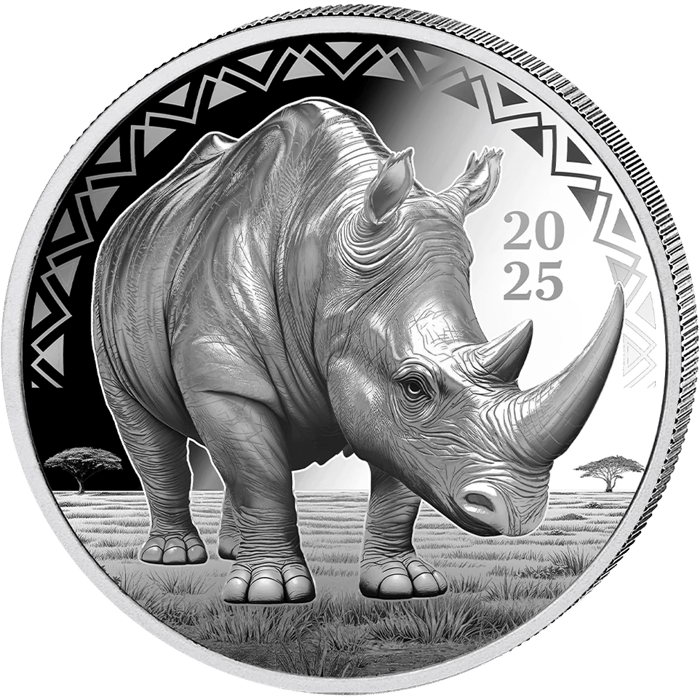
In silver, a rhinoceros standing with its head lowered and two horns, umbrella trees in the background.
In 1798 Cuvier explains the name of the rhinoceroses: on the nose they carry one or two large horns that sit only on the skin, “dont la substance paroît consister en des poils réunis et agglutinés”. In 1817 he describes the thick nasal bones that carry the horn, and the horn itself as firm, attached to the skin and fibrous, as if it consisted of hairs stuck together.
In English: whose substance seems to consist of hairs joined and stuck together
The silver coin shows the head of a rhinoceros in three-quarter profile, with two horns and deep folds in the skin.
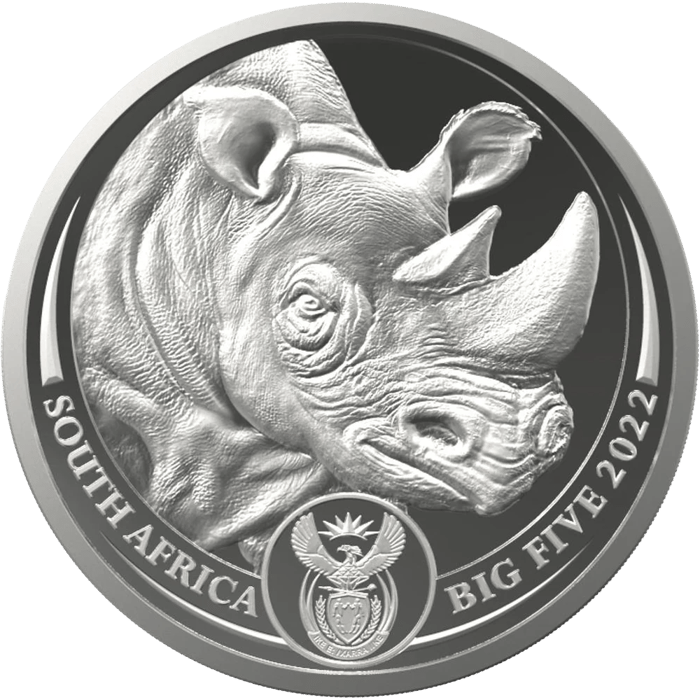
The Animal Diversity Web describes the skin of the white rhinoceros as dense and tough, with plate-like folds. Its epidermis is 1 mm thick on average, the dermis beneath it 18 mm. In 1798 Cuvier wrote about the rhinoceros from Asia, which usually carries only one horn: “Sa peau forme des plis profonds et réguliers …”.
In English: Its skin forms deep and regular folds …
On the silver coin, a rhinoceros with one horn, its skin folded in plates.
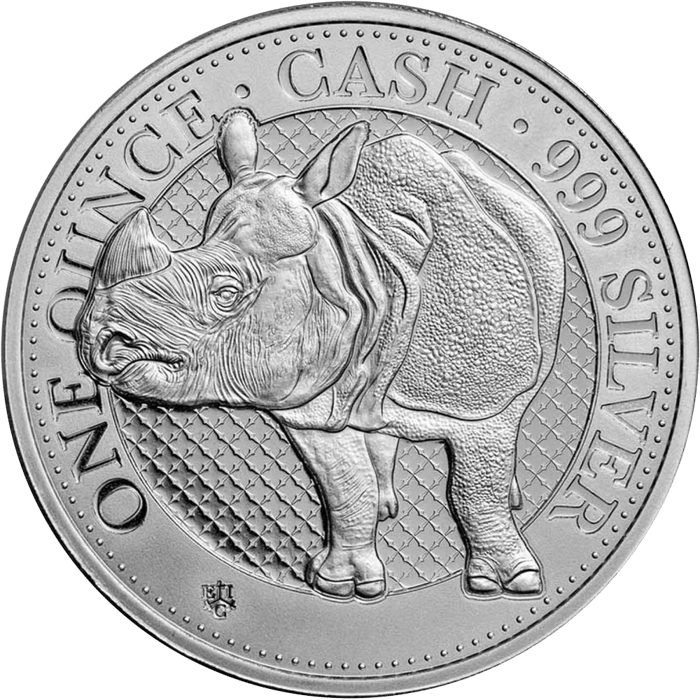
Cuvier sorted by what one sees on the animals: in 1798 by feet and hooves, in 1817 by chewing the cud; in 1798 he attributes the thick skin to all pachyderms. As we read it, he was right in part. The rhinoceros, the tapir and the horse, which he listed under one name in 1817, still form one order today; the elephant and the hippopotamus stand elsewhere. The horn, which he compared to hairs stuck together, has been studied by Hieronymus and colleagues in a CT scanner.
 Land AnimalsDickhäuter
Stay informed with product launches, financial news and exclusive offers. Sign up for our free newsletter today.
By entering your email address and clicking the "Submit" button, you give the following consent: "I agree to be informed by email about new products, financial news and exclusive offers, and therefore consent to the processing of my email address for the purpose of sending the newsletter. I can revoke this consent at any time without giving reasons, with effect for the future. The lawfulness of processing carried out prior to revocation remains unaffected."