






Currency of the United Provinces (Dutch Golden Age)
- New arrival: Product is new in the shop
- Secure shipping: 100% insured & anonymous delivery
- New arrivalProduct is new in the shop
- Secure shipping100% insured & anonymous delivery








By submitting your order you accept our Terms & Conditions and confirm the Right of withdrawal.
- New arrival: Product is new in the shop
- Secure shipping: 100% insured & anonymous delivery
 1 ×Trade Ducat Kingdom of the Netherlands (1739-1794 | Golden Age)
 1 ×Silver Ducat Trade Coin of the Netherlands (1672-1735)
This package saves you €10.00
 Price alert
 Share
Currency of the United Provinces: Gold and Silver from the Great Era of the Netherlands
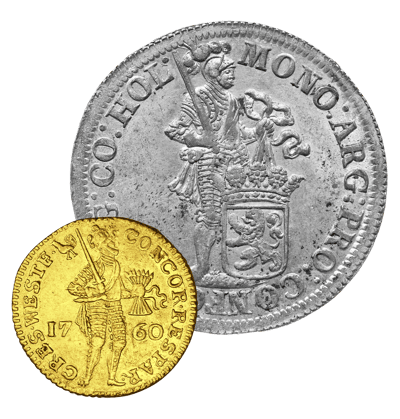
Two coins. One chapter of world history. This set combines an original gold ducat and an original silver ducat from the Republic of the Seven United Provinces. This small republic on the North Sea had broken away from the Spanish crown, and its merchants traded from the Baltic Sea to Asia in the 17th and 18th centuries. Both pieces are genuine currency that passed through trading posts, port cities and ship cargoes.
Both coins bear the same image, an armoured knight with raised sword. Each shows in its own way how self-confidently the United Netherlands presented itself after becoming Europe's leading trading power during the Golden Age.
The Set at a Glance
- 1x Trade Ducat of the Netherlands (gold ducat, 1739-1794): approximately 3.5 g, gold at the traditional coinage standard of 986/1,000
- 1x Silver Ducat of the Netherlands (1672-1735): approximately 28.2 g, silver 873/1,000, diameter approximately 41 to 42 mm
- Total weight of both coins: approximately 31.7 g
- Origin: mints of the provinces of the Dutch Republic. Year of minting and mint vary from piece to piece.
- Character: historical originals that circulated as currency in payment transactions
The Gold Ducat: Knight, Bundle of Arrows and the Law of the Empire
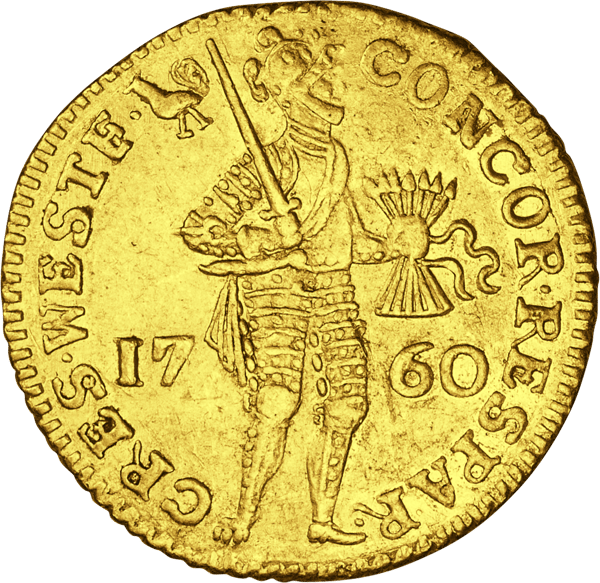
The first Dutch ducats of this type were struck in 1586. They were based on an edict that precisely defined weight and fineness. On the obverse stands the knight with the sword in his right hand. In his left hand he holds a bundle of arrows, usually seven, one for each province. The inscription CONCORDIA RES PARVAE CRESCUNT ends with the abbreviation of the issuing province, for example HOL for Holland or WESTF for West Friesland. On either side of the knight is half of the year date.
The reverse is strictly arranged. Within an ornamented square are five lines: MO ORD PROVIN FOEDER BELG AD LEG IMP. Translated, this reads "Coin of the States of the Allied Dutch Provinces according to the Law of the Empire." This refers to the imperial coinage standard. It made the Dutch ducats, with their high fineness, comparable on an international scale. As a result, they became one of the most sought-after trade coins of their time. The East India Company shipped them in large quantities.
The Silver Ducat: the "Rijksdaalder" of the Republic
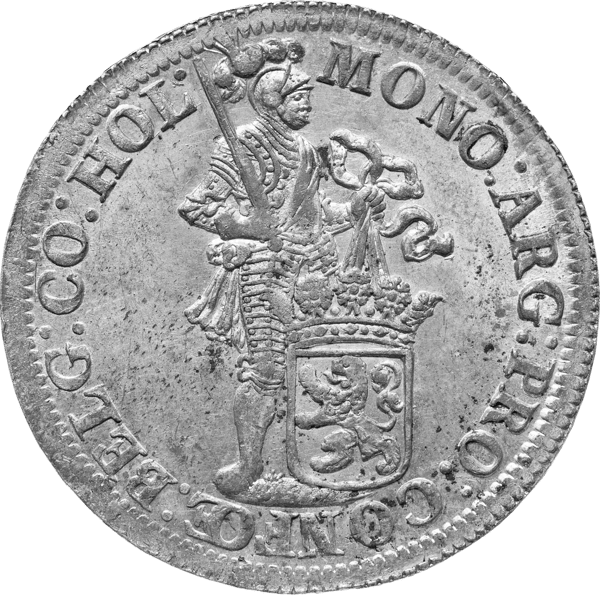
In 1659, the States General introduced the silver ducat. Its design was deliberately modelled on the gold ducat. Here, too, a knight stands, this time with the coat of arms of his province before him. The reverse shows the crowned coat of arms of the States General, a lion with sword and bundle of arrows. Around it are the motto of the Republic and the year date.
At the time of issue, the silver ducat was worth 50 stuivers, equivalent to 2½ guilders. It was therefore popularly known simply as "Rijksdaalder". It was minted in almost all provinces, including Holland, West Friesland, Zeeland, Utrecht, Gelderland and Overijssel. Many mints struck it mainly for export, which is why it was also widespread in trading centres far beyond the Netherlands. At 28.2 g and just over 41 mm in diameter, it ranks among the great historical silver coins. This silver coin feels substantial and pleasant in the hand.
"Concordia res parvae crescunt": Through unity, small things grow. The motto of the United Provinces appears on both coins of this set.
Condition: Traces of Genuine History
The pieces are circulated currency and bear corresponding traces: darker patina, individual centring, nicks, wear and sometimes weaker areas of the legend. This is precisely what makes them appealing. Since the year of minting, mint and reverse variant can vary, the piece delivered will differ from the image shown: you receive an original, not a mass-produced item.
Please therefore understand that the image in the shop is expressly an example image and may differ individually from the item delivered in terms of appearance and condition due to historical circumstances. Many pieces also bear the mint mark of their mint or the responsible mint master. This makes each piece its own small research subject.
Original or Restrike? An Honest Comparison
Anyone looking for Dutch ducats will quickly come across the new gold ducats from the Koninklijke Nederlandse Munt or the well-known Austrian 1 ducat. Both are excellent coins. However, they can only be compared to this set to a limited extent.
- Advantage original: Each piece is a genuine document of its time with its own history of circulation and cannot be replicated.
- Advantage original: You receive gold and silver together. The two coin types together illustrate the monetary history of the Republic.
- Advantage restrike: It looks uniform and flawless, so you know exactly what you are getting beforehand.
- To consider with the original: Condition and appearance differ with every piece. Those who love historical coins particularly appreciate this.
For Collectors and Everyone Who Loves Value
Gold and silver have outlasted states, currencies and empires. Gold is humanity's oldest currency. These two coins show that precious metal has remained recognised as a store of value for centuries. The set combines the metal content of gold and silver with the appeal of genuine historical coinage. It is suitable as a building block for a collection on Dutch coin history, as a gift for history enthusiasts, or as an introduction to the world of trade coins.
A gold ducat and a silver ducat from the great era of the United Provinces: bring home a piece of trading history that was already trusted more than 250 years ago.
Product image may differ from the actual product.
