





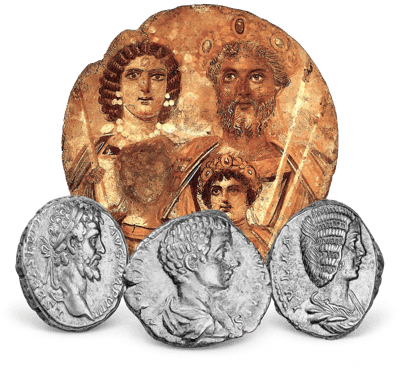


Severan Imperial Family - Dynasty Collection (187-217 AD | 3 Coins | Roman Empire)











- Genuine originals: no restrikes
- Great history: father, mother, son
- Hand-struck: each piece a one-off
- Genuine originalsEvery denarius once circulated as real currency
- Great historyFrom victory over Persia to citizenship for the empire
- Hand-struckPatina and wear marks make every coin unique
Total discount in this bundle
20,00 €
- 20,00 € promotional discount on the bundle
 Price alert set
 share
shareThe Severan Imperial Family: Three Original Denarii of a Dynasty
Father, mother and son, each on genuine silver. The Dynasty Collection "The Severan Imperial Family" unites three ancient denarii from the Roman Empire, minted between the late 2nd and early 3rd century AD. Septimius Severus, his wife Julia Domna and their son Caracalla: whoever places these three coins side by side holds one of the most fascinating ruling families of antiquity in their hands. These are neither restrikes nor replicas, but originals.
Among ancient silver coins, the denarius holds a special position. Introduced around 211 BC, it became the leading currency of the Mediterranean region. Rome used it to pay legionaries, merchants and officials, from Britain to Syria. Each of these denarii is thus a piece of lived monetary history.
These Three Coins Are Included in the Collection
- 1x Silver Denarius Emperor Septimius Severus (193–211 AD | Victor over Persia), approx. 3.2 g
- 1x Silver Denarius Empress Julia Domna (187–211 AD | Oriental elegance in Rome), approx. 3.1 g
- 1x Silver Denarius Emperor Caracalla (211–217 AD | Roman citizenship), approx. 3.2 g
Please note: The fresco of the imperial family shown in the product image is not part of the collection. It serves solely for historical illustration.
Septimius Severus: The Soldier Emperor from Leptis Magna
Lucius Septimius Severus was born in 146 AD in Leptis Magna, in present-day Libya. In the civil war year of 193, he prevailed over all rivals and founded the Severan dynasty. During his campaign against the Parthians, the rulers of ancient Persia at the time, he captured their capital Ctesiphon in 197/198. The Senate granted him a triumph, and the mighty Arch of Septimius Severus on the Roman Forum still commemorates this victory today. On the obverse of his denarii, the emperor usually wears a laurel wreath and his characteristic curly full beard. Reverse designs such as the goddess of victory, Victoria, celebrate his military successes. Severus died in 211 during a campaign in Britain, in Eboracum, present-day York.
Julia Domna: The Empress from Emesa
Julia Domna was the daughter of a priest of the sun god Elagabal from the Syrian city of Emesa. Severus married her in 187, long before he ascended to the throne. She accompanied him on his campaigns and in 195 received the honorary title mater castrorum, "Mother of the Camps". Her coin portrait is instantly recognizable: the elaborately waved hair arranged in rows above a draped bust facing right. On the reverse, goddesses such as Vesta, Venus or Pietas frequently appear. Intelligent, educated and politically influential, she shaped the imperial house across two reigns.
Caracalla: Roman Citizenship for the Entire Empire
Caracalla's actual name was Lucius Septimius Bassianus, and he officially bore the name Marcus Aurelius Antoninus, a deliberate reference to Marcus Aurelius. After his father's death, he initially ruled together with his brother Geta, but soon had him murdered. He owes his firm place in history primarily to the Constitutio Antoniniana of 212: through it, almost all free inhabitants of the empire received Roman citizenship. In 215, he also introduced a new silver coin, which today bears his name as the Antoninianus.
The fresco depicted is the famous Severan Tondo from around 200 AD, the only surviving painted imperial portrait from antiquity. It shows Severus, Julia Domna and their sons in ceremonial attire. Geta's face was scratched out after his murder, evidence of the damnatio memoriae, the official erasure of his memory. The original is preserved in the Antikensammlung of the Staatliche Museen zu Berlin. It is not included in the delivery.
Circulated Originals with Genuine Patina
Each of these coins was hand-struck between two dies and was actually in circulation as a means of payment. This is visible on the pieces. Darker patina, individual centering, nicks, signs of wear and sometimes weaker legend areas are part of it, and this is precisely where their appeal lies. Since the year of minting, mint mark and reverse variant may vary, the delivered specimen will differ from the image shown. You receive an original, not a mass-produced item. Please understand that the image in the shop is only an example. For historical reasons, the delivered item may individually differ from it in appearance and condition.
Why Collectors Value This Collection
- A family portrait in silver: Three members of a dynasty in one set, more compelling than any single denarius.
- Witnesses to a turning point: Under Severus, the silver content of the denarius dropped to about half, and Caracalla created the Antoninianus. The collection documents this upheaval in Roman coinage history.
- Each piece a one-of-a-kind: Hand-striking, circulation traces and patina make each coin unique.
- Silver with intrinsic value: The metal carries its value within itself, independent of any government's promise.
A single denarius tells one episode, while this collection tells an entire family history of rise, power and tragedy. Compared to modern bullion coins, the historical collector's value clearly takes center stage here. Anyone wishing to primarily build up silver weight should turn to bars or bullion coins. Anyone wishing to own a piece of Rome should choose the Severans.
Silver: A Monetary Metal for Millennia
Even the denarii of the Severans show how closely silver and money are linked. Since antiquity, this precious metal has been regarded as a symbol of wealth and prestige, as a medium of exchange and as a store of value. It is durable, retains its physical properties over centuries and is traded worldwide. Industry needs silver for electronics, solar and medical technology, while supply remains limited. Compared to gold, silver is significantly more affordable and thus also readily accessible to private buyers. In times of inflation and political or economic uncertainty, many people value physical precious metal as tangible protection.
Another advantage: profits from the sale of physical silver in Germany are generally tax-free after a holding period of at least one year. This makes the Severan Imperial Family a suitable building block for long-term retirement provision and a special heirloom that you can pass on from generation to generation.
Product depiction may differ from the final product.
